
Posidonia Antibes was a beautiful surprise. I went to Posidonia Espace Mer et Littoral this spring with my husband and our toddler, expecting a quick stop for the Posidonia Museum Antibes visit by the sea. Instead, we got a full family outing at Batterie du Graillon, with a hands-on first room, a tiny but beautiful Mediterranean aquarium, local history, a VR dive, shaded pine paths, sea views, and enough room for a 2-year-old to explore without turning our visit into damage control.
This guide from The Travel Bunny shows you exactly how to visit Posidonia Antibes without wasting half your day figuring out parking, timing, food, or what to combine nearby. I’ll walk you through Posidonia Cap d’Antibes, covering the Espace Mer et Littoral with the Graillon Battery Antibes museum, the family-friendly details, the VR dive, the botanical path, the small café, and the practical stuff nobody else bothers to gather in one spot.
Visit Posidonia Antibes Guide
I strongly recommend Posidonia Antibes for families, locals, expats, and travelers who want a smarter Cap d’Antibes outing instead of another crowded beach stop. The aquarium is small, much smaller than the one in Monaco, but this made it better for our toddler. He loved the place where fish swim close enough to hold his attention without sending him sprinting through endless rooms. For adults, the views, the old fort, and the marine-life angle give the visit enough substance.
The location matters as much as the museum. Posidonia sits on the Cap d’Antibes, close to the Sentier de Tirepoil, a beautiful Cap d’Antibes coastal path, part of the wider Sentier du Littoral Antibes route. We walked along the coast with the stroller toward Port de l’Olivette, and even in low season, the beaches already felt alive because the water stays shallow far from shore, so you can go for a dip earlier than most places.
Use The Travel Bunny’s Posidonia Antibes guide to plan your visit properly. You’ll find a local’s thoughts on what to see inside, how long to stay, why parking needs a strategy even in spring, what to bring for kids, when to pack your own picnic, how to pair the museum with the coast, and why the small Posidonia Museum Cap d’Antibes deserves more attention than it gets.
Want the same kind of local planning help across the Riviera? Open my Provence-Alpes-Côte d’Azur interactive map guide to find saved beaches, villages, viewpoints, family stops, food spots, and weekend ideas across PACA.
Disclosure: Some of the links on this page are affiliate links. This means that at no extra cost to you, The Travel Bunny will earn a small commission if you click through and make a purchase. Thank you!
What Is Posidonia Antibes?
Posidonia Antibes is a small marine museum on the coast at Cap d’Antibes, set inside the Batterie du Graillon. It introduces visitors to Mediterranean marine life, coastal habitats, local history, and the protected natural setting around the Cap d’Antibes shoreline.
The official name, Posidonia Espace Mer et Littoral, points to the full experience. Inside, the Posidonia museum covers sea and land heritage, with a Mediterranean aquarium, interactive displays, a VR dive, and information about the coastline.
Outside, the visit continues into the landscape. The site has shaded paths, benches, sea views, and a botanical trail where families, locals, expats, and travelers can slow down after the museum rooms.
I went to Posidonia Antibes with my husband and our toddler in the spring, and it turned into an easy family day out. The visit has enough variety for adults, with local history, sea views, and a VR dive, and enough hands-on details for young children, with touch-friendly displays, fish close by, shaded paths, and room to move outside.
For trip planning, check the Posidonia Antibes official website before leaving. Opening hours, activity schedules, ticket prices, the Posidonia Antibes contact phone number, and booking details belong in your final pre-visit check, especially for kayak outings, snorkeling, and school holiday periods.
Why this place is different from any Antibes museum
Posidonia Antibes is closer to a coastal outing than a museum visit. You start indoors, with marine displays and local history, then the visit spills outside toward the pine grove, the sea views, and the paths around Batterie du Graillon.
This makes a world of difference with children. The aquarium is small, but for our toddler, that was a plus. He could watch the fish without getting overwhelmed, and the bridge area where they swim just below you kept him focused longer than I expected.
Adults still have enough to enjoy. The old military setting, the views over the coast, and the VR dive add more depth than a quick family stop usually gives. I did the VR experience while Mathieu fed our toddler, and if my husband had been interested in diving as well, we could have switched afterwards.
The outdoor space is what makes Posidonia Cap d’Antibes different. After the museum rooms, you can walk under the pine trees, sit on a bench, let the children move around, or bring a picnic. In warm weather, that shaded break near the sea makes the visit much easier than staying the whole time indoors.
The location also changes how you plan the day. Posidonia sits on Cap d’Antibes, close to the coast, beaches, Port de l’Olivette, and walking routes. You can keep the visit short, stretch it into a half-day, or pair it with the sea if the weather cooperates.
Build the rest of your Cap d’Antibes day faster with my PACA travel map with local Riviera stops, including nearby beaches, viewpoints, ports, villages, and easy family add-ons.
I’d recommend Posidonia most to families, locals, expats, and travelers who want a calm, practical Riviera nature visit. It combines marine life, local history, shade, views, and space for children in one compact location.
Posidonia Antibes Family Tip: Bring your own picnic. The café had limited food when we visited, while the pine grove gave us a much better place to pause with our toddler.
Batterie du Graillon history
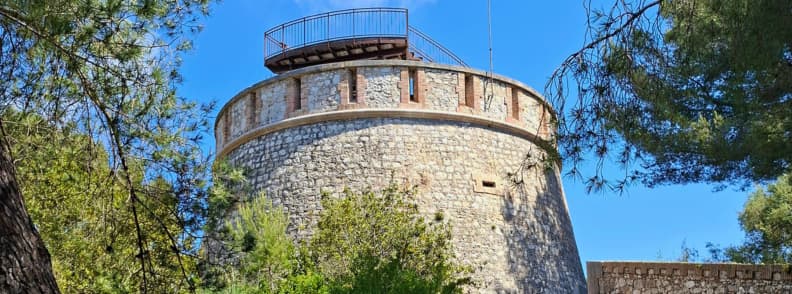
Batterie du Graillon gives Posidonia Antibes its spine. Before it became a sea and coastline museum, this place guarded the Golfe Juan from the rocky edge of Cap d’Antibes. The history panels inside show why this stretch of coast drew so much military attention. Ships could anchor here and take cover from the weather. Still, enemies could approach from the sea, and Antibes sat in a vulnerable position between Provence, the Lérins Islands, and the wider Mediterranean routes.
The history of the Graillon Battery in Antibes starts with Golfe Juan as a strategic anchorage. The bay offered shelter from western winds, easy landing points, and access to beaches, which made it useful for trade and dangerous during conflict. This is why military engineers kept returning to this coastline with new ideas for coastal defense.
The Batterie du Graillon history reaches back to the 17th century. In 1635, Cardinal de Richelieu ordered urgent fortifications along the Provençal coast in response to Spanish threats. A chain of coastal batteries and artillery towers stretched from Marseille to Antibes, through the Îles d’Hyères, with the Graillon Tower controlling the entrance to the Golfe Juan.
Vauban later saw the same weakness from the sea. During his inspection of Provence, he identified the Golfe Juan as one of the best anchorages in the Mediterranean, so he proposed a fort à la mer around 1700. His plan placed forts roughly 700 metres from shore, with firing range across the bay, but the project remained on paper.
The 18th century proved Vauban’s point. There is repeated naval pressure around Golfe Juan, including English attacks and conflicts involving France, England, Holland, Italy, and Barbary powers.
The Siege of Antibes in 1746-1747 marks the site’s most dramatic chapter. Austrian and English forces threatened Provence and Antibes, while French troops prepared the recovery of the Lérins Islands from the arsenal at Toulon. The exhibition explains how troops embarked from Cannes and Le Graillon before retaking the islands.
The Batterie du Graillon then changed with each military era. After the English occupation of Toulon in 1793, Bonaparte’s inspection led to upgraded coastal defenses across Provence. The battery gained stronger organization, with six cannons and two mortars placed within a defensive network covering the coast from Cap de la Fourcade to Cap Gros.
The 19th century brought another rebuild. In the 1840s, artillery modernization and renewed Franco-English tension led to a full reconstruction of the battery. The tower rose again on the base of the older 1635 structure, with stronger protection and a layout adapted to modern firepower.
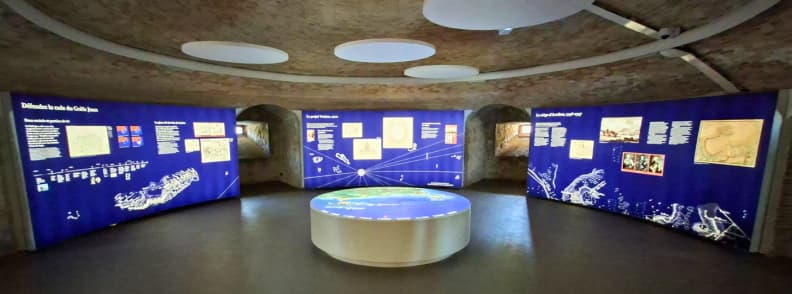
The drawings inside Posidonia Antibes make the entire Batterie du Graillon history easy to follow. Plans show the tower, sections, gun positions, and coastal firing lines, so you can understand the site even without military history knowledge. There is also a projection table in the center, animating centuries of history.
By the late 19th century, the Batterie du Graillon had entered a new age of defense. Steam-powered ships changed naval warfare because vessels could move without relying on wind, and night attacks became possible. The battery received a projector with a range of about 6 km to light the Golfe Juan during possible attacks.
During the Second World War, the site shifted again. The exhibition explains that the battery had two 75 mm guns in the late 1930s, then lost armament after the 1940 armistice. During the Occupation, small concrete shelters for machine guns were added to the site.
Batterie du Graillon Antibes is a pretty building with sea views that carries three centuries of coastal defense, from Richelieu to Vauban’s unrealized plan, from Bonaparte-era upgrades to Second World War adaptations. For anyone interested in historic military sites in Antibes, the Graillon Battery tour adds real depth to the Posidonia visit.
Today, the same defensive site has a calmer purpose. Posidonia turns the Graillon battery Antibes story toward coastal heritage, marine education, and protection of the Cap d’Antibes shoreline. That contrast gives the visit its best twist: a place once built to watch for enemies now teaches people to pay attention to the sea, switching from military to environmental protection.
Posidonia Antibes Local Tip: Take a few minutes with the blue history panels before heading outside. They explain why the views from the tower and coastline have mattered for centuries, and the rest of the Posidonia visit makes much more sense afterward.
Quick Info for Visiting Posidonia Espace Mer et Littoral
Posidonia Espace Mer et Littoral is easy to enjoy once you plan the basics properly. The museum is small, the setting is beautiful, and the Cap d’Antibes coast adds beaches, sea views, shaded paths, and short walks around your visit.
The main thing to plan ahead is your arrival. We visited Posidonia Antibes by car in spring, during low season, and parking already took effort because beach-goers filled the tiny nearby parking areas fast.
Save yourself the usual Riviera parking panic. Use my South of France travel guide with interactive map to plan smarter stops around Antibes, Cap d’Antibes, and the rest of PACA.
Posidonia Antibes Family Advice: For families, Posidonia Antibes works best as a half-day outing. You can visit the museum, take your time with the fish, climb the historic stairs if everyone in your group can manage them, sit in the pine grove, and add a coastal walk toward Port de l’Olivette or the beaches nearby.
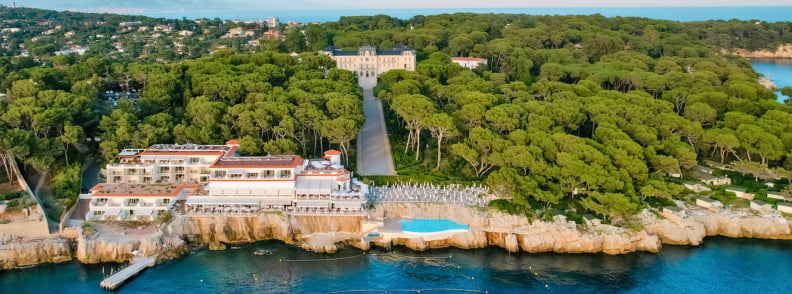
Posidonia Antibes address, location, and map area
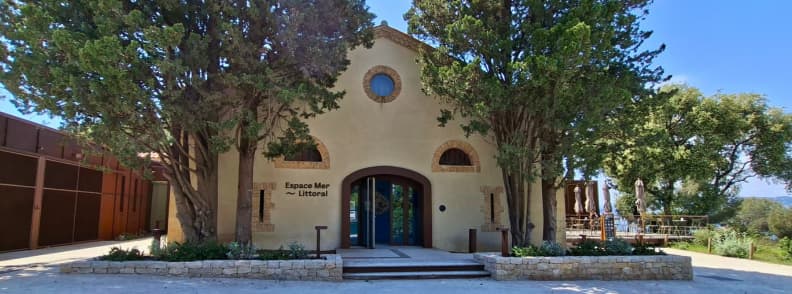
Posidonia Antibes is located at Batterie du Graillon on Posidonia Cap d’Antibes. Use Posidonia Espace Mer et Littoral in your map app, then confirm the route against the official website before leaving.
The location places you near some of the best Cap d’Antibes attractions. You’re close to the coast, Port de l’Olivette, the beaches, the wider Cap d’Antibes nature area, and walking routes that make the museum easier to turn into a real outing.
Planning beyond Posidonia? My Cap d’Antibes and French Riviera interactive map guide helps you spot nearby beaches, scenic stops, quiet ports, and family-friendly places before you waste time on detours.
If you arrive from Juan-les-Pins, the route follows the coast toward the southern side of the cape. Posidonia Antibes from Juan les Pins pairs well with a slow coastal drive or a stroller walk in the calmer parts near Port de l’Olivette.
If you arrive from Antibes town center, allow extra time. The roads around Cap d’Antibes are narrow in places, and beach traffic can take over early once the weather turns warm.
You will find Posidonia Antibes near Hotel du Cap Eden Roc. If you’re traveling with kids and staying at Hotel du Cap Eden Roc fits your budget, I think it’s a great option.
The Travel Bunny’s Antibes Local Tip: Save the map location before you leave. Once you’re on Cap d’Antibes, you’ll want your attention on narrow roads, cyclists, pedestrians, and parking spots, rather than retyping the name into your phone.
Posidonia opening hours by season
Posidonia opening hours change by season, with a summer schedule from Tuesday to Sunday, 9 AM to 6 PM, and an off-season schedule from Tuesday to Saturday, 9 AM to 5 PM, with Monday closures and major holiday closures. To have the latest information, check the official Posidonia website before planning your visit.
The best time to visit Posidonia Antibes is early in the day. This timing helps with parking, gives families more energy for the museum, and leaves time for a beach stop or coastal walk afterward.
In summer, I’d plan the beach first to stay out of the sun in the afternoon. A morning beach swim followed by Posidonia Antibes protects you from the heat with shade, air conditioning, and sea breeze during the warmer part of the day.
In spring, Posidonia Antibes already attracts beach traffic around the coast. We visited in the low season and still had a parking challenge, which tells me summer mornings need a tighter plan.
Posidonia can also suit rainy day activities in Antibes Juan les Pins. The indoor museum, aquarium, history panels, and VR dive give families an option when beach time loses appeal, while the pine grove and coast still add value during dry breaks.
Posidonia Antibes Local tip: Go early in spring and even earlier in summer. Parking near the site fills fast once people head to the beaches.
Posidonia tickets, prices, and booking
Posidonia Antibes ticket price and booking information belong on your pre-visit checklist. This is especially useful if you want kayak outings, snorkeling, a guided visit, a group visit, or a school holiday activity.
| Posidonia Antibes Ticket or Activity | Costs |
|---|---|
| Adult ticket | €12 |
| Reduced ticket* | €6 |
| Children under 6 | Free |
| Family ticket (2 adults and up to 4 children) | €24 |
| VR dive (starting 10 y.o.) | €3 |
| Nature workshop (starting 6 y.o.) | €12 |
The museum itself has paid entry, while the surrounding coast gives you extra value. You can pair the visit with free things to do in Cap d’Antibes, such as a coastal walk, a beach stop, viewpoints, or a stroller walk toward Port de l’Olivette.
Want more free and low-cost ideas nearby? Browse my budget-friendly Provence and Côte d’Azur guide with saved map spots for beaches, villages, viewpoints, markets, and family outings across the region.
The VR dive is worth adding if you like immersive experiences. I did it while Mathieu fed our toddler, and it gave me a quiet adult moment in the middle of a family visit.
For Posidonia Antibes guided tour booking, check availability ahead of time. Kayak and snorkeling are seasonal activity opportunities, with guided kayak pricing listed at €34 for adults and €28 for children aged 8 to 17.
Visit Posidonia Antibes Tip: Treat the café as backup, not as the lunch stop. We found tiny sandwiches and pain bagnat, in very small numbers. It’s best to pack a picnic and take advantage of the pine grove.
How long to visit Posidonia Antibes
Plan 45 minutes for a quick Posidonia Antibes visit. This gives you enough time for the first displays, the small aquarium, and a short look at the Batterie du Graillon history.
Plan 90 minutes for a better visit with small children. This gives the kids time to look at the fish, touch what they can in the first room, move through the museum at a slower rhythm, and pause outside.
Plan half a day for the best Posidonia Antibes family day out. Add the VR dive, the Tower if stairs suit your group, the pine grove with its botanical path, a picnic, and a coastal walk or beach stop.
A full day is great when you add the beach. The nearby shallow water was already warm enough for swimmers in April, and the narrow beaches were surprisingly family-friendly because the water stayed shallow far from shore.
For Posidonia Antibes visitor tips and advice based on my experience, I think Posidonia Antibes is a half-day visit by default. The museum itself is small, but the setting rewards slower travel.
Turn this half-day into a better Riviera itinerary with my Provence-Alpes-Côte d’Azur local secrets guide, built around saved places you can open directly on the map.
The Travel Bunny’s Tip: Leave time for the pine grove. It gives toddlers space to reset, and a stroller nap there is doable on a quiet day.
Parking, bus, and public transport access
Parking is the biggest practical issue at Posidonia Antibes. The parking near Espace Mer et Littoral is small, and it can fill with beachgoers even in spring.
We came by car and found the closest parking lot full. The accessible spaces by the coast were the only ones open when we arrived. So go early if you plan to drive. A late arrival can turn a simple museum outing into a slow loop around Cap d’Antibes roads.
For Posidonia museum parking and access by car, keep the day flexible. Pairing the visit with a beach or short walk helps if you park a little farther than expected.
Visit Cap d’Antibes Travel Tip: Arrive before beach-goers take the small coastal parking areas. This advice applies even in spring, and it becomes more important as soon as beach weather starts.
For public transport to Cap d’Antibes, check Envibus Route 2 and Envibus Route 15 before leaving. Live timetables should guide your final choice.
If you use the bus, plan your return before you start the visit. Cap d’Antibes is much easier to explore when you already know your return stop, your final departure time, and your backup plan.
Posidonia Antibes accessibility, toilets, picnic, and comfort notes
Posidonia Antibes has clean accessible toilets. I saw two toilets inside the museum and one in the café, and all were very clean during our visit.
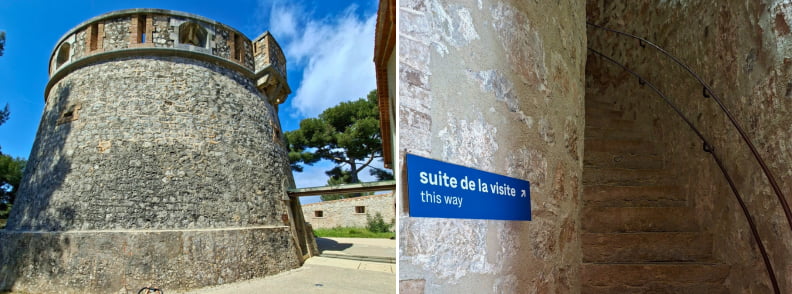
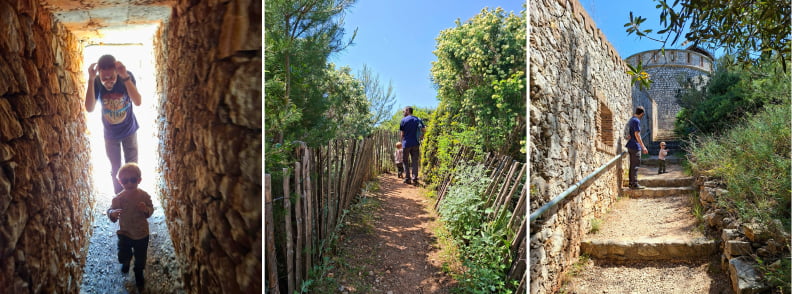
Wheelchair users should plan for a partial visit. The first part of the museum is the best area to visit, while the historic Batterie du Graillon tower and the pine grove have stairs to move up and down. Also, entering the museum may add a small detour because there are two steps just in front.
Accessible parking exists, but the gate deserves attention. During our visit, the gate was closed and had an intercom, so I’d call ahead if wheelchair access is central to your plan.
For stroller users, Posidonia is still an excellent family stop. We walked along the coast with our toddler in the stroller, and the outdoor areas gave us space to move at a family pace. And he tackled the stairs on his own, with us ready to intervene.
The café is useful for a drink or a small bite. For lunch, bring your own picnic if you’re visiting with children, because the choices were limited when we visited.
As for the Posidonia Antibes dog policy, they accept service dogs only.
The Travel Bunny’s Antibes Local Tip: Pack lunch, water, sun protection, and a light layer. The pine grove gives shade, the coast brings sea breeze, and a picnic makes the visit far easier with children.
What You See Inside Posidonia Antibes
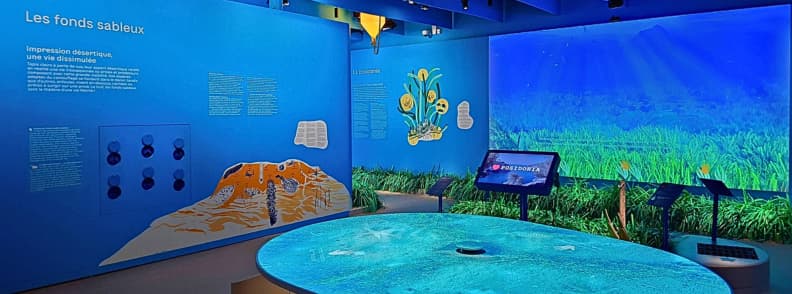
Inside Posidonia Antibes, the visit starts like an underwater walk adapted for families. The rooms use blue walls, low lighting, projections, touch panels, soft seating shaped like rocks, and buoy-style lamps to place you inside the Mediterranean Sea.
The first room gives children plenty to do with their hands. Our toddler moved from one interactive spot to another, while we could still read enough about Antibes marine life, Posidonia meadows, turtles, sandy seabeds, coralligenous habitats, and marine pollution to enjoy the museum as adults.
For travelers and expats, Posidonia Antibes is a useful introduction to the sea around Cap d’Antibes. It explains what lives below the surface, why protected habitats need care, and why a small seaside museum in an old coastal battery fits this spot.
Living nearby or visiting often? My PACA guide for travelers and expats gives you a growing local map of places worth saving across the French Riviera, Provence, and the inland villages.
The Mediterranean habitat exhibition, the hands-on first room
The Mediterranean habitat exhibition is the most child-friendly part of Posidonia Antibes. It turns marine education Antibes into something active, visual, and easy to follow, even with a toddler who has zero patience for you to read walls of texts.
As soon as you enter, the Posidonia oceanica panels explain the plant that gives the museum its name. They describe a strictly protected flowering plant with leaves, flowers, fruits, rhizomes, roots, and a slow-growing structure called a matte.
The seagrass panels continue to explain how Posidonia meadows produce oxygen, store carbon, stabilize the seabed, protect the shoreline, and support fish and other marine life.
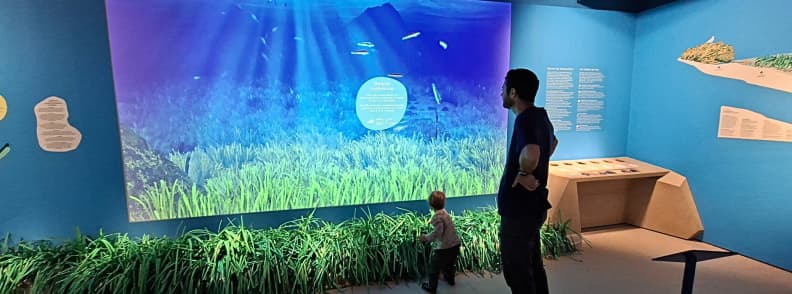
One wall shows a projection of Posidonia seagrass. Children shake the artificial seagrass in front of the screen, and fish swim out in the projected meadow, which makes the underwater habitat click instantly.
This was one of the best toddler moments of our visit. Our son could move, touch, and trigger something visible, which kept him engaged far better than a quiet display case would have.
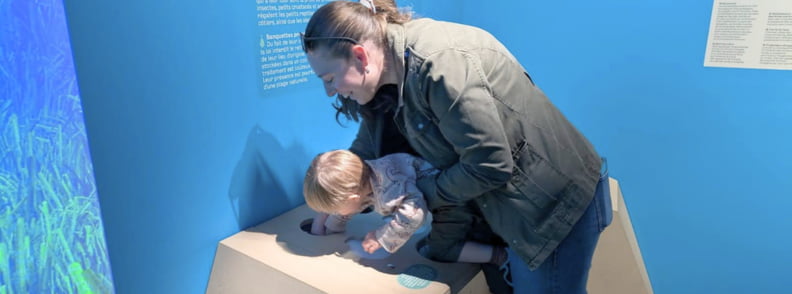
Another corner introduces different seabeds through touch. You place your hands on sand, rocks, dry algae, and more that represent the sea floor. This helps children and adults understand why sandy bottoms, rocky areas, seagrass meadows, and coralligenous formations support different species.
The sandy seabed panels explain a habitat many people dismiss too quickly. The museum presents it as a place with hidden life, camouflage, small burrows, and nighttime activity.
The quiz wall adds movement to the learning. Questions appear on the projection, and you tap your answer directly in the seascape below, choosing a fish, a plant, or another marine element.
Next to the quiz wall, the coralligenous habitat panels add depth for adults. They explain how, between about 20 and 100 metres, coralline algae help build complex Mediterranean structures that shelter gorgonians, molluscs, bryozoans, tubeworms, sponges, ascidians, red coral, and hard corals.
Here, you get a closer look at marine biodiversity in the Mediterranean. You see how many organisms build, cling, filter, feed, and shelter in habitats most visitors never notice from the beach.
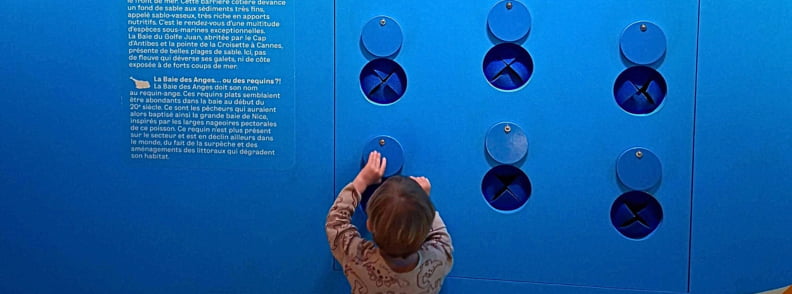
This continues with a separate tactile game that asks visitors to identify marine creatures by touch. You touch moulds and try to identify the right animal, which adds a simple hands-on layer to the Antibes immersive exhibition about Mediterranean habitats.
The projection at the back of the room gives the space its strongest visual moment. Marine life swims across the walls and the floor, with whales, rays, dolphins, turtles, and a blue shark moving around you. You can even hear some of them. Our toddler adored the blue shark, which he followed with the kind of focus parents pray for in museums. Though it did raise some questions about his survival instinct.
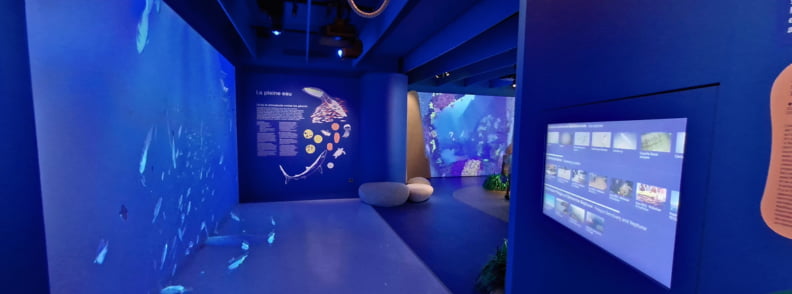
Next to this projection wall, you have two more displays.
- The turtle display introduces three protected species found along French coasts. The panels present the loggerhead turtle, the green turtle, and the leatherback turtle, then invite children to put together shell pieces to identify the correct species.
- The open-water display widens the scene beyond the shore. It presents la pleine eau as the largest habitat on the planet, where plankton, fish, jellyfish, tuna, sharks, turtles, and marine mammals cross paths.
The exhibition also mentions the Pelagos Sanctuary. This connects Posidonia Antibes with the wider Mediterranean marine world between France, Monaco, and Italy, which adds useful context for anyone living on or visiting the Côte d’Azur.
The waste displays bring the message back to everyday choices. One panel shows how rubbish moves from land to sea through wind, rain, rivers, drainage, and human carelessness, with packaging, cigarette ends, fishing lines, masks, cans, and other debris ending up in the marine environment.
A biodegradability panel compares how long items persist in the sea, from weeks for toilet paper to thousands of years for glass, which gives adults and older children an easy number to remember.
The room also explains damage from anchoring. A display beside artificial Posidonia shows how repeated anchoring can tear through seagrass meadows and presents existing solutions, including sandy anchoring zones and tools such as DONIA for finding suitable seabeds.
As someone who has sailed the Mediterranean coast, I know that in many places you can get fined for anchoring in Posidonia meadows. But sea vegetation is something sailors should want to avoid anyway, because anchors don’t hold well in it, and a bare sandy soil offers safer holding anyway.
As an Antibes ocean awareness museum experience, this room succeeds because it connects play with responsibility. Children touch, shake, guess, and follow animals across the floor, while adults pick up clear messages about marine biodiversity, seagrass protection, waste, and fragile Mediterranean habitats.
I liked the design because it gave our toddler freedom inside a well-organized space. He could explore the room, touch safe elements, watch projections, and stay close to us, while we learned enough to see the Cap d’Antibes coastline differently afterward.
Posidonia Antibes Family Tip: Start slowly in this first room if you visit Posidonia Antibes with young children. It sets up the whole marine story, and the hands-on displays give toddlers their best chance to connect with the visit before the quieter museum areas.
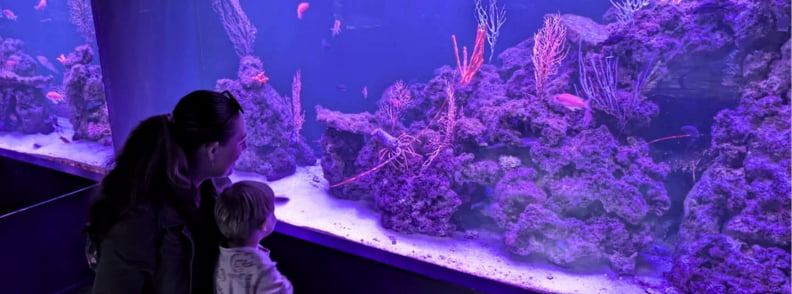
Posidonia Antibes Mediterranean aquarium
The Mediterranean aquarium is small, calm, and easy to enjoy with children. If you’re expecting a large Antibes aquarium, you’ll need to reset the scale, because Posidonia Antibes gives you a tiny fish-viewing space inside a wider marine museum visit.
The often-mentioned 10,000-litre aquarium in Antibes belonged to Marineland. Marineland Antibes closed permanently on 5 January 2025, after 55 years of activity, following years of financial pressure and the French law phasing out cetacean shows.
At Posidonia, the charm comes from proximity. You stand on a small bridge above the water, with fish swimming below, and the scene resembles the edge of a rocky Mediterranean shore rather than a large tank wall.
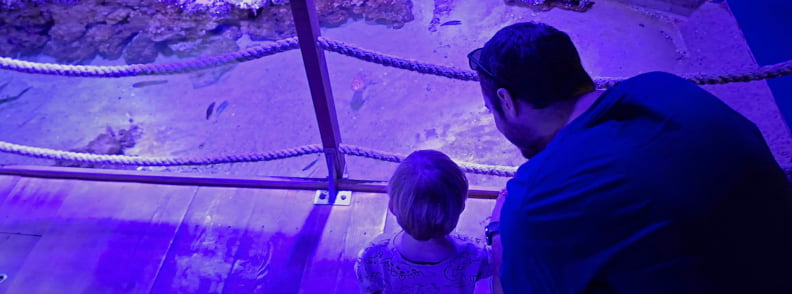
Our toddler loved the bridge! He is obsessed with the French comptine Les petits poissons dans l’eau, which had pushed me toward visiting Posidonia in the first place, and he sang it to the fish while they moved around us.
The bridge has rope handles now. I read older online reviews saying the bridge originally lacked them, and some visitors stepped into the water by accident. The rope handles protect visitors and marine life at the same time. A foot in the water would ruin the moment for anyone, but it could also injure the small fish and other fragile Antibes sea life below.
Small aquariums around the room have sliding information panels, so you can reveal details about the species inside without turning the visit into a long reading session.
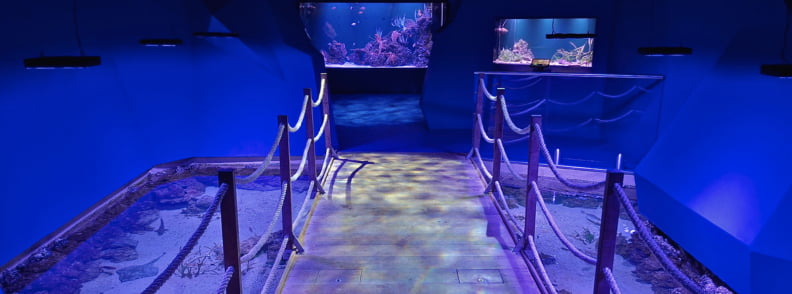
The blue light adds to the underwater mood. It makes the Mediterranean aquarium area quiet and focused, which suited our toddler far better than a bigger, brighter aquarium packed with too many distractions.
This setup suits families because everyone can choose their pace. Children watch the fish, adults read the panels, and nobody has to drag the visit through endless rooms.
As part of the wider Posidonia Antibes things to see inside, the aquarium gives children a close encounter with Antibes marine life, while keeping the museum calm enough for a family visit.
Posidonia Antibes Travel Tip: Let children spend time on the bridge instead of rushing them to the next room. For our toddler, the fish under the bridge became one of the clearest memories of the visit.
Posidonia virtual dive experience in Antibes
The virtual dive Antibes experience surprised me. I expected a small extra attraction, useful mainly for teens, but the VR dive turned into one of the most memorable parts of my visit to Posidonia Antibes.
The experience is available in several languages, including English. This makes it easy for international travelers, expats, and mixed-language families visiting the Cap d’Antibes sea museum to learn more about the local Mediterranean flora and fauna.
You wear the headset and enter a virtual Mediterranean dive in Golfe Juan. The experience takes you below the surface, through marine habitats and encounters with sea life, while staying completely dry inside the old Graillon battery.
The first intense moment came when the dive dropped deeper and everything went dark. I knew I was safe in the museum, but the sense of depth still hit my body before my brain caught up.
The second intense moment came when a fish moved toward me unexpectedly. The dive isn’t made to be scary. It’s just that I was looking at something in the opposite direction, and when I turned, he was swimming into me. It was beautiful and slightly alarming at the same time, which says a lot about how immersive the Antibes VR diving experience can be.
I also spent the whole dive expecting sharks to appear, because there are blue shark sightings on the Côte d’Azur. None came, which my nervous side appreciated, although my travel-writer side admits a harmless virtual shark would have made a great story.
When I went up to return near the surface, I had to look up. Looking down made me dizzy, and the movement gave me a sharp little rush even though I’ve never considered myself that afraid of deep water.
The whale encounter was the best part. A whale passed above me and turned in a way that made me want to reach up and touch it, which felt both instinctive and slightly ridiculous in the headset.
The beauty of the Posidonia Antibes virtual Mediterranean dive is the distance it gives wildlife. You can see marine life closely, learn about the underwater world, and leave the real animals in peace. It’s an amazing experience, especially for someone who doesn’t scuba dive.
For travelers with a partner or child who feels uneasy around deep water, this VR diving Antibes experience offers a gentle compromise. You can explore an underwater world, keep your feet on dry land, and come away with a better understanding of the sea around Cap d’Antibes.
The VR dive also gives parents an adult moment inside Posidonia. Mathieu fed our toddler while I did it, and that made the timing perfect for us: one parent had a focused museum experience while the other handled the very real snack economy of toddler travel. Had he wanted to dive also, we would have switched roles afterwards.
As an Antibes immersive museum feature, the VR dive adds value to this small site. It turns a short marine museum visit into something more memorable for adults, teens, and older children.
Visit Posidonia Antibes Tip: Do the VR dive if someone in your group can watch younger children for a few minutes. It gives adults and teens a full Posidonia experience, especially if real scuba diving has never fit your travel style.
The 360-degree viewpoint from the Graillon tower
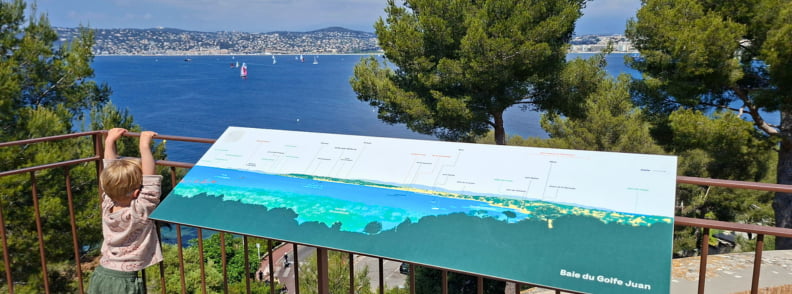
The Graillon Tower gives Posidonia Antibes some of its best sea views. After the darker museum rooms, you step back into the light and reach the Cap d’Antibes panoramic view over the Baie du Golfe Juan, the coastline, the pines, and the boats crossing the water.
The viewpoint helps you understand why Batterie du Graillon stood here. From above, the bay reads like a natural anchorage, wide, sheltered, and easy to watch from the rocky edge of Cap d’Antibes.
There’s an orientation panel by the railing. It identifies the marine landscape below, which makes the Cap d’Antibes Golfe Juan view more than a pretty photo spot.
Although the view is beautiful, there is one caveat. The pines around the tower have grown tall, so they cut into some sightlines and cover parts of the panorama.
But this small limitation didn’t ruin it for me. The mix of sea, trees, sails, and coastline still gives you one of the best moments inside Posidonia Antibes, especially after reading the history of the Graillon Battery below.
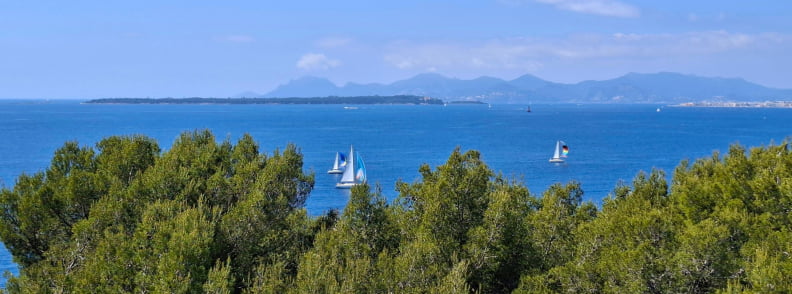
For photos, move around rather than stay in one spot. Some angles give you more water, others frame the trees against the bay, and a few openings catch the Antibes rocky coast more clearly.
The Graillon Tower Antibes viewpoint also adds a quiet adult reward to the visit. Children may rush, but the climb gives adults a clear reason to pause, breathe, and reorient themselves to the museum’s coastal setting.
If you like scenic stops, keep your camera ready here. It belongs among the best Instagram spots Cap d’Antibes sea views, with the bonus of context from the museum rather than a simple roadside viewpoint.
Posidonia Antibes Visit Tip: Take the tower view after the history rooms. The bay makes much more sense once you’ve seen why this coast needed watching for centuries.
Antibes pine grove and botanical path
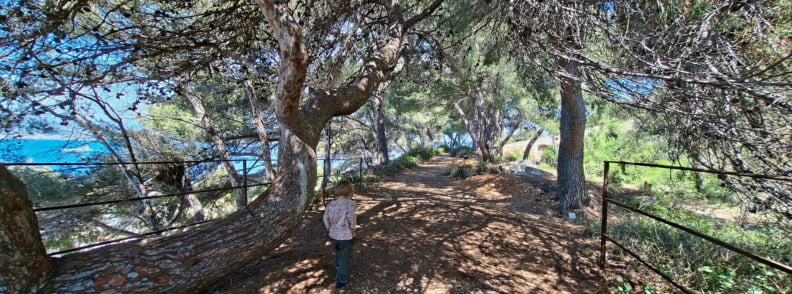
The pine grove gives Posidonia Antibes its best family pause. After the museum rooms and the Graillon Tower visit, the Cap d’Antibes botanical trail takes you outside into shade, sea air, low paths, and small learning stops.
I liked this part more than I expected. We have recently started thinking about our new garden, so we walked through the botanical trail Antibes with a second agenda, which was spotting Mediterranean plants that could survive near our home.
Posidonia Antibes Safety Tip: Parents with toddlers should keep close. Several of Posidonia’s Mediterranean plants are toxic if ingested, so this is a hands-on nature walk and not a tasting menu for curious little mouths.
The path adds a softer side to the old military site. One moment you’re reading about cannons, projectors, and coastal defense, then a few steps later, you’re resting under pines, watching insects, plants, and the sea take over the story.
This is where Posidonia becomes an Antibes outdoor museum. The visit spreads beyond the walls, into a Mediterranean pine forest walk with benches, shade, sea glimpses, and panels that connect the fort, the plants, the coast, and the marine habitats below.
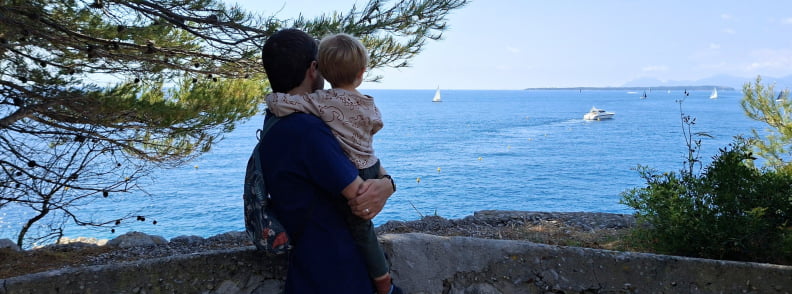
The old defense viewpoints still shape the path through the pines. Some lookout spots open toward the water, and the panels explain how those positions helped protect Golfe Juan and the Cap d’Antibes coast.
We also saw the gathering and access points for guided kayak and snorkeling outings, plus the gate that leads directly from the museum grounds toward the water. I want to come back here when my son is older to try them out. I’m particularly interested in the guided snorkeling experience.
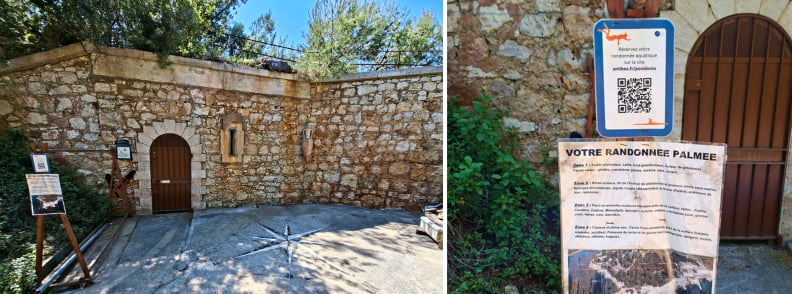
The marine life rescue center building also sits along the Cap d’Antibes nature path. When we visited, the area looked partly covered by surrounding vegetation. I’m unsure if it’s still being used during the turtle nesting season, so check the official information before planning anything around the center itself.
The turtle panels by the rescue center present Mediterranean sea turtles and the work linked to injured or struggling marine animals, which fits the wider Posidonia message about coastal care.
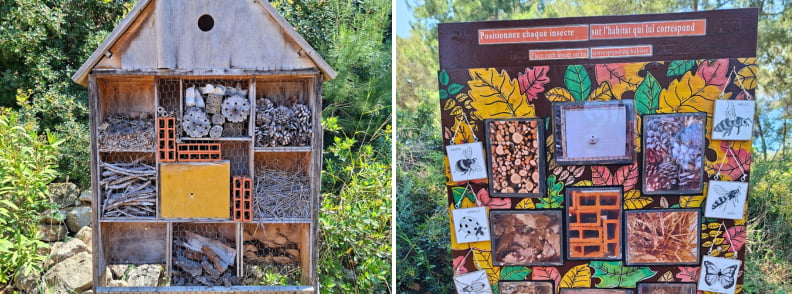
Children also get small Atelier Nature stops along the path. We saw an insect hotel and a matching game where kids place each insect in the habitat that suits it. This simple insect panel helps children notice life in the pine grove rather than treating it as a shortcut to the exit.
The Cap d’Antibes nature path is also useful for families who need a reset. A child can move and play, while parents can sit for a moment. The shade makes the visit easier during warm weather.
Posidonia Antibes coastal nature trail gives a quick introduction to local Mediterranean planting. Pines, hardy shrubs, coastal plants, insects, stone walls, and sea views all sit inside one compact route. Take the time to read a few panels, let children stop at the insect games, look toward the water, and use the benches instead of treating the pine grove as an afterthought.
Posidonia Antibes Family Tip: Bring water and keep young children close on the botanical path.
Cap d’Antibes kayaking, Snorkeling, and Guided Sea Activities
Beyond the museum, Posidonia Antibes connects visitors to guided sea activities, including kayak outings and snorkeling experiences around the rocky Cap d’Antibes coast.
Want more sea, coast, and nature ideas in the region? Open my French Riviera outdoor activities map guide for beaches, walks, viewpoints, family outings, and coastal stops across PACA.
Therefore, Posidonia is useful for two types of visits. You can keep it calm with the museum, aquarium, VR dive, pine grove, and viewpoints, or plan a fuller sea-focused day with a guided activity.
I’d treat kayaking and snorkeling as activities to check before you go. Weather, season, sea conditions, age limits, and booking slots can change the plan fast along this part of the Riviera.
Museum-only visit or guided sea activity. which Posidonia visit fits your day?
A museum-only visit suits families with young children best. You can move through the interactive displays, spend time at the Mediterranean aquarium, climb the tower if your group manages stairs, and then slow down in the pine grove.
This was the right rhythm for us with our toddler. He had space to touch, watch, sing to the fish, walk outside, and reset under the pines without turning the day into a rushed activity schedule.
A guided activity visit suits older children, teens, active adults, and curious expats who already know the Antibes beaches. It adds the sea itself to the museum story, which makes the Posidonia Antibes kayak experience or snorkeling outing much fuller than a simple indoor stop.
The Posidonia Antibes naturalist guide experience can give the visit extra depth. A guide can point out coastal habitats, explain marine life, and connect the Batterie du Graillon setting with the protected Cap d’Antibes shoreline.
Check Posidonia Antibes guided tour booking before building your day around an activity. Look at the official schedule, the Antibes museum ticket price, the separate guided activity price, meeting time, required gear, and age rules.
For a first visit, I’d choose the museum-only plan with small children and the guided activity plan with confident swimmers. That gives each traveler the right level of sea contact without forcing the same experience on everyone.
The Travel Bunny’s Antibes Activity Tip: Book the sea activity first, then fit the museum around it. Kayaking and snorkeling depend on timing and sea conditions, while the museum visit gives you more flexibility.
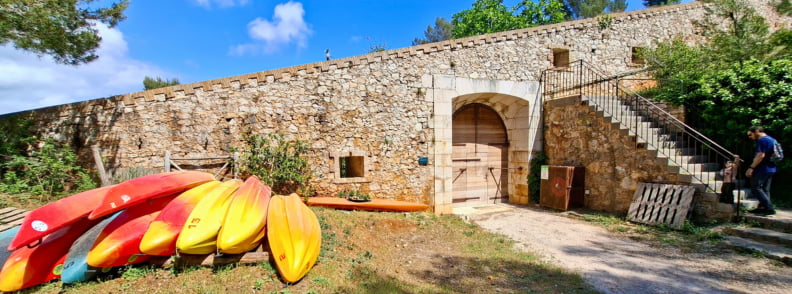
Kayak at Cap d’Antibes
Kayaking Cap d’Antibes turns the coastline into the main attraction. From the water, the rocky shore, pine-covered slopes, small coves, and old military site should look completely different from the paths above.
A guided kayak tour Cap d’Antibes adds local context. This coast has marine habitats, military history, protected areas, boat traffic, and weather exposure, and a guide can help you read and understand this place vs simply paddling past it if you were to DIY.
The Posidonia Antibes kayak experience sounds especially appealing because of the departure setting. You start near the old Batterie du Graillon, then move toward the same Mediterranean Sea that the museum has spent time explaining.
For families, both Posidonia sea activities start from age 8. After that, Posidonia could shift from a calm family museum day into a proper sea-learning outing, with the coast, marine life, and guided activity all connected.
Kayaking Safety Note: Children aged 8 to 12 need an adult on the water with them, while teens aged 13 to 17 need an adult waiting at the water’s edge.
For expats, this can become one of the best outdoor activities Cap d’Antibes offers. It has a local learning element, a coastal route, and a reason to return outside the usual beach routine.
Wear swimwear, water shoes, reef-safe sun protection, and a hat with a strap. The Cap d’Antibes coast can look calm from above while sun, wind, and reflected light do their usual Mediterranean ambush.
The Travel Bunny’s Local Tip: Pair a morning kayak with a slower museum visit afterward. The museum gives shade, toilets, and a calm break after time on the water.
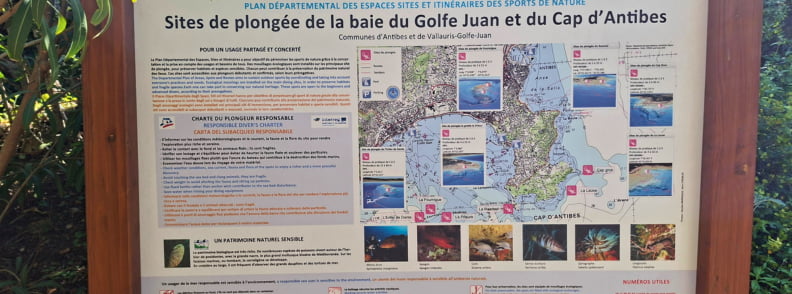
Snorkeling and randonnée subaquatique near Batterie du Graillon
Cap d’Antibes snorkeling fits the Posidonia story perfectly. Inside, you learn about seagrass, rocky habitats, coralligenous life, turtles, fish, and marine protection, then the guided sea outing with snorkeling on the underwater trail of the Batterie de Graillon can put that knowledge into the local coastal setting.
The French name of this activity is randonnée subaquatique. (You may also see randonnée palmée, guided snorkeling in Antibes, or snorkeling guided tour Cap d’Antibes used for this type of supervised underwater route.)
A snorkeling tour Batterie du Graillon can introduce several habitats in a small area. The outdoor panels mention shallow zones, rocky areas, seagrass, and richer marine life around the Cap d’Antibes coast.
This snorkeling activity suits confident swimmers best. Children, teens, and adults need comfort with masks, fins, waves, rocks, and changing sea visibility. Furthermore, children aged 8 to 12 need an adult in the water with them, while teens aged 13 to 17 need an adult waiting at the water’s edge.
The museum is great for Posidonia meadow snorkeling Mediterranean coast. After seeing the seagrass displays inside, you understand why Posidonia meadows in Antibes need care from swimmers, boaters, and anchors.
Seeing Antibes marine life without disturbing it: Stay with the guide, keep a distance from animals, and avoid touching rocks, plants, or the seabed while snorkeling.
Bring your own water and towel. A dry layer also helps after a sea session, especially in spring or when the wind comes up.
Antibes Snorkeling Tip: Ask about sea conditions before confirming snorkeling with children. Calm water can make the outing memorable, while wind and chop can make it hard work fast.
Kayak vs snorkeling at Cap d’Antibes. which activity should you choose?
Choose the museum-only visit for toddlers and relaxed family time. You will explore the interactive rooms, the small aquarium, the tower view, the pine grove, and enjoy enough variety for a Posidonia Antibes family day out. Grandparents, young kids, nervous swimmers, and visitors who prefer dry shoes can still enjoy Posidonia without taking on a sea activity.
Choose kayaking for views, coastline, and movement. Cap d’Antibes kayak outings suit active travelers who want to explore the shore, coves, and rocky coast from the water.
Choose snorkeling for marine life and underwater detail. Cap d’Antibes snorkeling suits confident swimmers who want to connect the museum displays with real fish, seagrass, rocks, and coastal habitats.
| Best choice | Best for | Main advantage |
|---|---|---|
| Museum-only visit | Toddlers, families, rainy days, short visits | Easy, calm, educational |
| Kayak | Ages 8+, active families, teens, adults Coastline views from the water | Coastline views from the water |
| Snorkeling | Ages 8+, confident swimmers | Direct look at marine life |
| Museum + beach | Families planning half a day | Flexible and budget-friendly |
For things to do in Cap d’Antibes with kids, I’d build the day around age and energy. Small children get the most from the museum and pine grove, while older children may enjoy kayaking, snorkeling, or a guided nature activity.
For free things to do in Cap d’Antibes after Posidonia, add a coastal walk or beach stop. That keeps the day budget-conscious while giving you sea views beyond the paid museum visit.
Cap d’Antibes Family Travel Tip: For a first Posidonia visit with children, choose the museum and pine grove first. Add kayak or snorkeling on a later visit once the kids have the age, stamina, and water confidence for it.
Is Posidonia Antibes Good for Kids?
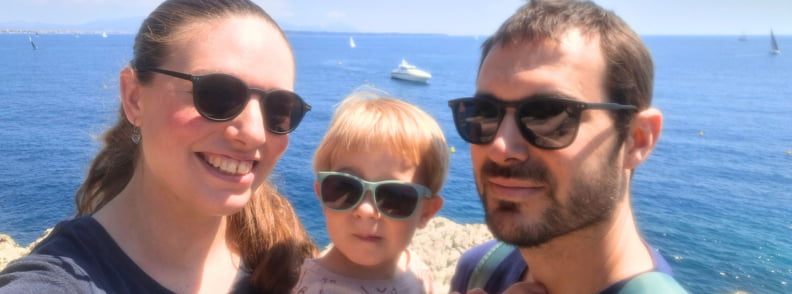
Yes, Posidonia Antibes is good for kids, especially young children who need movement, short activities, and space to reset. I took our toddler here in spring, and this small Antibes museum surpassed our expectations.
For families, Posidonia Antibes is just the right size. The visit shows children fish, projections, touch-friendly displays, outdoor shade, insects, sea views, and a pine grove, while adults still have history, marine education, and the Cap d’Antibes setting.
I’d place it high on a list of things to do in Antibes with kids. It suits locals, expats, and travelers who want a family museum on the Riviera with nature around it, instead of a long indoor visit that drains everyone by lunchtime.
Best ages for visiting Posidonia Antibes with kids
Toddlers can enjoy Posidonia Antibes because the museum is compact. Our 2-year-old toddler moved between the interactive first room, the fish bridge, the pine grove, and the outdoor path without getting lost in a huge building.
The first room suits young children best. They can shake the Posidonia seagrass, trigger fish on the projection screen, touch textures, answer visual quizzes, and follow animals moving across the floor.
The Mediterranean aquarium also suits small children. The fish swim close to the bridge, the blue light keeps the space calm, and the room gives children something clear to watch.
Primary-school children will understand all the marine information better. They’ll follow the displays about sea turtles, Posidonia meadows, marine waste, coralligenous habitats, and the animals living around Cap d’Antibes.
Older kids and teens will get more from the science and the local history. The Batterie du Graillon panels, the tower view, the VR dive, and the coastal defense story add depth beyond the child-friendly displays.
For babies, the visit depends on your stroller and timing. The main indoor area offers a manageable start, while the tower stairs and lower outdoor areas suit families who can carry, switch turns, or adapt the visit.
As an Antibes kids museum, Posidonia is worth visiting because it respects short attention spans. You move from touch to fish, from fish to history, from history to sea views, then outside to shade and nature.
For family activities in Cap d’Antibes, this is one of the easiest choices with young children. You can keep the visit short, add a picnic, or continue toward the coast when everyone still has energy.
Posidonia Antibes Family Visit Tip: Start with the interactive room before pushing toward the tower. It gives children a win early, which makes the rest of the visit easier.
Best ages for VR, snorkeling, kayak, and workshops
The Posidonia Antibes virtual dive experience suits adults, teens, and older children who enjoy immersive screens. It’s available in several languages, including English, which helps international families and expats.
For nervous swimmers or families with mixed comfort levels around the sea, Antibes VR diving has real value. You explore the Mediterranean underwater world from the museum, with zero need for scuba experience.
I enjoyed the VR dive far more than expected. The deep-water moments surprised me, the whale encounter was beautiful, and the experience gave me a way to see marine life closely while staying on dry land.
For snorkeling and kayaking, the starting age is 8 at Posidonia. This makes the sea activities better for older children, teens, and adults than for toddlers or preschoolers.
Cap d’Antibes snorkeling suits confident young swimmers. Children need comfort with water, masks, fins, rocks, waves, and the idea of seeing marine life below them.
Cap d’Antibes kayak suits active families with good balance and patience. The guided kayak tour gives older children a direct link between the museum displays and the rocky coast outside.
- For snorkeling, children aged 8 to 12 need an adult in the water with them.
- For kayaking, children aged 8 to 12 need an adult on the water with them.
- For both activities, teens aged 13 to 17 need an adult waiting at the water’s edge.
Kids workshops and Posidonia Antibes school visits are for curious children who like touching, matching, observing, and moving. The insect hotel and habitat matching panel on the botanical path add a simple land-based activity after the sea displays.
Visit Antibes Posidonia Tip: Check activity age rules, weather, and booking slots before promising kayaking or snorkeling to children. The museum is a good plan even when sea activities need another day.
How long to visit Posidonia Antibes with kids
- Plan 45 minutes for a short family visit. This gives you enough time for the interactive room, the fish bridge, and a quick look at the main museum areas.
- Plan 90 minutes for a calmer visit with young children. This gives your child time to watch the fish, press buttons, move between rooms, and take a short pause outside. With toddlers, the pine grove can save the visit. It gives them space to run, shade, benches, insects, plants, and a quieter setting after the blue museum rooms.
- Plan half a day for the best Posidonia Antibes family day out. Add the tower if your group manages stairs, the VR dive for one adult or older child, the pine grove, a snack break, and a coastal walk.
- A full day suits families who add the beach. The nearby shallow water made the coast surprisingly child-friendly when we visited in spring, and people had already started swimming.
For things to do in Cap d’Antibes with kids, Posidonia is an easy choice. My ideal Posidonia Antibes itinerary with kids would start early. Arrive before beach parking fills, visit the museum while everyone has energy, then eat your picnic in the pine grove.
Antibes Local Tip: Bring lunch instead of relying on the café. We found limited options, while the pine grove gave us a much better family break.
Strollers, naps, heat, and rainy-day planning in Antibes
Posidonia Antibes fits stroller families in parts, with planning. We used our foldable travel stroller to get from the car to the museum and along the coast toward Port de l’Olivette before going back to the car. Inside, it was useless to us, but for smaller babies a stroller can be used in the marine museum and aquarium part.
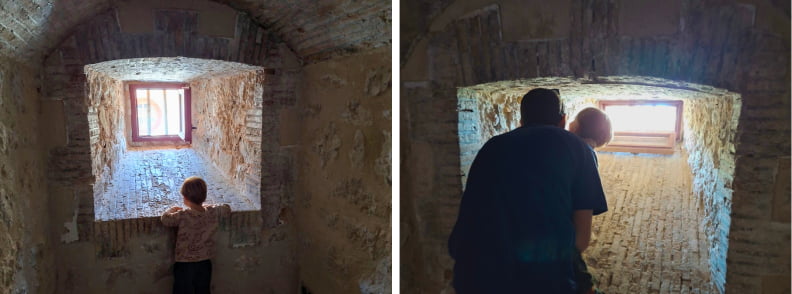
The tower has its narrow original stairs. You need to leave the stroller outside by the entrance and either carry the child up or let them climb with your help and/or supervision. You can also skip this part and focus on the museum, aquarium, and outdoor areas.
The pine grove is wonderful in warm weather. Shade, benches, and sea breeze make it a good and useful pause when the Cap d’Antibes sun gets stronger. A stroller nap in the pine grove is doable on a quiet day. The area was calm during our spring visit, and the outdoor shade offers the kind of break parents hope for.
For babies and toddlers who touch everything, watch them closely on the botanical path. Many Mediterranean plants look interesting, and some deserve distance from curious hands and mouths because they are poisonous.
In summer, choose your timing carefully. Morning offers better parking and softer heat, while the museum can help during the hotter part of the day, after beach time.
For rainy day Antibes plans, Posidonia is a good choice. The indoor displays, aquarium, history rooms, and VR dive give families an educational option when beach plans lose appeal.
As for an Antibes museum open in winter plan, you’re in luck. Although the opening hours are reduced, you can still visit out of season.
For accessible museum Antibes planning, treat Posidonia as a partial visit for wheelchair users. The first part of the museum gives the best access, while the tower stairs and lower pine grove create limits.
Visit Posidonia Antibes Tip: Pack water, snacks, sun protection, and a light layer. Posidonia has indoor rooms, shaded outdoor areas, sea breeze, and coast exposure, so family comfort changes from one part of the visit to the next.
Posidonia and the Cap d’Antibes Coastal Path
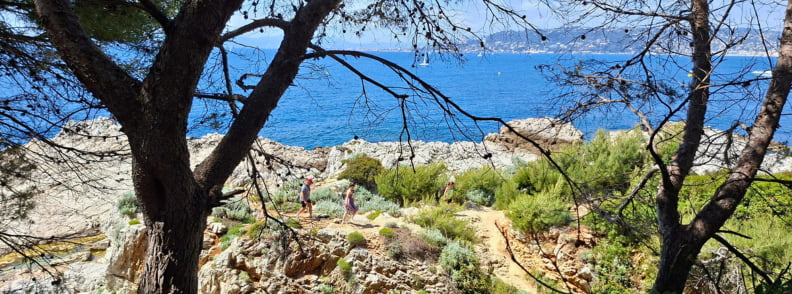
Posidonia Antibes sits in one of the best parts of Cap d’Antibes for turning a short museum visit into a coastal outing. The museum has marine life, local history, and sea views, and the surrounding coast gives you beaches, pines, rocky edges, and walking routes.
The Cap d’Antibes coastal path is the natural follow-up. After learning about Posidonia meadows, marine habitats, and coastal defense, you can make better sense of the shoreline outside the museum.
For families, locals, expats, and travelers, this combination gives you a plan for most of the day. Start with Posidonia Espace Mer & Littoral, add a shaded pause, then choose a short walk, a beach stop, or the longer Sentier de Tirepoil if your group has the energy.
Make the rest of your PACA trip easier to plan with my interactive South of France itinerary map, packed with saved stops you can use for day trips, weekends, and family outings.
Why Posidonia pairs well with the Tirepoil path
The Tirepoil Path is the best-known coastal trail in this part of Cap d’Antibes. You’ll also see it written as Sentier de Tirepoil or Sentier du Littoral Antibes, depending on the map, sign, or local guide.
The route usually starts near Garoupe Beach. From there, the trail follows the rocky edge of the cape, with the sea on one side and villas, pines, and Mediterranean vegetation on the other.
Posidonia gives the Tire Poil Path context. After seeing the museum displays on marine life and Posidonia meadows, and learning about the sea and land heritage of this coast, the Cap d’Antibes rocky path lets you see the same landscape outside, with pines, rocks, coves, and beautiful views across the water.
With young children, I’d separate the full Tirepoil Path from the first Posidonia visit. We walked with our toddler in the stroller toward Port de l’Olivette instead, and enjoyed sea views without turning our day into a long hike.
For older kids and active adults, Posidonia plus the coastal trail makes a beautiful Cap d’Antibes itinerary. The museum brings the story, then the path shares the physical setting.
This pairing also suits slow travelers. You spend time indoors, learn the basics, step into the pine grove, then let the coast stretch the visit into a half-day plan.
Cap d’Antibes Travel Tip: Use Posidonia as your coastal warm-up, then decide how far to walk based on heat, wind, shoes, and children’s energy.
Best route order for a half-day Posidonia and Cap d’Antibes visit
For a half-day visit, start with Posidonia Antibes. Morning gives you the best chance at parking, cooler museum rooms, and a calmer start before beach traffic takes over. Posidonia Antibes best itinerary has four parts: museum, tower, pine grove, then coast.
Visit the interactive Mediterranean Sea room first. Children get the hands-on displays early, while adults learn the basic marine story before seeing the aquarium, history rooms, and tower.
Climb the Graillon Tower view next. The Cap d’Antibes Golfe Juan view helps you place the old battery, the bay, and the coast in one clear frame.
Walk through the pine grove and its botanical path after the tower. This gives children a nature break to move around and adults a shaded break before heading back toward the coast.
Pass by Port de l’Olivette. We walked that way with our toddler in the stroller, and it gave us a beautiful coastal add-on without needing a full Cap d’Antibes hike.
Choose the Sentier de Tirepoil for a longer route. This is a good choice for confident walkers who want a proper Cap d’Antibes coastal walk with rocks, sea views, and a wilder edge.
For travelers coming from Antibes town center or Juan-les-Pins, keep the return simple. Plan your parking, bus stop, or pick-up point before adding extra walking distance.
For a half-day trip from Nice to Antibes museum, keep the plan tight by visiting Posidonia Espace Mer & Littoral, going on a short coastal walk, and stopping on a nearby beach for a full outing without overloading the day.
For a day trip from Cannes Cap d’Antibes museum plan, add lunch carefully. The café at Posidonia had limited options during our visit, so a picnic or a planned meal nearby makes the day smoother.
The Travel Bunny’s PACA Local Tip: Plan your itinerary for the day in layers. Posidonia first, pine grove second, coast third, beach only if everyone still has energy.
Want more day plans like this? Get my PACA interactive map guide for easy day trips and plan beaches, villages, walks, viewpoints, and food stops without starting from zero.
Cap d’Antibes coastal path difficulty, safety, closures, and weather
The Cap d’Antibes coastal path deserves practical planning. Parts of the trail follow exposed rocky shoreline, so shoes, weather, heat, and sea conditions shape the visit.
Hiking the full Tirepoil Path takes around 2 hours. It’s about 5 km, which sounds short until sun, rocks, wind, and children enter the equation.
So the Cap d’Antibes coastal path difficulty depends on your group. Active adults may call it easy, while families with small children, strollers, or tired legs need a shorter version.
A stroller can be used on the easier coastal sections, but not on the full rocky trail. With our toddler, we chose a coastal walk toward Port de l’Olivette, which suited our day and our toddler’s nap schedule far better.
Check closure information before setting out. The path can close during bad weather, strong wind, rough seas, or safety alerts. In summer, when the heat is high and the winds are strong, it is likely to get closed for fire risks. You can check the fire risk map here to see if there are any warnings or closures today or tomorrow.
You should alson avoid the trail in poor sea conditions. Waves, spray, slippery stone, and exposed sections change the route quickly.
Bring proper shoes for this Cap d’Antibes walk. Beach sandals suit the sand, but the coastal trail needs grip and stable footing. Also carry water even outside summer. The Riviera sun has a way of making a short walk feel longer than your map promised.
For guided hikes in Cap d’Antibes, book them for local context. A guide can explain the coast, villas, plants, rock formations, and protected habitats better than a map alone.
As for public transport to Cap d’Antibes, check your return before starting your walk. A scenic route becomes far less fun when the last bus has already gone.
Cap d’Antibes Local Tip: Treat the full Tirepoil path as a real walk vs a casual beach detour. Shoes, water, weather checks, and timing will make it or break it.
Best viewpoints near Posidonia Antibes
The first great viewpoint sits inside Posidonia itself. The Graillon tower gives a Cap d’Antibes panoramic view over Golfe Juan, with boats, pines, and coastline spreading below.
The trees shape the view from the tower. Some pines have grown high enough to cover parts of the panorama, but the openings still give beautiful sea views.
The orientation panel helps you read the bay. Instead of taking a quick photo and leaving, pause long enough to match the coast below with the marine and military story inside the museum.
Port de l’Olivette gives a quieter coastal view nearby. We reached it with our toddler in the stroller, and it added a softer, local-feeling stop after the museum.
Garoupe plateau gives another classic Cap d’Antibes viewpoint. Pair it with the Garoupe lighthouse or chapel if you want a wider view over the coast.
The rocky coastline adds the most dramatic sea photos. The Cap d’Antibes cliff walk sea views guide angle belongs here, especially for travelers who want natural photo stops instead of polished viewpoints.
Billionaire’s Bay belongs on many Cap d’Antibes lists. Add it if your route and energy allow, especially during a full-day coastal plan.
For the best Instagram spots Cap d’Antibes sea views, vary the angles. Use the tower, the pines, Port de l’Olivette, the rocky coast, and the Garoupe area instead of chasing one single viewpoint.
For families, scenic stops need comfort too. Shade, benches, safe footing, and short walking distance matter as much as the view when you travel with children.
Antibes-Juan-les-Pin Local Tip: Take your first viewpoint from the Graillon Tower, then decide how much coast walking to add. If parking was painful or the kids are tired, Port de l’Olivette gives a lovely shorter option.
What to Do Near Posidonia Antibes
Posidonia Antibes pairs well with the coast around Cap d’Antibes. After the museum, you can keep the day easy with Port de l’Olivette, add a beach stop, or continue toward La Garoupe, Villa Eilenroc, Plage des Ondes, and the rocky shoreline.
Save the nearby stops before you go. My French Riviera local map guide includes Cap d’Antibes ideas plus hundreds of PACA places for future weekends, road trips, and family days out.
This area suits travelers and expats who want a slower Cap d’Antibes day. You have sea views, small ports, historic landmarks, beaches, walking routes, and family-friendly shallow water within a short drive or walk.
I recommend you plan your day around parking and energy. Start early, visit Posidonia first, then choose one nearby stop instead of trying to cover the whole cape with children.
Garoupe Plateau, Lighthouse, Chapel, and Beach
Garoupe plateau gives you one of the best Cap d’Antibes panoramic view points. It sits higher than the coast near Posidonia Espace Mer et Littoral, so it pairs well with the Graillon Tower if you want to understand the shape of Antibes Cape from different angles.
Garoupe Lighthouse or Phare de la Garoupe is the landmark most people associate with the plateau. The lighthouse area offers wide views over Antibes, Juan-les-Pins, the sea, and the surrounding French Riviera coastline.
Garoupe Chapel is also known as Notre-Dame de la Garoupe or Notre-Dame de Bon Port. If you are interested in religious heritage, small chapels, and places where sailors, families, and coastal communities left traces of devotion, the Chapelle de la Garoupe gives the plateau a stronger identity than the view alone.
Garoupe Beach or Plage de la Garoupe makes the area easier to explore with children. When we visited the coast near Posidonia in spring, the shallow water and protected pockets along this side of Cap d’Antibes made the beaches very family-friendly.
The downside is that these beaches are kind of narrow. This makes timing important, especially when locals and beach-goers arrive early on warm days.
Add Garoupe plateau to your itinerary if you’re planning things to do near Hotel du Cap Eden Roc. Posidonia, the Garoupe area, coastal viewpoints, and nearby beaches sit close enough to create a beautiful half-day route without turning it into a rushed checklist.
Visit Cap d’Antibes Tip: Pair Posidonia with Garoupe only if everyone still has energy after the museum. With small children, the beach or Port de l’Olivette can make a calmer second stop.
Villa Eilenroc and Gardens on the Same Cap d’Antibes Day
Villa Eilenroc is one of the best-known Cap d’Antibes attractions. The villa and Eilenroc gardens give you a different side of the cape, with local heritage, formal landscaping, and sea-facing paths.
Villa Eilenroc and Posidonia Museum can fit into the same day in Antibes-Juan-les-Pins with careful timing. The museum offers marine life and coastal history, while the villa adds architecture, gardens, and old Riviera atmosphere.
The combination suits adults, couples, expats, and older children better than toddlers. Posidonia Espace Mer et Littoral welcomes young children with hands-on displays and fish, while Villa Eilenroc requires a slower pace and more patience.
If you’re spending one day in Cap d’Antibes, build your local itinerary around Posidonia, Villa Eilenroc, a viewpoint, and a beach. This offers enough variety without losing the relaxed rhythm that makes this part of the French Riviera worth the effort.
Check how to visit Villa Eilenroc before adding it to your plan. It’s currently open year-round only on Saturdays from 10:00 to 17:00, with free access in the low season until 31 March. Then, Villa Eilenroc tickets cost €2. It’s recommended to call ahead here to confirm that the villa is open before you go, as access and opening times can change.
The recently added Salon de Thé at Villa Eilenroc is another reason to slow down and enjoy the gardens. Located in the heart of the park, this tea room serves drinks and sweet treats in one of the most peaceful settings on Cap d’Antibes. The Villa Eilenroc Salon de Thé is open on Tuesdays, Thursdays, and Saturdays from 10:00 to 16:30.
For travelers deciding what to visit at Cap d’Antibes, Villa Eilenroc is the elegant counterpoint to Posidonia. One explains the sea and coast, the other shows the villa culture that shaped this stretch of Riviera.
Pair museums, gardens, beaches, and viewpoints without overplanning. My Provence-Alpes-Côte d’Azur guide with interactive map helps you choose nearby stops by place, mood, and route.
Cap d’Antibes Travel Tip: Choose Posidonia first with children and Villa Eilenroc first with adults who care about gardens. Your route should follow the attention span of the group.
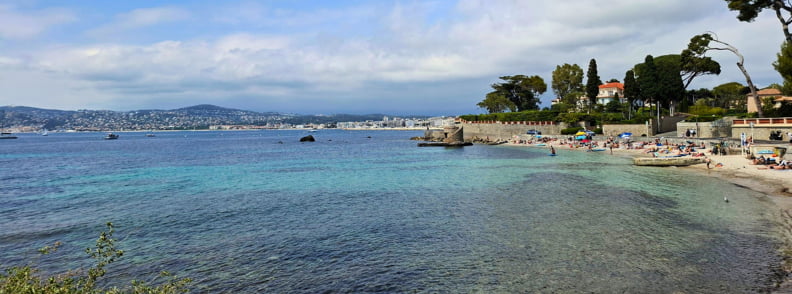
Beaches Near Posidonia Antibes and Cap d’Antibes Coves
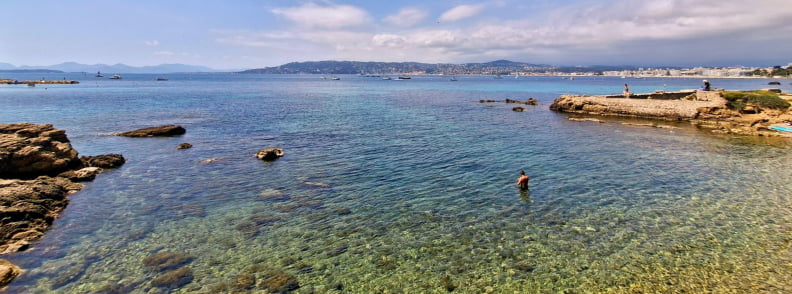
The beaches near Posidonia Antibes look fantastic. They are narrow, but the water stays shallow far from the shore in some places, which makes them practical for families when the sea is calm.
In the middle of spring, people were already swimming. The shallow water warmed enough for locals and visitors to get in, which tells you how appealing this coast becomes once the weather turns.
Plage de la Garoupe is the classic family-friendly beach in this area. It provides easier beach access than the rockier parts of Cap d’Antibes and links naturally with the Garoupe plateau, lighthouse, and chapel.
Plage du Port Mallet is another nearby coastal stop to consider. Use it for a shorter beach pause if your day already includes Posidonia Antibes and you want water time close to the museum area.
Plage des Ondes has that small Cap d’Antibes look people come for, with clear water, a compact shoreline, and a view that suits a slower beach stop.
Billionaire’s Bay or Baie des Milliardaires belongs to the wilder side of Cap d’Antibes. Travel creators always say it’s a hidden gem, but after so many shared it, the small bay has become quite well-known and popular even among tourists. It’s still beautiful, so you can add it to a longer route if your group can handle more walking and a less convenient beach setup.
Cap d’Antibes coves reward people who travel light. Water shoes, a small towel, sun protection, and enough drinking water make the rocky coast much easier.
For Cap d’Antibes snorkeling, choose calm conditions and clear water. The museum’s marine displays give helpful context before you see the shore, rocks, and fish outside.
For families visiting Antibes-Juan-les-Pins, the best beach plan after Posidonia Museum is short and flexible. Aim for one beach, stay as long as the children enjoy it, then leave before everyone melts down in the sun.
Visit Antibes Local Tip: Bring water shoes for the beaches and coves near Posidonia. The shallow sea is lovely, but beyond the beach clubs, the French Riviera coastline is known for its rocks, edges, and awkward footing.
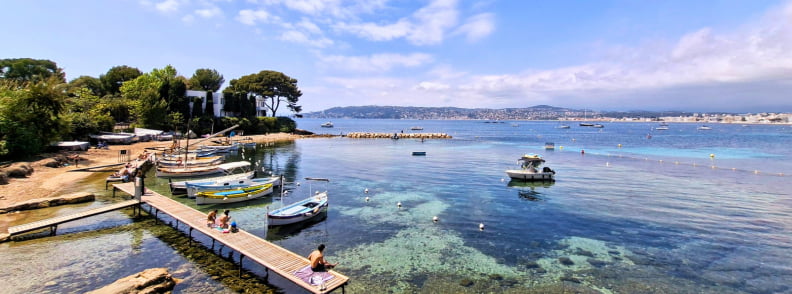
Port de l’Olivette, Petit Port la Valette, and Photo Stops
Port de l’Olivette was our easiest coastal add-on after Posidonia. We walked there with our toddler in the stroller, and we enjoyed sea views, boats, and a quiet local scene without needing a full hike.
The small port offers a Cap d’Antibes view that photographs well without effort. Boats, stone edges, clear water, pines, and the curve of the coast make it one of the best Instagram spots Cap d’Antibes sea views if you like softer local details.
Petit Port la Valette Cap d’Antibes sits by Plage des Ondes. Add it to your walk if you continue around the coast and are looking for a small harbour with beach views nearby.
Plage des Ondes and Petit Port la Valette make a good photo stop together. You can capture the shallow water, the small coastal structures, the boats, and the Cap d’Antibes rocky coast in one slow pause.
This part of the cape suits travelers who prefer small scenes over big attractions. It gives you a few Antibes hidden gems that rarely make it to international travel guides and that don’t need much explanation once you stand there with the sea in front of you.
For the best photos, use the coastline as a sequence. Start with the Graillon Tower view, add Port de l’Olivette, then continue to Plage des Ondes or Garoupe if time and parking allow it.
Visit Antibes Local Tip: Take the stroller on the sidewalk toward Port de l’Olivette if the full coastal path sounds too ambitious. It gave us a pretty Cap d’Antibes moment with our toddler and kept the day simple.
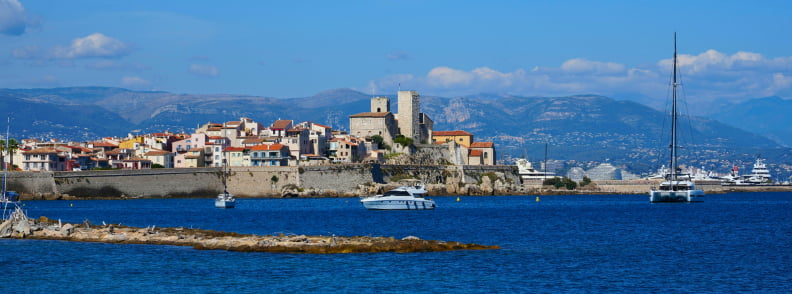
Antibes Old Town or Juan-les-Pins After Posidonia
Antibes Old Town is a better follow-up if you want cafés, restaurants, markets, and streets after exploring the coast. It lets you discover the local town life after the quieter Cap d’Antibes nature setting.
Juan-les-Pins is a better follow-up if you want beach time, summer energy, and an easier seaside pause. It’s appreciated by families who still have swimming or sand in mind after Posidonia Espace Mer et Littoral.
For things to do in Antibes after Posidonia, choose one clear direction. Antibes Old Town awaits with culture and food, while Juan-les-Pins is beckonig you with beach relaxation and a lighter end to the day.
If you’re planning Juan-les-Pins to Cap d’Antibes, Posidonia Museum can sit in the middle of a slower coastal day. Start your itinerary by the sea, visit the museum, then finish with a walk, beach, or simple meal.
For best things to see in Antibes beyond Old Town, Cap d’Antibes should be on the list. Posidonia, Garoupe, Villa Eilenroc, Port de l’Olivette, Plage des Ondes, and the coastal path show a very different side of Antibes.
For Antibes outdoor activities, Posidonia is an easy starting point. From there, you can choose walking, kayaking, snorkeling, beach time, viewpoints, or a short coastal photo route.
Antibes Safety Tip: If you visit in summer, protect yourself in the middle of the day. Use the museum, shade, lunch, or a rest break when the heat rises, then return to the coast later.
Posidonia, Natura 2000, and Mediterranean Conservation
Posidonia Antibes uses a small museum visit to explain a much bigger coastal story. The Mediterranean Sea around Cap d’Antibes has protected habitats, shallow coves, rocky seabeds, Posidonia meadows, and marine life that can look invisible from the beach.
The museum helped me see the coast differently afterward. After the first room, the aquarium, the panels about waste, and the outdoor path, the water below Batterie du Graillon looked less like a postcard and more like a living place with rules, pressure, and limits.
For travelers and expats, this is the real value of Posidonia Antibes as an eco tourism activity. It gives simple context before a beach day, a kayak outing, a snorkeling trip, or a walk along the Cap d’Antibes coast.
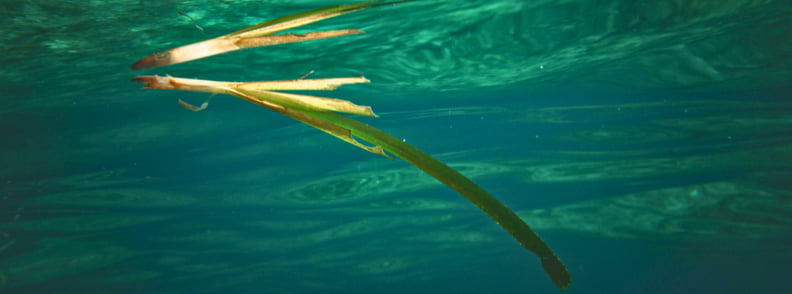
What Posidonia Seagrass Is and Why It Gives the Museum Its Name
Posidonia seagrass is a protected Mediterranean flowering plant that grows underwater. Also known as Neptune grass or Mediterranean tapeweed, it has roots, rhizomes, leaves, flowers, and fruits, so it belongs in a different category from seaweed.
Posidonia Oceanica forms underwater meadows across parts of the Mediterranean. These Posidonia meadows shelter small fish, young marine species, crustaceans, molluscs, and many creatures that need calm, structured habitats.
The Antibes Posidonia museum explains why these meadows deserve attention. Posidonia seagrass helps produce oxygen, store carbon, stabilize the seabed, soften wave action, and protect the shoreline from erosion.
That last point makes the subject easy to understand on Cap d’Antibes. When you stand by shallow beaches and rocky coves near Posidonia, you can see how closely the land and sea shape each other.
The Mediterranean habitat exhibition explains this with touch, images, and interactive games. Children can shake the model seagrass and trigger fish on the projection screen, while adults can read the panels about the ecosystem behind that simple play.
Discovering Posidonia meadows Antibes further can be done through snorkeling. During a guided outing, a Posidonia meadow snorkeling Mediterranean route can show how much life hides close to shore when the habitat stays protected.
For beach visitors, the lesson is simple. What grows under the surface supports the clear water, the fish, the shoreline, and the whole coastal scene people travel to enjoy.
Posidonia Family Travel Tip: Point out the Posidonia displays before a beach stop. Children understand the sea better when they’ve already seen why the plants below the surface shelter fish.
Why Cap d’Antibes Marine Area Has Natura 2000 Protection
Natura 2000 Antibes places the Cap d’Antibes coast inside a wider European conservation frame. The goal is to protect habitats and species while still allowing people to visit, swim, sail, paddle, and enjoy the coast responsibly.
The marine area around Cap d’Antibes has several fragile habitat types. Posidonia meadows, rocky seabeds, sandy bottoms, shallow coastal zones, and deeper Mediterranean habitats all support different forms of marine biodiversity.
This is why Posidonia Antibes at Batterie du Graillon is necessary. The museum sits above the same coastline it explains, so the displays connect directly with the water, rocks, plants, and coves outside.
The Conservatoire du Littoral Antibes places the site inside a wider French coastal protection effort, with the Batterie du Graillon serving a new purpose after its military past.
For visitors, Natura 2000 site FR9301573 sounds administrative at first. Posidonia makes it easier to understand through fish, turtles, seagrass, waste, anchoring, and the visible coastline below the museum.
For expats living near the Riviera, this added context changes daily habits. Where boats anchor, how people snorkel, what swimmers touch, and what families leave behind after a beach day all affect the same marine environment.
French Riviera eco tourism should start with basic respect. Visit, swim, paddle, walk, and picnic, then leave the coast cleaner, quieter, and healthier than you found it.
Sea Turtles and Marine Life at Posidonia Antibes
Sea turtles appear throughout the Posidonia Antibes marine biodiversity visit. Inside the interactive room, displays introduce protected species found along French coasts, including the loggerhead turtle, green turtle, and leatherback turtle.
The turtle panels make species conservation easier for children to grasp. Matching shell pieces to the right species turns marine education Antibes into a simple game with a useful message behind it.
The exhibition also introduces larger Mediterranean marine life. Projections show whales, dolphins, rays, turtles, and a blue shark moving through the room, which gave our toddler one of his favourite moments of the visit.
That visual approach helps adults too. The museum links Antibes marine life with habitats, depth zones, seabeds, waste, and human activity, instead of presenting animals as isolated attractions.
The outdoor path also passes by the building of a marine life rescue center. When we visited, the center for sea turtle rescue Antibes looked partly taken over by surrounding vegetation, so I’m unsure if its actity is seasonal or if it stopped.
Posidonia Espace Mer et Littoral teaches visitors how Antibes sea life depends on protected habitats, cleaner beaches, responsible boating, and respectful behaviour in the water.
Posidonia Family Visit Tip: Use the turtle displays as a conversation starter with children. They can understand protection faster through one animal than through a long explanation about policy.
Responsible Visitor Rules for the Cap d’Antibes Coast
Responsible tourism Antibes starts before you reach the water. Bring a reusable bottle, pack your picnic well, carry your rubbish out, and treat the area like a shared coastal space.
The waste displays at Posidonia Antibes make this point clearly. They show how rubbish travels from land to sea through wind, rain, rivers, drains, careless beach habits, and poor disposal.
Small objects create long coastal damage. Cigarette ends, fishing lines, plastic packaging, cans, masks, and glass can stay in the marine environment long after the visitor has gone home.
The anchoring panels add another useful lesson. Boats can damage Posidonia seagrass Mediterranean habitats when anchors tear through underwater meadows, so sandy anchoring areas and seabed guidance tools have a real purpose.
Snorkeling also needs restraint. Watch fish, rocks, and seagrass from a respectful distance, keep fins away from the seabed, and let marine life move around you.
Kayaking requires care as well. Keep your distance from swimmers, rocks, birds, and sensitive shorelines, especially in coves where space can shrink quickly.
On the Posidonia botanical path, respect the land side of the site too. Stay close to children, leave plants alone, and remember that some Mediterranean flora can be toxic when touched or tasted.
Family Travel Tip: Bring snacks, water, and a bag for rubbish to turn your visit into a lesson children can copy at the next beach.
Posidonia Antibes can reset local habits. The coast becomes part of everyday life when you live nearby, and everyday behaviour shapes how much of the Riviera stays healthy.
Responsible Tourism Tip: Carry a small rubbish bag in your beach or stroller kit. It weighs almost nothing, and it makes responsible travel on the Cap d’Antibes coast much easier.
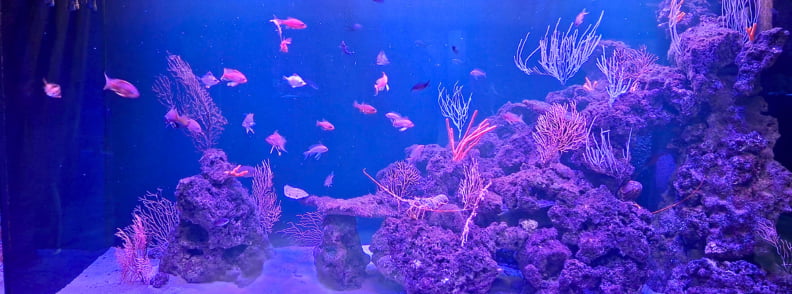
Is Posidonia Antibes Worth Visiting?
Yes, Posidonia Antibes is worth visiting, especially with children, curious adults, locals, and expats who want a calm marine-themed outing on Cap d’Antibes. I strongly recommend it because the visit includes sea life, local history, a small aquarium, a VR dive, shaded paths, and coastal views in an easy half-day plan.
My Posidonia Antibes review comes from a spring family visit with Mathieu and our toddler. I expected a small museum outing, but the mix of hands-on displays, fish, pine grove, and coastline made it one of the easiest Antibes family activities we’ve done.
Treat Posidonia Espace Mer et Littoral as a compact Cap d’Antibes nature visit. It has enough inside for a paid attraction, and enough around it to turn the day into a beach, stroller walk, picnic, or coastal viewpoint plan.
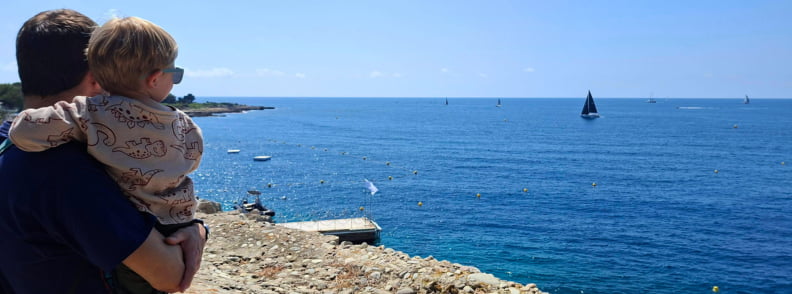
Visit Posidonia Antibes if you want a calm family outing
Go to Posidonia Antibes if you:
- Travel with young children. The museum has a small scale, interactive displays, a calm aquarium, and outdoor space, which makes it easier than many larger family attractions on the Riviera.
- Want things to do in Antibes with kids beyond the beach. Posidonia welcomes children with fish, projections, textures, insects, and sea views, while parents get enough history and marine education to stay interested.
- Want an Antibes family day out with a soft rhythm. You can visit the museum, pause in the pine grove, bring a picnic, then add Port de l’Olivette, Garoupe, or a short coastal walk.
- Live nearby and want a local expat guide idea for a weekend. Posidonia suits repeat visits because the museum, botanical path, kayak, snorkeling, and nearby beaches can create a different day each time.
- Like Antibes nature activities. The visit connects indoor displays with the Cap d’Antibes coast, so the sea outside has stronger meaning after you’ve learned about Posidonia meadows, marine waste, and rocky habitats.
- Want an Antibes eco visit with children. The museum explains marine biodiversity in a way that young visitors can touch, watch, and remember.
- Want best outdoor activities Cap d’Antibes options with backup shade. Posidonia gives you indoor rooms, outdoor pines, viewpoints, and nearby coast, which helps when heat, wind, or child energy changes the day.
- Enjoy small places with a clear local identity. Posidonia has the old Batterie du Graillon, the Cap d’Antibes coast, marine education, and a family-friendly pace.
Choose a shorter Posidonia visit if your group wants a big aquarium
Choose a shorter Posisonia visit if:
- You’re expecting a large Antibes aquarium. Posidonia has a small Mediterranean aquarium, and its strength comes from proximity, calm design, and the wider museum setting.
- Your main goal is a full indoor museum day. The visit suits a compact plan, especially when paired with the pine grove, the tower, Port de l’Olivette, or the beach.
- Your group focuses only on the ticket price. Posidonia prices make the most sense when you use the full setting, with the museum, VR dive, views, shade, and coast around it.
- Your children want only beach time. In this case, visit the aquarium and first room, then move outside before patience runs out.
- Stairs create limits for your group. The historic tower adds a strong viewpoint, but the old building has stairs, so some visitors will prefer the main museum rooms and outdoor areas.
- Parking already ate into your day. The small nearby parking can fill fast, even in spring, so a flexible plan helps the outing stay pleasant.
Antibes Posidonia museum how long to visit: I’d plan 45 minutes for a quick stop, 90 minutes for a balanced visit, and half a day with children. Add extra time for the pine grove, picnic, VR dive, or a short coastal walk.
Posidonia vs Marineland, Musée Picasso, a beach day, or the coastal path
Posidonia and Marineland belonged to very different ideas of marine education. Marineland gave Antibes a major marine park for decades, while Posidonia offersvisitors a smaller, quieter way to learn about Mediterranean habitats, coastal protection, and local marine life.
I visited Marineland Antibea before it closed, when I was pregnant with my son. I value the educational side it had, but I also understand the discomfort around displaying captive marine mammals for entertainment.
So my view on Marineland is mixed. I dislike the capturing of animals for display and/or shows and/or breeding in captivity, but I also find the aftermath difficult when animals born or kept in care face uncertain futures and reduced stimulation.
Posidonia gives families a gentler Antibes marine museum option now. It cannot replace Marineland’s scale, but it offers a better fit for families who are looking to learn about marine life and local conservation without a full theme-park day.
Compared with Musée Picasso, Posidonia suits children better. For adults, the experiences are completely different, though. Musée Picasso is richer for art, culture, and Antibes history, while Posidonia has fish, projections, touch activities, and outdoor space that the kids will enjoy.
Compared with a beach day, Posidonia Antibes adds purpose to your outing. You can still swim or sit by the water nearby, but the museum helps children understand what lives beneath that clear French Riviera sea.
Compared with the Cap d’Antibes coastal path, Posidonia is easier with young children. The full coastal walk needs shoes, stamina, and weather awareness, while the museum gives a shorter and calmer entry into the same coastal landscape.
For family friendly museums near Cannes, Posidonia Antibes belongs on your shortlist. It’s small, practical, sea-focused, and easy to combine with Antibes beaches, Port de l’Olivette, Garoupe, or a short Cap d’Antibes walk.
If you’re interested in the best museums in Antibes Juan les Pins, Posidonia Espace Mer et Littoral fills a gap. It gives the area a marine and nature-focused stop, while other Antibes attractions cover art, old town history, beaches, or coastal scenery.
Practical Checklist Before You Visit Posidonia Antibes
The best Posidonia Antibes visit starts before you reach Cap d’Antibes. The museum itself is easy to explore, but the day improves fast when you pack for the coast, the pine grove, children, parking, and possible beach time.
Think of Posidonia as a family day out with indoor and outdoor parts. You move between museum rooms, the aquarium, the tower, the botanical path, shaded benches, sea views, and nearby beaches, so one tiny handbag rarely covers the whole visit.
This checklist helps travelers and expats plan the visit to Posidonia Antibes. It covers what to bring, what to book, and what to confirm before building your Cap d’Antibes day around the museum, kayak, snorkeling, or coastal path.
What to bring to Posidonia Antibes
- Water for every person in your group. The museum has indoor areas, but the Cap d’Antibes coastal nature trail, the pine grove, the viewpoint, and nearby beaches all make water essential, even in spring.
- A picnic if you visit with children. The café had limited food when we went, while the Posidonia Antibes picnic area in the pine grove is a much better family pause.
- Baby or toddler food if your child has routines. We brought baby food and yogurt for our toddler, and that saved the visit while Mathieu fed him during my VR dive.
- Snacks for the gap between museum time and coast time. Posidonia Antibes family day out planning needs backup food, especially if you add Port de l’Olivette, Antibes beaches, or a short Cap d’Antibes walk afterward.
- Sun protection even when the museum visit seems short. The Riviera sun hits hard around the tower, the pine grove openings, the coastal road, and the beaches near Posidonia.
- Light layer for sea breeze. Cap d’Antibes can switch from warm sun to cooler wind quickly, especially near the water and after a shaded museum visit.
- Comfortable shoes if you plan the Cap d’Antibes coastal path. The museum itself has indoor floors and stairs, while the Cap d’Antibes hike and nearby rocky coast need better grip.
- Water shoes if you add beach time. The shallow water near Posidonia can suit families, but Antibes beaches and Cap d’Antibes coves often involve stones, rocks, and uneven footing.
- Swimwear and towels if you plan Cap d’Antibes snorkeling. This applies even when snorkeling fits later in the day, because the sea can look too tempting once you reach the coast.
- Dry bag or waterproof pouch if you plan Cap d’Antibes kayak. Phones, keys, sunglasses, and wallets need protection once the day moves from museum visit to sea activity.
- Stroller for the easier coastal stretches if you travel with a toddler. We used ours toward Port de l’Olivette, which gave us a calm walk after Posidonia without taking on the full coastal trail.
- Baby carrier if your child still needs/accepts carrying. The historic tower has stairs, and some outdoor areas suit carrying better than pushing a stroller.
- Small rubbish bag. Posidonia teaches marine protection clearly, and carrying your picnic waste out turns that lesson into a simple family habit.
- Patience for parking. Posidonia Antibes visitor tips and advice start with this simple truth: arrive early, because the small nearby parking areas can fill even in low season.
- A flexible plan for rainy day Antibes situations. Posidonia Antibes museum for rainy day planning makes sense because the aquarium, VR dive, history rooms, and interactive displays give you an indoor option with outdoor parts when the weather clears.
Visit Antibes Local tip: Pack for the museum and the coast, not only the ticketed visit. Posidonia Antibes becomes much better when you have water, food, sun protection, and shoes for whatever the day turns into.
What to book in advance at Posidonia Antibes
- Book or confirm Posidonia Antibes tickets before you go during busy periods. School holidays, warm weekends, and summer mornings can bring families, beach-goers, and activity visitors to the same small Cap d’Antibes area.
- Check Posidonia Antibes ticket price and booking details on the Posidonia official site. Prices, opening hours, reduced rates, family tickets, VR dive access, and activity schedules can change.
- Book the VR dive if your group has older children, teens, or adults who want the full museum experience. I enjoyed the Posidonia Antibes virtual dive far more than expected, and the English-language option made it easy to follow.
- Book guided kayak tour Cap d’Antibes before planning the rest of your day. Sea activities depend on season, weather, sea conditions, available guides, and group size. Keep in mind that kayaking starts from age 8, with children aged 8 to 12 accompanied by an adult on the water, and teens aged 13 to 17 accompanied by an adult at the water’s edge.
- Book snorkeling guided tour Cap d’Antibes in advance as well. This activity also starts from age 8, with children aged 8 to 12 accompanied by an adult in the water, and teens aged 13 to 17 accompanied by an adult at the water’s edge.
- Ask about language availability for guided activities. Posidonia suits international travelers and expats, but kayak, snorkeling, nature walks, and workshops may follow the day’s guide team and audience.
- Ask about kids workshop Antibes options if you visit Posidonia with primary-school children. The interactive museum for children Antibes angle gets stronger when activities, insect panels, habitat games, or school-style learning sessions fit your visit.
- Check Posidonia Antibes group booking information if you come with several families. Group visits need better timing, especially with parking, toilets, lunch, and child supervision. The perk is that the tickets are cheaper, only € 10 for adults.
Antibes Family Travel Tip: Keep sea activities as a bonus on a first family visit. With young children, the museum, aquarium, pine grove, and coast already make a full Posidonia Antibes family day out.
Posidonia Antibes FAQ
These Posidonia Antibes FAQs help you plan the visit with fewer surprises. Travelers, locals, and expats heading to Posidonia Espace Mer et Littoral can check the essentials here: opening hours, ticket prices, parking, public transport, wheelchair access, picnic options, kid-friendly activities, kayak, snorkeling, and the Cap d’Antibes coastal path.
I wrote these answers with family travel in mind, based on my experience. After visiting Batterie du Graillon with my husband and our toddler, I’ve focused on the details that shape the day: when to arrive, how long to stay, what to bring, what suits children, and how to combine Posidonia Antibes with nearby beaches, Port de l’Olivette, Garoupe, or the Tirepoil path.
What is Posidonia Espace Mer et Littoral in Antibes?
Posidonia Antibes is a small marine museum and coastal nature site inside the Batterie du Graillon on Cap d’Antibes. Its full name is Posidonia Espace Mer et Littoral, which tells you the main idea: sea, coastline, Mediterranean habitats, and local heritage in one compact visit.
The visit includes interactive marine displays, a small Mediterranean aquarium, local history rooms, a VR dive, the Graillon tower view, a shaded pine grove, and a botanical path. In season, Posidonia also offers guided sea activities such as kayaking and snorkeling from the coast below the museum.
It suits families, travelers, and expats who want a calm, educational Cap d’Antibes outing. I strongly recommend it with young children because the scale stays manageable, the first room has hands-on activities, and the outdoor areas give everyone space to reset.
Is Posidonia Antibes worth visiting?
Yes, Posidonia Antibes is worth visiting, especially as a half-day family outing on Cap d’Antibes. It gives you a small museum, marine life, local history, sea views, shade, and nearby coastal walks in one practical plan.
I went with my husband and our toddler in spring, during low season, and it was one of the easiest Antibes family activities we’ve done. Our toddler loved the fish under the bridge, the projections, the hands-on room, and the pine grove outside.
Go for the setting and the rhythm, not for a huge aquarium. Posidonia is small, but that size makes it easier with young children than larger, louder, more intense attractions.
Is Posidonia Antibes good for kids?
Yes, Posidonia Antibes is good for kids, especially toddlers, primary-school children, and curious older children. The first room has touch-friendly displays, projected marine life, simple games, and visual explanations that children can follow quickly.
The aquarium area suits young children well. The fish swim close to the small bridge, and the blue-lit room creates a calm viewing space.
Older children get more from the VR dive, marine ecology, turtle displays, insects on the botanical path, and the Batterie du Graillon history. Sea activities such as kayak and snorkeling start from age 8, with adult supervision rules depending on age and activity.
What can you see inside Posidonia Antibes?
Inside Posidonia Antibes, you see interactive displays about Mediterranean habitats, a small aquarium, sea-life projections, history panels, a VR dive, and access to the Graillon tower. The first room is the most playful, with seagrass you shake to trigger fish on a screen, tactile seabed displays, and marine-life quizzes.
The aquarium is small, but the fish-viewing bridge makes it memorable. Our toddler sang Les petits poissons dans l’eau to the fish below, which became one of the clearest family moments of the visit.
You also see how the Batterie du Graillon protected the coast. The history panels explain the strategic role of Golfe Juan, the coastal battery, and the military past of this site before it became a marine education space.
What are the opening hours of Posidonia Antibes?
Posidonia Antibes opening hours change by season. Summer opening schedule is from Tuesday to Sunday, 9 AM to 6 PM, and off-season opening programme is from Tuesday to Saturday, 9 AM to 5 PM.
Plan your visit early in the day. Parking was already difficult when we visited in spring, before the main summer crowds arrived.
Morning also suits families better. Children usually have more energy, the museum feels calmer, and you still have time for the pine grove, Port de l’Olivette, Garoupe, or a beach stop afterward.
How much does Posidonia Antibes cost to visit?
Posidonia Antibes prices are as follows: adult entry at €12, reduced entry at €6, children under 6 free, a family ticket at €24, and the VR dive at €3.
The ticket gives most value when you use the full site. Visit the interactive rooms, aquarium, history displays, tower, pine grove, botanical path, and nearby coast rather than treating Posidonia as a quick indoor stop.
If you travel with children, the family ticket makes the visit easier to justify. Bring a picnic and add the shaded pine grove or a beach stop to turn it into a fuller Cap d’Antibes family day out.
Where is Posidonia Antibes located?
Posidonia Antibes is located at Batterie du Graillon on Cap d’Antibes. Use Posidonia Espace Mer et Littoral or Batterie du Graillon in your map app, then confirm the route before leaving.
The museum sits close to the coast, Port de l’Olivette, Garoupe, Plage des Ondes, Villa Eilenroc, and the Cap d’Antibes walking routes. This location makes it easy to pair with a short coastal walk, beach time, or a slower half-day around the cape.
It also sits in the wider area near Hotel du Cap Eden Roc. That landmark helps when planning the route around Cap d’Antibes, especially if you want nearby viewpoints or beaches after the museum.
How do you get to Posidonia Antibes without a car?
To reach Posidonia Antibes by public transport, check the current Envibus timetable before leaving. Previous planning notes point to Envibus Route 2 toward the Posidonia stop, with another local route also mentioned as a possible option.
Confirm both the arrival and return times. Cap d’Antibes is easier when your return bus, walking distance, and backup route are clear from the start.
Public transport suits travelers staying in Antibes or Juan-les-Pins better than rushed day-trippers. If you travel from Nice or Cannes, build extra time into the day for transfers, walking, and the coastal setting.
Is there parking at Posidonia Cap d’Antibes?
Yes, there is parking near Posidonia Antibes, but it’s limited. We went by car in spring, during low season, and parking was already difficult because beach-goers had taken many nearby spaces.
The small parking near Posidonia fills fast. The accessible spaces near the coast were the only spaces open when we arrived, and the accessible parking behind the gate had a closed gate with an intercom.
Arrive early if you drive. This is the most important practical tip for Posidonia Antibes, especially once spring beach weather starts.
How long to visit Antibes Posidonia Museum?
Plan 45 minutes for a quick Posidonia Antibes visit. That gives enough time for the interactive first room, the small aquarium, and a brief look at the history displays.
Plan 90 minutes for a relaxed museum visit. This gives children time to watch the fish, use the hands-on displays, climb the tower if your group manages stairs, and pause outside.
Plan half a day for the best family visit. Add the VR dive, the pine grove, a picnic, Port de l’Olivette, Garoupe, or a nearby beach.
Can you snorkel near Posidonia Antibes?
Yes, Posidonia Antibes offers guided snorkeling, called randonnée subaquatique in French, during the activity season. Confirm dates, times, prices, equipment, and sea conditions on the official site before planning the day around it.
Snorkeling starts from age 8. Children aged 8 to 12 need an adult in the water with them, while teens aged 13 to 17 need an adult at the water’s edge.
This activity suits confident swimmers. Cap d’Antibes snorkeling involves real sea conditions, rocks, changing visibility, and marine habitats that deserve careful movement.
Can you kayak from Posidonia Antibes?
Yes, Posidonia Antibes offers guided kayak outings during the activity season. The activity links the museum’s marine story with the rocky Cap d’Antibes coast below Batterie du Graillon.
Kayak starts from age 8. Children aged 8 to 12 need an adult on the water with them, while teens aged 13 to 17 need an adult at the water’s edge.
This is the activity I’d most want to return for when our toddler is older. It turns Posidonia from a calm museum day into a direct sea-learning experience.
Is Posidonia Antibes wheelchair accessible?
Posidonia Antibes is partly accessible for wheelchair users. The first part of the museum offers the most realistic visit, with clean accessible toilets and an entrance route that may require a small detour.
The historic Batterie du Graillon tower has stairs and no lift. Wheelchair users should plan for the main museum areas rather than the full tower visit.
The pine grove and lower outdoor areas also have limits. During our visit, the accessible parking behind the gate had a closed gate with an intercom, so call ahead if wheelchair access is central to your plan.
What is the best time to visit Posidonia Antibes?
The best time to visit Posidonia Antibes is early in the day. Morning gives you the best chance of parking, cooler temperatures, calmer rooms, and enough time to add the pine grove or coast afterward.
Spring is a great time to go, with one warning. We visited in low season and the nearby parking already felt tight because beach weather had started.
In summer, plan around heat and beach traffic. Visit early, or pair a morning swim with the museum during the warmer part of the day when shade, indoor rooms, and sea breeze help families.
Can you picnic at Posidonia Antibes?
Yes, the pine grove makes Posidonia Antibes a good place for a picnic-style pause. We found the café limited, with small sandwiches and pain bagnat, so bringing food was the better choice with a toddler.
The shaded area outside gives families space to slow down. There are benches, paths, sea air, and room for children to move after the museum rooms.
Pack food, water, and a small rubbish bag. The museum teaches marine protection clearly, so leaving the site clean should be part of the visit.
What is posidonia seagrass and why is it important?
Posidonia seagrass is a protected Mediterranean flowering plant that grows underwater. It has roots, rhizomes, leaves, flowers, and fruits, which makes it different from seaweed.
Posidonia meadows shelter marine life and protect the coast. They support young fish, crustaceans, molluscs, and many small species, while also helping stabilize the seabed and soften wave action.
At Posidonia Antibes, children can learn this through play. The first room lets them shake model seagrass and watch fish appear on a projection, which turns a scientific idea into something easy to grasp.
What can you do near Posidonia Antibes?
Near Posidonia Antibes, you can visit Port de l’Olivette, Garoupe, Villa Eilenroc, Plage des Ondes, Plage du Port Mallet, and the Cap d’Antibes coastal path. The area gives you beaches, small ports, viewpoints, gardens, and rocky coast within a compact route.
Port de l’Olivette was our easiest add-on with a stroller. We walked there with our toddler after Posidonia, and it gave us boats, sea views, and a calm local stop.
For a fuller day, add Garoupe or Villa Eilenroc. Check opening times for Villa Eilenroc before planning around it, because access can change.
Can you combine Posidonia Antibes with the Tirepoil path?
Yes, Posidonia Antibes pairs well with the Tirepoil path if your group has the energy for a longer coastal walk. The museum explains the marine habitats and coastal history, then the path shows you the rocky Cap d’Antibes shoreline outside.
The full Tirepoil path usually takes about 2 hours and covers roughly 5 km. It suits walkers with proper shoes, water, and good weather.
With toddlers, choose a shorter coastal walk instead. We walked toward Port de l’Olivette with the stroller, which gave us a beautiful Cap d’Antibes moment without committing to the full rocky route.
Is Posidonia Antibes a good rainy-day activity?
Yes, Posidonia Antibes can help on a rainy day in Antibes, especially with children. The interactive room, aquarium, history displays, and VR dive give families an indoor plan when the beach loses appeal.
The visit still has outdoor parts. The tower, pine grove, and coastal areas are best during dry breaks, so bring a light layer and check the weather before adding extra walking.
For mixed weather, Posidonia is a smart choice. You can start indoors, then use the pine grove or coast if the sky clears.
What should you bring to Posidonia Antibes?
Bring water, snacks, sun protection, comfortable shoes, and a picnic if you visit with children. The café had limited choice when we went, while the pine grove made a better lunch stop.
Bring a stroller for easy coastal stretches and a baby carrier if your child still needs carrying. The tower stairs and some outdoor areas need flexibility.
Bring swimwear, towels, and water shoes if you plan to add the beach, snorkeling, or kayak. Cap d’Antibes has shallow family-friendly water in places, but rocks and uneven edges make water shoes useful.
Final Thoughts on Visiting Posidonia Antibes
Posidonia Antibes deserves a place in your Cap d’Antibes plans if you want a calm, smart, family-friendly coastal outing. The Posidonia Espace Mer et Littoral combines the old Batterie du Graillon, a small Mediterranean aquarium, a VR dive, shaded pine paths, sea views, and a useful introduction to the marine life around Antibes.
I’ll go again when my son is older, and I recommend it strongly to travelers, locals, and expats. Our toddler enjoyed it because the visit stayed short, visual, and varied. We enjoyed it because the setting combined history and nature, and a reason to slow down by the coast instead of treating Cap d’Antibes as another pretty sea view.
Plan your visit to Posidonia Antibes as a half-day rather than a quick museum stop. Arrive early for parking, visit the interactive rooms, take in the Graillon Tower view if stairs suit your group, bring a picnic for the pine grove, then add Port de l’Olivette, Garoupe, Plage des Ondes, or a short stretch of the Cap d’Antibes coastal path.
The Travel Bunny’s honest verdict: Posidonia Antibes is small, and that’s part of its strength. It will never replace a huge aquarium like Marineland Antibes had or a full beach day, but it gives families a gentler way to understand the French Riviera sea, the protected Posidonia meadows, and the coastline below one of Antibes’ old defensive sites.
Want more honest, local PACA picks beyond the obvious tourist stops? Get my Provence Côte d’Azur Local Secrets Guide and keep my saved map in your pocket for your next Riviera outing.
About the Author

Hi, I’m Mirela Letailleur, founder of The Travel Bunny, an award-winning travel blog focused on practical European travel, local experiences, and budget-smart trip planning. I live in the South of France with my family, and I write about the French Riviera from real visits, local research, and everyday life between Provence, the Côte d’Azur, and the Mediterranean coast.
I visited Posidonia Antibes at Espace Mer et Littoral with my husband and our toddler, then built this guide around what families, travelers, locals, and expats actually need to know before going. From parking near Batterie du Graillon and visiting the Posidonia museum with kids to pairing it with the Cap d’Antibes coastal path, beaches, and Port de l’Olivette, I share the details I wish every Riviera guide gave clearly.
After you visit Posidonia Antibes Espace Mer et Littoral, check out these Côte d’Azur local guides
Visit Saint-Cézaire Cave / Grotte de Saint-Cézaire. Your Full-Day Guide to the Domain
Train des Pignes à Vapeur 2026: Best Steam Train Journey in France
Menton Travel Guide: A Sailboat Journey on the French Riviera