

Cotignac, France, was where our weekend finally started going right. After a frustrating stop at Sillans-la-Cascade, where the camper parking was blocked and a steep turn looked like a risky choice in our 7-meter vehicle, we drove on through the Var. We reached Cotignac late on a windy October afternoon, still looking for somewhere to park. Above the tiled roofs, an enormous cliff caught the last of the sunlight. After Sillans, finding a village that seemed welcoming for our camper was already a promising start. So we stayed to visit Cotignac.
Cotignac is in Provence Verte, between Draguignan and the Verdon region. Around 2,200 people live beneath Le Rocher, a tufa cliff stretching roughly 400 meters across and rising 80 meters above the village. The Cassole River once flowed over this rock, creating the formations and cavities that later became Cotignac’s troglodyte dwellings. Medieval towers overlook the village from above, while narrow streets lead down toward cafés, shops, and the main square. It’s an unusual setting, even for Provene.
Visit Cotignac Guide
Cotignac has been one of Les Plus Beaux Villages de France since 2022, although the village hasn’t surrendered its everyday life to tourism. On 11 August 2026, Cotignac also received the official Station Classée de Tourisme designation, recognizing its commitment to welcoming visitors and developing tourism services. It has a busy Tuesday market, local producers, restaurants, and lots of things happening outside the usual sightseeing circuit. The annual Fête du Coing, a festival dedicated to quinces, was the reason we ended up spending an October weekend here.
We explored Cotignac as a family, with a toddler, a camper, and no schedule besides meal and nap times. We wandered through the old streets, visited the troglodyte caves, tasted delicious quince liqueur at the festival, and found ourselves dealing with everything from uneven parking to narrow staircases. The caves were worth the climb, although carrying a toddler through them wasn’t always easy. We also found time to appreciate Cotignac beyond its famous cliff, as the festival brought locals and visitors together.
This Cotignac travel guide by The Travel Bunny covers the best things to do in Cotignac France, from exploring the caves and walking around Le Rocher to visiting the sanctuaries of Notre-Dame de Grâces and Saint-Joseph du Bessillon. I’ll explain how to get here, where to park in Cotignac, what to expect when visiting with children, where to eat, and which nearby villages deserve a small detour.
You’ll also find practical advice for visiting for the Fête du Coing, getting to Cotignac by camper, and planning a day trip or a weekend in Provence Verte. I’ll share what we enjoyed, what caught us unprepared, and what I’d do differently.
Disclosure: Some of the links on this page are affiliate links. This means that at no extra cost to you, The Travel Bunny will earn a small commission if you click through and make a purchase. Thank you!
Best Things to Do in Cotignac, France
The best things to do in Cotignac France start with its enormous cliff, although I wouldn’t rush straight to the top. Start by exploring the village at ground level, where old houses lean against the rock, narrow streets disappear behind the main square, and café terraces stretch beneath plane trees. Looking up from the streets, you’ll spot cave openings, terraces cut into the stone, and two towers watching over the rooftops.
We spent a late October weekend exploring Cotignac with our toddler, timing our walks around meals, naps, and the Fête du Coing. This still left us plenty of opportunities to see the village. Spend at least half a day visiting Cotignac’s historic center and caves, or a full day if you want to include a sanctuary, a hearty lunch, and some time with local producers.
Here are the places I’d put on your Cotignac itinerary, with realistic time allowances and a few practical details worth knowing before you set off:
- Explore the Cotignac troglodyte caves. The village’s most unusual attraction takes you inside the soft tufa cliff, through passages and chambers that once sheltered people, animals, and provisions. We climbed the narrow staircases with William in a baby carrier, which was easier than attempting the visit with a stroller. Expect around 90 steps, uneven surfaces, and some tight passages. The self-guided cave visit takes approximately 15 minutes, but I’d allow 30 to 45 minutes including the climb and photographs. Tickets cost €2.50 for adults and visiting is free for children under 10. The caves are open seasonally and close during rain. You’ll find our experience in Sunday Morning Hiking & Visiting Cotignac Troglodyte Caves.
- Admire Cotignac from the Le Rocher viewpoints. You see the cliff from almost everywhere in the center, but looking down from it gives you a much better understanding of the village’s layout. The cave visit includes a rockside balcony overlooking the tiled rooftops, while the summit near the towers offers wider views across Provence Verte. You’ll notice how closely the oldest houses follow the base of the cliff, with vineyards and wooded hills extending beyond the village. Spend 15 to 20 minutes at the viewpoints, without the the climb. I really liked the warm light on the rock when we arrived in late afternoon. There’s more about the views in Photography & Best Viewpoints Cotignac.
- Climb to the Saracen towers. Two old defensive towers, known locally as Tours Sarrasines, rise above Le Rocher. Their name recalls Cotignac’s medieval history, although the surviving structures and their dating have prompted historical debate. Follow the pedestrian route from Place de la Mairie, up the Montée des Escaillons and Chemin des Tours. At the top, an orientation table identifies the surrounding countryside, and the elevated position explains why this site served as a lookout. I’d set aside 30-45 minutes for the uphill walk, views, and return. Access is possible only on foot. You’ll find more in Cotignac Culture & History Highlights.
- Wander on Cours Gambetta. This tree-lined avenue is where Cotignac settles into its everyday routine. Café tables occupy the shade, people stop at shops, and the main square leads into smaller streets with fountains, galleries, and old stone façades. During our visit, festival preparations were already underway, with stalls and equipment appearing ahead of Sunday’s celebrations. We stopped near Bar Le Marigny, where Mathieu noticed a sign advertising hot white wine flavored with quince. Sadly, we were a day early for it. Our first walk through the village appears in Our Saturday Visit to Cotignac.
- Visit the Cotignac Tuesday market. Every Tuesday morning, the center fills with around 80 stalls selling seasonal produce, olives, cheeses, wine, prepared food, clothing, and local crafts. The regular Cotignac market is from 8 AM to 1 PM. Take your time, especially if you want to browse and buy something for a picnic. Arriving early also helps with parking before the market draws more visitors. This weekly market is separate from the annual quince festival we attended. I cover that experience in Market & Village Life During the Fête du Coing.
- Visit the Sanctuary of Notre-Dame de Grâces. On Mont Verdaille, above the village, this Catholic pilgrimage site commemorates an apparition of the Virgin Mary reported in 1519. The sanctuary includes a chapel, religious artwork, and grounds where visitors come to pray or learn about Cotignac’s religious history. Louis XIV visited with his mother, Anne of Austria, in 1660, and the royal connection remains an important part of the sanctuary’s story. You have the choice of driving up or walking 20 minutes uphill from the village. Visiting is free and it will take around 20-30 minutes. Read more in The Sanctuary of Notre-Dame de Grâces.
- Continue to Saint-Joseph du Bessillon. Cotignac has a second major pilgrimage site on the slopes of Mont Bessillon. According to Catholic tradition, Saint Joseph appeared here to a young shepherd named Gaspard Ricard in 1660 and directed him toward a source of water. Today, the site includes a chapel and a monastery associated with a religious community. It’s a separate destination from Notre-Dame de Grâces, so plan 30-45 minutes for the sanctuary visit plus travel time. Visitors should respect the monastery’s quiet atmosphere and check access restrictions during the summer fire-risk season. The history of Cotignac’s religious sites appears in Cotignac Culture & History Highlights.
- Follow the Balade du Rocher. Signs for the Promenade du Rocher lead uphill from Place de la Mairie toward the cliffside passage and troglodyte habitats. This short walk takes you close to the unusual texture of the tufa, with old walls and rock-cut openings showing how residents adapted the cliff for shelter and building materials. It’s closely connected to the paid cave visit, so there’s no need to schedule the two as completely separate attractions. Wear shoes with a good grip, especially after wet weather. Our walk and cave visit are described in Sunday Morning Hiking & Visiting Cotignac Troglodyte Caves.
- Taste products from Cotignac’s local producers. Wine, olive oil, honey, and fruit preserves offer another reason to spend time around the village. Les Vignerons de Cotignac is a useful name to know if you’re interested in local wines. The wider area has vineyards, olive growers, and honey producers, including Les Ruchers du Bessillon. On our weekend, we passed the wine cooperative’s sign while wandering through town, and the Fête du Coing introduced us to to quince liqueur. I’d plan 20 to 40 minutes for browsing and tasting, longer for a prearranged winery visit. Check opening hours before driving out to a producer.
- Experience the Fête du Coing in October. Cotignac’s annual quince festival was the highlight of our weekend. The village streets filled with stalls, food, music, and visitors celebrating a fruit with a surprisingly long local history. We tasted quince wine, followed the market, and watched an equestrian performance during the 2025 edition. The program changes each year. The 2026 celebration takes place on Sunday, 25 October, with an artisan market, quince-paste competition, parade, and concerts. The Fête du Coing 2027 date is still awaiting official confirmation. Plan to spend at least half a day if you’re visiting for the festival, and arrive early enough to find parking outside the busiest streets. Read our festival experience in Market & Village Life During the Fête du Coing and Equestrian Show at the Fête du Coing.
My recommendation for a first visit to Cotignac is to explore the old village, Cours Gambetta, the troglodyte caves, and the viewpoints above Le Rocher. Add Notre-Dame de Grâces if you’re interested in religious history, or make time for local producers if food and wine are closer to your interests.
Cotignac local tip: The caves, cliffside passages, and tower paths involve stairs and uneven ground. If you’re visiting with a toddler, take a baby carrier and leave the stroller for the easier streets around Cours Gambetta. Also, check the current trail notices before attempting longer walks around the sanctuaries and Mont Bessillon. Wildfire-related restrictions can affect access to some routes.

Getting to Cotignac France & Why We Skipped Sillans-la-Cascade
Getting to Cotignac is simple once you know what to expect. The village sits deep in Provence Verte, between Draguignan and the Verdon canyon, surrounded by vineyards, olive groves, and winding country roads. Driving to Cotignac is the best option, since there’s no direct train. Most travelers arrive by car or camper after landing at the nearest airport to Cotignac, Marseille, or Nice, both about two hours away.
The drive is easy and scenic, but if you plan to explore in a camper or van, you’ll want to understand parking restrictions in the smaller Provençal villages along the way. This is where our weekend started to unravel before Cotignac won us back.
Our Camper Start from Bagnols-en-Forêt
We set off from Bagnols-en-Forêt in our 7-metre camper, and we were well stocked after a stop at a commercial zone in Draguignan for groceries and Halloween candy. The plan was simple: visit Sillans-La-Cascade, hike the famous Sillans waterfall trail, spend the night near the village, and continue to Cotignac France the next day.
The drive through Provence was peaceful, and with the sun still high, we felt confident that parking near the falls would be as straightforward. After all, most camper France travel stops in rural areas are easily accessible outside peak season. What we didn’t know was that Sillans-la-Cascade parking would test every bit of patience we had.
Why We Moved On from Sillans-la-Cascade
By late afternoon, the charm of Sillans-la-Cascade had faded behind red and white “no campers” signs. Both Place du 8 Mai 1945 and Parking Cascade were closed to larger vehicles. The only remaining option, Parking du Village, technically allowed campers but came with a hidden obstacle. The easy descent had been blocked with a boulder (!), leaving only a broken stretch of road that dropped at a sharp 90-degree angle. We assessed it, took a deep breath, and turned around. Everything in Sillans-la-Cascade felt designed to keep campers away. After wasting an hour circling, we decided to skip it altogether.
Large vehicles should avoid Sillans-la-Cascade parking. Base instead in Cotignac, which welcomes campers and offers several safe spots outside the village. You can still do the Sillans waterfall hike as a day trip once you’re settled. For those coming from Marseille, Nice, or Aix, aim to reach Cotignac by camper before evening to secure a level space. It’s the smartest move for anyone doing vanlife Provence or planning a slow journey through southern France.
How to fly to Cotignac in 2027
Since publishing this guide, I’ve had quite a few people ask me about flights to Cotignac. Cotignac doesn’t have a commercial airport. You’ll need to fly into Toulon, Marseille, or Nice, then continue by road into Provence Verte. Luckily, all three airports are within a reasonable driving distance, although your choice will depend on where you’re flying from.
Toulon-Hyères Airport (TLN) is the closest passenger airport to Cotignac, 70 km away or around 1 hour and 10 minutes by car. It’s a small airport with a few domestic and European flights, including Paris-Orly and several seasonal routes. If you find a convenient direct flight, this is the shortest transfer. Check the Toulon-Hyères Airport website for available connections.
Marseille Provence Airport (MRS) is 100 km from Cotignac, with a drive of 1 hour and 20 minutes in normal traffic conditions. Located in Marignane, northwest of Marseille, Marseille Airport offers a wider selection of international flights and is often the better option for visitors arriving from outside France. You’ll travel east toward the Var before turning onto smaller roads through Provence Verte.
There’s also good news for American travelers planning a Provence trip in 2027. United Airlines has announced a new daily nonstop service between New York-Newark (EWR) and Marseille Provence (MRS). The first flight is scheduled to leave Newark on 4 June 2027, arriving in Marseille on 5 June. The seasonal connection is planned through October, using an Airbus A321XLR. Marseille Provence Airport has confirmed the route, with tickets already on sale. That’s one less airport connection between New York and a holiday among the villages, vineyards, and markets of inland Provence!
New York to Provence, nonstop? Compare flights from New York to Marseille and start planning your Cotignac getaway!
Nice Côte d’Azur Airport (NCE) is another option, at 118 km from Cotignac or 1 hour and 35 minutes by car without heavy traffic. Nice has an extensive international network, which is useful if you’re visiting the French Riviera and then spending a few days in the Var. The drive takes you west along the A8 before heading inland. Expect more time on the road during summer weekends, when traffic toward and away from the coast gets considerably busier.
I recommend renting a car at the airport, especially if you’re planning to visit nearby villages such as Carcès, Sillans-la-Cascade, or Tourtour. Cotignac doesn’t have a railway station, and reaching the village from any of these airports by public transportation requires careful planning and maybe even a taxi for the final stretch. I think you should compare the total cost of flights and car rental before choosing your airport. A cheaper ticket isn’t much of a bargain if you spend what you saved on transfers.
Cotignac airport tip: If your flight lands late in the evening, check your rental company’s collection hours before booking. Driving through inland Var after dark is manageable, but arriving in an unfamiliar village with narrow streets and limited parking is hardly my favorite way to end a travel day. We had enough parking adventures reaching Cotignac in broad daylight.

First Impressions After Arriving in Cotignac by Camper
The moment we reached Cotignac France, the atmosphere changed completely. After wasting so much time navigating tight turns and closed gates at Sillans, our Provence weekend trip finally felt like it was heading in the right direction. The first glimpse I caught was of the cliffs above the village bathed in the golden light of the afternoon sun, and I understood why it was named one of the Plus Beaux Villages de France in 2022. Arriving in Cotignac by camper van was a relief, a feeling shared by anyone who has ever driven through Provence searching for a proper and level place to park.
Parking in Cotignac
Finding parking in Cotignac with a 7-meter camper took us longer than expected. The village has several parking areas, but some have height restrictions, and others close during local events. After our failed attempt to visit Sillans-la-Cascade, I was in no mood to test another steep village road.
Our first choice was Parking Lauron (634 Lauron), a large gravel parking area near the lower entrance to Cotignac. Unfortunately, it was still closed when we arrived, despite a notice suggesting it would reopen before we arrived. We later learned that the site was being prepared for the Fête du Coing equestrian show. This is a useful reminder that festival preparations sometimes begin well before the event dates.
The parking area near the Cotignac Tourist Office looked promising, with level ground, trees, and a convenient position outside the busiest streets. There was only one problem: a 2-meter height restriction! Fine for most cars, but useless for our camper…
We eventually found somewhere to park at 867 Chemin de la Colle, a location listed on Park4Night. It’s a green area beside the road, near a few houses, around 15 minutes on foot from the village center. We managed to park our 7-meter vehicle without blocking access, and the surroundings were quiet during our October weekend.
We spent one night at Chemin de la Colle without any problems, but it’s not an officially authorized overnight camper area. We saw no signs prohibiting overnight parking, and nobody asked us to leave. This was our experience on that weekend, please check the latest municipal restrictions and signs before planning to sleep here.
The ground was slightly uneven, leaving us sleeping with our feet a little higher than our heads. We decided against taking out the leveling blocks, since we were parking outside a campsite. But after the day’s driving adventures, a mildly tilted bed was a reasonable compromise.
Camping Municipal Les Pouverels is the official alternative for an overnight stay in Cotignac. It has dedicated camper pitches, electricity, and sanitary facilities, 30 minutes on foot from the village. I’ve included the prices and practical details in my camper travel section below.
Cotignac parking tip: Arrive early during the Tuesday market or the Fête du Coing, and check temporary closures before driving toward a parking area. Pay attention to height restrictions and avoid entering the narrow historic center with a large vehicle.
Fête du Coing Cotignac 2026 date, program & visitor tips
The Fête du Coing Cotignac 2026 takes place on Sunday, 25 October 2026, from 9 AM, with free admission. This annual quince festival brings local producers, artisans, musicians, and residents into the streets of Cotignac for a day dedicated to a fruit that has been part of the village’s identity for centuries.
We attended the 2025 edition, which gave our October weekend in Cotignac an unexpected theme: quinces everywhere! We’d seen the fruit before, of course, but I hadn’t realized how many things people could make with it. Quince paste, jams, jellies, cakes, syrups, and even delicious hot wine. I especially enjoyed tasting the quince liqueur and we even left with a bottle. Butlthough the festival offered plenty of entertainment without involving alcohol.
The quince (coing in French) has a long association with Cotignac, and the local Comité du Coing actively promotes its cultivation and traditional products. Established in 1998, the committee helps preserve the village’s quince-growing heritage through initiatives including a conservation orchard. The Confrérie du Coing de Cotignac, a local brotherhood dedicated to the fruit, also participates in the festivities.
According to the Mairie de Cotignac, the brotherhood traditionally gathers at the bottom of Cours Gambetta before proceeding to Place de la Mairie for an induction ceremony.
Fête du Coing Cotignac 2026 Program
The 2026 festival on Sunday, 25 October spreads all over Cotignac’s village center, with an artisan market, quince specialties, a traditional parade, and live music.
Here’s the confirmed program:
| 9 AM to 6 PM | Artisan market with local producers and craftspeople. |
| 11 AM | Conference on forest management and fire prevention. |
| 12 PM | Food and dishes featuring quince. |
| 1:30 PM | Awards ceremony for the quince paste competition. |
| 2:30 PM | Traditional Défilé du Coing. Visitors are encouraged to wear green and yellow. |
| 3:30 PM | Concert by Casa Flotante. |
| 5 PM | Music with DJ Yvan des Collines. |
The quince paste competition is an interesting addition for anyone curious about regional food traditions. The 2026 jury includes chef Benoît Witz, and the awards take place before the afternoon parade.
The program changes between editions. When we attended on 26 October 2025, the afternoon included an equestrian performance at 2 PM and a parade at 3:30 PM. The horse show was one of the highlights of our visit, but it doesn’t appear in the 2026 schedule.
Admission to the Fête du Coing is free. You’ll pay for food, drinks, and anything you purchase from the stalls, but there’s no ticket required to attend the market, parade, or public entertainment.
You can find the latest announcements and any last-minute changes on the official Fête du Coing 2026 event page. The Cotignac tourist office also provides information at +33 4 94 04 61 87.
What to Expect at the Cotignac Quince Festival
The festival turns Cours Gambetta and the surrounding streets into an open-air market, with local food, artisan products, and quince appearing in forms you’d never normally think to look for.
During our visit, preparations were already underway on Saturday. By Sunday, the village was noticeably busier. We wandered between the stalls, sampled local specialties, and followed the afternoon entertainment. The market was interesting, but I enjoyed seeing the village residents participating in their own celebration instead of leaving all the entertainment to professional performers.
The 2026 edition also brings quince into local restaurant menus. Lou Calen, for example, has announced a special quince-themed brunch at its Bistrot, starting at €56, and a quince cocktail at O’Fadoli. I recommend booking ahead for the brunch!
Travel tips for visiting the Fête du Coing
Parking is the first thing I’d plan when visiting Cotignac during the festival. We learned this during our camper weekend. Parking arrangements depend on the activities scheduled each year, so a space available on an ordinary weekend might be unavailable during the celebrations.
I’d arrive around 9 AM, especially if you’re driving a camper or hoping to browse the artisan market before the village becomes busier. The parade starts at 2:30 PM in 2026, leaving plenty of time for a walk through Cotignac, lunch, and the market beforehand.
Cotignac is small enough to explore on foot, but the festival brings extra visitors into streets with limited parking. We eventually left our camper approximately 15 minutes from the center, which spared us the trouble of moving it once the celebrations began.
The Fête du Coing is also suitable for families with young children. We attended with William and found plenty to keep him entertained. The afternoon performance was very interesting, although we still had to organize our day around meals and naps. You can bring a stroller for the central streets and a baby carrier if you’re planning to visit Le Rocher or the troglodyte caves during the same trip.
Planning a longer autumn trip? Read my autumn in Provence travel guide for seasonal markets, harvest festivals, weather advice, and places worth visiting from September through November.
October weather in Provence Verte deserves some attention. We had a windy arrival in Cotignac, followed by cooler mornings and comfortable temperatures for walking. Dress in layers, especially if you plan to stay until the late-afternoon music. A sunny lunchtime doesn’t guarantee a warm evening beneath the plane trees.
My Fête du Coing tip: Spend the morning browsing the artisan stalls and sampling quince specialties, then have lunch before the 2:30 PM parade. Stay for Casa Flotante at 3:30 PM if you enjoy live music. And if you’re joining the parade, remember the green and yellow dress code. There’s no need to dress as an actual quince, although Cotignac seems like the sort of place where someone might!

Our Saturday Visit to Cotignac. Fête du Coing Preparations & Village Walk
Arriving in autumn Provence means shorter days, golden light, and the kind of calm that makes small villages feel even more alive. Cotignac France was preparing for its famous Fête du Coing, the annual quince festival Provence that fills the lanes every October with stalls, music, and the scent of simmering fruit.
For the 2025 edition, scheduled on 26-27 October, the village was already buzzing on Saturday evening. Cours Gambetta was lined with folding tables, tents, and stacks of wooden crates ready for the next day’s Cotignac market. Volunteers carried boxes while shopkeepers hung banners, creating a quiet anticipation that only small Provençal towns manage to build.

Wandering Under the Cotignac Rocher
We walked through the lanes under the tufa cliff as the sunlight dropped lower on
the rock face. The stone glowed orange, the air cooled, and every turn revealed a new poster announcing the Fête du Coing Cotignac. Families lingered outside cafés, and kids ran between tables set for Sunday’s feast. The mood felt festive but relaxed, like the village was collectively taking a deep breath before the big day. This is what Provence autumn looks like away from the coast, with real people preparing for real traditions.
Dreaming of Vin Blanc Chaud au Coing
In front of Bar Le Marigny, Mathieu spotted a sign advertising vin blanc chaud au coing, a hot spiced white wine made with local quince. The bartender smiled and explained it was still brewing and wouldn’t be ready until the next day. Even without tasting it, the moment summed up Cotignac autumn market life, all patient, simple, and focused on doing things properly.

Evening in the Camper
When darkness approached, we made our way back to the camper parked just outside the village. Dinner was quick and quiet, more of an apéro dinatoire with stuff we bought in Draguignan.
Willy’s bedtime is a small ritual of its own. After outgrowing the baby bed we got for the camper, he now sleeps in a toddler tent on top of the salon couches, turned into a second bed for the night, while we settled in the rear bed. Mathieu laughs about it, saying he goes camping in the camper.
For us, it was an important moment, because for the first time, he fell asleep without Papa next to his tent. Just knowing we were near was enough. And we had time to watch an episode of Wayward on Netflix with headphones, before turning in for the night as well.
Cotignac Travel Tip: If you visit during the Fête du Coing Cotignac, park outside the center. Most central lots become event zones or vendor areas. The walk into town is short and peaceful, and you’ll avoid getting blocked by market closures.
That night, Cotignac felt like the perfect base for slow travel in Provence Verte. The festival banners moved softly in the wind, and the cliff stood above everything, silent and golden under the streetlights.
Sunday Morning Hiking & Visiting Cotignac Troglodyte Caves
Our Sunday morning in Cotignac started with church bells, breakfast in the camper, and William watching the first cars struggle to find parking for the Fête du Coing. The village was waking up for its busiest event of the autumn, but we had a few other plans before joining the market. We wanted to explore the paths around Le Rocher and visit the Cotignac troglodyte caves, the old dwellings inside the enormous tufa cliff overlooking the village.
We packed water, took the baby carrier, and dressed William a little warmer than ourselves. He’d spend much of the morning sitting while we did the walking, and October mornings in inland Var are cooler than you’d expect after a sunny afternoon.

First Attempt to See Cascade Cassole and Gouffre de Cotignac
We started behind the Mairie de Cotignac, following a sign toward Cascade Cassole, also known as the Gouffre de Cotignac. The path climbed away from the village, reminding me of a walk we’d taken in Moustiers-Sainte-Marie. Then the trees thickened, the ground became muddy, and we reached a bridge above the waterfall.
We heard the Cassole River falling below us, but seeing the waterfall was a different thing. There was no obvious signed route down to its base, and I wasn’t interested in improvising one with our toddler in tow. We had already experienced enough road problems during our camper trip.
Instead, we returned toward the village and followed the Balade du Rocher, also called the Promenade du Rocher. This cliffside route passes above the old houses and leads toward Cotignac’s medieval lookout towers. The ground was dry during our visit, but some sections were uneven.

The views alone make the detour worthwhile. From above, we looked across the terracotta rooftops at the cultivated land and wooded hills surrounding Cotignac. Houses occupy the narrow space beneath a cliff that was once used as a natural refuge and defensive position.

Visiting the Cotignac Caves
The Cotignac caves were one of my favorite parts of the weekend, partly because it’s unusual to explore former homes built into a rock above an inhabited village. By mid-morning, we reached the ticket booth at Le Rocher. We were among the first visitors, which gave us time to explore the narrow passages without having to squeeze past many other people.
Inside, the light changed as we climbed. Some chambers had small windows cut through the rock, and others opened toward terraces and viewpoints. We noticed traces of plaster on the walls, old stonework, and spaces adapted for practical use. These weren’t decorative caves created for visitors, actual people had spent centuries altering them for shelter, storage, and everyday life.
The lookout balcony offered a wonderful view. The roofs of Cotignac spread out below us, with the valley extending behind them. It’s easy to understand why people once relied on this position to watch the surrounding countryside. You have an excellent view of anyone approaching the village, although reaching it with a toddler requires more attention at where you place your feet.
The staircases were the most challenging part. Some were steep, narrow, and tightly curved, so Mathieu carried William through several sections while I handled the baby carrier. Near the top, we left the carrier by the steps and let Willy walk independently for a few minutes. On the descent, Mathieu carried him again while I followed with the empty gear.
There were railings in the narrower sections, and the cool, slightly damp air was pleasant after the climb. Still, I wouldn’t recommend the Cotignac troglodyte caves to anyone with serious mobility difficulties or a strong fear of heights. You have 90 steps, steep passages, and no stroller access.
Why Are There Troglodyte Caves in Cotignac?
The history of Cotignac’s troglodyte caves begins with a waterfall that once occupied the site of the present village. During the Quaternary period, the Cassole River flowed over what became Le Rocher, depositing calcium carbonate as the water passed over the cliff. Over thousands of years, these deposits accumulated into tufa, a kind of soft, porous form of limestone, with cavities, overhangs, and formations shaped by the moving water.
The Cassole’s course was diverted beginning around the 11th century, leaving behind a 400 meters long and 80 meters high cliff. The river now flows to the east of Cotignac before joining the Argens. Its former course explains why you find such an unusual rock formation immediately above the village, with natural openings that people later enlarged and adapted.
The earliest medieval settlement developed on the plateau above the cliff, around the hamlet of Saint-Martin. During periods of insecurity and raids, inhabitants gradually moved downhill, taking advantage of the enormous rock face as a defensive barrier. By around the year 1000, another settlement had developed beneath Le Rocher.
In 1032, a small fortified castle, or castrum, was constructed near the new settlement. According to Cotignac’s local heritage walking guide, the castle was 24 meters long, 8 meters wide, and 14 meters high. That’s a big defensive structure for a village of this size, especially when combined with the natural protection of the cliff.
The two towers above Le Rocher, traditionally called Tours Sarrasines, were part of Cotignac’s medieval defenses. Some historians place them in the 11th century, around the establishment of the castle, while other studies suggest a later date, possibly the 14th century. Their name doesn’t establish that Saracens built them.
These two towers served as observation posts overlooking the Saint-Martin plateau to the north and the valley to the south. Neither had a ground-level entrance, a feature which made unauthorized access more difficult. Local tradition also describes secret passages connecting the towers to the fortified caves within the cliff. As intriguing as this story may be, the existence and precise location of these passages are subjects of historical interpretation.
The towers suffered damage during the Wars of Religion and deteriorated over subsequent centuries. Their original bases also disappeared. Both underwent restoration in 1994 under the supervision of an architect from the French historic monuments administration, preserving the structures that still dominate Cotignac’s skyline.
During attacks, the troglodyte caves offered refuge for Cotignac’s inhabitants, their livestock, and their food supplies. Local historical accounts even describe a cavern large enough to accommodate the entire village population and its animals. I have difficulty picturing how crowded that must have been, especially with livestock sharing the accommodation. And the smell! Still, when the alternative was fighting an armed group, comfort was hardly the priority.
People gradually transformed the natural cavities into spaces for daily use. They excavated the soft tufa to enlarge rooms, covered walls with lime to reduce humidity, built fireplaces, and constructed terraces, staircases, and small vegetable gardens. Some openings were used as windows, allowing daylight into chambers that otherwise would have been dark.
Several traces of these adaptations remain visible inside and around the caves. Niches cut into the walls, remnants of fireplaces, and old plaster provide clues about how the spaces were arranged. Lower cavities at the foot of the cliff housed pigs, sheltered hay, or served as storage areas. Remains of feeding troughs, hay racks, and pigeonholes also show how closely the rock shelters were connected to farming and animal husbandry.
Le Rocher also supplied building stone for Cotignac until the late 19th century. The soft tufa was relatively easy to excavate, so residents quarried sections of the cliff to construct houses and other buildings. Workers also filled unwanted cavities with leftover rubble. As a result, the number, shape, and purpose of the caves changed considerably over the centuries. What visitors explore today represents only part of the original network of shelters and excavated spaces.
Some of the earliest houses at the base of Le Rocher became semi-troglodyte dwellings, incorporating the natural cliff into their rear walls or interior rooms. Examples still survive, and some have since become tourist accommodations. It’s worth paying attention to the buildings beneath the rock when walking through the old village. The history of cave dwelling in Cotignac extends beyond the ticketed visitor route.
By the 14th century, the area around Le Rocher had developed into a center of village life and economic activity. The Hospice de la Charité was established here in 1314, while watermills operated against the cliff using water diverted from the Cassole River. The river that had originally created the rock was now helping residents produce flour and support local industries.
Water continued to play an important role in Cotignac’s development. In 1897, a hydroelectric installation supplied electricity to the village, making Cotignac one of the earlier communities in the region to benefit from electric power. The story had moved from a prehistoric waterfall to medieval mills and finally electricity, all connected to the same river.
Even the word troglodyte has an older history. It comes from ancient Greek roots associated with entering or inhabiting holes and caves. Writers such as Herodotus and Pliny the Elder used related terms when describing peoples living in caves or rock shelters. In Cotignac, the term refers to the inhabitants who adapted the tufa cavities into shelters, storage spaces, and dwellings.
What impressed me most was how many different purposes this one cliff had served. Le Rocher provided protection during raids, shelter for animals, stone for construction, water-powered economic opportunities, and eventually one of the village’s main visitor attractions. The caves changed alongside Cotignac, leaving behind small traces of ordinary life inside a rather extraordinary piece of geology.
Cotignac Caves Opening Hours and Tickets for 2026
The Cotignac troglodyte caves are a seasonal attraction, and opening hours change depending on the month. The annual schedule is:
- In July and August, open from Friday to Tuesday, 9:30 AM to noon and 2 PM to 6:30 PM. Closed on Wednesdays and Thursdays.
- In September and October, open on Mondays, Wednesdays, Thursdays, and Fridays, 2 PM to 5 PM and on Tuesdays, Saturdays, and Sundays, 10 AM to noon and 2 PM to 5 PM.
- In November and all winter, there isn’t a regular opening schedule.
The final admission is 15 minutes before closing, and the caves close during rain. Group visits are available on request.
The Cotignac caves entrance fee is €2.50 per adult, with free admission for children under 10. Visitors pay by cash or bank card.
You can check the latest visiting arrangements through Provence Verte & Verdon tourism or contact the tourist office at +33 4 94 04 61 87.
Plan at least 15 minutes for the self-guided visit inside the caves, or 30-45 minutes including the approach, stairs, and photographs. I’d leave more time if you’re visiting with young children. We certainly spent enough time reorganizing the carrier to justify a few extra minutes!
Cotignac caves tip: Start from Place de la Mairie and follow the Promenade du Rocher signs. Wear shoes with good grip and pay attention to the low ceilings when carrying a child. If you’re visiting with a toddler, a carrier is useful, but you’ll need to adjust how you carry your child in the tighter passages. Our experience was manageable, although Mathieu ended up carrying William himself for much of the descent.

Market & Village Life During the Fête du Coing
Sunday morning in Cotignac France, felt like walking into a postcard of autumn Provence. The Fête du Coing is the highlight of the season here, turning the village into a mix of market, festival, and family reunion. For locals, it is a celebration of everything grown or made from the quince, the fruit that symbolizes patience and warmth in this part of Provence.
Cotignac Market Details
The Cotignac market for the festival spreads across the square in front of the mairie and along Cours Gambetta. There were jars of jam, bottles of liqueur, pastries, and trays of fresh fruit. We bought a bottle of Coing Nature et Saveurs digestif from Artignosc-sur-Verdon for around twelve or fourteen euros. It came in a simple glass bottle and smelled sweet and slightly floral. The vendor poured a small sample into a small metal cup for us to taste and smiled proudly as she spoke to us about it.
We wanted to try the pâtes flambées. We passed by the big cheese wheels carved out to mix the hot pasta inside, but they weren’t yet ready at that time. We also searched for the promised mulled white wine with quince at the pop-up Resto du Coing, but the sign had been crossed out that morning.
Kids’ Activities
In front of the mairie, the organisers had set up a wooden play area for children. It looked amazing, but wasn’t a great fit for our toddler. The games were either meant for older kids with some knowledge of cooperative play or for little ones still crawling on a playmat, so we watched for a bit and then moved on.
Cotignac Family Tip: For families visiting at other times of year, there’s a permanent playground on the path that leads to the Sanctuary, which might make a better stop for small children.
Feeding our son during the Fête du Coing was a small challenge. Although he eats the same meals as us, most market food that interested us seemed too salty for him, and the Spar grocery in the village had very few baby-friendly options. And while I know the Good Goût range is expensive, Spar really upped the cost, in my opinion.
We ended up returning to the camper so he could eat there. It took longer than we expected, so we stayed for our own lunch as well. The quiet break in the camper turned out to be a good pause before heading out again to explore more of Cotignac.
Fête du Coing Tip: Bring toddler snacks and a spoon when visiting markets in Provence Verte. Local markets like the Fête du Coing Cotignac focus on traditional food, not baby meals, so it’s easier to plan ahead if you’re visiting Cotignac with small kids.
Instead, we went to Bar Le Marigny, which had been infusing vin blanc chaud au coing overnight. For four euros, we received steaming cups fragrant with spices and fruit. The warm sweetness felt perfect in the cool wind of October.

Second Attempt to Visit Cascade Cassole / Gouffre de Cotignac
After lunch, we decided to try again to see the Cotignac cascade, this time by following the path that starts next to the Police Municipale. The trail runs along the river, shaded and peaceful, with benches and picnic tables near the start. It looked promising, easier to follow, and more open than the one behind the mairie. We hoped this would finally bring us down to the base of the falls.
For a while, it was beautiful. Then the path along the river ended abruptly. A few large trees had fallen across it, and just beyond, red-and-white tape blocked access.
William had fallen asleep, and to keep him asleep, we had to keep walking. So we decided to go back and hike up to the Cotignac Sanctuary.
The Sanctuary of Notre-Dame de Grâces
Visiting Notre-Dame de Grâces Cotignac is a quiet shift from the lively village streets below. The sanctuary sits on a hill covered in cypress and pine trees, overlooking vineyards and the cliffs that shape Cotignac Provence. Notre-Dame de Grâces is an important part of Cotignac’s religious history, with centuries of pilgrimage, royal connections, and stories of families coming here to pray for children. Even without a religious interest, there’s plenty to learn from the sanctuary’s past. The site has drawn pilgrims for centuries, ever since the reported apparition of the Virgin Mary in 1519, followed later by a visit from Louis XIV, who left an ex-voto plaque in gratitude.

Getting to the Shrine of Our Lady of Graces
We started our walk up the hill in the early afternoon, taking the road beside the Police Municipale. The route climbs by houses before joining the main staircase to the church. It’s a bit steep but shaded. We preferred this way to the road, which has no sidewalk and steady traffic. The trail isn’t stroller-friendly, so we carried our son in his baby carrier. He stayed asleep, his head resting on his hands, while we climbed the stairs in silence. The breeze smelled faintly of pine resin and dry earth, and the village bells rang below us.

Inside the Shrine of Our Lady of Graces
The sanctuary was calm when we arrived, and there was barely anyone in sight. Inside, the ceiling caught my eye first. It’s painted in deep shades of blue, and there are stars above the Virgin’s statue. Along the walls hung hundreds of ex-voto plaques and military medals, each one a note of gratitude or remembrance from those who believed they had received help here.
Seeing the small Louis XIV ex-voto, I thought about how many stories had passed through this place. We stood there a while, not talking. I’m not a regular churchgoer, but this visit felt different. After all the blocked roads and parking frustrations, somehow we had ended up here. Maybe it was a coincidence. Or maybe, as people say, some places pull you in for a reason. After years of trying to start a family, we finally had our son. And after all the troubles of starting our family weekend, we finally ended up here, in a place where families come to pray for a child and say thanks for the one(s) they were given (including Louis XIV).
Cotignac Travel Tip: The Notre-Dame de Grâces Cotignac sanctuary is open daily, but the best time to visit is late morning, when it’s not crowded. Bring a scarf or light jacket for modesty, as locals dress respectfully inside.
Saint-Joseph du Bessillon is a separate pilgrimage sanctuary on Mont Bessillon, associated with a reported apparition of Saint Joseph in 1660. The two sanctuaries are connected by a longer pilgrimage route, so you shouldn’t expect to reach Saint-Joseph immediately after leaving Notre-Dame de Grâces. If you’re planning to visit both, allow additional time for the journey between them.re parking for campers?
Afternoon Surprise. Equestrian Show at the Fête du Coing
By early afternoon, Cotignac France was lively again. The wind had picked up, and banners from the Fête du Coing fluttered along Cours Gambetta. We knew from the posters that there would be an equestrian show at 14 h, so we planned our hikes and our son’s nap around it. After the Sanctuary visit, we walked back toward the market, arriving right on time.
But the posters with the Fête du Coing programme hadn’t mentioned any performance location, so nobody seemed sure. We asked at Resto du Coing, where the staff smiled and pointed us toward Parking 634 Lauron Cotignac, the same lot that had been closed the day before when we first arrived.
Discovering the Show
The spectacle équestre by the Association Chevaux de Prestige was about to start when we reached the lot. Riders in Mongolian costumes or wearing the yellow and green of the quince festival guided beautiful horses in tight circles around the tall plane trees, the sound of hooves pounding the ground strongly.
Families stood around the edges, children sitting on the barriers or on shoulders, everyone bundled in jackets against the cold. The horses moved with a rhythm that felt both rehearsed and effortless, the kind of show that small Provençal festivals still do with pride.
Watching with Our Toddler
Our son watched wide-eyed, silent for nearly forty minutes, completely absorbed. Every time the horses trotted past, he laughed and even clapped sometimes. It was the kind of happiness that makes family travel worthwhile. The wind got stronger as the show went on, though, and our fingers grew cold.
The parade that was supposed to follow would likely continue along Cours Gambetta, but we decided to skip it. Instead, we stopped at Bar Le Marigny to warm up with their fabulous vin blanc chaud au coing that brewed all night.
I ordered our mulled wine to go. Then, I found out that they don’t accept cards for payments under 15 euros. And our two glasses of mulled wine were only 8 euros. So I ran to the ATM, took out some cash, then hurried back.
We wrapped our hands around the cups as we walked. The square was full again, music mixing with the sound of people laughing and chatting. It felt like Cotignac had given us an ending that was both simple and real.

Sunday Evening Wind Down & Return via Carcès
As the afternoon faded, we packed the camper and got ready for the way back home. Leaving Cotignac France, after such a full weekend felt a little bittersweet.
The Drive through Carcès
We left Cotignac Provence, and drove through Carcès and past Thoronet Abbey, remembering the weekend we had spent in that area just a few months ago. It was the most scenic route to the highway. The drive wound between vineyards, olive groves, and small stone walls that caught the sunset. The camper moved slowly through the narrow turns, and the light shifted from gold to pink. It was a beautiful end to our Provence road trip, quiet and steady after two busy days.
Looking Back at Our Cotignac Weekend
As we drove, I kept thinking about how different Cotignac had felt from Sillans. After the “no campers” signs and blocked roads there, Cotignac’s open attitude stood out even more. It’s a place that makes space for visitors without losing its local rhythm.
I told Mathieu that we should come back for other events and stay longer next time, maybe try the hikes we couldn’t do this time. My mother-in-law and her partner had missed the Fête du Coing this year, but added it to their calendar for next October. With Willy a year older, we’ll be able to enjoy the market and the local restaurants better, maybe as an extended family group.
Our Cotignac weekend itinerary ended where it began, surrounded by the hills of Provence Verte. The short escape reminded me that the best trips aren’t the ones that go perfectly, but the ones that still feel right in the end. Cotignac did that. It turned a weekend of blocked parkings and detours into a calm, genuine memory, the kind that makes you plan your return before you even get home.
Practical Cotignac Travel Guide
Planning your Cotignac France trip is simple once you understand how the seasons and small-village logistics shape daily life here. This part of Provence Verte still follows the rhythm of markets, church bells, and warm evenings that stretch long into summer. Whether you’re visiting by car, camper, or rental van, these tips will help you plan the perfect stop in your Cotignac weekend itinerary or longer Provence road trip.

Best Time to Visit Cotignac
The best time to visit Cotignac depends on the kind of experience you want. The village has a Mediterranean climate, with hot, dry summers and mild winters. In summer, daytime temperatures can reach around 33°C, while in winter they drop to about 10°C. The most comfortable seasons are spring (April to June) and autumn (September to October), when days stay around 25°C and the markets feel lively without being crowded.
Spring in Provence is full of flowers and long market mornings that start to spill onto the terraces. This is a perfect time to explore the cliffs, trails, and surrounding vineyards without the summer heat.
Autumn markets are colorful, full of figs, grapes, and quince products, leading up to the Fête du Coing in October, one of the key Cotignac events each year.
Summer in Cotignac is the high season for festivals and nightlife. One highlight is Les Toiles du Sud, held in the Théâtre du Rocher, Cotignac’s open-air theatre built at the base of the cliff. Screenings run through July and August, turning the rock face into a natural cinema wall. Locals bring chairs, snacks, and wine, making it one of the most charming summer festivals in southern France.
Winter in Provence is quieter but still worth considering. Streets remain walkable, cafés stay open, and the cliffs look beautiful in the low light. For expats or slow travelers living nearby, winter is ideal for peaceful walks, visiting sanctuaries, and taking in the rhythm of Provence without the heat or the crowds.
Cotignac Market Day: Tuesday Morning
Cotignac’s weekly market takes place every Tuesday from 8 AM to 1 PM, along Cours Gambetta and Place Joseph Sigaud, in the village center. With around 80 exhibitors, it’s a good opportunity to shop for Provençal produce, local wines, cheeses, olives, and handmade products while exploring the village.
The Cotignac market spreads beneath the plane trees of Cours Gambetta, where cafés and restaurants offer somewhere to stop after browsing. You’ll find food producers alongside artisans, clothing stalls, and traders selling everyday goods. It’s a proper village market, where you might leave with ingredients for lunch, a bottle of local wine, and something you hadn’t intended to buy.
We visited Cotignac during the Fête du Coing, which takes place on the third Sunday in October. It’s a separate annual celebration with quince specialties, entertainment, and a dedicated artisan market.
Cotignac market tip: I’d arrive between 8 AM and 9 AM to find parking before the busiest shopping hours. Leave time for a coffee beneath the plane trees afterward. If you’re traveling by camper, check access restrictions before heading toward the center. Some parking areas have height barriers, as we learned during our weekend visit.
Getting Around & Parking in Cotignac
Cotignac is easiest to explore on foot once you’ve found somewhere to park. The historic center is small, with Cours Gambetta, the main square, cafés, and shops within a short walk of each other. The climb to Le Rocher and its troglodyte caves is another story, especially when you’re traveling with a toddler. We took a baby carrier for the steeper paths and staircases, which saved us a lot of trouble.
Finding parking in Cotignac depends on your vehicle and when you visit. There are several free parking areas in the village, but space becomes limited during the Tuesday market and events such as the Fête du Coing. Here’s what we found during our weekend:
- Parking Lauron (634 Lauron) is a large gravel parking area near the lower entrance to Cotignac. Unfortunately, it was closed when we arrived because of festival preparations. We later discovered it’s where they held the equestrian show. Check temporary restrictions before relying on it during major events.
- Cotignac Tourist Office parking is a convenient level parking area surrounded by trees. But during our visit, a 2-meter height restriction excluded our camper. But the parking next to the Cotignac Tourist Office is a very good choice for regular cars, though.
- 867 Chemin de la Colle is where we eventually parked our 7-meter camper, at around 15 minutes on foot from the center. The area was quiet during our October stay, although the ground was uneven enough to leave us sleeping with our feet just slightly higher than our heads and as we were off-camping, we didn’t take out the leveling blocks. We didn’t see any signs prohibiting overnight parking at the time, but check current municipal restrictions before planning an overnight stay.
Camping Municipal Les Pouverels is the official alternative for camper travelers. The municipal campsite has 35 pitches, electricity connections, and sanitary facilities. It’s30 minutes on foot from the village and is open from 1 April to 31 October. It costs €19 per night for a camper with one or two people, plus €5.50 for electricity and payment is cash only.
Reaching Cotignac without a car is possible, but it requires planning. The village doesn’t have a railway station. Les Arcs-Draguignan is the closest practical TGV-served station, 37 km away, with a drive of 35-40 minutes to get to Cotignac. Regional bus connections are available through the ZOU! network, although services and connections vary by day. The Cotignac municipality also lists local taxi services and community transport options.
I still recommend a car if you’re staying several days and want to visit Sillans-la-Cascade, Entrecasteaux, Carcès, or the surrounding vineyards. You have a lot more freedom to explore Provence Verte without spending half the day coordinating buses.
Cotignac parking tip: Arrive earlier on market days and festival weekends, especially with a camper. Check the height restrictions before entering a parking area and avoid driving into the narrow historic center. After our experience in Sillans-la-Cascade, I learned to take a closer look at parkings before planning to a village detour.
Where to Stay in Cotignac
Finding accommodation in Cotignac varies from boutique luxury to family-friendly budget stays, so you’ll comfortably match your travel style in this guide to Cotignac hotels, villa rentals Cotignac Provence, and camping Cotignac.

Boutique & Luxury Option
Start with Lou Calen Hotel, an eco-resort located in the heart of Cotignac on a lush estate of three hectares. With 36 rooms set among gardens or overlooking the village, an outdoor pool, and a Michelin Green Star restaurant, this property is ideal for travelers who want comfort, style, and a true village-centre location. It also supports villa rentals with pool on their estate, making it a top pick for families or groups seeking luxury near the centre.

Mid-Range / B&B Option
For a charming mid-budget choice, consider La Maison du Bonheur B&B. Just a few minutes from the village centre, it offers comfortable rooms with private bathrooms, free parking, and a friendly atmosphere. It’s a fine option for couples, small families, or expats seeking a quieter stay and easy access to the village’s cafés and lanes.
Another excellent mid-range choice is La Licorne, a boutique-style guesthouse located close to the Cours Gambetta. This Provençal property combines elegant, air-conditioned rooms with a shaded terrace and outdoor pool, creating a relaxing atmosphere that feels both central and peaceful. With easy walking distance to restaurants and markets, La Licorne Cotignac balances authenticity with modern comfort, perfect for a weekend in Cotignac.
Family & Budget Options Nearby
If you are traveling with a toddler or a camper, or you want budget flexibility, look to options within 5-10 km of Cotignac in surrounding villages like Entrecasteaux or Carcès. These locales often offer villa rentals Cotignac-region, larger family-friendly homes with pools, and sometimes camping Cotignac sites with full services, such as Camping Municipal Les Pouverels. They provide space and value while keeping you within reach of Cotignac’s charm.
Cotignac Accommodation Tip: When booking, check for family rooms, baby-bed availability, parking, and pool access. Terms like Airbnb Cotignac and villa rentals with pool may give more flexibility than standard hotels.
Where to Eat & Drink in Cotignac
Exploring food in Cotignac means choosing between rustic authenticity and refined flavours. Below are top picks across budgets that align with local life for travelers and expats.
Le Jardin Secret (Michelin Green Star)
Le Jardin Secret, at 13 Rue de l’Araignée, is one of Cotignac’s more ambitious restaurants, set within the three-hectare Lou Calen estate. Chef Benoît Witz prepares Provençal dishes using vegetables from the kitchen garden and ingredients sourced from nearby producers. The menu changes regularly, sometimes between lunch and dinner, depending on what’s available.
The restaurant received a Michelin Green Star in 2023, recognizing its commitment to sustainable gastronomy. This is an environmental distinction, separate from Michelin’s conventional stars for cooking. Jardin Secret also features in the 2026 Michelin Guide, with menus generally priced around €58-€74. I’d reserve ahead, especially during weekends and the summer season.

Bar Le Marigny & Café de l’Union
Bar Le Marigny is on Cours Gambetta, right in the village centre. It’s a local favourite for coffee, aperitifs, and casual drinks, especially during events like the Fête du Coing. We stopped here several times, once for a warm vin chaud au coing, and it’s the perfect place to watch Cotignac go by.
For food, Café de l’Union nearby serves reliable Provençal classics at fair prices, ideal for lunch or a relaxed evening meal.
Wine Tasting at Maison Mirabeau
Maison Mirabeau’s wine boutique is at 5 Cours Gambetta, right in Cotignac’s historic center. You can taste its Provence rosés, including wines available exclusively at the boutique, and browse regional food products and artisan gifts. Walk-in tastings are available, with staff speaking French and English. It’s an easy stop while exploring the village, although I’d phone ahead if you’re visiting specifically for a tasting.
Le Clos des Vignes
Le Clos des Vignes sits outside Cotignac’s village center, at 4540 Route de Montfort, Chemin du Claou de Vachoun, in the Nestuby area. The restaurant overlooks vineyards and serves seasonal dishes alongside regional wines. It’s an option for a longer lunch or dinner after exploring Provence Verte, but you’ll need to drive there from the center. Reservations are recommended, especially during the high season.
A New Italian Restaurant Coming to Cotignac?
George Clooney is reportedly preparing to open an Italian restaurant in Cotignac, in partnership with Graham Porter, owner of Lou Calen. According to Le Parisien, the project involves converting the former Les 3 Marches pizzeria at 11 Cours Gambetta. Renovations are underway, with spring 2027 mentioned as the intended opening period. There’s no officially confirmed opening date, restaurant name, or menu yet. Cotignac already attracts its share of well-known visitors, but this particular development might bring a few people who previously couldn’t have located the village on a map.
Cotignac Olive Oil Mills & Local Producers
Beyond restaurants, Cotignac’s local producers matter. Some olive oil mills open to visitors offer tasting rooms where you can sample fresh-pressed oil, herbs, and tapenades. For expats or food-loving travelers, pairing a visit here with dinner at a top table enriches the experience.
Money, Language, Packing, Connectivity
Travel in Cotignac France is straightforward and comfortable, even for first-time visitors. The village caters well to both short-term tourists and expats living in Provence Verte, so practical details like payments, communication, and connectivity rarely cause problems.
Money & payments
Bring some cash when visiting Cotignac, especially for markets, small purchases, and village cafés. Most establishments accept bank cards, including the troglodyte caves, but some have minimum payment amounts. We found this out at Bar Le Marigny when our two glasses of hot quince wine cost €8, below its €15 card minimum at the time. I ended up running to the nearest ATM while Mathieu waited for our drinks. At least the wine was worth the detour.
The main square has a convenient ATM Var branch near the mairie if you prefer withdrawing euros. Prices are typical for rural Provence: a coffee around €2, a glass of wine €4, and a three-course meal €25-30.
Language & communication
English is widely understood in shops, restaurants, and accommodation, but using a few French phrases always helps. Simple greetings like Bonjour, Merci, and L’addition, s’il vous plaît go a long way with locals. Expats living nearby tend to mix French and English easily, so don’t worry if your French is basic. Locals appreciate any effort to speak their language.
What to Pack for Cotignac
When you pack for Cotignac, think layers. The climate shifts quickly between sun and shade, especially in spring and autumn. It’s best to pack layers in autumn so you can add or remove as needed. Comfortable shoes are essential for the cliff paths, and a light rain jacket is useful in late October. Families with young children should remember small items that make a big difference, such as a baby spoon, snacks, and extra wipes for market days.
Connectivity & mobile use
Mobile coverage is reliable across Cotignac and the surrounding valley, with good mobile signal Var on all major French networks. Most hotels, gîtes, and cafés with wifi cafés access, often without a password. Data speeds are fast enough for remote work or video calls, making the village a comfortable base for expats or digital nomads who need to stay connected while enjoying the Provençal pace of life.
Cotignac Day Trips & Nearby Villages in Provence
Cotignac France makes a perfect base for visiting Provence Verte, with scenic drives, lakes, and hilltop towns all within easy reach. The landscape shifts between vineyards, olive groves, and limestone ridges, giving you something new each day without long hours on the road. These day trips from Cotignac highlight the best of the region’s history, nature, and food traditions.
Sillans-la-Cascade, 7 km
Just fifteen minutes away, Sillans-la-Cascade waterfall is one of the most photographed sites in Provence Verte. The 42-metre-high falls drop into turquoise water surrounded by dense forest. It’s best visited early in the morning before parking areas fill. Bring walking shoes and avoid visiting after heavy rain, when access paths can be slippery.
Entrecasteaux, 12 km
Drive twenty minutes west to Entrecasteaux, a small village famous for its castle and gardens. The Château d’Entrecasteaux overlooks the Bresque River, and its symmetrical gardens, designed in the 18th century, are open to visitors. The village itself is quiet, with narrow lanes and a few cafés serving regional dishes. It’s an easy half-day trip from Cotignac Provence, ideal for history and architecture lovers.

Carcès, 10 km
To the south lies Carcès, known for its lake and cooperative wine cellar. The Carcès Lake walk is peaceful, surrounded by reeds and birdlife, and the wine co-op offers tastings of local rosé and red blends at good prices. The village has a few shaded terraces where you can enjoy lunch or a coffee before continuing your Provence road trip.
Aups, 20 km
Head north to Aups, a market town with a proud truffle tradition. The Aups truffle market runs from December to March and draws chefs and locals from across the region. Outside truffle season, Aups still feels lively, with art galleries, a Friday market, and traditional Provençal restaurants serving local goat cheese and honey.
Salernes, 17 km
A short drive west brings you to Salernes, a pottery town where workshops line the streets and ceramic tiles decorate the façades. Many artisans open their studios to visitors, making it a great stop for expats interested in design or craftsmanship. Combine it with Entrecasteaux for a full day loop through villages near Cotignac.
Tourtour, 25 km
Nicknamed the village in the sky, Tourtour sits high above the valley and offers one of the best panoramic views in Provence Verte. Cobbled lanes lead to small galleries, and the central square is full of cafés. It’s ideal for a late afternoon visit when the light turns golden across the vineyards.

Moustiers-Sainte-Marie & Gorges du Verdon, 60 min
For a full-day adventure, drive an hour north toward the Gorges du Verdon. Stop in Moustiers-Sainte-Marie, a beautiful pottery village set beneath limestone cliffs. From there, rent a kayak at Lac de Sainte-Croix or take the panoramic Corniche road for sweeping views of the canyon. This trip combines nature, culture, and easy access back to your base in Cotignac France.
Each of these villages near Cotignac offers something distinct, whether it’s waterfalls, castles, pottery workshops, or truffle markets. Together they create a rich Provence Verte itinerary that balances relaxation with discovery, all while keeping Cotignac as your peaceful, central base.

Cotignac guide for camper travelers. Parking, camping & real tips from the Road
Cotignac is manageable with a camper or motorhome, but I’d plan where to stop before driving into the village. We arrived in our 7-meter camper after a frustrating detour through Sillans-la-Cascade, where parking restrictions and a difficult access road had defeated our original plans. By the time we reached Cotignac, a decent parking space had become our priority.
The historic center has narrow streets, and several parking areas have height restrictions. Staying outside the center and exploring on foot was the easiest solution for us. Cotignac is small enough to visit without moving your camper between attractions.
Overnight camper parking at Chemin de la Colle
We parked overnight at 867 Chemin de la Colle, 15 minutes on foot from Cours Gambetta. The location appeared on Park4Night, and we found enough room for our camper without obstructing the road.
The area was pretty quiet during our October visit, but it’s beside a road and near residential properties, so you can’t expect complete silence at all hours or during busier periods.
The important distinction is between somewhere we managed to park and somewhere officially designated for overnight motorhome stays. We didn’t see any signs forbidding overnight parking, but that doesn’t establish permission. Park4Night is useful for recent traveler reports, although an app listing doesn’t replace local regulations.
Before relying on Chemin de la Colle, check the latest reviews, municipal restrictions, and signs on arrival. If overnight parking is prohibited or the location is unsuitable for your vehicle, use an authorized campsite instead.
Staying discreet and respecting residents
We kept our camper parked like an ordinary vehicle, without setting out tables, chairs, or other camping equipment. Another camper owner nearby used leveling chocks, but we decided to leave ours in storage.
Our parking spot wasn’t completely level, so we slept with our feet slightly raised. It wasn’t too uncomfortable, and we preferred leaving the vehicle as it was.
There’s an important legal distinction here. Sleeping inside a legally parked camper doesn’t automatically give you permission to camp on public land. Parking rules, local restrictions, and activities outside the vehicle all need consideration. Keeping a low profile is respectful, but it doesn’t replace checking the regulations.
We also avoided occupying extra space or leaving anything outside. Cotignac is a residential village, and people living near informal parking areas shouldn’t have to deal with somebody else’s campsite appearing outside their homes.
Camping Municipal Les Pouverels, official camper accommodation
Camping Municipal Les Pouverels is the more dependable choice for an organized overnight stay in Cotignac. The municipal campsite sits among pine trees on Chemin des Pouverels, around 30 minutes on foot from the center.
It has 35 pitches for tents, caravans, and motorhomes, with electrical connections using European sockets. The campsite also has sanitary facilities adapted for visitors with reduced mobility.
The camping is open from 1 April to 31 October, with arrivals from 2 PM. The municipality specifies cash-only payment, so bring enough euros to cover your stay.
The campsite also has a snack bar, Les Gourmandises du Rocher, offering breakfast and simple meals. It’s useful after a long drive, particularly if you arrive without much food left in the camper.
Camper Services and Preparing for Your Stay
Don’t rely on informal parking areas around Cotignac for water, electricity, or waste disposal. Our spot at Chemin de la Colle was just somewhere to park. There were no facilities for filling the water tank, connecting to electricity, or emptying wastewater.
We already had everything needed for a night in the camper, so we didn’t require additional services. Still, I’d recommend arriving with drinking water, charged devices, and enough battery capacity to manage without an electrical hookup.
Autumn nights in Cotignac are cooler than afternoons on the coast, and we had a fair amount of wind during our stay. A warm blanket and suitable clothing are worth bringing, especially if you’re traveling outside the summer season.
Visiting Sillans-la-Cascade with a large Camper
Our experience in Sillans-la-Cascade is the reason I recommend checking camper access before planning village stops in Provence Verte. We originally intended to visit its famous waterfall before reaching Cotignac, but the parking arrangements made that difficult.
Several parking areas had signs excluding campers. The route toward the designated camper parking involved a narrow road, potholes, and a steep turn we weren’t comfortable attempting with our 7-meter vehicle. So we eventually abandoned the visit and continued to Cotignac.
Not every motorhome traveler should avoid Sillans-la-Cascade. Smaller vehicles and drivers familiar with narrow roads might have a different experience. But I’d check the current access route carefully before taking a large camper there, particularly during busy periods.
If you’re staying at an official campsite in Cotignac and have access to a smaller vehicle, visiting the waterfall separately is a better option.

Traveling with Kids in Cotignac
Cotignac France is small enough to explore easily yet full of things that catch a child’s attention. It’s one of the most toddler friendly Provence villages we’ve visited, especially for families who travel slowly and don’t mind adjusting plans to fit naps and meals. The streets are calm, most lanes are pedestrian, and locals always seem ready to smile or stop for a chat. Here’s what helped us make family travel here simple and enjoyable.
Cotignac Stroller & Carrier Logistics
Using a stroller in Cotignac works well in the center along Cours Gambetta and the main square, where the surface is mostly flat. Once you head toward the cliffs or the Sanctuary, it’s better to switch to a baby carrier.
We used a baby carrier for the Balade du Rocher and our climb to Notre-Dame de Grâces. Some paths have steep staircases and uneven ground, so carrying William was easier than trying to manage a stroller. He even slept through part of the sanctuary climb, leaving us free to explore without interrupting his nap.
For families traveling with more than one child, alternating between stroller and carrier makes it easy to move around without feeling limited.
Cotignac Playgrounds & Family Activities Provence
Cotignac has a few spots where kids can run around safely. During the Fête du Coing, there was a temporary kids’ area by the mairie with wooden toys and games. On regular days, the playground on the path to the sanctuary is a better option. It’s shaded, clean, and has space for toddlers to move freely. We stopped there on our way down from the sanctuary and appreciated having a calm place where Willy could play before the walk back to the camper.

Family Rhythm & Daily Flow
Our family rhythm shaped the weekend. Willy walked most of Saturday through the village lanes, waving at locals and pointing at every dog that passed. He napped in his carrier during the sanctuary climb, which turned out to be perfect timing. When he slept, we could visit quietly and take in the view without rushing. This balance made visiting Cotignac with kids work for all of us. Family travel Provence is easier when you plan walks around naps instead of trying to keep a strict schedule.
Eating with Toddlers in Cotignac
Finding suitable meals for a toddler takes a bit of planning, especially on Sundays. Market food is often too salty or spicy for small children, and grocery shops like the village Spar stock only a few baby options that are more expensive than in hypermarkets. Bringing your own spoon and a small food kit can help a lot. We fed Willy in the camper both days, which saved time and avoided frustration.
Cotignac is a great choice for families who prefer calm, flexible days instead of packed itineraries. The setting is safe, the locals are kind, and the landscape keeps kids curious without overwhelming them. With a good baby carrier, a few snacks, and an open plan, Cotignac with kids becomes one of the most rewarding experiences in southern France.
Cotignac Culture & History Highlights
Cotignac France carries centuries of history in its cliffs, fountains, and narrow lanes. Walking through the village feels like moving between time periods, each marked by small details carved in stone or written on the plaques that guide you along the heritage walk. Below are the main cultural and historical highlights that make Cotignac one of the most authentic destinations in Provence Verte.
The French government’s Station Classée de Tourisme designation recognizes Cotignac established tourism services and efforts to improve the visitor experience. According to the Mairie de Cotignac, the new classification aims to encourage year-round tourism, improve facilities, and support local businesses. The municipality also emphasizes that attracting ever-larger crowds isn’t the objective. It’s a sensible ambition for a village whose narrow streets already have plenty to deal with during festival weekends.
Cottinius Etymology & Origins
The Cotignac history begins with the Romans. The village name likely comes from a Roman officer named Cottinius or Cottinus, combined with the Latin suffix –acum, used to mark land ownership. Over time, the name evolved into Cotiniacum, then Cotignac. The area was prized for its fertile soil and water sources, which supported vineyards, olive trees, and mills for centuries.

The Cassole River & Water Management
The Cassole River has always been the lifeblood of Cotignac France, shaping both its landscape and its prosperity. Long before the village took its modern form, the Cassole’s strong flow carved the tufa cliff known as Le Rocher, forming the overhangs that later became home to troglodyte dwellings. The Cassole River’s diversion began around the 11th century, when its course was redirected away from the cliff. The river now flows east of Cotignac before joining the Argens. Without the waterfall pouring over Le Rocher, the village gradually expanded beneath the cliff, while the redirected water served its mills and farmland.
The Cassole powered flour mills built against Le Rocher, helping Cotignac develop an economy around its water supply. Olive oil production also played an important role. At the Moulin de Piquet, traditional presses used scourtins, woven mats stacked with crushed olives, to extract oil. These old milling techniques explain how much labor went into producing something we now pick up in a bottle at the supermarket.
The river also supplied water for agriculture and other local trades. Vineyards, olive groves, and cultivated gardens developed around Cotignac, taking advantage of the water available in the valley. In 1897, the village went a step further, using the Cassole to generate electricity.
In 1897, Cotignac entered a new era when it built one of the region’s first hydroelectric power stations at the base of Le Rocher. Using a system of penstocks to channel water from the Cassole into turbines, the plant produced enough electricity to light village streets and homes. Output varied with the river’s level, but the installation made Cotignac one of the earliest electrified communities in Provence.
The municipality also invested in a reliable water network. Over successive generations, Cotignac purchased springs, built underground pipelines, and installed a network of public fountains to supply clean water to every neighbourhood. Many still run today, adding their constant trickle to the soundscape of the village.
The river even shaped the local language and trades. In Provençal, naïs means basin. The Rue des Naïs, which continues from Rue des Marais, once held several basins where wheelwrights and basket makers soaked their wood to harden it. The water stood stagnant most of the year, becoming a haven for insects and tiny transparent worms that locals also called naïs, after the small freshwater creatures found in the Cassole’s shallows.
Through every era, from medieval mills to hydroelectric turbines, the Cassole River has defined Cotignac’s identity. Its water has powered industry, nurtured crops, and even lent its name to the streets, leaving behind a living heritage that still runs through the heart of Provence Verte.

Cotignac Troglodyte Fortifications & Saracen towers
Unlike most Provençal villages that settled on hilltops for protection, Cotignac France chose an unusual position, built directly into the flanks of its Rocher. The enormous tufa cliff became both a natural wall and a living foundation for the medieval village. By the 13th century, Cotignac had become a castrum, or fortified settlement, that used the rock itself as its outer defence.
Until 1785, four fortified gates controlled entry to the village: Porte de la Puade, Porte Saint-Sébastien, Porte Notre-Dame, and Porte Saint-Martin. The area known as La Puade, from the old Provençal word meaning strong smell, referred to the pigsties once kept nearby. The heart of the medieval village stood at the base of the cliff, with its southern limit near today’s Place de la Mairie, once called Place du Marché, the market square.
At the summit, the two Saracen Towers marked the upper limits of the Cotignac troglodyte fortifications. Built mostly from local tufa, a porous limestone formed by the slow deposit of calcium on moss and vegetation, they are unique in Provence. The material was abundant, light, and easy to carve, allowing the towers to rise directly from the cliff they guarded. The smaller tower served as a watchtower, while the larger acted as a fortress with a vaulted storage chamber at its base for supplies and weapons.
These towers had no ground-level entrance, strengthening Cotignac fortifications. Access was through an opening several metres above the ground, reached by a removable ladder that could be pulled up in case of attack. Inside, narrow slits and geminated windows (twin openings divided by a small central column) provided both light and surveillance points.
Archaeological research suggests that the towers were built between the 13th and 14th centuries, possibly replacing an earlier defensive structure from around 1032, when the first lord built his castle at the foot of the cliff to protect villagers from raids and invasions.
From the top, guards could watch both the Saint-Martin plain to the north and the valleys stretching south toward Carcès and Entrecasteaux. The site’s position gave the community a full visual command of the region, together with protection from invaders and the floods that once plagued the valley.
Few medieval remnants remain today, though a fine corbelled-arch house on Rue Clastre still shows how upper floors once extended over the street to enlarge living space. In the early 20th century, a rockfall destroyed part of the Upper City, forcing the demolition of several unsafe buildings, whose ruins now form part of the Théâtre du Rocher.
Damaged during the Wars of Religion, the Saracen towers deteriorated for centuries until they were fully restored in 1994 under the supervision of Mr. Farhner, architect of Les Bâtiments de France. Standing once more in their original grace, they remain the proud sentinels of Cotignac, silent witnesses to a thousand years of resilience, ingenuity, and life lived beneath the stone that has always protected this village.
Industry & Rural Heritage in Cotignac
By the 1800s, Cotignac France had evolved into a small but industrious village powered by water, fields, and craftsmanship. The same Cassole River that sculpted the cliffs also powered mills, irrigated gardens, and sustained the workshops that defined daily life in Provence Verte.
The Harvest Season
Before vines and olive trees came to dominate the valley, Cotignac lived from its grain harvests. From the Middle Ages until the 18th century, bread was the essential food, and cereal fields covered most of the arable land. Harvest time was the heart of village life.
Around mid-July, teams of reapers worked from sunrise to sunset. One man cut wheat with a curved sickle (oulame), while women and children gathered and tied the sheaves. The rhythm of the day was precise: a break at 9 AM for breakfast, another at 1 PM for lunch, followed by a short nap, and a final rest at 5 PM. During harvests, meat (usually rare on the table) became part of the daily meal, shared in long, communal dinners that turned hard labour into moments of togetherness.
Once the crops were gathered, came the threshing of grain. Work began only after the morning dew had dried. The threshing floors were placed where the afternoon wind could help separate straw from grain. Horses turned endlessly in circles, treading the sheaves, while workers used forks and brooms made of heather to clear the straw and collect the grain. Local accounts from the mid-19th century describe the mix of fatigue and satisfaction that marked these days, dusty, hot, and exhausting, but always shared.
Silk & Tanneries
As agriculture modernized, Cotignac entered the age of silk and tanning. The village hosted a large magnanerie, a silkworm farm that employed about forty people at its peak in the 19th and early 20th centuries. The work followed a delicate rhythm, where eggs were incubated for three weeks in warm, humid rooms kept at 24°C and 60% humidity, while workers carefully fed the worms mulberry leaves. Thousands of silkworms required hundreds of trees, and the constant cleaning of their trays created a quiet hum of daily labour.
Once spun, the cocoons were sent to the grainage facility, where male and female moths were selected for breeding. By 1900, Cotignac ranked among France’s leading producers of natural silk seeds, exporting to Europe, Africa, and Asia until synthetic fibres replaced silk in the 1950s.
Meanwhile, the tanneries of Cotignac flourished along the Rue des Marais, where a canal brought water directly into their workshops. Around ten tanneries operated here, employing about fifty workers year-round. They specialized in thick leathers used for French army boots during World War I, and later for export to Africa, Cyprus, and Singapore.
The process was long and precise. Hides were soaked in lime to remove hair, scraped clean, and immersed for months (sometimes years) in vats of tannin extracted from oak bark. The final stages of softening and dyeing used sumac leaves, a local plant prized for its natural pigment. Cotignac’s reputation for durable leather lasted until chemical treatments made traditional methods obsolete in the mid-20th century.
By the end of the 19th century, Cotignac stood as a symbol of rural innovation in Provence, balancing manual labour with early technology. Though the mills, tanneries, and silk farms have vanished, traces remain in the arches along the riverbanks and in the stories of families whose work connected the village’s fields, cliffs, and water into one living whole.
Architectural Heritage & Village Symbols
Walking through Cotignac France reveals how history is layered in its streets, façades, and squares. The village’s architecture blends Provençal charm with centuries of civic pride, from its campanile and 17 public fountains to its church, town hall, and sculpted stonework. These details tell the story of a community that has evolved with its land yet never lost its sense of place.

The Town Hall & Former Bakehouse
The Mairie de Cotignac occupies a 16th-century building that began as the village bakehouse. In 1555, the baker lived upstairs, but the heat from the oven made the space uninhabitable, and in 1558, the council approved its sale and conversion into a municipal office.
By 1610, the first floor housed the council chambers while the ground floor became the oil mill room, nicknamed l’école after the small classroom located on the upper level beside the archive and local court. Over time, the mairie adapted to new roles, from operating municipal turbines and early electrical systems to its most recent renovation, which preserved the original stonework while modernizing the interior.
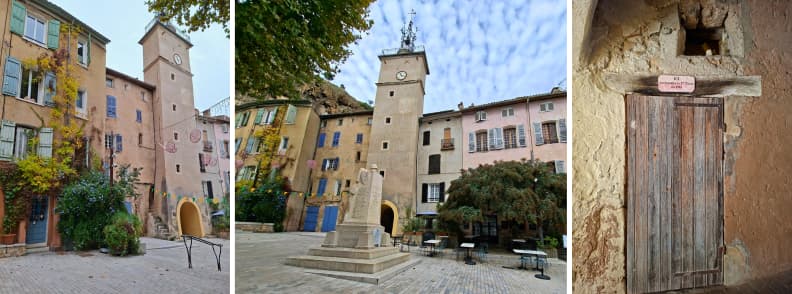
The Campanile & Sundial
Rising above the old town, the Cotignac campanile dates back to 1496. Made of open wrought iron to resist the strong mistral wind, it crowns the public clock tower with Provençal grace.
Originally, a mechanical system of pulleys and wires connected the clockwork to a hammer that struck the bell to mark the hour, a mechanism still in use today, electrified in 1963. A sundial, added in the 16th century, decorates the façade below. The earliest dials did not show numbered hours but only four lines, marking the start and end of the workday, and two for meal breaks.
Restored in 2007, the campanile remains one of the village’s proudest symbols, linking Cotignac’s daily rhythm to the Provençal sun.
Cours Gambetta
The wide Cours Gambetta, Cotignac’s main promenade, stretches along the southern side of the village. Once owned by the Prince of Condé and used for grazing, it was purchased by the town council in 1770 and planted with elm trees that were later replaced by hackberries, then by plane trees.

By the 19th century, it had become a bourgeois avenue lined with elegant houses, a washhouse and two fountains, namely the Cascade Fountain (1850) and the Four Seasons Fountain (installed later, though bought in 1810).
Early in the 20th century, it was home to the Cercle des Ouvriers and other social clubs, the forerunners of today’s cafés and bars where locals still gather over an apéritif under the trees.
Today, Cours Gambetta and the Place Joseph Sigaud (Place Neuve), fully restored in 2023, form the heart of village life, ideal for strolling, dining, or simply living on Provençal time.

Grande Rue & the Cariatides
On the Grande Rue, a stately 17th-century house displays three Cariatides, female statues sculpted in 1623 by a wealthy landowner to signal his social standing. The figures, dressed in flowing robes and balancing the roofline on their heads, were inspired by the classical women of Caryae, in the Peloponnese. They were restored in 2013, returning their refined detail to one of Cotignac’s most photographed façades.

The Churches of Cotignac
Two churches shaped Cotignac’s spiritual and architectural landscape: Saint-Martin Chapel, founded in the 5th century, and the Parish Church of the Annunciation (Église Saint-Pierre), built in 1266 at the base of the cliff.
Saint-Pierre replaced earlier chapels that stood in the plains above. Expanded in the 17th and 18th centuries, it now holds an exceptional collection of registered historic furnishings: a Louis XV marble high altar attributed to Pierre Puget, a 1524 bronze bell, a 16th-century marble font, and a finely wrought 17th-century iron communion rail.
Its 19th-century organ, built by Daublaine and Callinet and restored several times (most recently in 1990-2004), fills the nave with warm, resonant sound. The church underwent a complete interior restoration in 2004, including the renewal of flooring, lighting, and heating, preserving its calm atmosphere for generations to come.
The Saint-Martin Chapel, Cotignac’s oldest religious site, dates to the 5th century and was expanded repeatedly over six hundred years. Its 14th-century frescoes still show angels and saints painted in soft earth tones. Once the village’s main place of worship, it was gradually abandoned after floods and invasions pushed residents downhill. The chapel later served as a barn, then returned to public use after 1905. Mass was celebrated there each year on Saint Martin’s Day until the 1960s, and the site remains a silent witness to the village’s earliest history.
Faith & Pilgrimages to Notre-Dame de Grâces & Saint Joseph du Bessillon
Cotignac is known in Catholic tradition as the village of the Holy Family, because of reported apparitions of the Virgin Mary in 1519 and Saint Joseph in 1660. These accounts helped establish the village as an important pilgrimage destination, drawing visitors interested in religious history as well as those coming to pray.

Notre-Dame de Grâces & the 1519 Apparition
According to Catholic tradition, the Virgin Mary appeared to Jean de la Baume on Mont Verdaille on 10 and 11 August 1519, asking him to tell the people of Cotignac to build a place of worship in her honor. The villagers obeyed, and by 14 September, the first stone of Notre-Dame de Grâces was laid. The sanctuary soon filled with ex-votos in thanks for miracles, and in 1521, Pope Leo X granted indulgences to the site.
The Royal Connection. Louis XIII, Anne of Austria & Louis XIV
In 1637, Frère Fiacre, an Augustinian friar in Paris, reported visions of the Virgin Mary, which he interpreted as instructions for Queen Anne of Austria to pray three novenas, including one to Notre-Dame de Grâces, for the birth of an heir. Nine months later, Louis XIV was born.
In 1660, the young king and his mother visited the sanctuary to give thanks, and the Sanctuary has a set of stairs leading up the mountain that are called L’Escalier Louis XIV. The Sun King laid his blue cordon before the Virgin and authorised the transfer of Frère Fiacre’s heart to Cotignac. A royal plaque from that visit remains visible inside the shrine.
The Sanctuary Today
The church’s choir (1534) is original. The rest was rebuilt in 1811 after the French Revolution.
Inside, you’ll find the miraculous painting of the apparition to Frère Fiacre, the statue of Notre-Dame de Grâces, stained glass of the visions, and Louis XIV’s ex-voto.
The sanctuary is run by the Frères de Saint-Jean, who celebrate daily Mass and prayer, supported by the Pèlerins de Notre-Dame de Grâces Association. On-site amenities include the Foyer de la Sainte-Famille for simple meals, a pilgrim boutique, gardens, and scenic lookouts such as the Grande Croix and Belvédère pour la Vie.

Visiting Notre-Dame de Grâces
Open year-round and free to visit, the sanctuary can be reached by car or on foot via a 2 km walking path from the village. The Escalier Louis XIV commemorates the royal pilgrimage, while the Porte de l’Aumône and Diorama Room illustrate 500 years of faith history. Families can enjoy the Baludik trail, while pilgrims follow the Chemin de Croix and Parcours des Saints through olive groves and oaks.
Saint-Joseph du Bessillon & the 1660 Apparition
Saint Joseph appeared to a thirsty shepherd, Gaspard Ricard, on Mont Bessillon on 7 June 1660. A bearded man appeared and said I am Joseph. Lift that rock and you will drink. Water gushed from beneath it, forming the Fontaine Saint-Joseph, which continues to flow today. A small oratory was built that year, followed by a chapel consecrated in 1663, engraved with Isaiah 12:3 With joy you will draw water from the wells of salvation.
The Monastery & Pilgrim Welcome
After centuries of silence, the site was revived in 1975 by Benedictine nuns from Algeria, who rebuilt the monastery under the architect Fernand Pouillon. Since 2019, it has been cared for by the Sisters of Mater Dei from Argentina, who maintain a quiet rhythm of Mass, Adoration, and teaching. The monastery is closed to visitors, but the chapel remains open daily.
Chemin Saint-Joseph & The Holy Family Route
A 4 km pilgrimage trail, the Chemin Saint-Joseph, links Notre-Dame de Grâces with Bessillon. Six small oratories mark meditations on the life of Saint Joseph and the Holy Family. Another 9 km loop from the village passes vineyards and the Source Saint-Martin, offering a peaceful countryside walk filled with history and reflection.
A Living Pilgrimage in Provence Verte
Five centuries after the first apparition, Cotignac continues to welcome pilgrims, travelers, and curious visitors alike. Between its two sanctuaries, forest paths, and open horizons, this small Provençal village remains a place where faith and landscape intertwine, where stories of kings and shepherds still echo in the wind.
Cotignac Heritage Walk & Cultural Events
The Cotignac heritage walk connects many of these landmarks in a one-hour loop starting at the mairie. Numbered plaques explain the history behind fountains, façades, and alleyways. The route is easy to follow, and the tourism office offers a free printed map.
Beyond its monuments, Cotignac France stays lively all year with local traditions that give the village its rhythm:
- In October, the Fête du Coing fills the streets with an artisan market, live music, and a cheerful parade celebrating the quince, a fruit deeply rooted in Provençal heritage.
- During July and August, the Festival Les Toiles du Sud transforms the Théâtre du Rocher, the open-air theatre beneath the cliff, into a summer cinema. Animated films, original-language screenings, and premieres make it one of the region’s must-see cultural events.
- In December, the exposition of Provencal nativity scenes (crèches provençales) brings local craftsmanship and festive spirit to life with nativity scenes displayed throughout the village.
- Every Tuesday morning, the Cotignac market bursts with colour and scent. You’ll find stalls of lavender, honey, cheese, and fruit reflecting the unmistakable accents of Provence Verte.
Photography & Best Viewpoints Cotignac
For travelers who love photography, Cotignac France, a Village de Caractère du Var, offers a rare mix of natural drama and village detail. The cliffs, stone houses, and small squares create a setting that changes with the light. Each part of the day brings out something new, from the soft gold of sunrise on the rock face to the deep blue of twilight on the church and sanctuary. Whether you travel with a camera or a phone, this guide to Cotignac photography highlights the best spots to capture the spirit of Provence Verte.

The Top of the Rocher
The top of Le Rocher Cotignac gives the most striking panorama of the village and valley. The climb takes about fifteen minutes from the centre, following the Balade du Rocher trail that winds past the caves and Saracen towers. From above, the terracotta rooftops look like a patchwork set against the pale tufa cliff. Early morning is ideal for photos of the Rocher panorama, when the low sun lights the stone in shades of gold and pink. The path is uneven but well marked, making it one of the best viewpoints Cotignac for photographers.

Cours Gambetta Terraces
In the heart of the village, Cours Gambetta offers a completely different view. The terraces along the cafés frame everyday Provençal life, with glasses clinking, people chatting, and children playing around the fountains. From a photography perspective, it’s perfect for candid shots and atmosphere. Late afternoon light filters through the plane trees, creating patterns on the cobblestones. These street scenes make excellent Instagram spots Provence, showing Cotignac’s rhythm beyond the obvious landscapes.

Sanctuary Views
From the Sanctuary stairs, the view back over the village is wide and peaceful. You see the roofs, the vineyards, and the cliffs rising behind them. Morning visits offer soft light, while evening brings long shadows that emphasize the shape of the valley. For a balanced shot, frame the sanctuary’s stone balustrade in the foreground. Inside, the blue ceiling tones of Notre-Dame de Grâces glow especially well under low light near sunset, giving a warm contrast to the exterior views.
Photography Cotignac Light & Timing
The Cotignac weather changes quickly, and light plays a major role in how photos turn out. Morning light paints the cliff golden and highlights the details of the houses built into the rock. Around midday, the shadows disappear, making the village streets ideal for colour shots. In the evening, the cliffs turn soft grey while the interiors of the sanctuary reflect deep blue tones, perfect for low-light photography. Patience is key. Waiting ten minutes often transforms an average shot into a perfect one.
Cotignac Photography Info: Drone use is strictly limited near religious sites, including the Notre-Dame de Grâces sanctuary and the Saint Joseph du Bessillon chapel. Always check drone rules Provence before flying, as Cotignac sits near protected zones.
Each of these best viewpoints Cotignac offers a different perspective on the village, from daily life on Cours Gambetta to the grand panorama from Le Rocher. Together, they make Cotignac one of the most photogenic small towns in southern France.
Visit Cotignac FAQ
Planning a trip to Cotignac France often brings the same practical questions from travelers and expats. Below are the most complete answers, covering everything from transportation and family logistics to weather and nearby attractions.
Is Cotignac worth visiting?
Yes, Cotignac is worth visiting for its unusual troglodyte dwellings, accessible cliff viewpoints, Tuesday market, and historic sanctuaries. I especially recommend it to travelers who enjoy exploring small Provençal villages on foot. Plan at least half a day for the center and caves, or longer if you want to explore the sanctuary trails. If you are expecting major museums or a busy nightlife scene, Cotignac is unlikely to be your first choice.
What is Cotignac known for?
Cotignac is best known for its troglodyte caves and historic cliff-walk, its longstanding Tuesday market, and the Sanctuary of Notre-Dame de Grâces, which has drawn pilgrims since 1519. The village also celebrates the annual Fête du Coing (quince festival) each October and enjoys its reputation as one of the Most Beautiful Villages of France.
Do I need a car in Cotignac?
Yes, especially for day trips and regional travel. There’s no train station in Cotignac, and local buses from Brignoles or Aups run infrequently. The village itself is walkable, but exploring nearby attractions such as Sillans-la-Cascade, Entrecasteaux, Carcès, and Aups requires driving. Renting a car is the best way to make the most of a Provence road trip itinerary that includes Cotignac.
When is the market in Cotignac?
The Cotignac market takes place every Tuesday morning year-round on Cours Gambetta and Place de la Mairie, typically from 8 AM to 1 PM. At the market in Cotignac, you’ll find local produce, cheese, and crafts. In October, the market expands for the Fête du Coing, when stalls sell everything from quince jam to liqueur. Arrive early to find parking and enjoy coffee before it gets crowded.
Is there parking for campers?
Yes, Cotignac has parking areas accessible to some campers and a municipal campsite for overnight stays. We spent one night at 867 Chemin de la Colle, around 15 minutes on foot from the village center. We had no problems, but the absence of prohibition signs during our visit doesn’t establish permanent overnight parking permission.
Camping Municipal Les Pouverels is the official alternative, with 35 pitches, electricity, and sanitary facilities. The campsite operates from 1 April to 31 October and is approximately 30 minutes on foot from the center.
Can I visit the Cotignac caves with kids?
Yes, you can visit the Cotignac troglodyte caves with children, although the narrow passages, steep stairs, and approximately 90 steps make the visit unsuitable for strollers. Tickets cost €2.50 per adult and admission is free for children under 10.
We visited with our toddler. We used a baby carrier for the visit, but Mathieu carried him in his arms through the tighter sections and on the descent. Older children who are comfortable with stairs should find the visit interesting, especially the rock-cut rooms and viewpoint overlooking the village.
Plan 30 to 45 minutes for the visit, including the climb, and supervise your children closely around the stairs and elevated passages.
Is tap water drinkable in Cotignac?
Cotignac has a public drinking-water supply, but don’t assume every historic fountain provides water safe for drinking. Refill your bottle at fountains marked eau potable. Avoid drinking from fountains marked eau non potable or those without a clear indication of drinking-water suitability. Cotignac’s old fountains are worth seeing for their history, even when you’re better off filling your bottle elsewhere.
What should I pack in autumn to visit Provence?
Autumn in Provence brings mild days and cool evenings. Pack light layers that can adapt to quick temperature changes, a rain cover for occasional showers, and flat shoes for walking on cobblestones or trails. Families should also bring a baby spoon and toddler snacks, since local markets sell mostly adult food.
What is the nearest airport to Cotignac?
Toulon-Hyères Airport (TLN) is the closest passenger airport to Cotignac, at 70 km away or 1 hour and 10 minutes by car. It serves a small selection of domestic and European routes, so you’ll have fewer flight options.
Marseille Provence Airport (MRS) is around 100 km away, with a drive of 1 hour and 20 minutes. Nice Côte d’Azur Airport (NCE) is 118 km away, or 1 hour and 35 minutes by car. Marseille and Nice offer better international connections.
For visitors arriving from the United States, Marseille is interesting in 2027 thanks to United Airlines’ new nonstop New York-Newark service. I’ve included the details in my How to fly to Cotignac in 2027 section above.
I recommend comparing flight prices alongside car rental costs. The closest airport isn’t always the cheapest or most convenient option, especially when you’re flying internationally.
What villages are near Cotignac?
Several charming villages near Cotignac make excellent day trips. Visit Sillans-la-Cascade for its 42-metre waterfall, Entrecasteaux for its castle and gardens, Carcès for its lake and wine cooperative, and Aups for its winter truffle market. You can also explore Salernes, known for pottery, Tourtour, the village in the sky, and Moustiers-Sainte-Marie, the gateway to the Gorges du Verdon and Lac de Sainte-Croix. Each is within an hour’s drive, making Cotignac an ideal base for exploring Provence Verte.
Why Visiting Cotignac Stays with You
Cotignac France is one of those places that works its way under your skin slowly. You don’t fall for it because of a single sight or restaurant, but because of how it feels when the crowds fade and the village breathes at last. There is a rhythm here that matches the idea of Provence slow travel. Mornings that start with the smell of coffee on Cours Gambetta, afternoons that stretch into soft golden light under the cliffs, and evenings when the air cools just enough to make a walk feel perfect.
What lingers most is how the place behaves. The weekend in Cotignac that began with blocked roads and detours ended in quiet satisfaction, the kind you only find when plans fall apart but the experience still feels right. We came for a short break, yet left with the sense that we had brushed against the real Provence that’s generous, a bit stubborn, and still ruled by its seasons rather than schedules.
Cotignac is alive in the most grounded way. It’s a village that welcomes you without putting on a show, where the same people who sell you fruit at the market wave at you later from a café table. It’s the type of place that makes travelers and expats stay longer than planned, drawn by the pace and honesty of daily life. Cotignac is the Provence you dream about, the one that’s alive, imperfect, and kind to those who linger.
If you’ve been here before, share what stayed with you. And if you haven’t yet, plan that visit to Cotignac France soon. Come for the weekend, stay for the feeling, and let the cliffs, markets, and warmth of the people remind you why Provence still matters.
About the Author

I’m Mirela Letailleur, a Provence-based travel writer from Romania, creator of The Travel Bunny, where I share firsthand cultural, family, and slow-travel experiences across Europe. I’ve lived in the Var region of southern France for years and have explored every corner of Provence Verte, often by camper with my husband and son. My itineraries mix practicality with authenticity, from navigating small-village parkings to finding the best local festivals and family-friendly trails. As a long-term expat in France, I write guides that help travelers experience Provence as locals do, balancing curiosity, logistics, and cultural respect.
Cotignac holds a special place in my heart. I’ve visited it as both a mother and a travel professional, drawn by its troglodyte cliff dwellings, the Fête du Coing, and its deep pilgrimage heritage. My expertise blends local insight with on-the-ground research, and every recommendation in this Cotignac travel guide comes from personal experience. Whether you’re a cultural traveler, a camper van explorer, or a family on a Provence road trip, I’ll help you plan an authentic visit to Cotignac France, one of the most beautiful villages in France and the spiritual heart of Provence Verte.
After planning your visit to Cotignac Provence, check out these other guides on The Travel Bunny
Bagnols-en-Forêt. Discovering the Hidden Charm of Provence
Life in a French Village. The Realities of Moving to the South of France
Train des Pignes à Vapeur. Best Steam Train Journey in France