
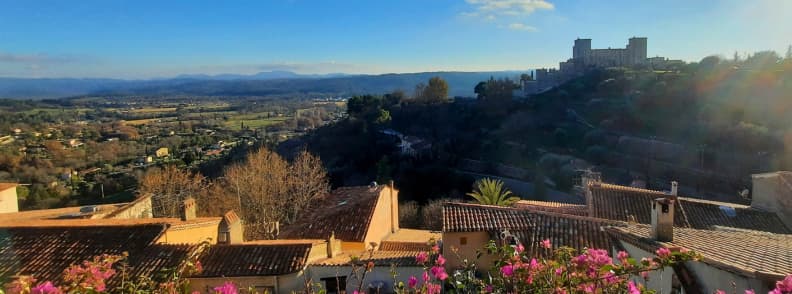
Mons Var is at 814 m above the Pays de Fayence, high enough for the village streets to end suddenly in wide views across the Estérel and toward the Mediterranean. On a clear visit, I’ve picked out Lac de Saint-Cassien, Le Blavet, the Îles de Lérins, and the coast from Place Saint-Sébastien. Corsica sometimes appears on exceptionally clear days too.
But the first thing my son noticed in Mons wasn’t the panorama. It was the goldfish!
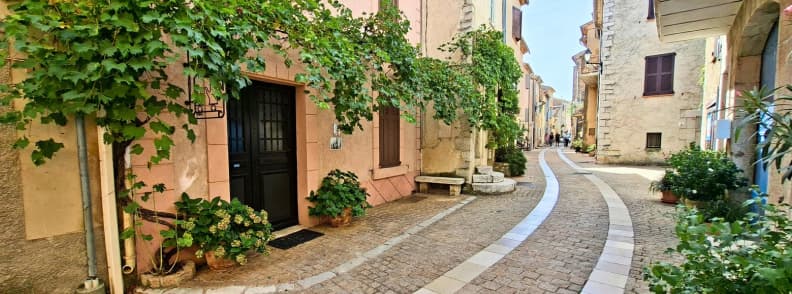
They swim in the fountain beside Place Saint-Sébastien, a few steps from the parking area and the large horse chestnut where my dad later stopped to rest on another visit. From there, Rue Jean Vadon leads into the old center, where stone-paved lanes, wrought-iron trade signs, vines trained along wires, fountains, stairways, and small squares kept pulling us farther into the Mons village.
Mons Var travel guide
I’ve visited in both summer and autumn, with my husband and young son and once with my parents. On each visit, half a day was enough to explore the center at an easy pace. I still left with reasons to return, such as the Christmas market, the hiking trails, Maison Monsoise, the Marine et Montagne museum, and a long meal at L’Auberge Provençale.
This Mons France travel guide by The Travel Bunny follows the village as I experienced it on foot. I’ll cover the best things to do in Mons, the viewpoints worth stopping for, the streets and heritage details I liked most, where I parked, where we ate, what visiting was like with a toddler and with my dad’s limited mobility, and how much time I’d plan next visit.
Disclosure: Some of the links on this page are affiliate links. This means that at no extra cost to you, The Travel Bunny will earn a small commission if you click through and make a purchase. Thank you!
Is Mons Var Worth Visiting?
Yes, Mons Var is worth visiting, especially if you like small hilltop villages where the pleasure comes from walking, stopping for the view, and paying attention to details along the streets. I’ve visited Mons in summer and autumn, and I’d go back again without hesitation.
Half a day was enough for us to walk through the center at an easy pace. We started at Place Saint-Sébastien, wandered along Rue Jean Vadon, then gradually covered the rest of the village streets. I never had the impression that we were rushing from one attraction to another. Mons is small, and much of the visit happens between the named sights anyway, among stone lanes, fountains, wrought-iron signs, vines trained along wires, stairways, and small places to sit.
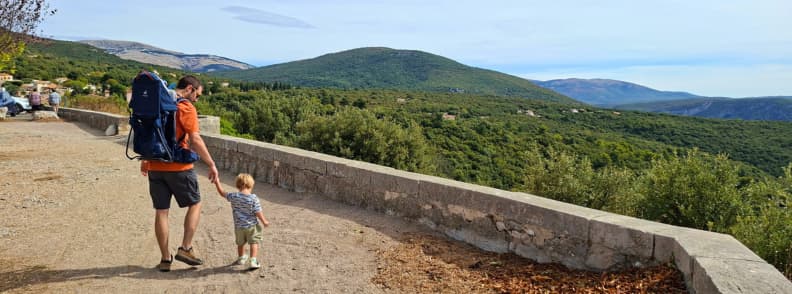
The views are one of the main reasons to come. From Place Saint-Sébastien, I’ve seen Lac de Saint-Cassien, Le Blavet, the Estérel, and the Îles de Lérins. The local tourism office also notes that Corsica appears from Mons in especially clear conditions.
Part of what I loved about visiting Mons was how manageable some of the village was for my dad. Mons has plenty of steps and steep little passages, but the central streets include flatter stretches, and small benches appear throughout the village. My dad stopped whenever he needed a break while my mom and I explored the steeper lanes.
The official heritage circuit starts at Place Saint-Sébastien and takes about an hour on average, which also makes Mons practical for a shorter visit.

Visiting Mons was also easy with a toddler, although I was glad we had left the stroller at home. William wanted to walk almost everywhere! He climbed steps, sat on low walls, inspected the goldfish in the fountain, and finished the visit exhausted. For families with young children who like walking, the small center is a good match. A carrier still helps once small legs give up.
Is Mons Var touristy or authentic? I’d describe it as tourist-friendly, with a clear visitor route, orientation table, heritage signs, museums, restaurants, and a tourist information point.
On my visits, I noticed many visitors and relatively few locals in the center. At the same time, the wrought-iron signs, old washhouses, church, bread oven, market, and traditional streets belong to the village itself, not to some staged attraction. Mons is officially classified as a Village de Caractère de Var, and the heritage route focuses heavily on local trades and village history.
I also wouldn’t call Mons the quietest, most authentic village in Provence. Mons receives day-trippers, cyclists, hikers, and people touring the perched villages of the Pays de Fayence. The terrace at L’Auberge Provençale was busy during our summer visit, and arriving late meant missing the lunch we had hoped for.
Mons isn’t empty, especially in summer. But what I like is that tourism hasn’t turned the center into a row of souvenir shops and photo stops. We still spent most of our time walking, looking at houses, reading the old trade signs, stopping at fountains, and sitting in the shade.
I’d spend half a day visting Mons. Each time, this was long enough for us to cover the historic center twice without hurrying. One to two hours would cover the main viewpoint and a shorter heritage walk, but you’d miss much of the detail that made me want to return.
A full day becomes worthwhile if you add a proper lunch, Maison Monsoise, Marine et Montagne, or a longer walk. I haven’t managed to visit the museums yet because they were closed or I arrived too late, and the church was closed on my visits. Those unfinished visits are part of the reason Mons is still on my local list.
An overnight stay interests me for a different reason. I want to return for the trails around Mons, especially the megaliths, Siagnole area, Roche Taillée, and Mont Lachens, and I’d like to stay at the village hiking gîte. For a first visit, though, half a day gives Mons the right amount of time without stretching the village beyond what is there.
Mons at a Glance
Mons looks much steeper from a distance than it does once you start walking around the center. The village is at an altitude of 814 m, high above the Pays de Fayence, but Place Saint-Sébastien and several of the streets around it are surprisingly level. That was one of the things I appreciated most when I came back with my parents.
My dad has limited mobility, so we weren’t going to drag him up and down every stone staircase. And he didn’t need to. He still saw the panorama, wandered through a good part of the center, and found plenty of benches whenever he wanted to rest. My mom and I disappeared into the steeper lanes while he waited for us somewhere comfortable.
Mons is also tiny in terms of residents. Only 909 people live in Mons Var, according to the latest INSEE figure, based on the 2023 census. This population helps explain why the village center changes character through the day. During my visits, I saw plenty of day-trippers and cyclists, but relatively few locals lingering around the streets.
I’d plan half a day for Mons if you want to enjoy it properly. This was enough on my visits to walk through the whole center, stop for the views, look for the wrought-iron signs, read their stories, and take our time. An hour would cover Place Saint-Sébastien and the official heritage circuit, but I’d only choose that option if Mons were just one stop in a packed Pays de Fayence day.
Parking has been refreshingly easy every time I’ve visited. We parked for free beside Place Saint-Sébastien, a few steps from the fish fountain, the viewpoint, the big horse chestnut tree, the first streets of the old village, and the public toilets. We found a parking space without trouble in summer, and outside the main season, it was easier still, even on a market day.
I’ve seen Mons in summer and autumn, and I liked both. Summer was easy to visit, partly because many of the village streets have shade. But the drinking-water fountain was still a welcome stop! Autumn was quieter around the parking and restaurants, but the village itself didn’t seem transformed between my visits.
With a young child, I’d skip the stroller. We learned that lesson after visiting Seillans and left ours at home when we came to Mons. William wanted to walk anyway. He went over the stone paving, climbed whatever steps caught his attention, sat on low walls, and eventually wore himself out. A toddler who likes walking will have plenty to explore here, but I’d keep a carrier ready for the end.
What surprised me most about Mons was this combination. It has the height, views, stone steps, and stacked streets of a perched village, but you don’t have to tackle every steep lane to enjoy it. This made my visit with my dad much easier, and it’s one reason I’d recommend Mons to families traveling with different ages and walking abilities.
Where Is Mons in the Var?
The postal address is Mons 83440, in the eastern Var and within the Pays de Fayence. Administratively, Mons PACA is in the region Provence-Alpes-Côte d’Azur.
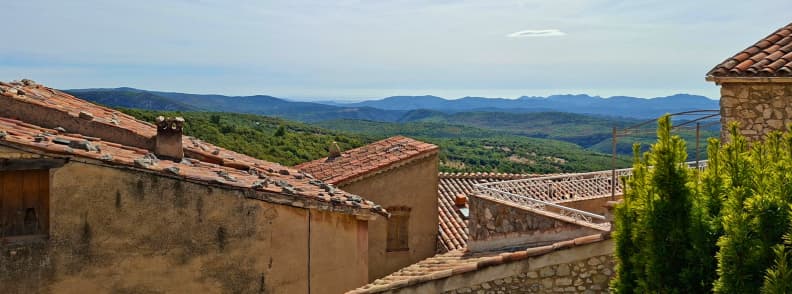
Mons Var France is inland, well above the coast, on a mountain spur at 814 m. The road to get here already tells you you’re leaving the French Riviera behind, with wooded slopes replacing the busier coastal roads before the village appears high above the surrounding countryside.
I’d place Mons PACA travel in a Pays de Fayence road trip. You come here for stone streets, high viewpoints, old village houses, and the landscape between the Estérel Massif and the first Alpine foothills.
There are two very different places called Mons. Mons France is the small perched village in the Var that this guide covers, while Mons Belgium is a much larger city and the capital of Hainaut, known for its UNESCO-listed heritage and cultural attractions.
Two geographic details are easy to mix up before a first visit. Mons is the highest village in the Pays de Fayence, while nearby Mont Lachens rises much higher and is a separate destination altogether. I’ll separate the two below, because the difference helps explain both the views from Mons and the hiking possibilities above the village.
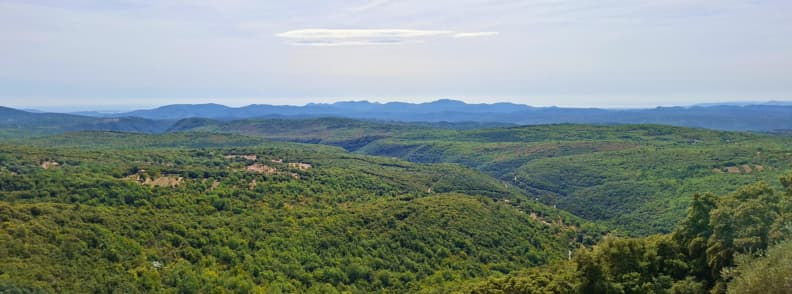
Mons, the Highest Village in the Pays de Fayence
At Place Saint-Sébastien, you notice the height immediately. The land drops away toward Lac de Saint-Cassien and the Estérel, with the Îles de Lérins visible in the distance on a clear day. Among the high-altitude villages in the Var, Mons has one of the most dramatic settings I’ve visited.
The figure to remember for Mons altitude is 814 m. The official Pays de Fayence tourism office describes Mons as the highest village in the Pays de Fayence. The Mons Var altitude also explains why the panorama stretches so widely from the orientation table at Place Saint-Sébastien.
There is an important correction here because Mons is often described too broadly. Mons, Var’s altitude above sea level is about 814 m, but Mons is not the highest village in the Var. Calling Mons the Var’s highest village mixes up the Pays de Fayence with the entire Var department.
What is the highest village in the Var? This title belongs to Bargème, which stands at 1,097 m in the Verdon area. While Mons holds the local distinction within the Pays de Fayence, Bargème is higher when the whole department is compared.
Mons is still high enough to change the character of a visit. The wide panorama, cooler air compared with the coast, and immediate access to mountain terrain separate it from the lower villages around Fayence. The commune also reaches much higher ground toward Mont Lachens.
Mons and Mont Lachens
Mons Var and Mont Lachens are close enough to be mentioned together all the time, but they’re two very different stops. Mons village sits is at 814 m, while Mont Lachens rises to 1,714 m and is the highest point in the Var.
This difference is easy to underestimate when you’re planning from a map. Mons is the place for stone streets, fountains, viewpoints, and a slow walk through the old center. Mont Lachens is true mountain terrain, right on the transition between the Mediterranean side of the Côte d’Azur and the more Alpine landscape inland. The summit has orientation tables and wide views across the Var, Alpes-Maritimes, and Alpes-de-Haute-Provence.
I haven’t hiked Mont Lachens yet, and this is one of the reasons I want to come back and stay overnight in Mons. A half-day visit was enough for discovering the village, but when hiking is part of the plan, adding Mont Lachens turns the trip into something else.
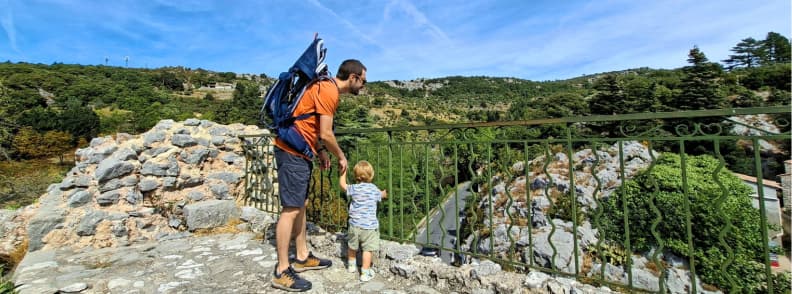
How to Get to Mons
How to get to Mons is easiest to answer from my own visits: we drive. From Fayence, the D563 climbs through forest toward the village before reaching its rocky setting above the Siagnole valleys.
Getting to Mons Var by car also leaves you free to combine the village with Fayence, Seillans, Callian, Lac de Saint-Cassien, or a hike without planning the day around a timetable. Mons Var is easiest to reach by car, especially once you start adding other villages or countryside stops. I’ll go into the driving routes from Fayence, Grasse, Cannes, Nice, and Fréjus below.
Getting to Mons Var by public transport is possible, but I’d plan the outward and return connections before leaving. ZOU! asks passengers to reserve on-demand services through its customer service line. A spontaneous detour becomes much harder once the final bus needs advance booking.
I’d plan visiting Mons Var without a car as a dedicated day trip, not as a stop in an ambitious perched-village circuit. The village is small once you arrive, so the challenge lies in reaching it and getting back, not in moving around Mons on foot.
Getting to Mons from Nice without driving takes several stages. TER trains run frequently between Nice and Cannes, while ZOU! line 832 links Cannes with Fayence. The final connection to Mons uses ZOU! line 803 between Callian, Fayence, and Mons, which currently operates as an on-demand service.
Driving From Fayence, Grasse, Cannes, Nice, and Fréjus
Every time I’ve visited Mons, I’ve arrived by car. That’s the only way I’d choose to visit again (unless we’ll one day brave the narrow roads and visit by camper). The village is easy to reach from several directions, but the road changes quickly once you leave the coast or the larger towns behind. The last part climbs through forest and open mountain scenery before you reach Mons. It’s narrow, but wonderful!
From Fayence, Mons is close enough for an easy pairing. The Mons Fayence day trip route follows local roads north toward the village, for 15-20 km, depending on your starting point. Mons to Fayence driving time is around 20-30 minutes, as long as you follow the signs in Fayence. (The gps was less reliable on our last trip). This short distance is why I’d happily combine Mons with Fayence on the same day.
Coming from Grasse is a different drive. The driving from Grasse to Mons Var route is 33 km long and takes 50 minutes, with the road passing through the Saint-Cézaire and Siagne area. The route is scenic, but I’d leave some margin in summer because these inland roads aren’t the place to chase an optimistic navigation estimate.
From Cannes, Mons is 48 km away by road, so around 55 minutes by car. A day trip from Cannes to Mons is easy to plan without spending half the day behind the wheel.
A day trip to Mons from Cannes also pairs well with another Pays de Fayence stop if you start early. I’d keep the plan simple, though. Mons already deserves a few hours, and squeezing four perched villages into an afternoon turns them into parking stops.
Driving to Mons Var from Cannes usually means taking the A8 toward the Pays de Fayence, then leaving the motorway for the inland roads at exit 39, Fayence and Les Adrets-de-l’Estérel.
A Mons Var one day itinerary from Cannes is easy to plan around Mons plus Fayence or Seillans, with lunch somewhere along the route. I’d choose two villages and take my time exploring them on foot instead of trying to see every village in the Pays de Fayence before dinner.
Nice is farther, but still ok for a day trip. The distance from Nice to Mons is 76.6 km by road, with driving taking 1 hour 10 minutes.
For a day trip from Nice to a hilltop village, Mons is a good option if you want to leave the coast completely and spend a few hours inland. The simplest way to visit Mons Var from Nice is by car, using the A8 toward the Pays de Fayence before climbing inland.
Driving to Mons Var from Nice also gives you plenty of freedom once you’re in the area. You could stop at Lac de Saint-Cassien, Fayence, or another nearby village without having to plan around a return bus.
A day trip to Mons from Nice or Cannes is easy by car, with Cannes clearly closer. From Nice, I’d make Mons the main destination. From Cannes, adding one nearby village still leaves plenty of time for a slow walk through Mons.
Coming from the coast to the south, Mons Var from Fréjus is 45 km by road and 48 minutes by car. Drivers arriving via Fréjus and Saint-Raphaël should use A8 exit 38 and continue toward Bagnols-en-Forêt.
The drive to Mons Var from Saint-Raphaël follows the same general inland approach. I’d allow around an hour once local traffic is included, especially in summer when the roads around Fréjus and Saint-Raphaël are busier.
How far is Mons from Saint-Tropez? Saint-Tropez looks deceptively close on a regional map because the straight-line distance is much shorter than the road route which is 130 km. I wouldn’t combine the two unless Mons was part of a larger inland route.
Whichever direction you come from, the final stretch of the drive is part of the transition into Mons. The coast disappears, the roads narrow, forest takes over, and then the village appears above the surrounding valleys. After that climb, arriving beside Place Saint-Sébastien and finding free parking a few steps from the center is pleasantly uncomplicated.
Parking in Mons
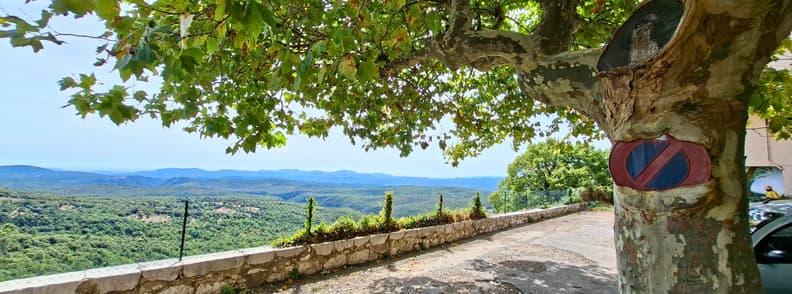
Mons parking has been easy on my visits, which I appreciate because perched villages have taught me never to expect parking to be simple. We park at Place Saint-Sébastien, right beside the viewpoint and a few steps from the old streets. We found a space without trouble in summer, and it was even easier outside the main season, including on a market day.
Free parking in Mons Var: Go to Place Saint-Sébastien. Parking here also puts you near the fountain with the goldfish, the panoramic table, the big horse chestnut, and the public toilets. The toilets were clean and had liquid soap when I used them, although the spiders had clearly claimed a few corners.
The location is especially handy with children or anyone who prefers shorter walks. The Mons Var parking near the village entrance is free, and you start exploring almost as soon as you leave the car. My dad could reach the viewpoint and flatter central streets without a long approach, while William immediately found the fountain much more interesting than anything we adults wanted to look at.
After several visits, I know where to park in Mons Var. Place Saint-Sébastien is my first choice because Rue Jean Vadon begins close by and leads naturally into the village center. But Place Saint-Sébastien is full, there’s also free parking in Place De La Rouguière, by the lavoir under L’Auberge Provençale, still close to the village center. And there’s also free parking at Place de l’Église. So where to park in Mons Var France is refreshingly uncomplicated compared with many small hilltop villages I’ve visited in the region.
How Long Should You Spend in Mons?
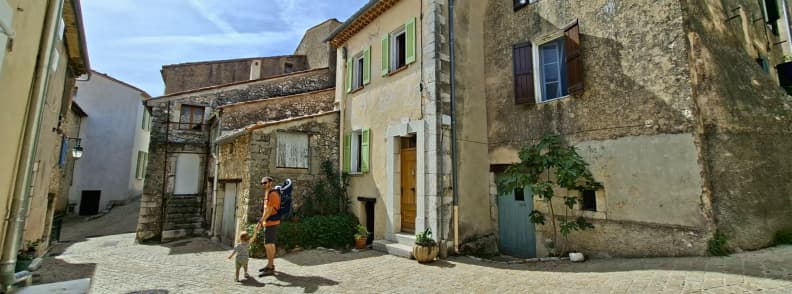
I’ve spent about half a day in Mons on each of my visits, and half a day is still what I’d recommend for a first visit. You have time to walk the whole center, linger at the viewpoints, follow whichever iron signs catch your eye, and stop for something to eat without watching the clock.
A shorter Mons France itinerary is still worthwhile. The official heritage trail is only 1 km and takes about an hour, starting at Place Saint-Sébastien. It’s very easy, but my own walks went beyond the marked route because I kept disappearing down side streets.
| Time in Mons | What I’d plan |
|---|---|
| 1 hour | Place Saint-Sébastien, panorama, Rue Jean Vadon, a loop through the old streets and some of the wrought-iron signs. |
| 2 to 3 hours | Full village walk, Maison Monsoise and Lou Fournas from the outside or on a guided visit, church, lavoir, fountains, viewpoints. |
| Half day | My choice for a first visit. Explore every street at an easy pace, add lunch or a cheese-and-wine stop, then a museum or heritage visit if open. |
| Full day | Village in the morning, lunch, then a short hike such as the 4 km Mégalithe de Riens circuit, or extra time for museums and a slower afternoon. |
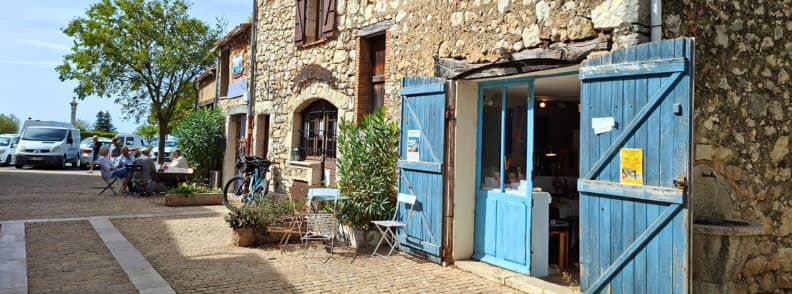
One hour in Mons
A one-hour Mons itinerary should stay focused on the center. Park at Place Saint-Sébastien and look at the panorama before entering the village. I’d then take Rue Jean Vadon, which is how my visits naturally started, and follow the streets through the center before looping back.
For a short Mons Var walking itinerary, the heritage trail is a useful backbone. It passes old doorways, fountains, lavoirs, Maison Monsoise, Lou Fournas, and the streets decorated with wrought-iron signs representing old village trades.
I wouldn’t spend this one hour trying to tick off every sign. Look up as you walk. One of my favorites is Acoucharello, the midwife. I remembered it from my first visit and went looking for it again when I returned with my parents.
With only an hour, I’d also skip visiting any museums. The views and the streets are the parts of Mons that never depend on an opening schedule.
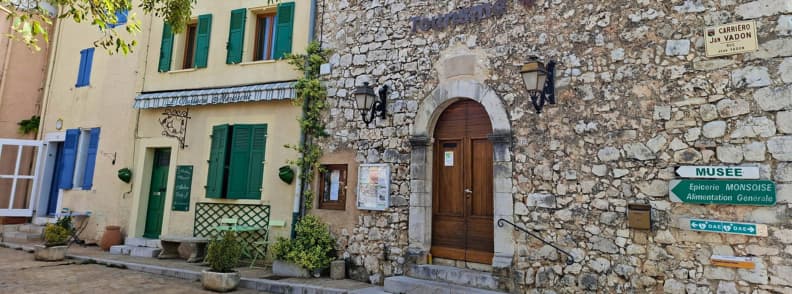
Two to three hours in Mons
Two to three hours gives your Mons Var day trip a nicer pace. Walk the main streets, take the smaller stairways that appeal to you, stop at the fountains, and go down toward the lavoir beneath L’Auberge Provençale.
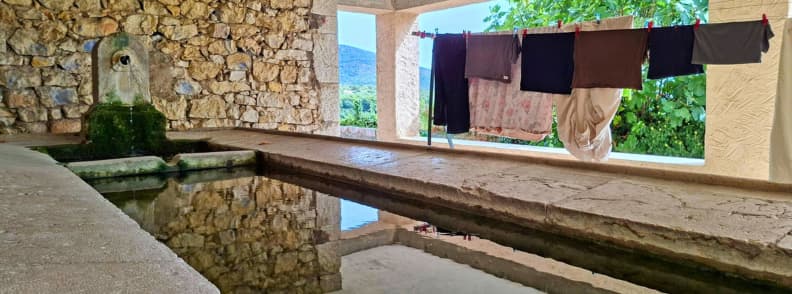
You have enough time to notice details you’d otherwise miss on a quick loop. Along the main street, vines climb over wires fixed to the façades of the houses. I loved them enough to start thinking about doing something similar at home one day!
If you visit on a Friday, the tourism office currently offers a guided village and wrought-iron-sign tour at 10:30 am, followed by a guided visit of Maison Monsoise and Lou Fournas at 11:30 am. Advance booking is required, and the 2026 price is €5 per adult, with free admission for under-18s. For reservations, call +33 4 94 76 01 02.
This timing creates an easy Mons Var day trip itinerary without inventing activities to fill the morning. Start at the viewpoint, join the guided visits, then eat or keep wandering afterward.
Mons tourist office opening hours: In summer, the office in the former White Penitents Chapel is open Tuesday-Saturday, morning and afternoon. During parts of autumn and winter, opening drops to Saturdays only.
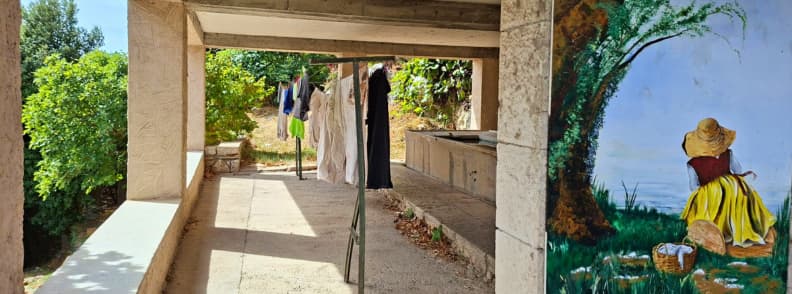
Half a day in Mons
My Mons Var half-day itinerary is close to what I’ve done myself. Start at Place Saint-Sébastien, spend a few minutes with the view, then walk from Rue Jean Vadon into the center, and keep going until you’ve covered the streets that interest you.
I’d leave enough time to sit somewhere. On our first visit, William was too restless for a full lunch at L’Auberge Provençale, so the staff let us settle into a corner of the terrace on a couple of small couches. We ordered a cheese platter and house wine while he ate his baby food. Once he wanted to move again, we were ready to go as well.
Go early if you want a terrace table at L’Auberge Provençale! On my summer visit with my parents, we arrived late after my dad’s equally late breakfast, despite my warnings, and the terrace was full at half past noon. It was a genuine disappointment because the tables have the view.
A half day also leaves time for the places I’ve repeatedly failed to get inside. The church was closed on my visits. I also missed Marine et Mon(s)tagne, and Maison Monsoise was closed when I passed. My advice is to check opening times before planning your day around indoor sights.
This is the Mons Var itinerary I’d choose for most first-time visitors. It leaves enough empty time to wander, which is important here because some of my favorite memories have nothing to do with landmarks. William watching the goldfish, my dad choosing another bench, the vines, a sign I wanted to check closer, the lavoir hidden below the restaurant…
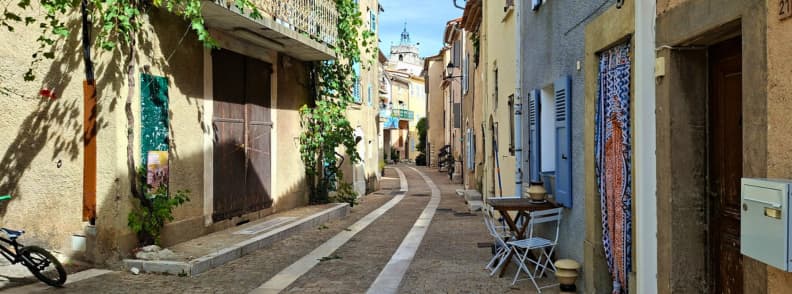
A full day in Mons
With one day in Mons Var, I’d keep the village visit for the morning and add a walk after lunch. Le Mégalithe de Riens is a 4 km option for a shorter family outing. Longer routes around Mons include an 11 km countryside walk and an 18 km megalith route.
This gives your Mons Var full-day itinerary a clear split. Spend the first part of the day in the village while you’re fresh, eat before the restaurant terraces fill, then change pace completely and head onto a trail.
If hiking isn’t part of your plan, use part of your day for the museums, Maison Monsoise, Lou Fournas, and a slower meal. There are enough things to do in Mons Var in one day once you include the heritage sites, but I wouldn’t pad the schedule simply to keep you in the village until evening.
I’d also watch the season. In summer, I found the shaded streets comfortable, but the afternoon is still a better time for an easy walk than an ambitious exposed hike. For longer trails, I’d personally return in cooler weather.
Combining Mons with other Pays de Fayence villages
A day trip from Fayence to Mons is an easy pairing because the villages are close. I’d allocate to Mons the larger share of the day if you want to walk all its streets, then stop in Fayence for another meal, market stop, or short wander.
A Mons to Grasse day trip also fits into a broader trip through the eastern Var and Alpes-Maritimes, but Grasse deserves a lot more time to explore. I wouldn’t reduce either place to a quick photo stop just because they’re on the same driving route.
A day trip to Mons from Cannes or Nice also changes how much I’d add. From Cannes, pairing Mons with one nearby Pays de Fayence village is reasonable. From Nice, I’d keep Mons as the main inland destination and avoid planning an overpacked loop.
I’d be especially wary of a Mons Fayence Seillans Tourtour day trip. Mons, Fayence, and Seillans already give you plenty for one day. Adding Tourtour pushes the route much farther west and turns a village day into a lot of driving.
If your aim is to visit several hilltop villages properly, move the extras into a weekend itinerary around the Pays de Fayence villages. This also opens the door to the part of Mons I still want to experience myself, which is staying overnight, hiking from the village, and starting the next morning without having to drive back in.
My Mons Walking Route
I’ve never followed a strict route through Mons. My walking tour always starts at Place Saint-Sébastien, with the goldfish fountain and the view, then continues along Rue Jean Vadon into the old village. From there, I simply follow whatever street catches my eye.
A walking tour of Mons village Var is easy to do this way because the center is small. I’ve covered all its streets over several visits, including the stepped lanes my dad skipped when I returned with my parents.
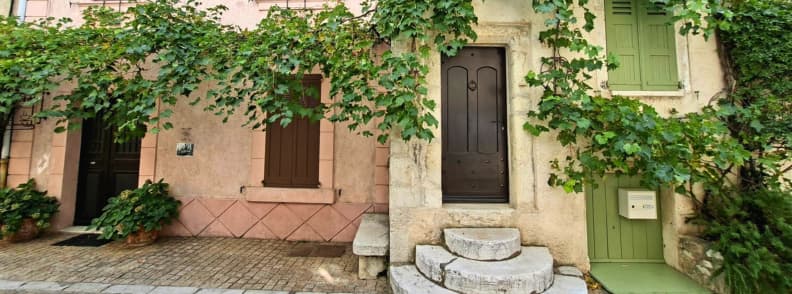
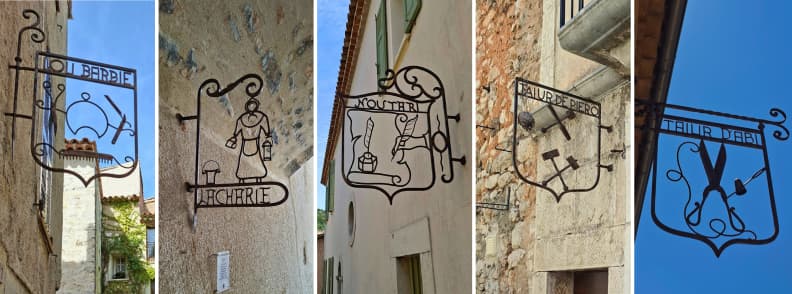
The wrought-iron trade signs are what I notice most. There are 35 around Mons, representing old local trades in Provençal. I also love the vines trained on wires along the houses and the lavoir tucked below L’Auberge Provençale.
A Mons Var guided walking tour is available through the Pays de Fayence tourism office, and Mons Var guided walking tours are available on request at certain times of year too. I still prefer leaving room to wander and discovering places like Caladoun Roumpe Cuou (Break-Neck Street). Mons rewards the little detours between Place Saint-Sébastien, the Circuit des Enseignes, Maison Monsoise, Lou Fournas, and the church.
Place Saint-Sébastien and the Panorama
Place Saint-Sébastien is where Mons opens up. I always stop here before heading into the village because the view takes over immediately.
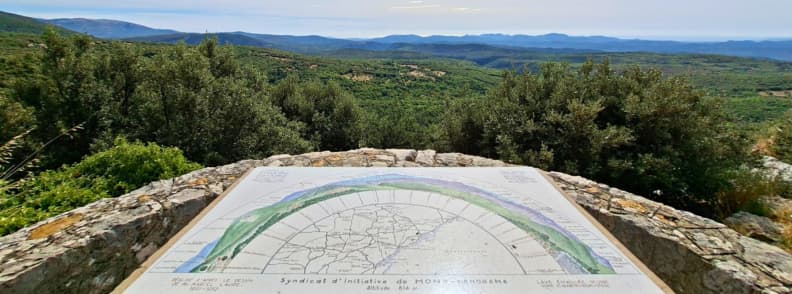
The Mons orientation table helps put names to the horizon. The Place Saint Sébastien panorama stretches across the Estérel, Pays de Fayence, and the bays of Cannes and Saint-Raphaël.
You can see Corsica from Mons Var in clear weather. I haven’t seen it myself from the Mons viewpoint. I have seen as far as the Îles de Lérins clearly, so Corsica is a bonus.
This caveat is worth keeping when you read about Mons Var altitude and panoramic views toward Corsica. At 814 m, the height explains the breadth of the landscape, but clear air decides how far you actually see. But the Mons Var altitude panorama is impressive even when Corsica stays hidden.
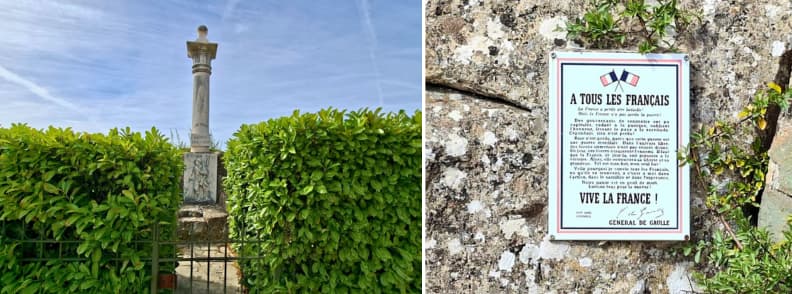
Exploring the square deserves a few minutes too. Beside the orientation table, you’ll also spot the wrought-iron Saint Sebastian figure, the Monument aux Morts de Mons, and the fountain with goldfish that fascinated our toddler on our first visit.
Then there is Le Grand Arbre de Mons, the huge horse chestnut in the middle of the square. It’s the largest of the horse chestnuts planted here in 1870. My dad sat under it on one of the wooden benches while my mom and I wandered off again.
For me, the best photo spot in Mons Var is the viewpoint before you enter the old streets. It’s one of the best viewpoints in Mons Var for wide landscapes, and the Mons Var panorama view is easy to frame with the tree, fountain, or ironwork in the foreground.
The Mons Var panorama view of the Estérel and sea is the obvious wide shot, but my Mons photos here usually end up including smaller things too. The fountain, the tree, the Saint Sebastian figure, and the war memorial give the square more character than a bare lookout.
Among the Mons Var photo spots, Place Saint-Sébastien is the easiest starting point. If you’re deciding where to take photos in Mons Var, take the big view first, then turn back toward the village. The stone streets and details behind you are often the better photographs.
The same goes for Mons Var photos aimed at social media. Mons Var’s best photo spots for Instagram aren’t limited to the panorama. I’d rather photograph the iron signs, vines on wires, old stone, and the lavoir than take twenty versions of the same horizon.
Photography is easy here without special planning, but Les Maisons de Mons advertises a Mons Var photography workshop with practical tips as part of a longer Provence stay.
Drone shots need more care. Mons Var drone flying regulations and spots fall under French UAS rules, and in 2026 open-category drone flights are prohibited in public space inside built-up areas. Check the official UAS restrictions map before flying anywhere around Mons.
Place Saint-Sébastien is a good Mons lookout point in the Var for anyone with limited time. A short stop here already shows you why the village sits so high above the Pays de Fayence, and the Mons Var viewpoint is only a few steps from the free parking.
Circuit des Enseignes and the Old Village Streets
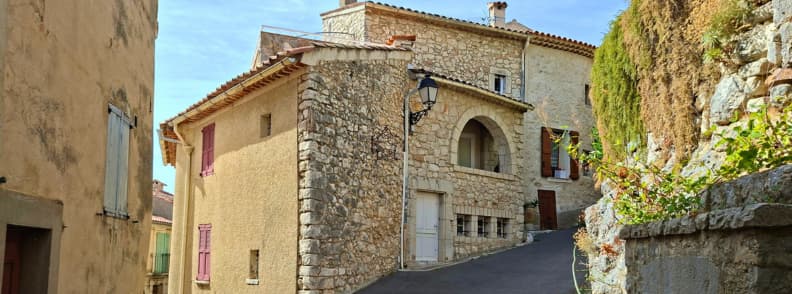
The Circuit des Enseignes Mons is one of the details I remember best from my visits. There are 35 wrought-iron signs fixed around the village, each linked to an old trade once practiced in Mons, with the names written in Provençal. They are part of the village heritage trail and a link between local history and the Provençal language.
A historical walk through Mons’ artisanal trade signs also leads you through the nicest parts of the old center. You pass porches, arcades, carved doors, Renaissance windows, little squares, fountains, and wash houses. I kept getting distracted by other details too, so I didn’t follow the route properly on my visits. I simply noticed the signs as we wandered and stopped whenever one caught my eye.
The Mons heritage walking circuit starts at Place Saint-Sébastien and takes about an hour if you follow it as marked. The visit is free and the route stays open year-round. I’d still plan extra time, because this is one of those villages where taking the wrong little street is often the better choice.
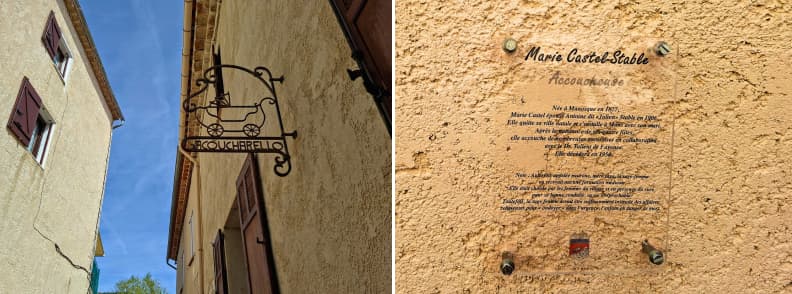
The Mons sign circuit of old trades gives your walk a thread without turning it into a museum route. You can follow the signs closely or let them appear one by one as you explore. I prefer the second option, but maybe you want a more structured visit.
Maison Monsoise, Lou Fournas and Village Heritage
I’ve managed to find Maison Monsoise closed on my visits, which is annoying because it’s exactly the kind of small local place I like. The Maison Monsoise museum preserves the layout of an old village home, with the vegetable garden, bugadier, stone hearth, furniture, and everyday objects left to show how a Monsois family once lived.
Maison Monsoise opening hours are tied mainly to guided visits. In 2026, the Pays de Fayence tourism office schedules a visit every Friday at 11:30 am, by reservation, together with Lou Fournas. It costs €5 per adult, under-18s enter free, and the visit runs with at least four paying adults.
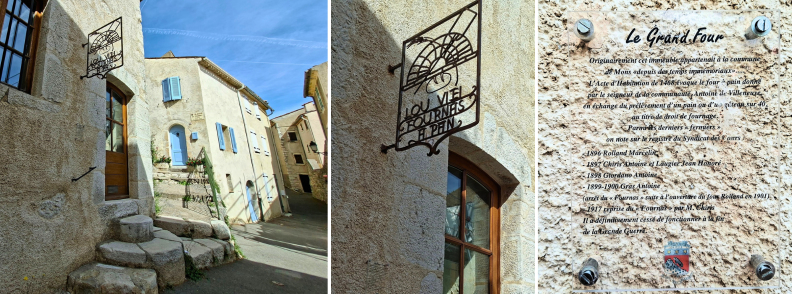
A Lou Fournas Mons visit takes you into the old communal bread oven. The plaque says that Le Grand Four, Mons’ communal bread oven, was mentioned as early as 1468 in the habitation charter. The local lord granted the oven to the community in return for a baking fee of one loaf or cake out of every 40. It continued operating under different administrators until the early 20th century and closed around the end of World War I.
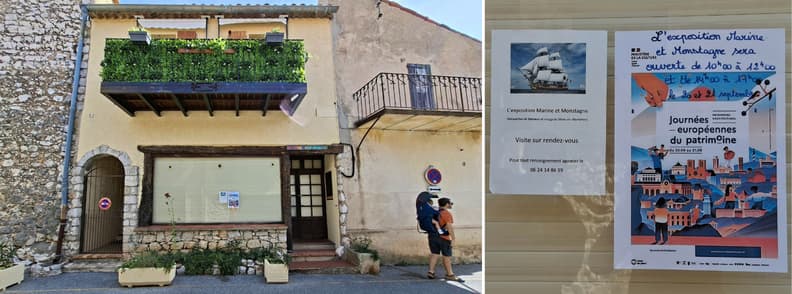
The other Mons museum I still want to catch open is Marine et Monstagne, the spelling used as a play on mer (sea) and montagne (mountain). This Mons Var museum grew from Robert Audibert’s obsession with building ships from matchsticks. His Soleil Royal alone took over 5,000 hours and around 32,000 matches!
The Mons Var museum Marine et Montagne exhibits also include a scale model of Mons, complete with houses, lanes, and tiny lights. That is the piece I’m especially curious to see after walking every street outside.
I’d book Maison Monsoise and Lou Fournas before arriving, and confirm Marine et Monstagne separately. I’ve already missed all three several times by relying on luck.
Notre-Dame-de-l’Assomption and the Chapels
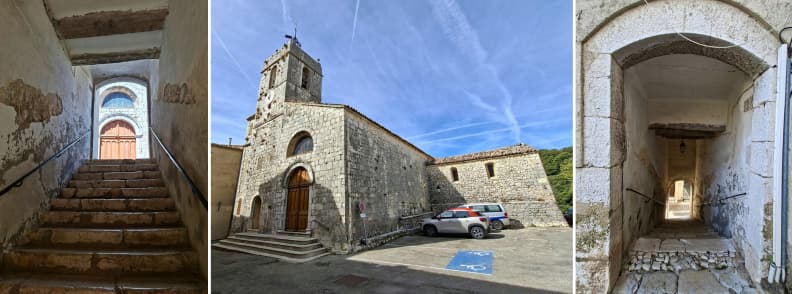
I’ve tried twice to get inside the Mons church, and twice I found the door closed. This is frustrating because Notre Dame de l’Assomption Mons has a much richer interior than the plain stone exterior suggests. Mons Var church Notre Dame de l’Assomption history begun in 1260 and enlarged in the 15th and 17th centuries, with six Baroque altarpieces and a collection of dressed santons inside.
The bells are another detail worth knowing before you pass by. The Mons Var church has three old named bells, Vénus from 1488, Marie-Anne Sauveterre from 1501, and Musane from 1535. If you want to see the interior, the tourism office has a guided Saturday visit by reservation, from €5 per adult and free for under-18s, with a minimum of four paying adults.
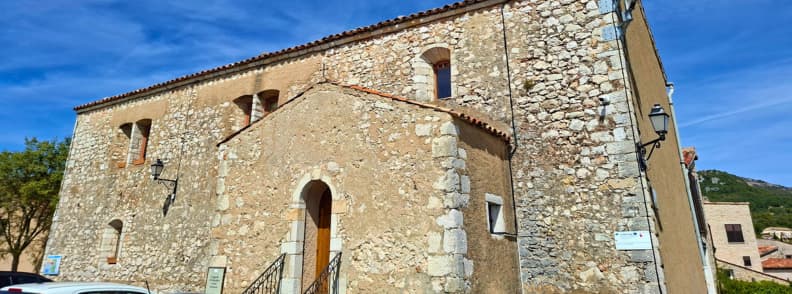
Mons also has several small religious buildings. The White Penitents Chapel Mons dates from 1604 and was dedicated to Saint Sebastian. Part of the building became the town hall in 1969, and today it houses the tourist information office, a local-products shop, and an art gallery.
A different chapel, Notre-Dame de la Pitié, stands outside the old center on the road toward Callian. The Notre-Dame chapel in Mons dates from the late 16th century and normally opens for the Journées du Patrimoine and on 15 August for the procession.
The 2026 fête patronale celebrations took place from 14 to 16 August, with Mass and a procession on 15 August, followed by an aïoli at Place Saint-Sébastien, pétanque, music, and evening events.
Best Things to Do in Mons Var
After several visits, my list of the best things to do in Mons Var still starts with walking around. Most Mons attractions are close together, and the village is small enough to explore without turning the entire day into a race. My advice on how to visit Mons Var is to park at Place Saint-Sébastien, start with the view, then let the old streets take over.
For me, the best things to do in Mons Var France are these:
- Start at Place Saint-Sébastien for the panorama.
The view across Lac de Saint-Cassien, Le Blavet, the Estérel, and the Îles de Lérins tops my list of what to see in Mons Var. Start with the Place Saint-Sébastien panorama, then turn toward the village. - Walk the old streets and follow the wrought-iron signs.
The Circuit des Enseignes is one of my favorite Mons sights. I never followed it religiously, but I kept finding the signs as I walked. Acoucharello, the midwife, is still the one I remember first. - Try to get inside Maison Monsoise and Lou Fournas.
I’ve missed them on all my visits, so I’d plan this part in advance. See the current access details in Maison Monsoise, Lou Fournas and Village Heritage. - Visit Notre-Dame-de-l’Assomption if the door is open.
I’m currently at two attempts, two closed doors. The church and smaller chapels are covered in Notre-Dame-de-l’Assomption and the Chapels, including the guided-visit option. - Stop for food instead of rushing through.
Our first visit ended with house wine and a cheese platter on the terrace at L’Auberge Provençale because William had no patience for a long lunch. Next time we visit with him, I want the proper meal. See where to Eat in Mons before relying on a terrace table at lunchtime. - Add a hike once you’ve seen the village.
The biggest Mons Var things to do list continues outside the stone streets, toward the Siagnole, Roche Taillée, the Dolmen de Riens, and Mont Lachens. I’m saving these for a return visit and an overnight stay. See Walks and Hikes Around Mons. - Come on Sunday morning for the market.
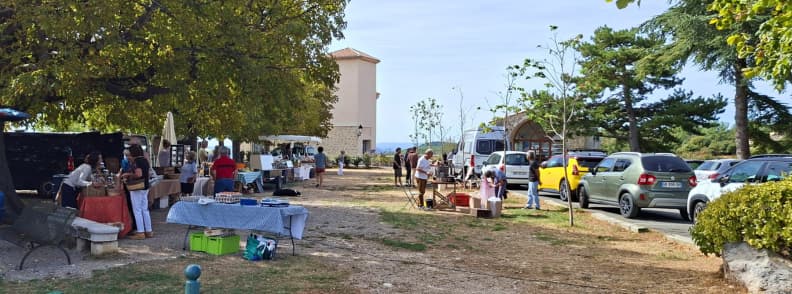
The current Mons Var market day is Sunday, with Le Petit Rucher de Mons at the Mons market from 9:00 am to 12:30 pm. I once caught the end of a small market beside the viewpoint, when it was already quiet. - Check the calendar before choosing your date.
Mons Var events include the August fête patronale, summer cultural events, pottery markets, exhibitions, and guided visits. My own priority is the Christmas market. My sister-in-law and nieces go every year, and I’m determined to join them this time! - Try canyoning, climbing, or fishing around the Siagne and Siagnole.
Mons Var canyoning and rock climbing nearby are real options. There is guided canyoning on the Siagnole from Mons, or you can try climbing sectors in the Gorges de Siagne and Siagnole around Mons. For Mons Var trout fishing rivers nearby, you can try for brown trout in the Siagne. The Siagnole is a technical river for experienced anglers. - Take to the air from Fayence-Tourrettes.
Take off is actually at the Tourrettes-Fayence airfield, not inside Mons. There are sightseeing flights by reservation to fly over the Pays de Fayence with Mons below.
In a nutshell, this is how to visit Mons, the perched village of the Pays de Fayence. Keep the village walk as the core, then add one extra according to your interests: market, lunch, museum, hike, canyoning, or another nearby village. There are plenty of things to do in Mons Var, but the old streets and the view are still the part I’d protect first.
Walks and Hikes Around Mons
Walking beyond the village is the part I still owe myself. On my visits so far, I stopped by the lavoir below L’Auberge Provençale and noticed the path disappearing into the trees. Next time I want to stay at the hiking gîte and give the countryside a full day.
Mons hiking starts almost at the edge of the old village. Mons trails descend toward the Siagnole valley, pass old olive terraces and prehistoric sites, and head north toward Mont Lachens. The GR49 also crosses Mons on its route between Saint-Raphaël and Rougon.
The best walks from Mons Var range from the short Riens outing to a full day on Mont Lachens. Riens one of the easy hikes near Mons Var, while Les Campagnes de Mons drops into the Siagnole valley. I cover Siagnole and Roche Taillée, Dolmen de Riens and the Megalith Route, and Mont Lachens separately below.
A night at the municipal gîte would help with Mons Var hiking, especially for an early start. The tourism office sells the FFRandonnée topo-guide Le Pays de Fayence à pied, and several route pages provide downloadable GPS traces. You can use those as your Mons Var hiking trail map before heading away from the village.
Mons hiking tip: The longer Mons Var hiking trails also need one extra check before departure in summer. From mid-June through late September, the Var prefecture publishes daily access rules for forest massifs according to wildfire risk. Check the official massif-access map the evening before your hike, especially during hot, dry weather.
Siagnole and Roche Taillée
The path below L’Auberge Provençale is the bit of Mons I keep saving for next time. I saw the trail drop past the wash house and disappear under the trees, toward the Siagnole below the village. After several visits spent mostly among the old streets, this is where I want my next trip in Mons to begin.
The Siagnole below Mons starts at the Neïssoun springs and runs for 5.8 km before joining the Siagne. This little river has been part of Mons’ water story since Roman times.
How to reach the Siagnole from Mons: Hike Les Campagnes de Mons loop. From Place Saint-Sébastien, the 10.3 km route passes L’Auberge Provençale, then descends on a rocky path beneath oak trees toward the protected source area and valley. A full Mons to Siagnole source walk takes four hours on this marked circuit, so I’d plan half a day for this outing.
The Roman story of Mons starts down here as well. The Mons Roman aqueduct carried water from the Siagnole toward Forum Julii, modern Fréjus, from the 1st century AD. The Aqueduc romain Mons Fréjus stretched for 42 km, crossing streams, cliffs, and the Estérel Massif on its way to the coast. Parts survived, including sections near Mons and arches closer to Fréjus.
The part I most want to see is the Roche Taillée. Roman engineers cut a passage 50 m long, 3.6 m wide, and over 10 m high through the rock to keep the channel at the required gradient. The Roche Taillée aqueduct section is still in service today, which makes this piece of Roman engineering unusually tangible.
A Roche Taillée Mons stop is free, with year-round access subject to weather conditions. I’d combine a Mons Var Roman aqueduct Roche Taillée visit with time in the Siagnole valley. A Roche Taillée Mons Var walk is a more realistic plan than trying to trace the entire ancient watercourse on foot.
The Mons Var Roman aqueduct is a historical route, not a continuous hiking trail. A Mons Roman aqueduct walk or ancient Roman aqueduct hike around Mons refers to modern paths near surviving remains. There is no single official trail following the whole structure. An ancient Roman aqueduct hike from Mons to Fréjus would therefore piece together separate modern routes, roads, and surviving sites.
Another thing to keep in mind is that the Gorges de la Siagne and the Gorges de la Siagnole are separate parts of the same river system. Mons is above the Siagnole, and the Siagne Gorges are farther downstream after the Siagnole joins the Siagne.
Long-distance hikers meet both areas through GR49 Mons. The 107 km GR49 crosses the Pays de Fayence via Lac de Saint-Cassien, the Gorges de la Siagne, Mons, and Mont Lachens before continuing toward Rougon. Hiking from Mons to the Gorges de la Siagne belongs to a longer outing, and the safest hiking trail from Mons to the Gorges de la Siagne is the current marked GR network.
Dolmen de Riens and the Megalith Route
I still haven’t explored properly the prehistoric side of Mons. The village has 11 late-Neolithic dolmens, dating back over 4,000 years, scattered through the countryside around Mons. The Mons megaliths can be grouped into a short family walk to Riens or a longer Brainées circuit for a full day.
The easiest option is taking the Dolmen de Riens Mons route. The trail starts at Place Saint-Sébastien, crosses the village along Rue Jean Vadon and Rue Pierre Porre, then heads toward Barriguetou and Saint-Pierre. The Riens dolmen walk from Mons is 4.5 km, takes around 1 hour 30 minutes, gains about 50 m, and is very easy. It’s even suitable for an all-terrain stroller!
The Riens Dolmen is 50 m off the small road, hidden in vegetation near Saint-Pierre. (This is why it’s also called the Saint-Pierre Dolmen.) Built inside a tumulus, the tomb once held collective burials. Its covering slabs are missing, but the pointed, ogive-shaped entrance survives as an unusual feature.
Riens is the most approachable Mons Var dolmen if you want prehistoric history without committing to a long hike.
Mons Var dolmen de Riens how to visit: Start from Place Saint-Sébastien and follow the signs for Sentiers des Mégalithes. Access is free year-round, and the official Riens Dolmen route page provides a GPX track.
The wider story is bigger than one tomb. The Mons Var dolmens include Riens, La Colle, and La Brainée, with the latter two lying farther along the route toward Escragnoles. These dolmens and prehistoric sites near Mons turn the hills around the village into an older layer of the Pays de Fayence than the medieval streets above.
A full Mons megalith circuit hike follows the longer Brainées option. I’d keep this for a separate hiking day. Riens is the better choice if you want to see a Mons Var megalith alongside the village, lunch, and the panorama without stretching the visit too far.
Riens is the prehistoric walk I’d choose first on my next stay in Mons. The distance is manageable, the trail begins right from the village, and the route adds something completely different to the stone lanes, and wrought-iron signs I already know.
Mont Lachens
At 1,714 m, Mont Lachens is the highest point in the Var, rising 900 m above Mons. Also called the Roof of the Var, the summit is inside a 43-hectare Espace Naturel Sensible, with the Forêt Domaniale d’Esclapon and the ruins of Vieux Esclapon on the approach.
A Mont Lachens hike from Mons needs a full day. It’s a 16 km loop taking about six hours that starts and finishes in Mons.
The reward is the summit panorama. Views stretch from Sainte-Baume to the Mercantour, with the Mediterranean in the distance. There’s also an orientation table at the top, plus another table identifying birds seen around the summit.
Mont Lachens hiking isn’t the only way up. Road access reaches the mountain from the Esclapon side or via the D21 near Col de Clavel, so you could visit the summit without tackling the full climb from Mons. Access to the natural site is free and available year-round, though mountain weather and summer wildfire restrictions still deserve a check before setting out.
Then, there are the people launching themselves off the mountain! Mont Lachens is one of the Var’s established free-flight sites, with paragliders and hang gliders using the summit. Spotting pilots take off alongside birds of prey is common here. If you want to try it yourself, reach out to Club Lachens Vol Libre for tandem flights.
| Route | Distance & Duration | Difficulty | Best season | Starting point | Notes |
|---|---|---|---|---|---|
| Les Campagnes de Mons, Siagnole valley | 10.3 km, 4 hr | No clear rating on the current FFRandonnée page | Spring and autumn. Check summer forest access before leaving | Place Saint-Sébastien | Partial shade, including an oak-shaded descent |
| Mégalithe de Riens | 4 km, 1 hr 30 min | Easy family walk | Year-round. Check summer fire restrictions | Place Saint-Sébastien | Officially described as a family walk |
| Mont Lachens | 16 km on the current FFRandonnée route, 6 hr | Difficult | Year-round in favorable weather | La Lubi d’Esclapon parking | Partial shade, with forest and undergrowth sections |
Where to Eat in Mons
The first thing I’d tell anyone deciding where to eat in Mons Var is to pay attention to the clock. Mons has a small number of places, and lunch tables disappear quickly in summer. My parents learned that the hard way. They wanted to have breakfast after 10 am despite my warnings, we reached Mons late, and the terrace with a view plan I had in mind was pretty much dead on arrival.
I’m not going to pretend I’ve eaten my way through all the best restaurants in Mons Var, because I’ve only stopped at one myself. There are only four restaurant options in the village, so dining in Mons, France needs a little planning, especially around weekly closing days and seasonal hours.
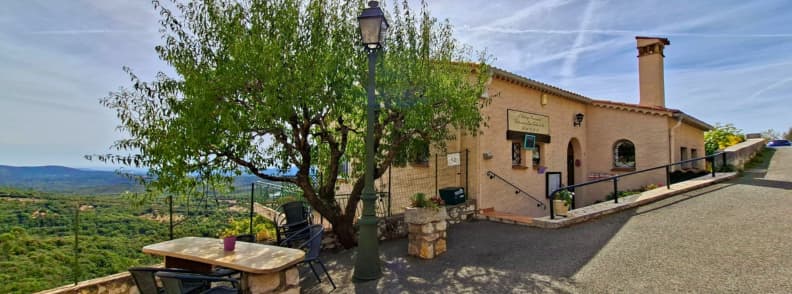
The place I know personally is L’Auberge Provençale. The Restaurant Auberge Provençale in Mons is below the old village with a terrace overlooking the Siagne valley, the Pays de Fayence hills, the Estérel Massif, and the Mediterranean. If your priority is where to eat in Mons Var with a panoramic terrace, this is the obvious address! There are only 30 terrace seats, though.
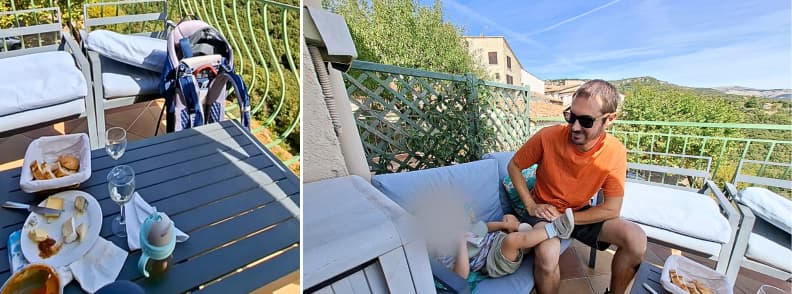
Our first stop here was improvised. William had zero interest in sitting through lunch, so the staff kindly let us settle into a corner of the terrace on some small couches. Mathieu and I shared a cheese platter and house wine while William ate the food we had brought for him, then we left as soon as he decided sitting time was over. They handled a restless toddler kindly, which I remember better than any formal meal.
I still want to return for a long lunch. The Mons Var Auberge Provençale menu prices list an €18 daily suggestion, €36 for three courses, €46 with cheese added, and €13 for the children’s menu. Outside the peak period, the Mons Var Auberge Provençale restaurant opens Monday, Tuesday, Thursday, Friday, and weekends from 9 am to 6 pm, with Wednesday closed. From July through August, hours extend to 10 pm with evening service. Annual closure is from 25 October to 4 December.
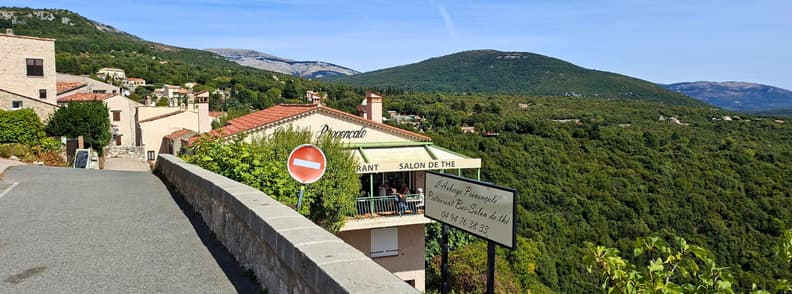
Book ahead if you want the terrace in summer. I arrived too late with my parents and the terrace tables we wanted were already gone. Among Mons Var restaurants with terraces, this is the one I’d reserve first because the view is part of the meal.
The Auberge also has a bar and tea room with homemade pastries, open during its daytime hours. This is a good option if you’re searching for Mons Var’s best cafés for coffee with a view.
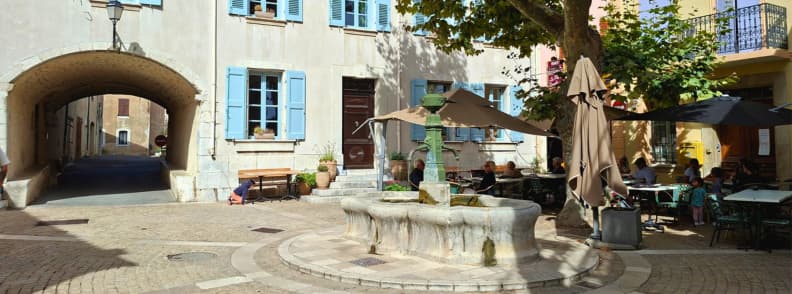
Another option is Le Petit Bonheur in Mons Var, which serves homemade oriental cooking alongside pizzas, with couscous priced from €18 to €25, pizzas from €12, and desserts from €8. They have a shaded terrace, and the restaurant opens Monday for lunch, then Wednesday to Sunday for lunch and dinner. Tuesday is the weekly closing day.
Then, there is Chez Brigitte et Rachel on Place Saint-Sébastien. Among Mons Var restaurants, this is the casual choice. Burgers, paninis, wraps, tacos, and sandwiches are listed alongside traditional dishes such as daube provençale, lasagna, and paella, with the latter available by reservation on weekends. Prices range from €10 to €19. It opens Tuesday to Saturday for lunch, with service until 2:30 pm.
Table d’Hôte Le Petit Château is the smallest of the current village options. The table d’hôte on Place Frédéric Mistral has only 20 seats, including 10 outside, and serves a daily dish, soups, cakes, Var wines, and produce sourced from local organic farms. It serves lunch from 11 am to 2 pm, from Monday to Saturday, with Sunday closed. With only 20 seats, I’d call before planning lunch around it.
Those four places cover Mons restaurants, from a panoramic Provençal meal to a quick lunch on Place Saint-Sébastien. Anyone comparing the best restaurants in Mons Var, Provence should check opening days first, then choose by the kind of meal they want. The village is too small for a long backup list.
The Boulangerie de Mons deserves its own stop. I haven’t tasted anything there yet, although I’ve wanted to since my first visit. That day the queue was huge and full of cyclists. My mother-in-law has already tried it and confirmed the bakery was very good, so I’m counting that as another reason to go back.
The Mons Var bakery is known for olive bread, fougassettes flavored with orange blossom, Provençal navettes, pastries, and sandwiches. It’s open from 8:30 am to 1 pm, except for Monday and Wednesday when it’s closed . A fresh-bread morning visit to the Mons Var bakery is a safer plan than arriving late and hoping plenty is left.
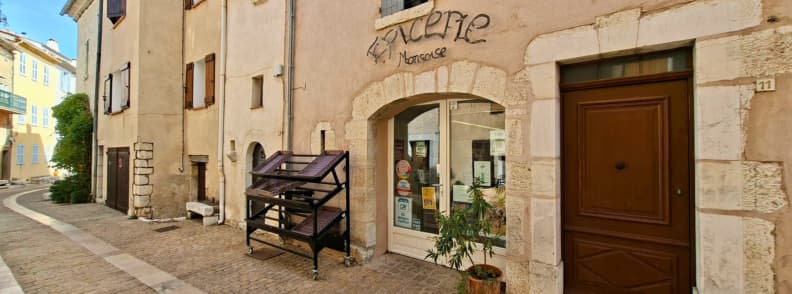
Picnic planning needs a little more care. Epicerie Monsoise served as the Mons Var grocery store for picnic supplies during July and August 2026, but it’s open only during summer. Outside those months, I’d buy supplies before driving up or use the bakery for bread and sandwiches when open.
For local food in the Pays de Fayence, Mons has a small selection. If everything in the village is full or closed, Fayence is a good fallback. You’ll find 23 restaurants there compared with four in Mons, which gives you a broader pool among the best restaurants near Fayence and Mons.
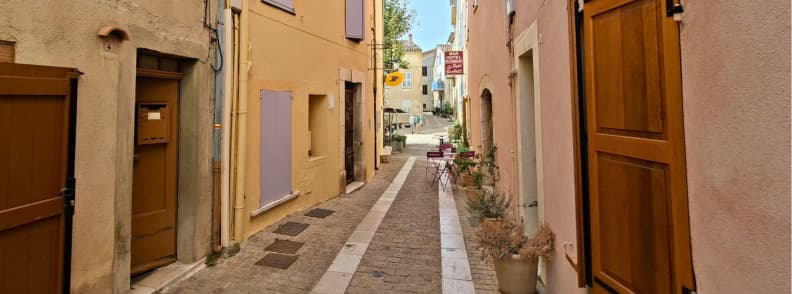
Where to Stay in Mons and Pays de Fayence
Mons accommodation is small-scale, which fits the village. I’d stay in Mons for hiking and early starts, then widen the search to Fayence or Tourrettes for pools, hotel services, and a larger choice. This is my practical split for where to stay in Mons Var.
The gîte I want for my next trip is the Mons hiking lodge in Pays de Fayence, right in the village. The Mons gite has 12 beds in four rooms, a shared kitchen, Wi-Fi, bike storage, and repair tools. Prices start at €20 for one bed, €38 for a two-bed room, €72 for a four-bed room, or €210 for the whole Mons Var gite. The lodge stays open year-round and requires advance reservation.
Mons Var communal gîtes booking information also limits stays to three consecutive nights from June through September and five nights during the rest of the year. For hikers, this is the Mons Var accommodation I’d pick first. GR49 passes through Mons, so sleeping in the village saves an early drive before a long day on the trails.
If you prefer conventional Mons hotels, widen the map to Fayence and Tourrettes. Mas de la Coste in Fayence is a good choice for a quieter stay with a heated outdoor pool, hot tub, terraces, breakfast, and the village center about four minutes away on foot.
For a splurge, Terre Blanche Hotel Spa Golf Resort in Tourrettes has suites and villas, pools, a spa, restaurants, and two golf courses. Families also have larger villa options. This is the luxury end of Mons Var’s best hotels and gîtes for a stay.
Le Moulin de la Camandoule in Fayence is the place I’d book for a smaller hotel with some character. The historic property has a restaurant, garden, pool, free parking, and air-conditioned rooms, so you have dinner and your bed in the same place after a day around the perched villages.
For Mons Var private vacation rentals on Airbnb, I’d compare prices and location with the official Pays de Fayence directory before booking. There are 19 furnished vacation rentals in Mons, which gives you a useful second source for houses and apartments in the village.
Camping means staying outside Mons. There is no Mons Var campsite. The nearest Mons Var camping sites near the village include options in Fayence, Tourrettes, and Saint-Paul-en-Forêt. Camping Le Grillon in Tourrettes stays open year-round, while Camping Le Parc in Saint-Paul-en-Forêt is available in the warmer season.
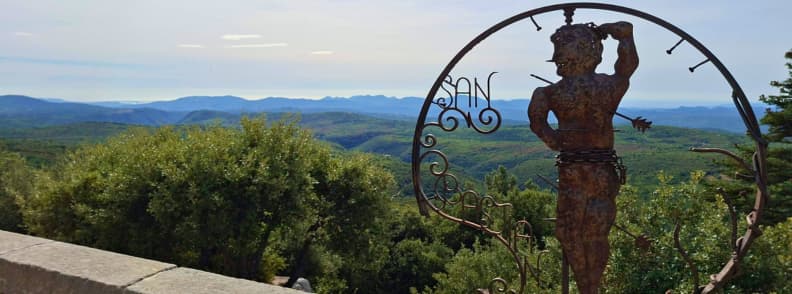
Best Time to Visit Mons
For me, the best time to visit Mons Var is late spring or early autumn. I’ve visited in summer and autumn, and the village changed less between those two trips than I expected. Summer brought a busier restaurant terrace, but the shade between the houses kept our walk comfortable. Autumn in Provence is quieter and better suited to taking our time.
The best time of year to visit Mons Var shifts with your plans. Village sightseeing is easy across much of the year. Hiking is better outside the hottest weeks. Photography depends on the light and visibility you want. Opening hours are the biggest reason to check the calendar before an off-season trip.
| Season | Heat | Views and photography | Hiking | Opening hours and crowds | Daylight |
|---|---|---|---|---|---|
| Spring | Cool mornings, increasingly warm afternoons | Green hills, spring flowers, softer light | One of my preferred periods for longer walks | Visitor services gradually expand toward summer | Days lengthen quickly |
| Summer | Warm to hot, with useful shade inside the village | Strong light, long evenings, occasional heat haze | Early starts are best. Forest access restrictions apply on high fire-risk days | Broadest opening pattern and busier restaurant terraces | Around 15½ hours near the June solstice |
| Autumn | Warm at first, cooler later | Good low-angle light, foliage later in the season, long-distance views on clear days | Excellent after the strongest summer heat has passed | Noticeably reduced visitor-office hours after September | Shortens rapidly through October and November |
| Winter | Cold mornings and cool afternoons | Clear days are good for distant landscapes | Best kept flexible around rain, frost, and mountain conditions | Quietest period, with limited heritage access | Around 9 hours near the December solstice |
Mons is at 814 m, so the Mons Var climate deserves a little more respect than the Côte d’Azur coast below. A hot day in the Var still reaches Mons, as summer 2026 proved, but evenings and mornings at this altitude often differ from Fréjus or Cannes. During my own Mons Var summer visit, I noticed the street shade most. Walking between the stone houses was much easier than several exposed summer outings elsewhere in the Var.
Summer also brings the longest days. Mons has about 15 hours 27 minutes of daylight around the June solstice, compared with about 8 hours 55 minutes around the December solstice. The extra evening light is useful for the viewpoint and village photography.
For hikers, summer has one serious drawback. From mid-June through the end of September, the Var prefecture publishes daily forest-access restrictions according to wildfire risk. Check the official access map the evening before any summer hike around Mons, the Siagnole, or Mont Lachens.
Spring is the period I’d pick for longer walks before the strongest heat arrives. Mons Var spring flowers and hiking conditions are especially appealing from April into June, when vegetation across this part of Provence is greener and wildflowers are active. Regional tourism guidance also points to spring for flowering vegetation and outdoor trips before peak summer heat.
Late spring is an excellent candidate for Mons Var’s best season for hiking and views. Early autumn is the other. September maintains useful daylight and warmer afternoons, while October starts bringing cooler walking temperatures. My own autumn visits were comfortable enough that the season never felt like a compromise.
Photography pushes the trip slightly later. For Mons Var autumn colors, the best time for photos is usually later in autumn, once deciduous vegetation around the surrounding valleys starts changing. Place Saint-Sébastien is still worth photographing even before the foliage changes because the panorama does most of the work.
Winter has a different appeal. A Mons Var winter visit means short days, colder conditions, and fewer open services, but also a much quieter village. The Mons Var summer vs winter visiting experience changes most in restaurant availability, heritage opening patterns, daylight, and outdoor planning, not in the basic pleasure of walking the old streets. Although you have higher chances of finding snow here than in the rest of Pays de Fayence.
Opening hours are one reason I lean toward late spring through September for a first visit. If museums and heritage interiors are important to you, check each place before driving up.
The Travel Bunny’s Mons travel tip: Looking at Mons Var weather by season, summer brings the greatest risk of heat and wildfire restrictions, spring and autumn offer the easiest hiking window, and winter brings the shortest days. Mons weather also changes quickly enough that I’d check the forecast before any long walk, even outside summer.
So my Mons Var best-time visit would fall in late spring or September into early October. That is also the best time to visit if hiking and village sightseeing share the same trip. For photography alone, autumn and clear winter days have their own appeal. For the broadest opening hours and long evenings, summer wins.
Visiting Mons With Children, Dogs or Limited Mobility
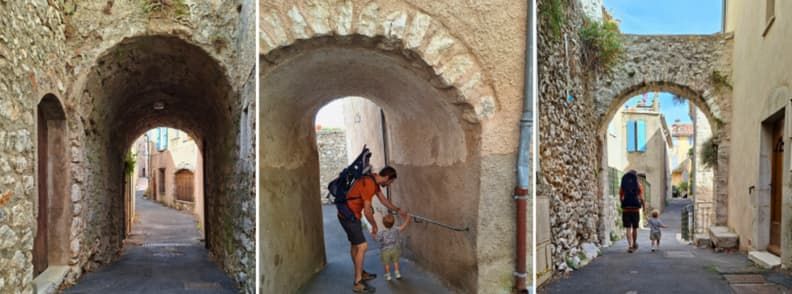
I’ve visited Mons with a toddler and later with my dad, who has limited mobility. Those visits taught me the same thing. The center is easier than the steep setting suggests, but you need to choose your route instead of assuming every lane will be comfortable.
Our first trip to Mons Var with kids was after we had already learned our lesson in Seillans. We left the stroller behind, so William walked most of the village himself, climbed steps, sat on every low wall that looked remotely suitable, and was completely worn out by the end. My strongest memory from that day is still him toddling along the stone streets on his little legs.
The official heritage circuit is gentler. The 1 km route from Place Saint-Sébastien is very easy, has only 19 m of ascent, follows hard surfaces, and is specifically listed as suitable for all-terrain strollers. The heritage trail one of the easiest Mons Var family activities with young children, especially if you want the panorama, wrought-iron signs, fountains, and old streets without committing to a hike.
I’d still choose an all-terrain stroller over a lightweight city model. Mons has calades, steps, slopes, and uneven patches once you leave the official circuit. The stroller-friendly designation applies to the marked heritage route, not to every old lane or trail below the village.
For Mons Var with children, Place Saint-Sébastien is an easy place to pause. William loved the goldfish fountain, and there are benches around the village when small legs need a break. That’s also where you’ll find a small playground.
The next step up is the Riens Dolmen circuit. Among the family walks in Mons Var, this one is 4.5 km, takes 1 hour 30 minutes, gains 50 m, and is very easy. This trail is also suitable for all-terrain strollers.
The Dolmen de Riens is one of the best family hiking trails near Mons Var and a good starting point for Mons Var hiking with kids on easy trails. I would still judge the distance against your own child, especially in hot weather.
The longer countryside routes belong in a different category. Mons Var hiking trails for families toward the Siagnole, the Gorges de la Siagne, and Mont Lachens include rocky ground, steeper descents, longer distances, and greater exposure to weather. They’re better with older children.
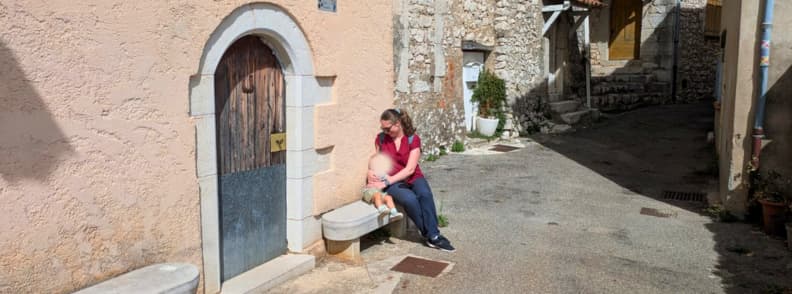
My visit with my parents gave me a better picture of limited-mobility access. My dad skipped the steeper lanes while my mom and I explored them, but he still saw a good part of central Mons because several streets around Place Saint-Sébastien are relatively flat. The benches helped too, as he used several while we wandered off and came back.
For Mons Var accessibility and wheelchair-friendly paths, I’d be more cautious. The official heritage route is very easy, hard-surfaced, and suitable for all-terrain strollers, but the tourism office doesn’t label the entire circuit wheelchair accessible.
Restaurant Chez Brigitte et Rachel on Place Saint-Sébastien is specifically listed as wheelchair accessible with assistance, with hard surfacing and the possibility of dropping someone directly in front.
Dogs are well catered for in the Pays de Fayence. The Pays de Fayence area, which includes the village of Mons, participates in the national Toutourisme network, which welcomes holidaymakers accompanied by their pets.
In Mons, restaurants L’Auberge Provençale and Chez Brigitte et Rachel both currently accept animals, and the White Penitents Chapel allows dogs on leash. These are useful starting points for Mons Var dog-friendly restaurants and trails.
The trail rules are worth reading before heading into the countryside with a dog. From 15 April to 30 June, dogs must be leashed on GR, PR, and GR de Pays trails outside forest roads. Dogs must also stay on leash in protected Natura 2000 areas such as the Gorges de la Siagne.
The Travel Bunny’s local hiking tip: Hikers should also be aware of livestock guardian dogs, or patous. If you meet a flock, keep your own dog leashed and move calmly away from the animals.
What to Visit Near Mons Var
Every time I visited Mons, I didn’t pair it with some other place, mostly because of our toddler’s schedule. Anyway, I think this is best for a first visit. Once you know Mons, though, the rest of the Pays de Fayence is close enough to turn a return trip into a wider day around the perched villages.
Pays de Fayence has nine hilltop villages, including Mons, Fayence, Tourrettes, Callian, and Seillans. Among Mons Var nearby villages, those four are the ones I’d pair first because each adds something different, from Fayence’s larger historic center to the art-filled streets of Tourrettes and the old stone lanes of Seillans.
The next section covers my preferred Mons Var nearby villages to visit on the same day, with Fayence, Tourrettes, Callian, and Seillans compared separately. I wouldn’t try to visit all of them in one afternoon. Mons deserves time to wander, and the other villages do too.
For a completely different stop, Lac de Saint-Cassien is high on my list of what to do near Mons Var. The 420-hectare reservoir spreads across Tanneron, Montauroux, Callian, and Les Adrets-de-l’Estérel, with swimming areas, paddling, fishing, and lakeside walks. I cover the lake separately below, especially for anyone who wants water and an outdoor break after a morning among the stone villages.
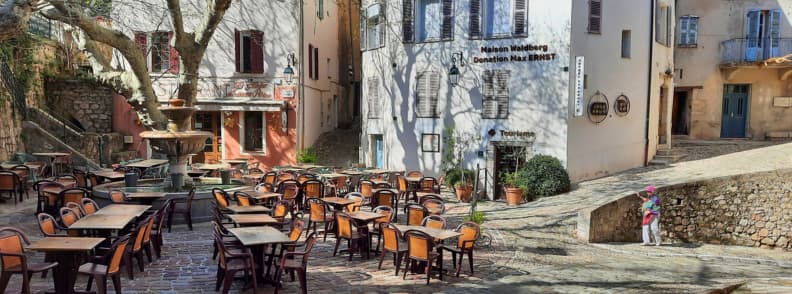
Fayence, Seillans, Tourrettes, and Callian
Mons in the Pays de Fayence is easier to place once you look beyond the village itself. The route through the Pays de Fayence villages links nine perched communities across this part of the Var. Fayence, Tourrettes, Callian, Seillans, and Mons are close enough to pair naturally, but each has a different character. These are the villages near Mons in Pays de Fayence I’d consider first if you have extra time.
Fayence is my easiest add-on. A Mons Var-Fayence day gives you two different versions of the same inland scenery. Mons is much higher, with that wide panorama from Place Saint-Sébastien. Fayence spreads across the hillside below, with its Clock Tower, market, cafés, shops, and a busier village center. If you want lunch or need to pick up supplies, Fayence is the practical stop.
Tourrettes is right next to Fayence, so I’d pair those two without overthinking the route. The old village has become an open-air art museum, with mosaics, paintings, metalwork, and other pieces tucked into doors, walls, and corners. You notice them as you walk, and you can also follow a formal museum route.
Callian belongs to the same group of Var medieval villages, but the mood changes again. The old streets curl around the château, with views opening toward the Estérel. A Mons Var-Callian pairing also gives you a nice change in altitude. Mons is closer to the mountains, while Callian looks across the lower Pays de Fayence and toward Lac de Saint-Cassien.
Visiting Seillans gave me the most useful family comparison. After visiting it with William, we stopped bringing the stroller into small perched villages. Still, a Mons vs Seillans comparison is useful for families. Seillans has steeper medieval lanes and more awkward paving, while central Mons is easier to visit with small children and adults with limited mobility.
A Mons Var-Seillans day would also avoid the problem of seeing two villages that blur together afterward. Seillans has its own artistic identity and belongs to Les Plus Beaux Villages de France, with strong links to Max Ernst and Dorothea Tanning. Mons has the higher mountain setting, the wrought-iron signs, and that enormous view.
My best villages near Fayence shortlist starts with Tourrettes, Seillans, Callian, and Mons. They’re also among the best villages in Pays de Fayence for seeing how different these places are despite the short distances between them. The full nine-village circuit also includes Montauroux, Tanneron, Saint-Paul-en-Forêt, and Bagnols-en-Forêt.
I’d keep a hilltop villages Var tour deliberately small. Two villages in one day is enough for me. Three still leaves time for lunch and a slower walk. A Var perched villages tour with five or six stops just isn’t doable unless you’re just driving through.
Mons, Seillans, and Fayence sometimes appear in roundups of secret villages of the French Riviera, but all three sit inland in the Var, west of Grasse. They belong to the arrière-pays, not the coastal strip most visitors picture when they hear Côte d’Azur.
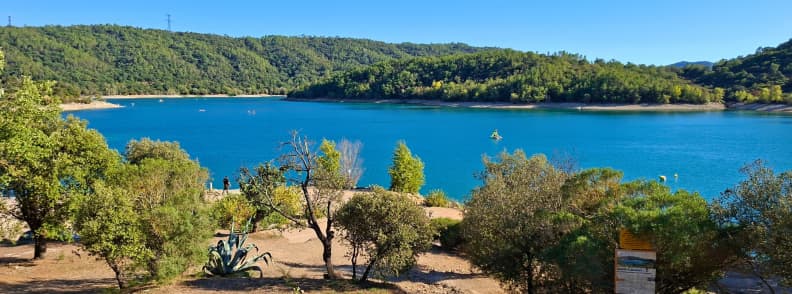
Lac de Saint-Cassien
You can already see Lac de Saint-Cassien from the viewpoint in Mons, so dropping down to the water afterward is an easy change of scenery. The 420-hectare lake spreads across Tanneron, Montauroux, Callian, and Les Adrets-de-l’Estérel, with beaches, picnic areas, and walking trails around its shores.
A Mons to Lac Saint Cassien day is best in summer, when I’d keep Mons for the cooler morning and head toward the lake later. Around the water you’ll find pedal boats, kayaks, paddleboards, sailing, rowing, and seasonal swimming areas.
This makes Lac de Saint-Cassien the main Mons Var water-sports option once you leave the mountain village. Families also have a playground, beach volleyball, pétanque, and a supervised swimming area near the Maison du Lac during the summer season.
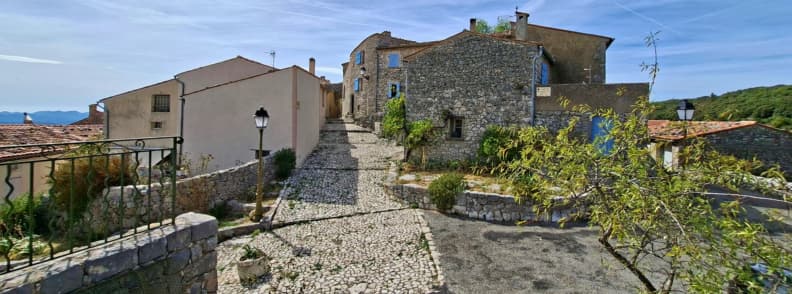
Mons Var FAQ. What to Know Before You Visit
I’ve pulled together the practical details I’d want before driving up to Mons for the first time, plus a few things I only understood after visiting myself. This Mons Var FAQ covers altitude, parking, driving times, walks, restaurants, family access, nearby villages, viewpoints, and what you can realistically fit into one day, with short answers you can check quickly while planning your visit.
What is Mons famous for, and what makes the village of Mons in the Var unique?
Mons is at 814 m, making it the highest village in the Pays de Fayence. The draw is the panorama from Place Saint-Sébastien, old stone streets, wrought-iron trade signs, prehistoric and Roman heritage, plus direct walking and hiking access toward Riens, the Siagnole, and Mont Lachens.
Is Mons Var worth visiting?
Yes. Mons in the Var is worth visiting if you like small hill villages, wide views, local heritage, photography, or hiking. I’ve happily visited the village several times. Two to three hours covers the village well. I’d skip Mons only if you want major museums, shopping, or a packed attraction list.
What is the altitude of Mons Var? how high is Mons Var?
The altitude of Mons in the Var is 814 m. The exact altitude of Mons Var shouldn’t be confused with Mont Lachens at 1,714 m. Also, Mons is the highest village in Pays de Fayence, not the highest village in the Var!
What are the best things to do in Mons Var?
The best things to do in Mons are:
– See the panorama from Place Saint-Sébastien.
– Walk the Circuit des Enseignes.
– Explore the old village streets.
– Visit Maison Monsoise and Lou Fournas when open.
– See Notre-Dame-de-l’Assomption.
– Walk to the Dolmen de Riens.
– Explore the Siagnole and Roche Taillée.
– Hike toward Mont Lachens.
– Stop for lunch or a drink at L’Auberge Provençale.
These are also my best things to do in Mons Var for a first trip, with the village itself taking priority over trying to fit everything into one day.
How long do you need in Mons?
One hour is enough for Place Saint-Sébastien and a quick heritage loop. Two to three hours gives you time to wander properly. Half a day is my preferred first visit. A full day is worth planning if you add Riens, a longer walk, lunch, or museums.
Where can you park in Mons Var?
I park at Place Saint-Sébastien, right beside the village center. The official heritage route still lists that parking as free. There is also free parking at Place de l’Église and at the village entrance, and another free parking by the lavoir below L’Auberge Provençale.
How do you get to Mons Var from Nice/Cannes?
By car it’s the easiest. From Nice, Mons is at 77 km and 1 hr 10 min away. From Cannes, the road distance is 48 km and 55 min. Arriving from the coast means taking the A8 toward the Pays de Fayence, then local roads toward Mons. Keep in mind that times change with traffic.
For getting to Mons from Nice/Cannes, public transport takes much longer. ZOU has line 832 between Cannes and Fayence and the on-demand 803 between Callian, Fayence, and Mons.
From Fréjus, you have 45 km and 45 to 50 minutes by car.
What is the best time of year to visit Mons?
My best time of year to visit Mons is late spring or early autumn. However, summer has long days and broader opening schedules, and I found the shaded village streets comfortable even in warm weather. But hiking is better outside the hottest weeks.
Winter brings shorter days and fewer open visitor services, but clearer air sometimes helps photography. For a first visit combining village walking, lunch, and hiking, I’d choose May, June, September, or early October.
Can you see Corsica from Mons?
Sometimes. Corsica is visible from Mons in exceptionally clear conditions. I haven’t personally seen Corsica from the viewpoint, but I have clearly seen the Îles de Lérins, Lac de Saint-Cassien, Le Blavet, and the Estérel.
What villages are near Mons Var to visit same day?
Fayence, Tourrettes, Seillans, Callian, and Montauroux are the obvious choices in Pays de Fayence.
Mons plus Fayence and Tourrettes is a logical combination because Fayence and Tourrettes are so close to each other that it’s hard to tell where one ends and the other begins.
Mons plus Callian and Montauroux fits well if you continue toward Lac de Saint-Cassien. Seillans goes nicely with Fayence when heading west across the Pays de Fayence.
I’d choose two villages, maybe three at most, instead of rushing through the whole circuit.
Is Mons Var good for families with children?
Yes. I visited Mons with a toddler, and he walked a surprising amount of the village himself. The goldfish fountain at Place Saint-Sébastien was an immediate success, and the benches helped when little legs needed a break.
The official 1 km heritage circuit is graded very easy and takes about one hour.
Is Mons accessible with a stroller?
An all-terrain stroller is suitable for the Mons heritage circuit. The route has a hard surface and only 19 m of positive elevation. Keep in mind that this classification applies to the marked village route, not the gorge paths or longer hikes.
Is Mons wheelchair accessible?
Parts of central Mons are relatively flat, which surprised me when I visited with my dad, who has limited mobility. He stayed around the easier streets and benches while my mom and I explored the steeper lanes.
The official heritage route isn’t specifically classified as wheelchair accessible, though. Chez Brigitte et Rachel also mentions it’s wheelchair accessible with assistance.
Mons Var is accessible for families and individuals with reduced mobility to a point, but route choice is important.
Are dogs allowed in Mons?
Dogs are accepted at several current village businesses, including L’Auberge Provençale and Le Petit Bonheur. The municipal hiking gîte doesn’t accept pets, though. Trail rules vary, especially in protected natural areas, so check the route before a longer hike.
Are there hiking trails near Mons Var?
Yes. The best walks around Mons range from the 1 km heritage circuit to the 4.5 km Dolmen de Riens walk, longer megalith routes, the Siagnole valley, GR49, and Mont Lachens. The municipal hiking gîte is right in the village for longer walking trips.
What are the easiest walks near Mons?
Start with the 1 km heritage circuit, very easy. Riens is the next step, at 4.5 km, around 1 hr 30 min, with 50 m of ascent, also very easy.
How do you reach the Siagnole?
Marked routes descend from Mons toward the Siagnole valley. The longer Les Campagnes de Mons walk starts from the village and drops toward the river and source area. I’d use the official route or GPX instead of trying to improvise a shortcut from the roads.
How do visitors access the Roman Aqueduct of Mons to Fréjus?
The easiest surviving feature to see near Mons is Roche Taillée on the D56, where Roman engineers cut through rock for the aqueduct carrying Siagnole water toward Fréjus. The remains are alongside the road corridor below Mons. There is no continuous pedestrian trail following the entire ancient aqueduct to Fréjus.
What is Roche Taillée?
Roche Taillée is a dramatic rock cutting created for the Roman aqueduct from the Siagnole toward Fréjus. The ancient aqueduct ran for about 41.5 km, and the surviving cutting below Mons is one of the clearest places to understand the scale of that engineering.
What is the Dolmen de Riens?
The Dolmen de Riens, also called the Dolmen de Saint-Pierre, is one of 11 late-Neolithic dolmens recorded around Mons. The 4.5 km return walk from Place Saint-Sébastien is very easy and reaches the dolmen through the countryside east of the village.
What is the Circuit des Enseignes?
The Circuit des Enseignes is a trail through Mons marked by 35 wrought-iron signs showing trades once practiced in the village. My favorite is Acoucharello, the midwife, which I deliberately try to see on every one of my visits.
This is the significance of the iron signs in Mons. They connect individual houses and streets with former village occupations instead of putting all the history inside a museum.
What is Maison Monsoise?
Maison Monsoise preserves the interior features of an old village home, including the potager, bugadier, old fireplace, and stone hearth. Guided visits with Lou Fournas are available by reservation. I’ve found Maison Monsoise closed on my visits, so I’d book ahead.
Where to eat in Mons Var?
L’Auberge Provençale is the only Mons restaurant I’ve personally tried. Mathieu and I shared cheese and house wine on the terrace while William ate his own food, and the staff were kind about our restless toddler.
Among the best restaurants in Mons Var, you have L’Auberge Provençale for Provençal cooking and the view, Le Petit Bonheur for couscous and pizza, and Chez Brigitte et Rachel for a quick lunch.
Where travelers dine in Mons Var also depends on opening days. I’d book the Auberge terrace in summer.
Where can you stay in Mons?
The municipal Gîte de Randonnée de Mons is the most useful stay for hikers. The year-round lodge has 12 beds in four rooms, a shared kitchen, Wi-Fi, bike storage, and 2026 rates from €20 per bed. Reservations are required.
What does Village de Caractère mean in France?
For Mons, Village de Caractère refers specifically to the Villages de Caractère du Var network. This is a Var heritage and tourism label, separate from Les Plus Beaux Villages de France. Mons is one of 15 villages currently included in the Var route.
What is Mont Lachens?
Mont Lachens rises above Mons to about 1,714 to 1,715 m and is the highest point in the Var. The mountain has hiking access, road access from the Esclapon side, and established paragliding and hang-gliding launch areas.
How far is Mons from Fayence?
Mons is at 14 km by road from Fayence, with a drive of 15 minutes on the shorter route. Allow extra time for local traffic and winding roads.
Where is Mons in France? is Mons part of the Pays de Fayence?
Mons is in the Var department of Provence-Alpes-Côte d’Azur, inland from Cannes and Fréjus. Yes, Mons is part of the Pays de Fayence, alongside Fayence, Tourrettes, Seillans, Callian, Montauroux, Tanneron, Saint-Paul-en-Forêt, and Bagnols-en-Forêt.
What’s the population of Mons Var?
INSEE gives Mons a 2023 municipal population of 909, the latest reference population in force in 2026.
Why is Fayence known for gliding?
The Fayence-Tourrettes gliding center has been open since 1929. Nearby relief produces strong thermal convection, frequent convergence, and wave conditions, which support long sailplane flights and pilot training.
Can you visit Mons without a car?
Yes, but I’d still choose a car. ZOU has line 803 Callian-Fayence-Mons as an on-demand service, while line 832 connects Cannes with Fayence. The limited connections make spontaneous day trips harder than driving.
Can you visit Mons Var on a sailing trip?
Yes, as an inland day trip from the Côte d’Azur. From Cannes, you’ve got a drive for 48 km and 55 minutes. From Fréjus, it’s 45 km and 45 to 50 minutes. I’d rent a car and spend at least half a day visiting Mons instead of turning this into a rushed shore stop.
What landmarks are visible from Place Saint-Sébastien in Mons?
I’ve personally seen Lac de Saint-Cassien, Le Blavet, the Estérel, and the Îles de Lérins. The orientation table also identifies the bays of Cannes and Saint-Raphaël, with Corsica sometimes visible in exceptionally clear conditions.
Can you swim in the Gorges de la Siagne near Mons?
Yes, swimming is possible at selected parts of the Siagne. You can take a dip near Pont des Tuves, and guided aquatic outings include swimming in the Haute-Siagne. Pont des Tuves is reached from Montauroux, not directly from Mons.
What can you visit near Mons?
Fayence, Tourrettes, Seillans, Callian, Montauroux, and Lac de Saint-Cassien are the easiest additions. I’d pair Mons with one or two places based on your route, then leave the rest for another day. This keeps the day focused on the villages instead of the car.
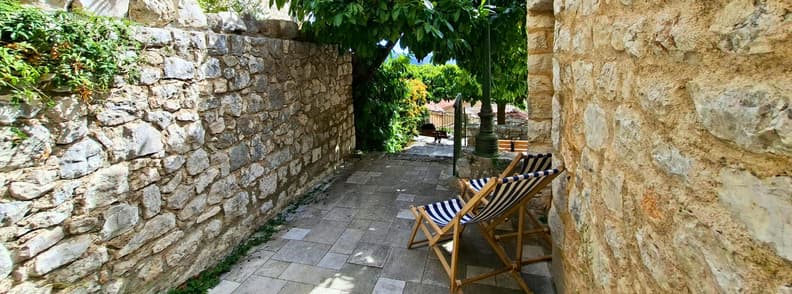
My Final Advice for Visiting Mons France
I’d visit Mons slowly the first time. Park at Place Saint-Sébastien, look at the panorama before you start walking, then follow the streets without trying to tick off every sight. A half day is enough to know the village without rushing through it. This is how I’ve visited several times, and I still have reasons to go back.
If hiking is your main reason for coming, stay overnight. Hiking to the Dolmen de Riens can be added to a village visit, but the Siagnole, Roche Taillée, and Mont Lachens require more walking time. The official heritage trail starts from free parking at Place Saint-Sébastien, and longer routes lead well beyond the old center.
My Mons Var guide for locals and expats is also meant for people who live close enough to return. Mons doesn’t need to become a once-only sightseeing stop. I still want to have a long lunch at L’Auberge Provençale, try the bakery myself, finally catch Maison Monsoise and the church open, hike from the village, sleep at the gîte, and come back for the Christmas market.
This is where Mons Var for locals and expats becomes especially rewarding. You don’t have to force the village, a hike, lunch, museums, and nearby villages into one day. Pick one reason to return. Mine is currently the Christmas market, closely followed by a hiking weekend.
The part I remember most still isn’t a monument. William was walking over the stone streets, stopping whenever something caught his attention, while the rest of us kept adjusting our route around him. Mons is better when you leave enough time for the small detours.
About the Author

Hi! I’m Mirela Letailleur, the travel writer behind The Travel Bunny, based in the Var and living in the Pays de Fayence area since 2021. I write first-hand guides to Mons Var, Fayence, Seillans, Tourrettes, Callian, the French Riviera, and inland Provence, using my own visits, local knowledge, and on-the-ground travel experience.
I’ve visited Mons in different seasons with my husband, young son, and parents, so I know the village from several practical angles, including family travel, limited mobility, parking, restaurants, viewpoints, and walking routes. I research every guide against current local sources, then add the details I’ve seen and tested myself.
After planning your visit to Mons Var, check these other local travel guides on The Travel Bunny
Visiting Tanneron France. The Complete Travel Guide to Provence’s Mimosa Village
Bagnols-en-Forêt. Discovering the Hidden Charm of Provence
Life in a French Village. The Realities of Moving to the South of France