
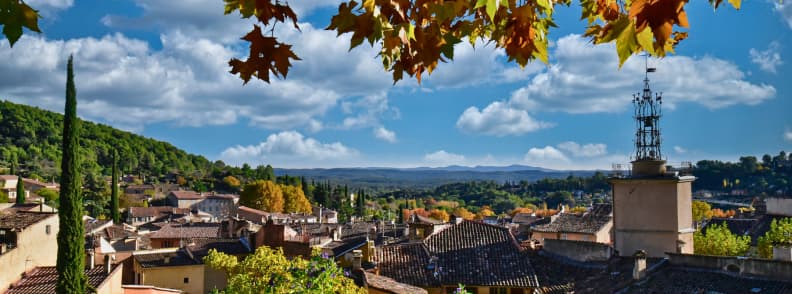
Autumn in Provence is a slightly misleading phrase. In September, summer hasn’t quite received the eviction notice. The school holidays end, families with older children leave, parking spaces reappear, restaurant terraces calm down, and the Mediterranean is still warm enough for swimming.
I’ve been living in Provence-Alpes-Côte d’Azur since spring 2021, after visiting regularly from 2017 and spending several months here in 2020. I’ve noticed that Provence in autumn changes faster than the calendar suggests.
Provence Autumn Guide
September is my favorite month here. (Birthday bias acknowledged.) A Provence September has much of what I like about June, with cooler afternoons and a sea that has already spent the summer warming up. Older visitors, grandparents traveling with children below school age, and people free from school calendars replace much of the August crowd. Prices generally ease too. Fall in Provence starts with swimming, open terraces, and locals gradually reclaiming places that were packed a few weeks earlier.
October sits in a less predictable middle ground. Recent Provence October weather has often stayed summery enough for T-shirts during the day, and I’ve still swum during the first week of the month. At the same time, campsites start closing, restaurants reduce their opening days or menus, and seasonal businesses begin winding down. Provence fall travel gets easier in practical ways, especially parking and crowds, but checking opening days becomes increasingly important.
By Provence November, the change is clearer. Daytime can remain mild enough for short sleeves, while evenings turn cold quickly. In the Pays de Fayence, chimney smoke starts returning around late October, and I prefer airing the house before late afternoon unless I want the bedroom scented like somebody else’s fireplace. Swimming season is over for me by then, but there will still be locals in the Mediterranean, naturally. I don’t think I’ve reached that level of Provençal citizenship.
The scenery also needs some expectation management. Provence fall rarely produces forests of red and orange leaves. Around the Pays de Fayence and much of the Mediterranean coast, vegetation often starts yellowing and even falling during the dry summers.
Coming from Romania, I find late Provence in fall closer to early autumn in Eastern Europe than to the deep seasonal change I grew up with. Autumn here announces itself through cooler nights, harvested vineyards, mushrooms appearing after rain, chestnut baskets, olives on the trees, and eventually the smell of wood smoke.
This seasonal progression is why Provence autumn travel deserves a month-by-month approach. September is great for swimming, vineyards, outdoor meals, and travelers who want summer without peak-season pressure. Then, October brings harvest events, hiking, mushroom season, Halloween celebrations, and the first serious reduction in seasonal opening hours. And finally, November rewards travelers who value quiet towns, food, markets, walking, and daily life over beach time.
Provence travel in fall also changes according to where you go. The coast can remain lively well into October while inland villages quiet down sooner. Hiking becomes easier once the harshest summer heat passes and the massifs reopen, although hunting season introduces its own restrictions on some trails. Local markets continue through the season, while accommodation remains available even as many highly seasonal properties shut after September.
The Travel Bunny’s Provence autumn travel guide 2026 will separate those differences instead of treating three months as one interchangeable shoulder season. I’ll compare weather, swimming, autumn colors, harvests, markets, hiking, sailing, accommodation, crowds, seasonal closures, and the practical changes I’ve watched from living here year-round. Consider this a complete traveler guide to autumn in Provence France, with enough detail to help you decide not merely whether to visit Provence in autumn, but which part of the season actually fits the trip you want.
Disclosure: Some of the links on this page are affiliate links. This means that at no extra cost to you, The Travel Bunny will earn a small commission if you click through and make a purchase. Thank you!
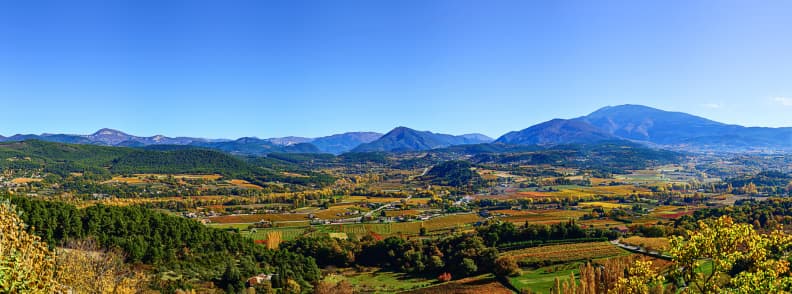
Is Autumn a Good Time to Visit Provence? My Answer as a local
Yes, I think autumn is one of the best periods to visit Provence, and September is the month I would choose above the others. You keep much of the warm weather, the Mediterranean has had all summer to heat up, school-holiday crowds retreat, and prices generally start easing. After living in Provence-Alpes-Côte d’Azur for the past half a decade, I’ve found the best time to visit Provence in autumn arrives surprisingly early. It begins as soon as the September school term sends much of the August crowd home.
My best time to visit Provence recommendation comes with one important qualification. Autumn here is a puzzle of different types of trips. September still belongs partly to summer, October sits between beach days and harvest season, and November is much quieter, especially once seasonal accommodation and businesses reduce their opening periods. The best month to visit Provence therefore depends on what you plan to do, although September wins for me by a comfortable margin.
The idea of a Provence shoulder season is often oversimplified. Early September can still resemble high season in weather, yet the human geography changes almost immediately. Families tied to school calendars leave first. They are replaced by older couples, grandparents traveling with very young children, and people free to travel outside school holidays become much easier to spot. Locals start moving around their own towns again.
Provence in shoulder season is particularly good for travelers who found July and August too hot, expensive, or crowded. Restaurants are still active, beaches haven’t emptied completely, and the coast hasn’t entered its winter rhythm. I also find it easier to travel locally in spring and autumn because road traffic drops enough to make day trips and parking less tiresome.
By late autumn, Provence off season has settled in. November has a different pace from September, with cooler evenings and fewer seasonal businesses operating every day. The advantage is space, lots of space wherever you go. The disadvantage is that you need to check opening schedules because many campsites, restaurants, beach businesses, or seasonal rentals close out of season.
This distinction and your personal priorities come to affect the best time of year to visit Provence France. Summer still has the longest days, the broadest seasonal opening schedules, and the classic beach-holiday atmosphere. Provence in spring gives you greenery, flowers, and comfortable outdoor temperatures. Autumn adds warm sea temperatures early in the season, harvests, hiking, easier parking, and a gradual return to ordinary local life.
Is autumn a good time to visit Provence? Very much so. September is the best all-round month in my opinion, with warm sea temperatures, good weather, and fewer crowds. October is ideal for hiking and food-focused trips as temperatures cool, while November is much quieter and better for slow travel, markets, and seasonal produce than beach days.
September vs October vs November. Which Month Should You Choose?
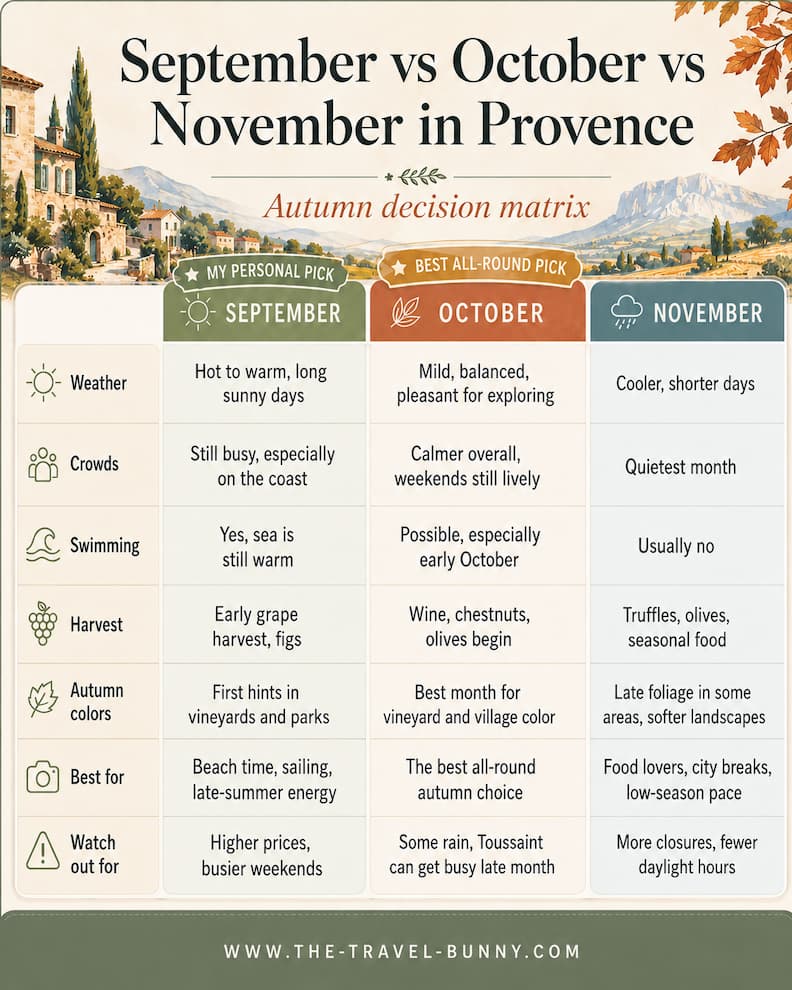
Choose September for the widest range of options, October for hiking and harvest season, and November for quiet towns, food, and a slower trip. After several autumns living in France, I would still choose September without much hesitation. October comes second, and November is a deliberate choice and not a consolation prize.
September is a good time to visit Provence if you want summer conditions without the full summer population. French schools restart at the beginning of the month, and the change becomes obvious quickly. Families tied to school calendars leave, roads clear, parking becomes less competitive, and beaches lose much of their August crowd. You will notice more new parents with prams, older couples and grandparents traveling with children below school age.
September travel in Provence also has one advantage June cannot match: the Mediterranean has been warming all summer. I think of Provence in September as June with better swimming. Daytime heat usually becomes easier to manage, but beach days remain entirely realistic and amazing. This is the month I pick for coast, markets, outdoor meals, vineyards, and longer days outside without arranging the entire schedule around the hottest part of the afternoon.
The Provence September vs. October choice becomes less obvious if swimming isn’t important to you. September offers greater certainty for beach time and seasonal businesses, while October brings cooler walking conditions and more events related to the harvest season. The famous grape harvest takes place from late August into mid-October, so both months overlap with vendange season.
The difference between visiting Provence in September versus October becomes especially noticeable at campsites, coastal businesses, and restaurants. In September, most summer infrastructure is still operating. During October, many campsites close and restaurants increasingly move to reduced schedules or shorter menus. Accommodation does remain available, but checking actual opening days becomes far wiser than trusting what Google displayed in July.
This doesn’t make October gloomy. Quite the opposite. October is a good time to visit Provence for hiking, village events, vineyards, mushrooms, chestnuts, quinces, and food-focused trips. Recent Octobers where I live have often stayed remarkably summery during the day, but I’ve still gone swimming during the first week of October.
Is Provence good in October? Yes, especially if you don’t need guaranteed beach weather. The Mediterranean coast can stay mild while inland walking becomes far more comfortable after the scorching summer heat. Autumn access to natural areas also improves once summer fire-risk restrictions ease, though hunting season introduces another reason to check local conditions before choosing a trail.
The practical list of what to do in Provence in September and October overlaps quite a bit. You can visit markets, tour vineyards, hike, explore villages, eat outside on warm days, and spend time along the Mediterranean in either month.
The Provence September vs. October comparison for visitors also changes according to school schedules. September is exceptionally attractive if you can travel after the rentrée because a large share of French and international family tourism has already departed. October can regain some domestic traffic during the Toussaint school holidays. Local families who worked the season can finally travel freely, so the word quiet deserves a small asterisk. Provence tourism data from previous Allsaints periods has shown a clear rise in French visitor activity during Toussaint holidays.
November changes the calculation far more dramatically. Provence in November has moved away from beach season and into a quieter local rhythm. Sunny afternoons can still be mild enough for a T-shirt in sheltered areas, especially near the coast, while evenings turn cold quickly.
Provence is worth visiting in November if you actively search calm instead of a discounted version of September. Villages are quieter, truffles start returning to regional markets, olive harvest activity increases, and hiking remains appealing between short spells of rain.
A useful November guide to Provence should also mention what disappears. Many seasonal accommodations have closed, some restaurants operate fewer days, and coastal businesses built around summer visitors may shut until spring. Cities such as Aix-en-Provence, Marseille, Avignon, and Arles give you a wider year-round choice than small resort towns, especially if restaurants and museums are central to your plans.
Provence is worth visiting in October with very few caveats for independent travelers. November asks for a bit more flexibility. Those are different propositions. October still offers a reasonable chance of warm afternoons and occasional sea time early in the month. By November, I would plan around markets, villages, cities, walking, food, vineyards, museums, and inland excursions instead.
Provence November travel tips: Plan outdoor stops earlier, check restaurant opening days before driving across the countryside, and keep a warmer layer in the car even after a sunny lunch in short sleeves.
Mediterranean autumn weather can shift sharply, and Météo-France describes autumn as a season when mild spells alternate with colder, wetter periods, including potentially intense Mediterranean rain episodes.
How long autumn lasts in Provence depends on whether you mean the calendar or what you experience outside. Meteorological autumn covers September, October, and November, but Provence doesn’t move neatly from summer to winter on schedule. As I said, September often behaves like softened summer, and October can continue the same for surprising stretches. It’s November that finally makes the seasonal change much harder to ignore.
That is why Provence September travel remains my first recommendation. You gain much of summer while losing much of the summer crowd.
Who Will Love Provence in Autumn, and Who Should Come Another Season?
Autumn is particularly good for people who want Provence after it has stopped performing quite so hard for tourists. The famous places are still there, but ordinary life becomes easier to spot around them. You’ll find markets serving locals buying dinner instead of entire coach parties buying soap. Forest paths fill with mushroom hunters carrying woven baskets after rain. Village calendars turn toward local food celebrations, association events, Halloween parties, and whatever somebody has managed to organize in the salle des fêtes.
This makes autumn especially rewarding for repeat visitors. Someone returning after a first summer trip already knows Gordes exists and doesn’t need to spend seven days collecting famous village names. Instead, they can pay attention to smaller places, local producers, weekly markets, and the everyday side of Provence that becomes harder to notice at the height of the tourist season.
Couples also have an unusually easy time here once summer crowds thin out. Provence autumn activities for couples don’t need much choreography. A market morning can turn into lunch somewhere nearby, a drive can stop because a village fête happens to be underway, and an afternoon can stretch without the constant calculation of queues and reservations. That’s a better basis for a Provence romantic getaway in autumn than rose petals arranged on a hotel bed by somebody who has clearly been through this routine before lunch.
Families get a different version of autumn. Provence fall events for families often come from local calendars rather than major attractions. In my area, Halloween is taken seriously enough that my local Carrefour Contact runs an annual costume competition and, in recent years, a pumpkin-decoration contest too.
The French interpretation of Halloween is refreshingly strict. Halloween costumes are supposed to be scary. Turning up dressed as a princess who has suffered no visible supernatural misfortune shows you didn’t get the assignment.
Provence in autumn with kids is easiest when what to do comes from local life. My mother-in-law takes our son chestnut gathering, and after rain you’ll regularly see people heading onto trails with baskets for mushrooms. Those are normal seasonal habits here, alongside village markets and community events, and they give children something far more tangible than being marched through another historic center because an adult itinerary says they should appreciate Romanesque stonework before snack time…
Autumn is also great for grandparents traveling with very young children who haven’t started school yet. They can move around when French families are back into their normal routines, while still finding plenty happening locally at lower prices. This young age group rarely needs elaborate entertainment anyway. A market, a playground, a chestnut, a farm visit and something involving a tractor can occupy an astonishing amount of the day.
Provence in autumn for expats living here reveals a different region from the one most visitors meet in July. Seasonal tourism fades into the background and year-round habits take over. You start noticing which markets people genuinely use, which businesses depend on residents, where families spend weekends, and how quickly an inland village can become quiet once everybody has gone home for dinner.
A Provence expat fall is also useful for anyone considering a move to the region. Summer makes almost everywhere in southern France seem socially effortless because terraces are full and streets stay busy late. Autumn gives you a much better indication of ordinary life. You see the weekly rhythm instead of the holiday version, especially in inland areas such as Pays de Fayence.
Any useful expat guide to living in Provence in fall should also account for how social life changes scale. Autumn events for Provence expats are often the same events attended by everyone else: village fêtes, producer markets, sports events, school-related activities, food celebrations, and local association gatherings. The useful approach is integration instead of looking for a parallel calendar labeled specifically for foreigners.
The Marché Paysan in Tourrettes, in the Pays de Fayence, is a good example of the kind of place I mean. It isn’t an attraction invented for visitors. It’s part of the local food economy, which makes it actually useful to someone trying to understand how people here actually shop and eat.
A Provence off season luxury travel guide for expats needs a similarly realistic definition of luxury. In autumn, the valuable part is often space, time, and access rather than conspicuous extras. You can make plans around a long lunch, a producer visit, a market, or a quiet village without building the day around peak-season congestion. The trade is that you need to care about the region itself. Don’t expect every summer service to remain staged for you.
Where locals go in Provence in autumn is usually far less mysterious than it sounds. We go to markets, forests, family gatherings, village events, sports activities, vineyards, shops, and restaurants they already know. Around here, we gather chestnuts and my brother-in-law goes looking for mushrooms or hunting. (He can head out into the forest and come back with a full meal, including desert.) Local life doesn’t relocate to a secret Provençal village once tourists leave.
Travelers who enjoy this ordinary rhythm will likely prefer autumn to high summer. People who want constant entertainment, late-night resort energy, beach clubs running at full speed, or a schedule with highly seasonal attractions will be happier in summer. Families whose children want pools, slides, and organized campsite entertainment may also find peak season a better fit.
First-time visitors whose idea of Provence begins and ends with lavender should come earlierm too. Autumn offers something richer in everyday life, but fall won’t produce the purple lavender field photographs they’ve been saving for years. There is no virtue in choosing the wrong season merely because somebody described it as authentic.
For me, autumn gives travelers and expats a clearer view of how Provence operates when fewer people are trying to consume it all at once. This is especially valuable if you already know the postcard version and want to understand the place behind it.
Provence Weather in Autumn. What September, October and November Are Really Like
Provence weather in autumn is mild by northern European standards, but mild hides a surprising amount of variation. I’ve spent enough autumns here to stop trusting the calendar alone. A sunny afternoon can still call for a T-shirt while the evening sends you back inside for second layer of clothes. September, October, and November represent meteorological autumn because this period marks the transition from summer warmth toward colder, wetter conditions. The transition can happen gradually or quite abruptly from one year to the next.
The Provence autumn weather I experience around the Pays de Fayence usually changes first at the edges of the day. Mornings become cooler, and evenings shorten quickly. By late October, fireplaces start operating again, and the smell of burning wood reaches open windows after dark. Daytime, meanwhile, can remain warm enough that dressing for breakfast tells you very little about what you’ll want to wear at dinner.
Geography complicates Provence fall climate further. The Mediterranean moderates temperatures along the coast, while inland valleys and higher ground cool faster, especially overnight. Autumn and winter temperatures in France generally decrease with distance from the Mediterranean, which helps explain why Cassis, inland Vaucluse, the Pays de Fayence, and the slopes around Mont Ventoux have quite different conditions during the same week.
French Riviera autumn weather often stays milder than conditions farther inland, particularly close to the sea. This doesn’t mean every coastal day is calm and sunny. Autumn is also the main season for Mediterranean rain episodes, when very warm seawater feeds humid air and can produce intense rainfall over a short period. These episodes occur most often from September to mid-December and can deliver the equivalent of several months of rain within hours or days.
This rain pattern is worth understanding because a monthly rainfall average isn’t the whole story. Provence can go through long stretches of dry, bright weather and then receive a large share of the month’s rain in one event. Heavy downpours can flood low roads, turn trails muddy, and make rocky paths slippery. Autumn hiking here becomes more comfortable once the summer heat eases, but after serious rain, I treat exposed stone and clay-heavy trails with considerably more caution than their innocent appearance suggests.
Then, you have the wind. The Mistral crosses the lower Rhône Valley and Provence before reaching parts of the Mediterranean coast. It’s a dry, turbulent wind with average speeds that can reach around 50 km/h and gusts of 80 to 100 km/h or higher. It often clears clouds and produces exceptionally bright skies, which is excellent for visibility and considerably less charming when you’re trying to eat outside while holding onto the napkins.
The Mistral doesn’t affect Provence uniformly either. It beats the strongest around the Rhône corridor, including areas near Orange, Avignon, Arles, and Istres, then changes direction toward Marseille and the Var coast. Around Nice, the comparable strong northwesterly wind is the Tramontane. This regional distinction is useful when comparing French Riviera autumn weather with conditions around western Provence.
A single Provence autumn temperature therefore doesn’t tell you much without a place, time of day, and altitude attached to it. Coastal afternoons can remain warm while inland nights cool sharply. Sheltered terraces can be comfortable at lunchtime while exposed viewpoints become chilly once the wind rises. I plan dressing in layers for autumn days here because the temperature at 2 pm and the temperature after sunset can belong to different wardrobes.
Stay flexible and you’ll enjoy the weather and temperatures of Provence in autumn. Most days aren’t dramatic, and long runs of sunshine remain entirely possible. Check the forecast each morning, then check Météo-France vigilance when heavy rain or strong wind appears in the forecast. Mediterranean conditions can quickly reshape your plans, particularly on exposed roads, hiking trails, coastal paths, and mountain routes.
This unpredictability is part of why I like autumn here. Summer often gives you heat with very little discussion, but Autumn has opinions.
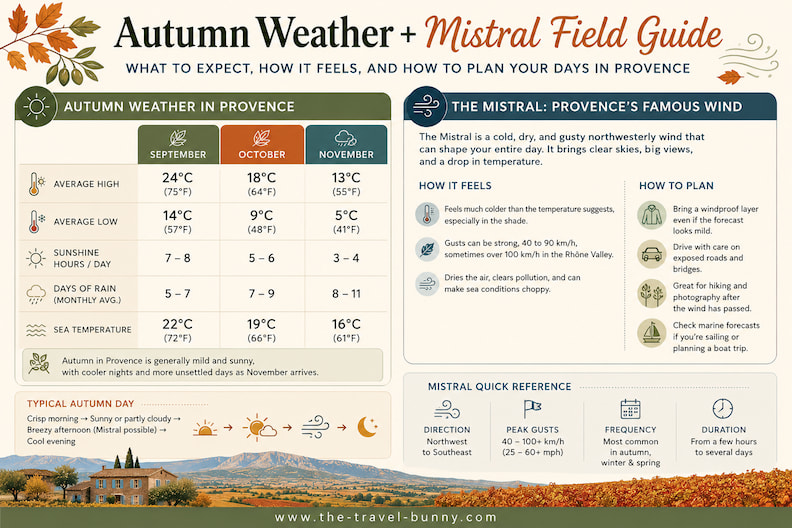
Temperature, Rain, Mistral, and Daylight by Month
The biggest autumn weather change in Provence happens between morning and evening instead of neatly between one month and the next. September afternoons still belong largely to summer, October introduces larger swings, and November makes the cold after sunset hard to ignore. An average temperature for Provence across September, October, and November also needs geographical context. Marseille beside the Mediterranean, Aix-en-Provence inland, and the higher Verdon country rarely look identical on the same day.
For a useful coastal reference, Météo-France’s current official climate normals use the 1991-2020 reference period, although they are aware they already carry a slight cool bias compared with today’s climate. In Marseille, the average temperature is about 20°C in September, 16.3°C in October, and 11.9°C in November. Average daytime highs fall from 24.8°C in September to 20.3°C in October and 15.5°C in November.
| Month | Marseille average high | Marseille average low | Average rain | Approximate daylight |
|---|---|---|---|---|
| September | 24.8°C | 15.2°C | 76.8 mm | 13 hr 11 min at the start, falling toward 11 hr 45 min |
| October | 20.3°C | 12.3°C | 90.6 mm | 11 hr 44 min at the start, falling toward 10 hr 17 min |
| November | 15.5°C | 8.3°C | 83.1 mm | 10 hr 17 min at the start, falling to roughly 9 hr 15 min |
The temperature and rain figures above use Marseille’s 1991-2020 normals as a Mediterranean reference, while the daylight figures use Marseille’s 2026 sunrise and sunset data. Provence extends far inland and upward from the coast, so treat this table as a baseline instead of a forecast for the entire region.
Provence weather in September still has a sturdy summer accent. A typical Marseille September has daytime highs close to 25°C, and the normal monthly average remains around 20°C. This explains why the Provence September weather I’ve experienced often supports beach time, outdoor lunches, and evening walks without the oppressive heat of July or August.
The weather in Provence in September isn’t reliably dry, though. Marseille averages about 77 mm of September rainfall, concentrated across relatively few wet days, and Mediterranean rain episodes already become possible during this month. In September 2025, for example, Météo-France recorded 145 mm at Mandelieu-la-Napoule, 141 mm at Fréjus, and 95 mm at Mons during a major episode. The point is that one storm can contribute an enormous share of a month’s total.
Provence weather in October is still mild, but the margin for assuming summer conditions shrinks. Marseille’s normal daytime high sits around 20°C, while Aix-en-Provence averages roughly 22°C by day and 12°C at night. Aix-en-Provence weather in October gives you a useful idea of what to expect inland: pleasant afternoons remain common, but breakfast and dinner increasingly require another layer of clothes.
The Provence October weather I’ve experienced in recent years has often stayed surprisingly warm. This personal observation sits comfortably beside the climate averages, but averages hide the daily spread. A sheltered terrace at lunch and an exposed street after sunset seem from separate seasons.
October qualifies as a rainy month in Provence France, by Mediterranean standards. Marseille’s 1991-2020 normal is about 91 mm, higher than September there. September and October are months associated with intense Mediterranean rainfall across southeastern France. These events form when warm, humid Mediterranean air feeds heavy storms, often over a short period.
How rainy Provence is in October depends heavily on the year. October 2024 provides a useful warning against reading a monthly average as a promise. Between 24 and 27 October, Météo-France recorded 337 mm at Le Luc, 286.4 mm at Vidauban, 182.2 mm at Draguignan, and 149.1 mm at Fréjus. Vidauban received 119 mm in a single hour!
Provence in October rain is often episodic and rarely an endless gray drizzle. You might have several dry days followed by a violent downpour that changes roads, river levels, and hiking surfaces within hours. Météo-France operates its Vigilance system for exactly this sort of risk, so an orange or red warning deserves greater attention than whatever your original itinerary said.
Visiting the Gorges du Verdon in October adds altitude to the weather equation. The gorge is located inland between the Var and Alpes-de-Haute-Provence, and areas around La Palud-sur-Verdon are much higher than Marseille or Aix.
I recommend September and October for off-season visits to the Gorges du Verdon. Autumn is a good period for the Blanc-Martel trail. Cooler mornings, exposed viewpoints, and earlier darkness still deserve planning before going on a long hike.
Provence weather in November finally brings a noticeable cold-weather shift, especially after sunset. Marseille’s average November high is still around 15.5°C, with an average low of 8.3°C. Along sheltered parts of the coast, a sunny lunch can remain remarkably mild. Inland and at altitude, temperatures drop further.
How cold Provence gets in autumn? Along the Mediterranean coast, nights stay relatively mild, while inland valleys and higher elevations turn considerably colder after sunset.
November beside the Mediterranean remains relatively gentle, while higher areas around the Verdon or Mont Ventoux move much closer to early winter. Meteorological autumn sometimes even brings early snow by November in colder parts of France.
How cold is Provence in November? On the Marseille coast, normal nighttime temperatures average a little above 8°C. How cold it gets in Provence in November depends heavily on location, with milder nights along the Mediterranean coast and noticeably colder temperatures inland and at higher elevations.
Compared with summer, it does rain a lot in Provence in November. November is the wettest month across several French regions, including Provence-Alpes-Côte d’Azur, while Marseille itself averages about 83 mm. Again, frequency and intensity differ. Seven ordinary wet days and one Mediterranean deluge produce quite different trips despite similar monthly totals.
Daylight deserves almost as much attention as temperature. Marseille has about 13 hours 11 minutes of daylight on September 1, roughly 11 hours 44 minutes on October 1, and about 10 hours 17 minutes on November 1. By November 30, daylight has dropped to around 9 hours 15 minutes. A three-hour walk started casually after lunch in September becomes a much tighter proposition late in November.
The clocks also change on 25 October 2026. Continental France returns to standard time at 3 am, moving the clock back one hour. Sunset shifts abruptly earlier by the clock even though the seasonal loss of daylight itself remains gradual. Plan late-October driving, hiking, and outdoor sightseeing with that date in mind.
Then there is the Provence Mistral in autumn, which has little interest in whether the temperature looks pleasant on your app. This dry, turbulent regional wind that crosses the lower Rhône Valley and Provence is often stronger in winter and spring, but autumn episodes still occur.
The Mistral wind in autumn in Provence is especially relevant around Orange, Avignon, Arles, Istres, Marseille, and the western Provençal coast. Its direction changes as it moves south, becoming northwesterly around Marseille and more westerly along the Var coast. Orange, Avignon, Istres, and Arles area is particularly exposed.
Provence autumn Mistral wind forecast: Expect brighter skies, much greater exposure on viewpoints and coastal paths, rougher sea conditions, and a temperature considerably less friendly once the wind starts. Mistral episodes often clear cloud because the wind is dry, so sunshine doesn’t necessarily mean comfortable outdoor conditions.
Autumn weather drops in Provence are easiest to underestimate after a warm afternoon. What to expect is a widening gap between midday and evening as the season advances, compounded by shorter daylight and occasional strong wind. This is why I keep a jacket nearby even when November lunchtime appears to have forgotten what month it is.
What to Pack and Wear in Provence in Autumn
Provence autumn packing is mostly an exercise of matching layers. September afternoons might call for shorts and a T-shirt, while an October morning needs a light jacket and a November evening requires something warmer. Autumn is a season of contrasts, with warm spells alternating with colder, wetter periods, so packing one outfit per day is less useful than building several combinations from a small number of clothes.
My Provence packing list for autumn would start with T-shirts, one or two long-sleeve tops, light trousers or jeans, a thin sweater or cardigan, a wind-resistant jacket, a waterproof outer layer, closed walking shoes, sunglasses, and swimwear early in the season. Add underwear and socks according to trip length rather than packing a small textile warehouse for a week in France.
| Month | Daytime clothing | Morning and evening | Useful extra |
|---|---|---|---|
| September | T-shirt, shorts, skirt, dress, or light trousers | Thin sweater, cardigan, or overshirt | Swimwear, sunglasses, sun protection |
| October | T-shirt or long-sleeve top with light trousers or jeans | Sweater plus light jacket | Waterproof shell, closed shoes |
| November | Long sleeves, trousers, light mid-layer | Warmer jacket or extra knit layer | Rain layer, warmer shoes and socks |
What to wear in Provence in September depends partly on how far you travel from the Mediterranean. Around the Var coast and the Pays de Fayence, I spend plenty of September days in ordinary summer clothes. And swimwear deserves its place in your suitcase too. The Mediterranean Sea has accumulated heat throughout summer, which is one reason I prefer September to June for swimming.
A thin second layer is good to have even in September. Temperatures fall after sunset, especially inland, and dinner on an exposed terrace is not the same as lunch in full sun. A cardigan, light sweater, or overshirt handles most of those changes without taking half the suitcase.
The calculation behind what to wear in Provence in fall changes during October. A T-shirt under a light knit or overshirt allows you to remove layers as the afternoon warms. Jeans, chinos, light trousers, dresses with an extra layer, and closed shoes all fit the season. Heavy winter clothing is excessive for most lowland October trips, but a proper jacket is useful around Mont Ventoux, the Verdon, and other higher areas.
Provence October weather and what to wear also depend on rain. Mediterranean autumn storms sometimes deliver heavy rainfall over a short period, so a lightweight waterproof jacket deserves priority over a collection of fashionable layers with no interest in keeping water out. A hood is particularly useful during windy weather. Mistral gusts and umbrellas have competing ideas about who is in charge.
What to wear in Provence during October mornings is usually one layer warmer than your afternoon clothing. Start with a T-shirt or light long-sleeve top under a sweater, cardigan, fleece, or overshirt, then add a light jacket if needed. By lunchtime, part of the outfit often ends up folded over the back of a chair.
What to wear in Provence in October evenings requires greater respect for the temperature drop. Closed shoes, trousers, a knit layer, and a jacket make outdoor dinners far easier, especially inland. An afternoon warm enough for short sleeves doesn’t promise an equally warm walk home after dinner.
This makes what to pack for Provence in October fairly straightforward. Bring clothes you can layer, a waterproof shell, comfortable closed shoes, one warmer top, and sun protection. Keep swimwear if you’re visiting early in the month or staying near the Mediterranean. I have swum during the first week of October, but I wouldn’t organize an entire October vacation around guaranteed beach conditions.
In November, you’ll need another level of insulation without requiring Alpine expedition equipment at low elevations. What to wear in Provence in autumn by this point means long trousers, closed shoes, long sleeves, a sweater or similar mid-layer, and a proper jacket for mornings and evenings. Coastal afternoons occasionally remain mild enough for a T-shirt, while inland nights remind you quite efficiently which month appears on the calendar.
Footwear deserves more attention if hiking appears anywhere in your plans.For example, Le Parc national des Calanques recommends hiking shoes and warns against open footwear on its rocky trails. The park also advises carrying at least 1.5 liters of water per person for a half-day walk because drinking-water points are absent inside the Calanques. Autumn removes some of the summer heat, but it does nothing to make limestone less sharp or slippery.
Sun protection still belongs in your autumn suitcase! I recommend sunglasses, protective clothing, and sun protection for outdoor trips, because exposed Provençal trails offer limited shade. A cool breeze is perfectly capable of disguising a sunny afternoon until your face shamefully displays the evidence later.
A Provence autumn packing list for women doesn’t need a separate climate theory. Light dresses and skirts remain practical in warm September weather, while trousers, jeans, tights, cardigans, and a rain-resistant jacket become increasingly useful through October and November. Comfortable closed shoes deserve priority if village streets, markets, hill towns, or trails appear in your itinerary. Provençal cobbles show little sympathy for footwear chosen primarily because it looked good beside the suitcase…
A Provence autumn packing list for men follows much the same logic. T-shirts, polos or shirts, light trousers, jeans, an overshirt or thin sweater, a waterproof jacket, and comfortable walking shoes cover most lowland trips. Shorts remain useful in September and occasionally later during warm coastal spells. Just add a warmer layer for November evenings or higher-altitude stops.
The best packing list for autumn in the South of France also depends on where the trip ends. Marseille, Cassis, Saint-Raphaël, and the Côte d’Azur are under a stronger Mediterranean influence than inland Vaucluse or higher parts of the Verdon. A suitcase built entirely around Nice weather is too optimistic once the itinerary climbs toward mountain roads and high plateaus.
Shoes, layers, and a small waterproof shell should be packed before elaborate seasonal outfits. And this is what to pack for Provence in autumn. Dress for the warm part of the day, carry the layer you’ll want three hours later, and remember Provence has a particular talent for making your morning clothing choice look either excessive or deeply inadequate by lunchtime.
What Autumn Actually Looks Like in Provence
Autumn in Provence is way less orange than many photographs suggest. Along much of the Var coast, the seasonal change can be surprisingly discreet. Mediterranean pines, olive trees, evergreen oaks, and scrub keep plenty of green in the view, while vegetation stressed by a hot, dry summer may already have turned yellow before September arrives. The Provence fall landscape doesn’t suddenly switch palettes just because the calendar says autumn.
Growing up in Romania, I was used to autumn arriving in color. I used to travel to the mountains every year to see the forests turn yellow, orange, and red, and even when I lived in Bucharest, I would take detours through parks simply to watch the season arrive.
I miss that here. In Provence, especially around the Pays de Fayence and the Mediterranean coast, autumn foliage is less glamorous. Temperature-wise, though, the comparison goes the other way. Late autumn in Provence often reminds me of early autumn in Romania, with mild daytime weather lingering well into a period when I would already expect much colder conditions back home.
The Provence in fall pictures that show entire hillsides glowing red and gold are therefore telling only part of the story. Those scenes do exist, particularly around vineyards and deciduous forests, but they don’t represent every corner of the region. Around my part of the Var, I wouldn’t drive out expecting blanket foliage. I would photograph the contrast instead, with dry grasses, dark green pines, pale stone villages, vineyards beginning to change, and the Mediterranean still looking obstinately summery.
Vineyards are among the most dependable subjects for Provence fall photography because their appearance changes more visibly than the surrounding garrigue. You can admire the autumn vines around the Luberon, the Alpilles, the Camargue, and the foothills of Mont Ventoux, where leaves shift through yellow, copper, and red as the vines enter dormancy.
The built environment helps too. Roussillon and Rustrel have ochre rock and mineral colors year-round, while villages such as Gordes, Bonnieux, and Les Baux-de-Provence have limestone, tiled roofs, narrow streets, and agricultural land in the same frame. These are useful photography spots in Provence in autumn because the season adds vineyard color and softer vegetation without requiring dramatic forest foliage to carry the photograph. The ochres around Roussillon and Rustrel come from iron-rich mineral deposits, so their reds and oranges remain present long after autumn leaves have fallen.
Light changes the photographs as much as vegetation does. Provence photography in fall light benefits from a lower sun than midsummer, which creates longer shadows across vineyards, village walls, olive groves, and rocky ridges. The harsh overhead light I try to avoid around midday in summer occupies a smaller share of the day. You still need to watch exposure on pale limestone, but autumn gives you longer periods when texture survives instead of being flattened by a sun sitting almost directly overhead.
The famous Provence golden light also deserves less mythology and a little planning. It isn’t a substance suspended permanently over the region waiting for photographers to arrive. Warm light appears when the sun sits low, and autumn simply brings those low angles earlier in the day.
Provence autumn photography tip: For Provence golden hour photography in fall, check sunrise and sunset for the exact date and location. Don’t rely on a generic one hour before sunset rule. Hills and mountains can block direct light well before the official sunset time.
Mistral days create another photographic character entirely. This strong Provence wind can produce exceptional visibility across distant ridges and the Mediterranean, although the same clear sky can also become rather empty in a photograph if you’re hoping for a dramatic sunset.
After rain, the visual change goes in the opposite direction. Darkened tree trunks, wet limestone, richer soil tones, puddled village streets, and cloud around the hills can give autumn photographs depth that endless blue skies sometimes lack. I would wait for roads and trails to become safe before heading onto slippery rock, but photographically, a clearing storm often offers a greater variety than a perfectly cloudless afternoon.
Best time for photography in Provence during autumn: Early morning favors mist in inland valleys and quiet village streets. Late afternoon brings warmer light across stone and vineyards. Post-rain conditions suit forests and agricultural areas. Clear Mistral weather is excellent for long-distance views. There isn’t one universal hour that turns every place into a postcard. That’s a Lightroom filter.
My favorite Provence autumn photography spots change as the season progresses. September still photographs largely as late summer near the Mediterranean. By October, vineyards and inland deciduous trees provide stronger seasonal color. November strips some areas back further, leaving bare vines, muted agricultural fields, darker woodland, and village scenes where chimney smoke starts appearing again around dusk.
The best photography spots in Provence in autumn are places where several visual elements overlap:
- Vineyards below Mont Ventoux
- Roads between Bonnieux and Lourmarin
- The ochre country around Roussillon and Rustrel
- Agricultural areas around the Alpilles
- Parts of the Camargue.
Provence autumn photography locations and tips: Chasing northern-European foliage along the Mediterranean coast is likely to produce a long drive and several photographs of pine trees looking exactly as they did in August.
Autumn shows up differently in Provence. Vineyards change first, harvested fields turn tawny, shadows lengthen, stone warms in late light, and the coast hangs onto summer colors long after the rest of Europe has accepted the arrival of fall.
Where to Find Autumn Colors in Provence: Luberon, Alpilles, Ventoux, and Verdon
I miss a proper colorful autumn. In Provence, warm October days don’t necessarily come with the vivid fall foliage I grew up with in Romania.
Around the Pays de Fayence and much of the Mediterranean coast, Provence fall colors can be surprisingly restrained. Pines, olive trees, holm oaks, and other evergreen Mediterranean vegetation keep large areas green, while summer drought can leave grasses and shrubs yellow before September even begins.
Provence foliage is something you can appreciate if you travel toward vineyards, deciduous woodland, higher elevations, and cooler inland valleys.
Timing also changes with altitude and weather, but leaves generally begin changing color in Provence during October, especially inland. October is the when tree and shrub foliage shifts toward yellow, red, and orange before starting to fall. November increasingly brings bare branches in cooler locations.
For the best places to see Provence fall colors, I would go to the Luberon, Mont Ventoux, and the Verdon before relying on the Mediterranean coast. The Alpilles photograph beautifully in autumn, but their forests contain a high proportion of Aleppo pine and evergreen holm oak, so they don’t produce the same broad sweep of deciduous color.
Luberon fall colors
The Luberon in autumn offers one of the most beautiful combinations of vineyard colors, deciduous trees, orchards, bare earth, and pale village stone. Agriculture plays a large visual role here. You will notice vines, olive trees, fruit trees, pasture, and woodland as defining parts of its agricultural environment. October marks the main shift toward yellow, orange, and red foliage.
A Luberon October trip is therefore a much safer bet to admire autumn colors than early September. After the harvest, Luberon vineyards shift through yellow, copper, and red, while deciduous trees along country roads and lower slopes bring in additional autumn color.
The Travel Bunny’s Provence Tip: I recommend autumn walks through the vineyards of the Luberon, Ventoux, and Rhône Valley if your’re hoping for the kind of autumn where entire hillsides change color.
The best photo spots in the Luberon during fall foliage are places where vines and deciduous vegetation sit against recognizable terrain or village architecture. Roads and footpaths through vineyard country around Bonnieux, Lourmarin, Gordes, and Roussillon give you far richer seasonal context than photographing a single tree beside a parking lot and hoping nobody notices.
Luberon fall colors also pair particularly well with Roussillon and the ochre country around Rustrel because the mineral reds and oranges remain visible regardless of the foliage. The Colorado Provençal at Rustrel stays open into November in 2026, subject to favorable weather, although opening hours shorten sharply as daylight decreases.
The Alpilles in autumn
Les Alpilles are less reliable for classic Provence fall foliage, and it’s useful to know this before planning an entire photography day around it. Mediterranean forest dominates much of the massif, especially Aleppo pine and evergreen holm oak. Those species preserve the familiar green-gray Provençal appearance through autumn instead of producing large areas of orange forest.
I would go to the Alpilles for cultivated autumn scenery instead. Vineyards, olive groves, limestone ridges, farm roads, and patches of deciduous vegetation create a more subtle Provence fall landscape around Saint-Rémy-de-Provence, Eygalières, Maussane-les-Alpilles, Les Baux-de-Provence, and Aureille. The Alpilles is a major olive-growing area with over 350,000 olive trees, alongside established vineyards in the Vallée des Baux.
The Alpilles region is better for Mediterranean autumn scenery than for dense fall foliage, so I’d choose the Verdon or Mont Ventoux if colorful forests are your priority.
Mont Ventoux in autumn
Mont Ventoux in autumn offers a better seasonal change because altitude introduces cooler conditions and greater vegetation diversity. The autumn season here starts in September and stretches through October. This is when the territory changes into a display of seasonal color during the annual Ventoux Saveurs period.
The lower slopes and surrounding wine country also let you appreciate extensive Provence vineyards in autumn, particularly around the AOC Ventoux appellation and neighboring Rhône wine areas. Here, rows of vines can move from green to yellow, orange, and red while Mont Ventoux rises behind them, which gives the photograph both seasonal evidence and a clear geographical anchor.
The Ventoux area is one of my best recommendations among the best places to see fall colors in the South of France if you want to stay within Provence. Altitude, forests, vineyards, villages, and agricultural land are within relatively short driving distances from each other, so a weak patch of foliage in one place doesn’t end the day.
Verdon autumn colors
The Verdon is the place I would choose for actual forest color. Around 63% of the Parc naturel régional du Verdon is forested, which already gives the area an advantage over much of the drier Mediterranean coast.
I specifically recommend the Blanc-Martel trail in autumn for its vivid tree colors through the gorge. The route runs between the Chalet de la Maline near La Palud-sur-Verdon and the Couloir Samson near Rougon, placing deciduous vegetation against pale limestone cliffs and the blue-green Verdon River.
A Gorges du Verdon October trip therefore has a much stronger chance of delivering the autumn scenery I personally miss from my childhood. The combination of cooler altitude, extensive forest, cliffs, and water makes the seasonal change easier to photograph than along much of the Var coastline.
Verdon autumn also has one visual advantage that doesn’t depend entirely on leaves. The river, limestone walls, forest, agricultural plateaus, and villages create strong color contrasts throughout the year. Once the trees begin turning, autumn adds another layer rather than carrying the entire scene by itself.
For photographers comparing where to see fall colors in Provence, I would rank the Verdon highly for forest, Mont Ventoux for elevation and variety, and the Luberon for vineyards mixed with villages and farmland. The Alpilles are relevant only if you prefer Mediterranean scenery with selective autumn color rather than dense foliage.
Provence fall foliage can look inconsistent online. Photographs taken in the Verdon or around Ventoux can create the impression that the entire region turns orange in October. Drive south toward the Mediterranean and the pine forests, olive groves, scrub, and drought-stressed vegetation share a different story.
The best Provence autumn colors tend to appear inland and at higher elevations, especially where deciduous woodland meets vineyards and other cultivated land.
No, This Is Not Lavender Season. What You Will See Instead
Lavender doesn’t bloom in Provence in autumn. The main flowering period of lavender is from mid-June to early August, with the peak usually around early July and later flowering at higher elevations. By September, the famous purple fields around Valensole, the Plateau d’Albion, the Luberon, and Haute-Provence have already been cut.
With the lavender gone, Provence loses the purple rows that dominate so many summer photographs, but the countryside doesn’t become visually empty. This change is especially obvious on the Plateau de Valensole. In summer, cars stop along roads for photographs and the rows of lavender become the destination.
But in autumn, Valensole’s harvested fields give way to bare or cultivated earth, cereals, almond trees, and the changing colors of agricultural land. November in Valensole has ochre plowed fields beneath clear blue skies, a far quieter scene than the July lavender spectacle. This is useful to know before making a large detour from Aix-en-Provence or the coast expecting purple fields.
Elsewhere in Provence, autumn shifts attention toward vineyards, olive groves, orchards, forests, ochre soil, and harvested farmland. Vine leaves gradually change color inland, olives remain on the trees before picking, and fields around villages show the practical side of the agricultural calendar rather than its most photographed few weeks.
You might still see isolated lavender plants or wild clumps while walking, because lavender grows naturally in parts of Provence across chalky hills at roughly 500 to 1,700 meters in altitude, as well as in cultivated fields. But these scattered plants are quite different from a flowering commercial field stretching across the Plateau de Valensole.
Does lavender bloom in Provence in autumn? No. Come in June or July if lavender fields are central to your trip. Come in autumn for a different version of Provence, with harvested farmland, changing vineyards, olives, chestnuts, mushrooms, ochre earth, and villages that have returned to their ordinary seasonal rhythm.
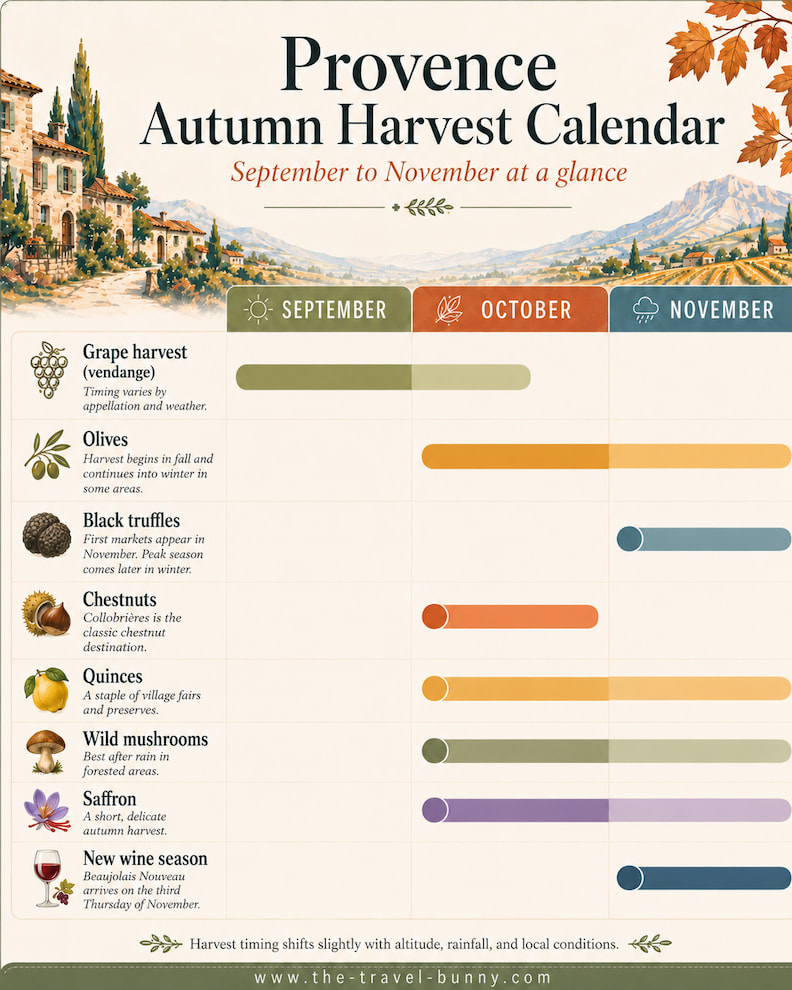
Provence Autumn Harvest Calendar. Wine, Truffles, Olives, Chestnuts, and More
The Provence harvest season changes the region faster than the weather does. September starts with grapes coming off the vines, October brings chestnuts, quinces, mushrooms, apples, and saffron, and by November olive picking is underway in many areas and the first winter black truffles return to markets. This sequence varies by altitude, rainfall, variety, and individual producer, but autumn is when agriculture becomes especially visible in everyday local life.
Provence’s food harvest is easiest to understand at a weekly market. Autumn stalls shift toward Muscat grapes, figs, apples, chestnuts, quinces, mushrooms, olives, honey, cheeses, and products made from whatever has recently come in from the fields and orchards. You can also find figs, quince, wine, and other local products among the region’s autumn foods.
What fruits are in season in Provence in autumn changes as the weeks pass. Grapes and figs belong strongly to the earlier part of the season, apples run well into October, and quinces arrive later. At Domaine de la Portanière near Collobrières, for example, visitors can pick eight varieties of apples during September and October.
The Provence autumn food I find most interesting isn’t necessarily restaurant food. A bag of chestnuts gathered by family, mushrooms brought home after rain, fresh grapes from a market, or olives slowly ripening on trees tells you more about the agricultural calendar than an elaborate seasonal tasting menu designed six months in advance.
The best autumn food to try in Provence is therefore whatever is genuinely in season where you’re staying. In the Var, chestnuts are closely associated with the Massif des Maures and Collobrières, with harvesting season from September through November. Around Ventoux and Vaucluse, saffron flowers are harvested toward the end of October, while olive harvests often begin later in autumn and continue toward winter.
Wine is where autumn first becomes visibly busy in Provence. The vendanges usually begin in September, although some estates keep picking into October as different grape varieties reach maturity. For a few weeks, vineyards are full of crates, tractors, cellar activity, and people doing rather less posing beside vines than travel brochures might suggest. Some wineries open parts of the harvest to visitors through special tours or participation days, giving you a rare chance to see the agricultural side of Provençal wine before everything ends up neatly bottled and labeled.
This overlap is why the best Provence fall food and wine experiences often happen at vineyards, producers, mills, and markets instead of in formal dining rooms. You might taste freshly pressed grape juice during vendanges, visit an olive mill later in the season, or buy chestnut cream within a few kilometers of the groves where the fruit was collected. These experiences connect the food to a place and a date instead of reducing Provence to a list of dishes.
Provence fall cuisine also gets earthier as autumn advances. Early fall still carries tomatoes, herbs, fruit, and grilled food from summer, but later weeks bring mushrooms, chestnuts, squash, game in some restaurants, richer sauces, olive oil, and eventually truffles. The change is gradual, which is another reason September and November produce such different meals even though both belong to autumn.
Don’t overlook saffron. It’s grown in my canton, and across Provence-Alpes-Côte d’Azur the main harvest arrives around late October, when Crocus sativus flowers are picked by hand early in the morning before the flowers deteriorate. The stigmas are then separated and dried, which helps explain why a tiny quantity costs so much.
Provence autumn culinary experiences become especially good when a village builds an event around a crop. I’ve been to the quince festival in Cotignac, where a fruit that most people rarely buy gets an entire day of attention. Around Collobrières, chestnut festivals take over the calendar. People come for the fruit, the producers, and the festival itself, so something normally gathered in the hills suddenly becomes the main reason the village is busy.
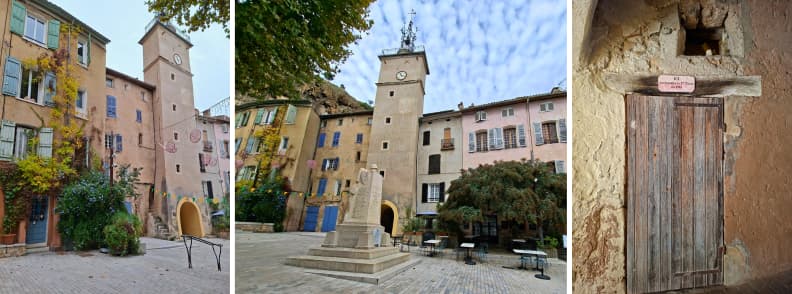
Restaurants in Provence in autumn reflect some of this seasonal change, although opening schedules become less predictable once summer ends. I pay closer attention to daily specials, shorter menus, and seasonal dishes built around mushrooms, chestnuts, game, squash, or truffles later in the season. A reduced menu isn’t automatically a disadvantage if the kitchen is using what is available locally rather than maintaining a summer card out of habit.
What to eat in Provence in autumn depends less on finding one famous dish and more on following the calendar. Start with grapes, figs, and early harvest produce. Move into chestnuts, quinces, mushrooms, apples, and saffron. Finish with olives and the return of winter truffles. Provence does seasonality particularly well because the evidence is sitting in market crates, vineyards, orchards, forests, and sometimes, inconveniently, dropping onto your own garden.
Provence Vendange. When and Where to Experience the Grape Harvest
I’ve seen harvest season unfold around Provence, although I still haven’t joined a vendange myself. You notice the Provence wine harvest first on the roads. Tractors appear between villages, trailers move grapes toward cellars, and vineyards that looked untouched a week earlier suddenly have rows already picked.
During the Provence grape harvest, vineyards look busier than usual, with crews picking, crates filling, and grapes moving toward the cellar while the tasting room becomes distinctly secondary.
The Provence grape harvest season usually begins from late August into September, but there is no regional starting gun. Later-ripening grapes and particular sites keep crews busy into October in some years. Grape variety, altitude, exposure, summer heat, rainfall, and the style of wine all influence the picking date. So when the grape harvest starts in Provence changes from one estate to another.
The Provence wine harvest season and when it starts also vary between appellations. For example, Bandol’s emblematic Mourvèdre is a late-ripening grape. It’s a variety that takes its time to reach full maturity, helped by the appellation’s sunshine, maritime influence, soils, and prevailing winds.
This also explains how long a grape vendange lasts in Provence. A large estate rarely harvests every parcel on the same morning. Different grapes and plots reach the desired maturity at different times. For example, at Châteauneuf-du-Pape in 2020, the first white grapes were picked during the third week of August and harvesting continued into mid-October. This was one vintage, and not a timetable to reuse every year, but it does show how long the process sometimes stretches.
When the vendange happens in Provence. September gives you the best odds across a longer trip. Early September favors estates beginning harvest. Mid-September usually places you deep inside the activity, while late September still has plenty of opportunities, particularly at estates harvesting several varieties or higher, cooler parcels.
The best time to see the grape harvest in Provence is therefore roughly the first three weeks of September, with flexibility built into your plans. I would’t arrange an entire trip around one predicted picking date months ahead. Grapes have an irritating habit of ripening according to weather rather than hotel reservations.
To check when the grape harvest is in Provence for a specific winery, look at the estate’s own calendar shortly before your visit. Harvest events frequently carry phrases such as subject to grape maturity for good reason. Calling or emailing the domaine a few days beforehand gives you a far better picture than assuming last year’s dates still apply.
Where to see the grape harvest in Provence depends on the wine style and scenery you want. The main Vins de Provence family includes Côtes de Provence, Coteaux d’Aix-en-Provence, and Coteaux Varois en Provence.
What wine region Provence is known for depends on how narrowly you use the word region, but AOC Côtes de Provence is the name most international visitors associate with Provençal wine. The appellation covers several distinct terroirs, including Sainte-Victoire, Fréjus, La Londe, Pierrefeu, and Notre-Dame des Anges, so a wine trip across Côtes de Provence already changes noticeably from one area to the next.
Among the best wine regions to visit in Provence in autumn, I would also include Bandol, the Alpilles around the AOP Les Baux-de-Provence, the Ventoux area, and Châteauneuf-du-Pape if your route reaches Vaucluse. (Châteauneuf-du-Pape belongs to the southern Rhône wine region, but geographically and culturally you are still in Provence.)
There is a real difference between booking Provence vineyard tours and visiting during harvest. At an ordinary tasting, you usually see established cellar routines and finished wines. Provence vineyard tours during grape harvest might include active sorting, tanks in fermentation, fresh juice, harvest equipment, and staff who are busy doing their actual jobs. This final point deserves some respect. September is fascinating precisely because wineries are working.
Tourists who want to join the grape harvest in Provence instead of watching from the edge of a vineyard have a good option in Vaucluse. This Provence grape harvest experience lasts three hours and includes picking grapes, stomping them in large oak barrels, learning how local grapes and wines differ, then sitting down to cheese, pâté, charcuterie, red wine, olive oil, and truffle oil. Harvest dates run through September, weather permitting, and booking at least a week ahead is recommended. Book the Provence grape harvest experience
This is the sensible version of how to experience the grape harvest as a tourist. Book an activity created by or with the producers rather than appearing at the edge of a vineyard and hoping enthusiasm qualifies as agricultural employment. Harvest is time-sensitive, physical work, and vineyards are private property.
The best wineries to visit during harvest in Provence are estates that explicitly publish vendange visits, cellar tours, or harvest events for your dates. For example, Château Pesquié and Domaine Fontaine du Clos have confirmed 2026 harvest programs, which gives them a practical advantage over a famous estate offering only its standard tasting while everybody behind the cellar door is too busy to talk.
When choosing the best wineries to visit in Provence in autumn outside the peak picking weeks, check opening days, reservation requirements, languages, and the type of visit offered. Some estates keep normal tastings running throughout harvest, but others reduce visitor access because every available pair of hands is needed elsewhere.
A Provence wine tasting during harvest is particularly interesting if the cellar lets you taste juice or wine still fermenting. Finished wine tells you what the estate produced in a previous vintage. Fermenting juice shows the current vintage halfway through becoming wine, which is messier, cloudier, and far less polished.
By October, Provence wine tasting in fall becomes calmer at many estates even where cellar activity continues. This is a good period to visit Provence if you are less interested in seeing grape picking and prefer longer conversations, quieter tasting rooms, and vineyards beginning to change color.
Is October a good month for Provence wineries? Yes, October is excellent for vineyard scenery and tastings, although it is less reliable than September for seeing active picking. Some harvests continue into October, while others have already moved entirely into the cellar.
Provence wine tours in fall also become easier to personalize once summer visitor numbers drop. A half-day with one or two estates gives each stop enough time. Four or five wineries in one day mostly gives the designated driver an unusually detailed knowledge of regional parking lots.
Visiting Bandol in autumn
Bandol is a destination to keep an eye on, in my opinion. A Bandol wine harvest tour takes you inland from the seaside town toward vineyards around La Cadière-d’Azur, Le Castellet, Le Beausset, Saint-Cyr-sur-Mer, and neighboring communes.
The Bandol rosé harvest starts with the same vendanges as the appellation’s reds and whites. A few growers begin picking by hand at the end of August, but September is the main harvest month. Mourvèdre, the grape most closely associated with Bandol, ripens late and is used in the rosés as well as the reds, so growers wait for each parcel to reach the maturity they want rather than harvesting everything at once.
Bandol in autumn is also visually different from high summer. The vines take on red tones in fall, while the surrounding wine country combines terraces, low hills, and the Mediterranean nearby.
Bandol wine tasting in fall season also has an easy fallback if you don’t want to arrange several domaines. The Oenothèque des Vins de Bandol in the town brings together wines from producers across the appellation and offers tastings and sales. It’s useful for comparing estates before deciding where to drive next.
The Alpilles vineyards in Fall
Farther west, the Alpilles give you one of the prettiest driving combinations of vines, olive groves, limestone, and villages. The AOP Les Baux-de-Provence covers 277 hectares and 12 estates, and its entire cultivated surface has been organic since the 2023 vintage.
For driving routes through Alpilles vineyards during harvest, I would build the day around Saint-Rémy-de-Provence, Les Baux-de-Provence, Maussane-les-Alpilles, and Mouriès, then reserve one or two domaines rather than stopping wherever a vineyard happens to appear beside the road. Harvest vehicles need access, and narrow Provençal roads already have enough personality without somebody parking creatively beside a tractor.
Châteauneuf-du-Pape in autumn
Châteauneuf-du-Pape in autumn offers a completely different wine experience. The AOC covers 3,150 hectares across Châteauneuf-du-Pape, Bédarrides, Courthézon, Orange, and Sorgues, producing roughly 93% red and 7% white wine. Its official 2026 calendar includes a Grand Banquet des Vendanges on September 4 and wine events continuing through October.
A Châteauneuf-du-Pape fall visit is useful if you want to compare Provence’s rosé-dominated vineyards with the southern Rhône’s red-wine culture. The shift is obvious in the glass. It also keeps the trip geographically coherent because Châteauneuf-du-Pape sits in Vaucluse, between Avignon, Orange, the Rhône, and Mont Ventoux.
Châteauneuf-du-Pape wine tasting in autumn is easy after the picking itself has finished. Several domains have fall opening hours with on-site tastings and wine-tourism experiences.
Beaujolais Nouveau Day 2026 on Thursday, 19 November
Beaujolais Nouveau Day is one of those French wine traditions that has escaped its own region and become a national ritual. Since the 1950s, the release of the year’s first Beaujolais has grown into an international event, and Beaujolais Nouveau now represents over 20% of the vineyard’s production. The wine itself is a vin primeur, made from the same year’s Gamay grapes and released only weeks after harvest. It’s meant to be young, fruity, uncomplicated, and sociable.
Beaujolais Nouveau always arrives on the third Thursday of November, which in 2026 falls on Thursday, 19 November. The date has been fixed by French regulation since 1985, and the wine comes only from the Beaujolais and Beaujolais-Villages, well north of Provence, but the date is marked across France. Wine shops put bottles out, restaurants build evenings around it, and families and friends use it as a reason to open several labels and compare them.
In our family, Beaujolais Nouveau day has become one of those small annual traditions that marks late autumn. Before we had a toddler running around, we went out to a local restaurant. Now somebody hosts at home, which is considerably easier with a small child who has no interest in discussing Gamay.
I wouldn’t plan a Provence wine trip around Beaujolais Nouveau because it belongs to another wine region entirely. I would still keep Thursday, 19 November 2026 free if you’re in Provence and enjoy these seasonal rituals. Wine shops, restaurants, bars, and families across France take part, and it’s the new vintage briefly becomes part of ordinary conversation everywhere.
A Provence wine and truffle tasting itinerary in fall belongs at the very end of the season rather than during September vendanges. By late November, winter truffles begin returning to Provençal markets while wineries remain open for tastings. I would treat truffle season as a separate late-autumn food trip, because trying to combine peak grape picking with peak black-truffle season is impossible unless you’re staying in the area for several months.
The best Provence fall food and wine experiences come from following the seasonal calendar without forcing things, and accdtpting that while the wine remains available throughout, the harvest itself does not.
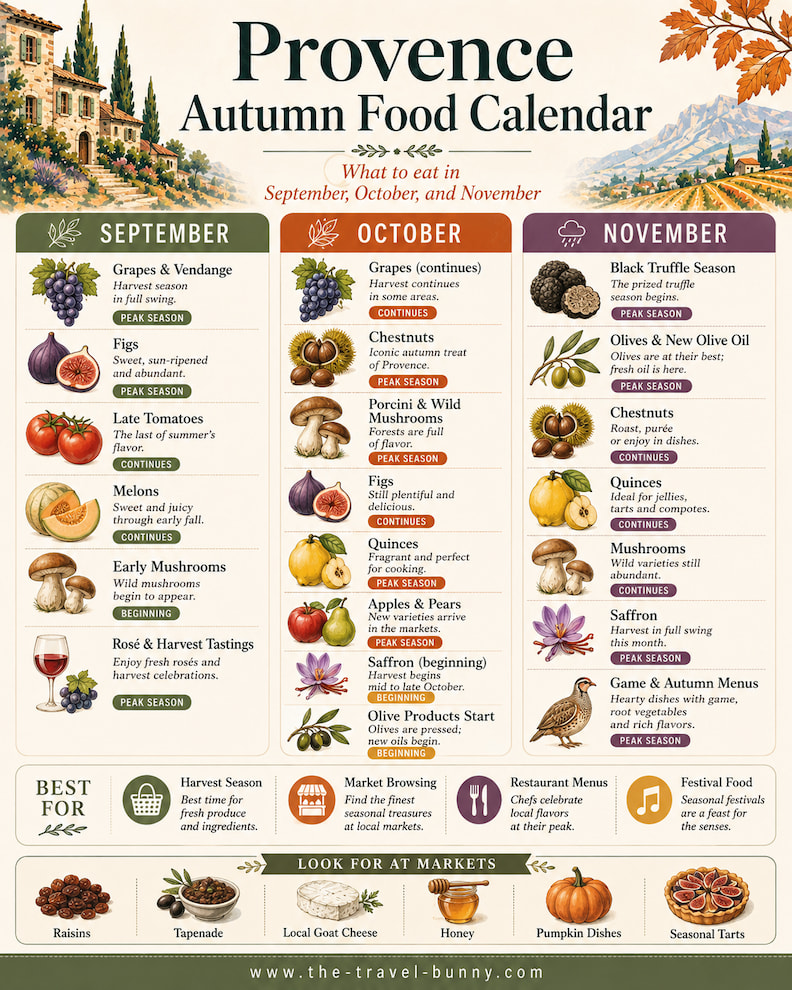
Truffles, Olives, Chestnuts, Quinces, Mushrooms, and Saffron
Autumn harvests in Provence don’t arrive together. Chestnuts and mushrooms belong mostly to October, and quinces and saffron peak around the same period. Olives push later into autumn and black truffles barely make it into the season at all, with the serious activity starting toward the end of November. A Provence food trip in early October therefore looks quite different from one six weeks later.
Provence truffle season
What months are truffle season in France? Provence truffle season dates depend on which truffle you mean. The black winter truffle, Tuber melanosporum, is harvested in the Var from November to March, with the most rewarding harvesting period from January into mid-March. Summer truffles, Tuber aestivum or Tuber uncinatum, belong to another species and another season. So for the black truffle associated with Provence, think late November through winter at the earliest.
When does truffle season start in Provence? The Provence truffle hunting season begins late enough that September and most of October are irrelevant for Tuber melanosporum. Late November is your best option if you want the first winter markets and hunts, although the richer part of the harvest comes later.
Provence truffle hunting is called cavage, the act of locating and digging up truffles, usually with a trained dog. Truffle hunting in Provence takes place on private truffle grounds rather than through casual wandering in the woods. The fungus grows underground in association with host trees, especially oaks, and finding it is skilled agricultural work.
Where to go truffle hunting near Aix-en-Provence? Les Pastras in Cadenet, in the southern Luberon, offers one of the easiest options for truffle hunting near Aix-en-Provence. You will spend three hours following trained truffle dogs through the plantation and tasting truffle hors d’oeuvres, Champagne, and olive and truffle oil tastings. Winter hunts run from November to mid-March, with separate summer tours from May through September, and the guide speaks English.
Book the Provence truffle hunting experience in Cadenet. Cadenet is around 40 minutes from Aix-en-Provence TGV station, so the outing fits neatly into a Luberon day without taking over the entire itinerary.
For black truffle hunting tours in Provence in November, I would reserve in advance because it’s unlikely a farm has space once the season starts. November is right at the beginning of the winter harvest, so dates depend on maturity and individual producers. Les Pastras explicitly lists November through March for its winter tours.
The best truffle markets in Provence in autumn are right at the end of the season. Aups, in the Haut-Var near the Verdon, opens its 2026 black-truffle market on Thursday, 26 November 2026, then holds it every Thursday morning while production lasts, generally through February or into March. The market sells Tuber melanosporum directly to the public and finishes once the truffles are sold, sometimes well before noon.
Aups is also a great trip because the Maison de la Truffe d’Aups et du Verdon is open year-round apart from listed holiday closures. It has a museum space, shop, and tastings, so it gives you something to do if you arrive before the outdoor Provence truffle markets start.
The Richerenches truffle market in the Enclave des Papes is the other major name to know. Richerenches is as a wine-growing and truffle-growing village, with the winter truffle market on Saturday mornings during the cold season, from late November to mid-March.
There’s also a useful fallback for where to buy fresh black truffles in Richerenches before relying on the market calendar. Maison Valayer lists fresh truffle sales from 14 November through the end of December 2026, with prices following the market rate.
Provence olive harvests
The Provence olive harvest begins from late October into November and continues into December, depending on variety, location, ripeness, and the style of oil a producer wants. At Domaine Oliversion in Cucuron, olives are accepted from 25 October into December, while Domaine l’Authentique near Mont Ventoux has olive picking during November and December.
When is olive harvest in Provence? November is the safest month for seeing mills and growers fully occupied. Some producers begin the olive harvest in Provence in the second half of October, while others wait until November.
This year I have a much more personal reason to watch the olive harvest in Provence. We moved into a house with two beautiful olive trees, both carrying fruit, so I am watching them with the concentration of somebody who has suddenly acquired agricultural responsibilities without reading all the instructions first.
If you want to see how olives turn into oil instead of admiring trees from a roadside, visit an active mill during harvest. Here are some tours with olive mill visits or harvesting sessions by appointment.
Provence chestnut season and Castagnades
New wine in Provence in autumn also starts appearing around local harvest celebrations once fermentations are underway. In the Var, chestnut fêtes and castagnades often include tastings of vin nouveau alongside regional produce, so the food calendar and wine calendar meet quite naturally by October.
Chestnuts are much closer to my everyday autumn. My mother-in-law takes my son chestnut gathering, and the Massif des Maures is one of the main chestnut-growing areas of the Var. There are around 2,000 hectares of chestnut groves across Collobrières, La Garde-Freinet, Gonfaron, Les Mayons, and Pignans.
A Provence chestnut festival is less of a novelty here than a whole seasonal circuit. Several villages in the Massif des Maures hold autumn celebrations, but the Collobrières chestnut festival is the largest local reference point. In 2026, the Collobrières chestnut festival dates are Sunday, 11, 18, and 25 October.
Around Collobrières, chestnut season takes over the calendar. People come for the fruit, the producers, and the festival itself, so something normally gathered in the hills suddenly becomes the main reason the village is busy.
The wider chestnut festival in Provence calendar also includes villages such as Gonfaron, La Garde-Freinet, Les Mayons, and Pignans. That markets, roasted chestnuts, chestnut products, agricultural stalls, and vin nouveau commonly appear during these celebrations.
Procenve mushroom hunting
Mushrooms are less organized and considerably more secretive. Provence mushroom foraging starts becoming visible after autumn rain, when people suddenly appear on woodland trails carrying baskets. I am lucky that my brother-in-law is an expert mushroom hunter. Precise mushroom locations are treated roughly like Netflix passwords.
Where to find porcini mushrooms in Provence forests is therefore information I am not going to pretend belongs on a public map. Conditions shift with rainfall, altitude, soil, and tree species, and productive patches are often known locally and never advertised. The useful clue is timing. After decent autumn rain, basket-carrying walkers start appearing quickly.
There are some rules too. In French state forests, the Office national des forêts allows family-scale mushroom picking up to 5 liters per person per day unless stricter local rules apply. Private woodland requires the owner’s permission. The ONF also advises leaving unidentified mushrooms alone and checking hunting activity before entering areas where shoots are taking place.
Provence Saffron Harvest
The Provence saffron harvest has a much shorter window. Crocus sativus flowers open around late October and early November, so picking last for around three weeks, then the red stigmas are removed by hand.
Saffron is grown in my canton too, which still catches me slightly off guard because the finished spice arrives in such tiny quantities that it’s easy to forget it starts as an actual field crop. Harvesting and separating three red stigmas from each flower explains the price well, though.
Provence quince Festival
Quinces get their own celebration in Cotignac. I have been to the Cotignac quince festival, and I like the fact that an unfashionable, stubborn fruit gets an entire village day rather than being quietly turned into delicious jelly and forgotten. Cotignac celebrates the quince with market stalls, food, local producers, and the Confrérie du Coing.
The 2026 Cotignac quince festival takes place on Sunday, 25 October from 9 am. The current program includes an artisan market, food built around quince, a parade, and an equestrian performance, with the detailed schedule still being finalized at the time of writing.
The Travel Bunny’s local tip: This late-October weekend creates an awkwardly good choice if you like regional food festivals. Cotignac celebrates quince on 25 October, while Collobrières holds the final Sunday of its 2026 chestnut festival on the same date. You will have to choose. Provence occasionally creates small scheduling problems.
Autumn Markets, Wine Events and Food Festivals Worth Planning Around
Autumn is when Provence starts filling its calendar with events built around what has come out of a vineyard, orchard, apiary, olive grove, or forest. I pay more attention to these local dates than I do to generic seasonal entertainment. A village fête devoted to one crop usually tells you quite a lot about what people nearby grow, eat, and care enough about to spend a Sunday celebrating.
For Provence autumn festivals and events 2026, I’m only including dates already published by the organizer, municipality, or tourism office. Several traditional fêtes still have partial programs as I write this in August 2026.
| 2026 date | Place | Festival or market | What is happening |
|---|---|---|---|
| 6 September | Violès, Vaucluse | Fête des Vendanges, Domaine des Favards | Confirmed. Harvest workshop from 10 am, cellar visit, organic wine tasting, then lunch from 1 pm. Adult price €40, child price €10. Reservation required. |
| 6 September | Saint-Cyr-sur-Mer, Var | Fête des Vendanges, Domaine Pieracci | Confirmed, 11 am to 4 pm. Visitors take part in grape picking and taste freshly pressed juice before the wine bar, music, and lunch. Adult price €69. |
| 12, 19, 26 September | Mormoiron, Vaucluse | Château Pesquié special harvest visits | Confirmed, 9:30 am to 2 pm. Vineyard and cellar visit, fresh grape juice, fermenting wine, barrel samples, and picnic. €55 per person. |
| 13 September | Biot, Alpes-Maritimes | Fête des Vendanges | Confirmed, 10 am to 5 pm. Blessing of the grapes, Servan grape heritage, vin nouveau tasting, Provençal market, music, dancing, and folklore. |
| 19 September | Bédoin, Vaucluse | Ventoux Saveurs educational vendange | Confirmed, 10 am to noon. Hands-on harvesting at the Vignerons du Mont Ventoux educational vineyard. |
| 19 September | La Londe-les-Maures, Var | Fête des Vendanges | Date confirmed, 9 am to 5 pm. A celebration of local winegrowing and artisan traditions at Place Charles-Camoin. The detailed 2026 program is unconfirmed yet. |
| 19-20 September | Mouriès, Bouches-du-Rhône | 54th Fête des Olives Vertes | Confirmed. Regional market, exhibitions, olive-cracking and aïoli competitions, Provençal parade, music, brocante, Camargue traditions, and the Olives Vertes race. |
| 3-4 October | Les Arcs-sur-Argens, Var | 33rd Fête du Miel | Dates confirmed, 9 am to 7 pm. Professional beekeepers, honey tastings, hive demonstrations, children’s activities, food, and producers. The detailed 2026 timetable is unconfirmed yet. |
| 11, 18, 25 October | Collobrières, Var | Fêtes de la Châtaigne et du Terroir | Confirmed. 11 October focuses on Var producers, 18 October has an international theme with delegations and folklore, and 25 October is devoted to artisans and traditional trades. |
| 18 October | Camps-la-Source, Var | Fête de la Châtaigne, du Vin et des Produits du Terroir | Date confirmed. Chestnuts, saffron, honey, olive oil, wine, cheese, charcuterie, and other local products are announced. Hours and the full 2026 program are unconfirmed yet. |
| 18 October | Jausiers, Alpes-de-Haute-Provence | Fête de la Courge | Confirmed, 9 am to 5 pm. Squash market, local products, music, vide-grenier, children’s activities, and the annual goat race. |
| 18, 25 October and 8 November | La Garde-Freinet, Var | Fête de la Châtaigne | Confirmed, 9 am to 6 pm. Chestnuts, roasted chestnuts, local products, and activities. Outdoor dates remain subject to favorable weather. |
| 24 October | Saorge, Alpes-Maritimes | Fête de la Châtaigne | Confirmed, 3 pm to 11:30 pm. Chestnuts, brousse, mulled wine, then an evening barbecue meal and dancing. |
| 25 October | Cotignac, Var | Fête du Coing | Date confirmed, from 9 am. The 2026 edition will include the traditional quince celebration, artisan market, parade, and equestrian element. The full 2026 program is still being prepared. |
| 8 November | La Garde-Freinet, Var | Fête de la Châtaigne | Confirmed, 9 am to 6 pm. Final 2026 chestnut-market Sunday in La Garde-Freinet, subject to favorable weather. |
| 19 November | Avignon, Vaucluse | Millévin | Date and hours confirmed, 6 pm to 9 pm. New Côtes du Rhône vintage, winegrowers, wine merchants, brotherhood parade, tastings, and music. The exact 2026 venue is still listed as lieu à venir, so the location is unconfirmed yet. |
| Estimated 21 November | Richerenches, Vaucluse | Ban des Truffes and opening of the winter truffle market | Estimated date, unconfirmed yet. Richerenches officially holds the Ban des Truffes on the Saturday following 15 November. In 2026, that rule gives Saturday, 21 November. The usual program includes the market, Confrérie du Diamant Noir parade, truffle omelet tasting, and cavage demonstration. |
| 26 November | Aups, Var | Opening of the black truffle market | Confirmed from 9 am. First Tuber melanosporum market of the 2026-27 season. It then runs on Thursday mornings while production lasts, and the market closes early if all truffles sell. |
The Provence autumn festivals I would prioritize are Mouriès for olives, Collobrières for chestnuts, Cotignac for quinces, and Avignon for wine. They each come from a crop or drink strongly tied to the surrounding area. The best autumn festivals in Provence are usually the ones where the location makes sense even without the festival poster.
The Travel Bunny’s local tip: Among the Provence fall festivals, Collobrières is the one that needs the most planning around traffic. If you booked chestnut-grove visits on festival Sundays, arrive in Collobrières by 9 am because of heavy attendance. If you’re driving into the Massif des Maures on 11, 18, or 25 October, an early start is sensible.
The best October festivals in Provence France also create a slightly ridiculous problem on 25 October 25. Collobrières is holding its third chestnut Sunday, La Garde-Freinet has its chestnut fête, and Cotignac is celebrating quince on the same day. I’ve already been to the Cotignac quince festival, while Collobrières is still on my list. It seems autumn food tourism in the Var eventually becomes a scheduling exercise.
Those are also excellent Provence fall events for families. Les Arcs has children’s activities built around bees, Jausiers turns squash into an entire family day, and chestnut festivals are easy to understand even for small children because there is an identifiable thing to eat at the center of the proceedings. My son already goes chestnut gathering with my mother-in-law, so this particular autumn activity requires very little explanation in our family.
The Travel Bunny’s recommendation: If I had to choose a single Provence harvest festival in September, Mouriès would be top of my list. Its Fête des Olives Vertes marks the beginning of the local olivades in the Vallée des Baux. This tradition has been listed in France’s national inventory of intangible cultural heritage since 2019.
The Provence October festivals become much more food-centered once you reach the middle of the month. Chestnuts dominate the Var, honey gets its weekend at Les Arcs, squash takes over Jausiers, and Cotignac closes the month with quince. These are the autumn festivals in Provence you shouldn’t miss if seasonal food is one of the reasons you are traveling.
Avignon Millévin festival on 19 November 2026
The Avignon Millévin festival takes place on Thursday, 19 November 2026, from 6 pm to 9 pm. It marks the release of the new Côtes du Rhône vintage with producers, wine merchants, wine brotherhoods, music, and tastings in central Avignon. Entry is free, while tastings are paid.
In 2026, 19 November is also Beaujolais Nouveau Day. Beaujolais belongs several hours north of Provence, while Millévin is firmly about Côtes du Rhône, so you can encounter two different French new-wine traditions on the same Thursday without pretending they are the same thing.
What to do in Avignon during Millévin festival is pleasantly uncomplicated. Arrive early enough to walk the historic center, eat before the evening tasting starts, then join the festivities from 6 pm.
Avignon Musées is also holding one of its free museum late openings that evening from 6 pm to 9 pm at the Musée Lapidaire, which gives non-drinkers, families, or anyone who has already exercised sufficient enthusiasm at the wine stands another option nearby.
Provence autumn markets that continue every week
The one-off fêtes are only part of the calendar. Provence autumn markets continue through September, October, and November, often with fewer visitors than in summer and a much clearer view of what is genuinely in season.
The best markets in Provence in autumn are the ones where producers still form a visible part of the market without being lost among clothing, accessories, and imported household goods. For food shopping, I would put Vaison-la-Romaine and Saint-Rémy-de-Provence high on the list, then add smaller producer markets according to where you are staying.
The best local food markets in Provence in autumn also reward early risers. Producers have finite quantities of mushrooms, figs, chestnuts, late tomatoes, grapes, cheeses, honey, and whatever else is ready that week. A market at 8:30 am and the same market near closing time are sometimes two different shopping experiences.
Vaison-la-Romaine markets in October 2026
The local produce markets in Vaison-la-Romaine in October is every Tuesday and Saturday morning from 8 am to noon. In October 2026, this means Tuesdays on 6, 13, 20, and 27 October, plus Saturdays on 3, 10, 17, 24, and 31 October. The producers follow a charter covering provenance and quality, with seasonal fruit, vegetables, dairy products, and other local food.
Tuesday also brings Vaison’s much larger Provençal market across the center of town, officially running until around 1 pm. The market tradition here dates back to 1483, and the current market can reach hundreds of stalls in high season. If food is your main interest, I would find the producer section first and leave the socks and kitchen gadgets for later.
Saint-Rémy-de-Provence markets in fall 2026
The Saint-Rémy fall market has two versions. The large Provençal market fills central Saint-Rémy every Wednesday from 8 am to 1 pm, while a smaller producer market runs every Saturday from 8 am to 1 pm throughout the year.
For food, I prefer the Saturday producer market. For atmosphere and browsing, Wednesday is the bigger occasion. This is one of those Provence market days in fall where choosing the day according to what you want saves a lot of wandering through stalls that have nothing to do with lunch.
L’Isle-sur-la-Sorgue for food, ceramics, brocante and antiques
L’Isle-sur-la-Sorgue keeps its Provençal market every Thursday and Sunday from 7 am to 1 pm throughout 2026, with roughly 230 exhibitors at its largest. The Sunday market gets extremely crowded in summer, so I recommend Thursday if you prefer an easier morning, like me. Autumn improves the situation considerably.
Buying ceramics and antiques in L’Isle-sur-la-Sorgue in fall is particularly easy on Sundays because the food and Provençal market coincides with the year-round brocante on Avenue des Quatre Otages, open from 8 am to 6 pm. You can buy vegetables, cheese, pottery, old furniture, tableware, and something completely unnecessary before lunch without moving the car.
This mix is why I wouldn’t reduce Provence local markets in autumn to grocery shopping. In places such as L’Isle-sur-la-Sorgue, a market morning also means ceramics, textiles, antiques, café terraces, and the serious French pastime of inspecting objects nobody intended to purchase five minutes earlier.
The Provence fall events calendar gets quieter toward the end of November, but food becomes more interesting again once the first black truffles appear. Aups opens its winter truffle market on 26 November, while Richerenches starts its truffle season around mid-November.
The Provence fall event calendar is part of why autumn is my favorite season. September begins with grapes and green olives, October turns toward honey, chestnuts, squash, and quince, and November ends with new wine and the first black truffles. The festival names are wonderfully literal. You know exactly what everyone has come to eat!
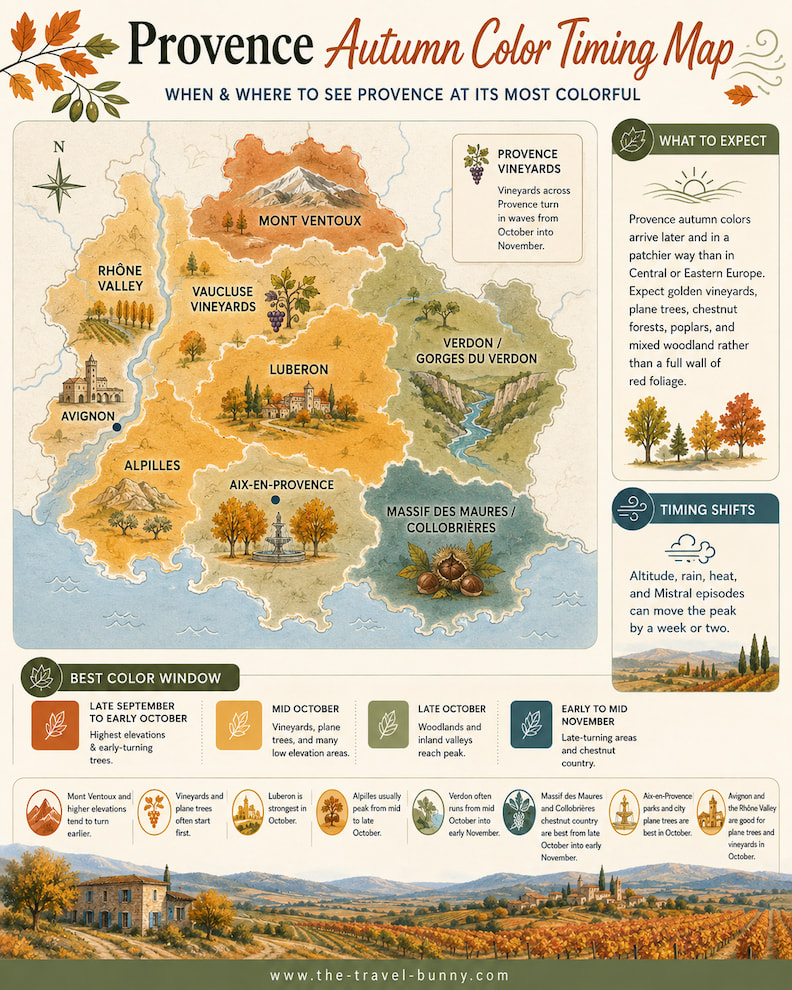
Where to Go in Provence in Autumn
Never think of Provence as a single destination, especially in autumn. The coast can still be warm enough for lunch outside while the Verdon is already moving toward colder mornings. Vineyards change color before much of the Mediterranean vegetation does. Small villages become easier to visit once the summer crowds thin, while cities such as Aix-en-Provence, Avignon, Arles, and Marseille have enough year-round life to make any rainy day interesting.
The Provence autumn villages I would prioritize sit mainly in the Luberon and Alpilles. Gordes, Roussillon, Bonnieux, Lourmarin, Saint-Rémy-de-Provence, Les Baux-de-Provence, Eygalières, and Maussane-les-Alpilles are all good places to visit in Provence in autumn. There are ten villages around Saint-Rémy, Les Baux, Mouriès, Eygalières, Fontvieille, and Maussane, with vineyards, olive groves, markets, and walking routes between them.
The best villages to visit in Provence in autumn are also the ones whose surroundings improve with the season. Luberon vineyards start changing color, olive groves become attractive again as harvest approaches, and cooler temperatures make walking through hill towns less punishing than in July.
The Travel Bunny’s advice: Among the best hilltop villages to visit in Provence in fall, I would put Gordes, Bonnieux, Roussillon, Les Baux-de-Provence, and Eygalières high on the list, although I would choose between them according to the rest of the day’s itinerary.
The best villages in Provence in autumn aren’t always the famous ones either. Mouriès becomes especially interesting around olive season, while smaller Alpilles villages such as Aureille, Fontvieille, and Maussane give you an easier look at local life once summer tourism recedes. Eygalières still has its Friday market, and the surrounding vineyards and olive groves make the stop part of a wider day rather than an isolated village visit.
The best places to visit in Provence in autumn also include cities. Aix-en-Provence, Avignon, Arles, and Marseille have museums, restaurants, markets, monuments, and plenty of indoor options to rescue any rainy afternoon. I would lean increasingly toward these places later in the season, when smaller tourist villages begin reducing opening days and early sunsets make long rural itineraries less appealing.
The best places to visit in Provence in October spread much farther. This is the month when I would happily combine a Luberon village day with vineyards, spend another day in the Alpilles, then head toward the Verdon or Mediterranean coast if the forecast cooperates. October is especially good for this kind of mixed trip because you can still enjoy warm coastal weather while inland areas are already showing a clearer autumn change.
Aix-en-Provence is a practical base if you don’t want to change hotels every night. Provence autumn day trips from Aix can reach the Luberon, Alpilles, Cassis, Verdon, Avignon, Arles, and nearby wine country. The Aix-en-Provence tourism office currently runs excursions from the city to all of those areas, which is useful if you don’t want to rent a car.
Provence autumn day trips from Avignon naturally favor the western side of the region. The Luberon, Châteauneuf-du-Pape, Saint-Rémy-de-Provence, Les Baux-de-Provence, the Alpilles, and Roman sites around the Rhône all fit an itinerary better from here than from the Côte d’Azur. Avignon is also a sensible base later in autumn because the city stays active after small seasonal resorts have started winding down.
These are the broad areas I would build a Provence autumn trip around. The next choice is less about ranking every Provençal town from first to twentieth and more about matching each part of the region to the month, weather, and kind of day you actually want.
Luberon and Alpilles Villages. Gordes, Roussillon, Bonnieux, Saint-Rémy and Les Baux
A good Luberon autumn day needs fewer villages than most itineraries suggest. Gordes, Roussillon, Bonnieux, Ménerbes, Lacoste, and Lourmarin are close enough on a map to tempt you into catching them all like Pokemons. But in reality, steep streets, market mornings, lunch, parking, and the small roads between villages eat into the day quite efficiently. I would choose two or three places at most and spend the rest of the time in the countryside between them.
Luberon in autumn is especially rewarding because the villages stop competing quite so aggressively with summer traffic. Vineyards, orchards, and farmland give you plenty to look at from the car, while cooler temperatures make hilltop streets easier to walk.
The Travel Bunny’s insider tip: The Parc naturel régional du Luberon keeps a large network of marked walks through Chemins des Parcs. You will find route length, duration, elevation gain, difficulty, maps, access details, parking, warnings, and downloadable route sheets for hikes across the Parc naturel régional du Luberon.
A Luberon October trip is a great idea if village walking and vineyard scenery outrank swimming. October also gives you a useful overlap between active markets, open attractions, harvest activity, and the first saturated autumn colors.
I would build a Luberon autumn itinerary around one side of the valley at a time. Gordes and Roussillon pair naturally because they sit close together, while Bonnieux, Lacoste, and Ménerbes make another compact group farther south and west. Trying to add Lourmarin to the same day means crossing the Petit Luberon through the Combe de Lourmarin, which is possible, but it turns your village day into a lot of driving.
Gordes in autumn
Gordes in autumn is still busy by Provençal village standards, but the difference from high summer is substantial. The village rises above the Calavon valley, and much of the visit involves steep stone streets. Tuesday morning is market day, so I would either arrive early and stay for the market or choose another day if I wanted the quietest possible visit.
A Gordes autumn visit also gives you access to the Gorges de Véroncle between Gordes and Murs. The gorge stretches for 7.5 km and contains the remains of ten old flour mills, with walking routes starting from Gordes, Murs, or the Grailles parking area. It’s a better use of a clear autumn morning than spending three hours circling souvenir shops, in my opinion.
For a Gordes fall itinerary, I would pair the village with either the Véroncle Gorge or nearby Roussillon instead of adding another four villages to the day. Gordes itself is small, but the surrounding countryside gives the visit context. The view over the valley is also better appreciated once you have driven through the vineyards, orchards, and fields below.
Rousillon in autumn
Roussillon in autumn gives you a completely different palette. The village is in the Luberon ochre country, and the Sentier des Ocres stretches through former ochre quarries directly beside the village. The trail remains open throughout October from 10 am to 5 pm, with the final entry at 4:30 pm, subject to weather. From 1 to 15 November, hours shorten to 11 am to 4 pm. Entry is €3.50 for adults.
The Roussillon ochres in fall are useful precisely because they don’t depend on foliage. Even if the trees are having an unimpressive year, the cliffs still give you red, rust, orange, and yellow mineral tones. The short and long circuits take roughly 30 to 60 minutes, so you can add the trail to a village visit without turning the entire day into a hike.
Bonnieux in autumn
Bonnieux is the village I would choose for height, a market, and views across the valley without the intensity of Gordes. Bonnieux fall travel is best on Friday morning, when the weekly market fills Place du Terrail and Rue d’Ittenheim with local producers and artisans. The old village climbs sharply toward the upper church, with views across to Lacoste, the Monts de Vaucluse, and Mont Ventoux.
Bonnieux also has a practical wine stop outside the village. BORÉLIS, the Cave de Bonnieux, stays open through 31 October 2026, then reopens from 3 November on its winter schedule. Tastings are free, and the cellar is about 100 meters from the Calavon greenway.
The best hikes in the Luberon in autumn depend on how serious you want the walking to become. The Gorges de Véroncle combine rock, old mills, and a proper gorge close to Gordes. Easier routes around vineyards and village edges are better for shorter days.
Choosing where to stay in the Luberon Valley during fall depends on how much driving you want at night. Apt is practical for markets, services, and access to several villages. Bonnieux and Ménerbes can be quieter village bases. Gordes is convenient for the northern side of the valley but usually costs more. Finally, Lourmarin is the best if your plans include Aix-en-Provence or the southern Luberon.
The Travel Bunny’s Luberon tip: Later in autumn, I’d favor a town with year-round restaurants over a tiny hamlet where your dinner options disappear by Tuesday.
The Alpilles autumn guide
My Alpilles autumn trip would center on Saint-Rémy-de-Provence, Les Baux-de-Provence, Maussane-les-Alpilles, Mouriès, and Eygalières. Here, the scenery is sprinkled with limestone ridges, olive groves, vineyards, farm roads, and villages that still have substantial local life after summer.
Saint-Rémy-de-Provence is the easiest base in the Alpilles because it has shops, restaurants, Roman sites, markets, and direct roads toward Les Baux, Eygalières, and Avignon. The Saint-Rémy fall market takes place every Wednesday from 8 am to 1 pm, spreading across Place de la République and the historic center. A smaller producers’ market also runs every Saturday morning year-round.
I would choose Wednesday for a full market morning, then leave Saint-Rémy after lunch. The larger market has herbs, olives, oil, fruit, vegetables, honey, flowers, clothes, and household goods. Saturday is better if the main purpose is buying food directly from local producers instead of spending an hour inspecting linen shirts you never intended to own.
Les Baux-de-Provence deserves to be explored beyond the fortified village itself. Several wine and olive estates sit immediately around the limestone outcrop, including Mas de la Dame and Mas Sainte Berthe, while Moulin Castelas produces olive oil nearby.
The most useful driving routes through Alpilles vineyards during harvest connect Saint-Rémy with Les Baux, Maussane, Mouriès, and Eygalières. I would start in Saint-Rémy, drive south toward Les Baux, continue through Maussane and Mouriès, then loop back toward Eygalières. This route passes vineyards, olive groves, and several estates, including Mas de la Dame near Les Baux, Mas de Gourgonnier at Mouriès, and Domaine de la Vallongue near Eygalières.
Mouriès is interesting later in autumn because olives are part of everyday agriculture here rather than decorative trees planted around hotel pools. Eygalières gives your loop a quieter finish, with vineyards and olive fields around the village and a large Provençal market every Friday morning.
I would split the Luberon and Alpilles across separate days. They look close on a regional map, but each deserves time outside the villages themselves. In autumn, the roads, vineyards, markets, olive groves, and walks between the famous names are often the reason I would go in the first place.
Aix-en-Provence, Avignon, and Arles. Best Choices as the Season Gets Quieter
Once smaller villages start trimming opening days, I would shift part of an autumn trip toward Aix-en-Provence, Avignon, and Arles. These are places with museums, markets, restaurants, monuments, and year-round residents that can easily occupy a rainy afternoon or a November Monday without forcing you to redesign the entire day around one closed door.
Aix-en-Provence in autumn
Aix-en-Provence autumn trips are easiest in September and October, when you still have long enough days for the historic center, Sainte-Victoire country, and a museum or two without rushing. The city can also be a practical base if you prefer unpacking once and taking rural excursions from there.
An Aix-en-Provence October stay has one particularly good 2026 advantage. The Atelier des Lauves, Cézanne’s final studio, reopened on 4 July after restoration and stays open through 31 October. In October, you can visit daily from 10 am to 5 pm, with the last departure at 4 pm. Full-price tickets range from €9.50 to €15 depending on the type of visit, and reservations are strongly recommended because places are limited.
Visiting Cézanne Studio in Aix during autumn is appreciated more once you know what the room represents. Cézanne had the studio built on the Lauves hill in 1901 and worked there during the final four years of his life. His furniture, painting equipment, and familiar objects remain inside, including the tall opening cut into the north wall so he could move large canvases in and out.
The Travel Bunny’s Aix tip: Timing needs attention if your trip extends into November. The Atelier des Lauves closes after 31 October, so I would visit it early rather than saving it for the quietest part of the trip. Cézanne’s Aix has three principal sites, with the Bastide du Jas de Bouffan and the Carrières de Bibémus completing the group.
Aix is also one of the easier Provence bases without a car. Day trips from Aix-en-Provence in fall can be to Luberon villages, wine estates, and combinations of Gordes, Roussillon, Lourmarin, and Fontaine-de-Vaucluse.
Provence autumn day trips from Aix are a good idea well after the summer excursion season has thinned. Avignon, the Pont du Gard, the Luberon, and the Alpilles are also among destinations you can reach from Aix. If you dislike driving narrow village roads or would prefer somebody else to deal with wine tastings and parking, this is one of the better autumn bases.
Avignon in fall
Avignon in fall is the base I would choose for western Provence. Châteauneuf-du-Pape, the Alpilles, Saint-Rémy-de-Provence, the Luberon, and the Pont du Gard all sit within easier reach from here than from the Mediterranean coast.
An Avignon October trip still gives you a broad choice of surrounding villages and wine country, while November brings a different reason to stay. Millévin takes over central Avignon on Thursday, 19 November 2026, from 6 pm to 9 pm. The festival celebrates the release of the new Côtes du Rhône vintage with winemakers, wine merchants, wine brotherhoods, music, and paid tastings. Participation is free.
What to do in Avignon during Millévin festival: I would spend the afternoon around the historic center and Palais des Papes, eat before the festival gets busy, then join Millévin once the tastings begin.
Book your accommodation in one of the best bases for Provence autumn day trips from Avignon. Saint-Rémy-de-Provence and Les Baux are south toward the Alpilles, Châteauneuf-du-Pape is north, and the Luberon spreads east. You spend less time crossing Provence and more time inside the area you intended to visit.
The Pont du Gard is a great trip from Avignon. Visiting Pont du Gard in autumn without crowds also comes with much cooler walking conditions than midsummer. The archaeological site itself stays accessible every day from 8 am to midnight, while the museum and other discovery spaces are open from 9 am to 6 pm in October. These indoor discovery areas close for winter from 2 November.
This distinction is useful if you visit in November. The Roman aqueduct and outdoor site remain accessible, but the museum, cinema, children’s Ludo area, and temporary exhibition are no longer part of the day after 1 November. Parking is €9 per vehicle for the day.
Arles for Roman sites, museums, and a quieter city day
Arles in autumn is one of the best places to visit once the weather becomes less reliable because the city has enough Roman archaeology and museums to build a full day itinerary without depending on a single outdoor attraction. The amphitheater remains open through autumn, with hours of 9 am to 6 pm in October and 10:30 am to 4:30 pm from 2 November through February.
The Arles autumn heritage cluster is unusually dense. The amphitheater, ancient theater, cryptoportiques, Alyscamps, and Musée départemental Arles antique are so close to each other that you can choose according to weather without following a rigid itinerary. The archaeological museum stays open from 9:30 am to 6 pm throughout 2026 except Tuesdays and several public holidays, including 1 November.
October 2026 also has a dedicated heritage weekend. Les Monument’Arles takes place from 16 to 18 October, with performances inside historic monuments included in normal monument admission, while opening and closing performances are free. You can attend this autumn event and plan a city day around it because the setting is doing half the work already.
The shorter November hours are worth taking seriously. The Arles amphitheater closes at 4:30 pm in November, with last entry at 4 pm. If you arrive after a long lunch and assume Roman monuments keep Mediterranean dinner hours, Rome has already shut for the afternoon.
Camargue from Arles with flamingos, horses, and wild wetlands
Arles also puts the Camargue immediately south of you. The Parc naturel régional de Camargue covers Arles, Saintes-Maries-de-la-Mer, and Port-Saint-Louis-du-Rhône across a Rhône Delta of over 100,000 hectares. This is a proper regional excursion and not a short detour to photograph one pink bird.
Camargue autumn flamingos can be spotted during your visit because flamingos stay in the region year-round. From September through November, young birds begin flying and colonies reorganize before winter, while some individuals later migrate toward Spain and North Africa. Autumn is a period when large groups are often visible before part of the population disperses.
The best time to visit Camargue for flamingos depends on what you want to see. Spring brings courtship and nesting behavior, summer has cute clumsy chicks, and autumn has juveniles, migration activity, lower temperatures, and birdwatching without summer heat. The Parc naturel régional de Camargue is also on a major migration route for northern European birds heading toward Africa, with over 150,000 waterbirds passing through annually.
For close observation, the Parc ornithologique de Pont de Gau near Saintes-Maries-de-la-Mer is the straightforward option. It opens every day of the year and has 60 hectares of marshes, ponds, reed beds, and walking trails, including 2.8 km of accessible paths in the southern section. Hundreds of flamingos are regularly present there.
How to see the Camargue horses and flamingos in autumn depends on how much independence you want. The Domaine de la Palissade, near the mouth of the Rhône, stays open Wednesday through Sunday from 9 am to 5 pm in October and November 2026, with horseback outings available by reservation through November.
Guided 4×4 safaris in the Camargue are another practical choice from Arles or Saintes-Maries-de-la-Mer. You can book year-round excursions through marshes and grazing areas where Camargue horses, bulls, and wild birds are part of the route. Some depart directly from Arles, which makes the city especially useful if you don’t want to base yourself in the delta overnight.
Camargue horses are livestock and not wild horses like in the Danube Delta wandering around for visitor photographs. The horses in Camargue are an extensively raised local breed that grazes marshes and rough ground from spring through autumn and is increasingly used for riding trips across the Rhône Delta.
This distinction is worth keeping in mind because the Camargue is still an agricultural region. Rice fields, grazing livestock, hunting, reed cutting, fishing, salt production, and conservation all share the same delta. Autumn gives you a particularly clear view of that coexistence once summer tourism quiets down.
Aix, Avignon, and Arles each solve a different late-season problem. Aix welcomes you with art, markets, restaurants, and easy eastern excursions through October. Avignon places the Rhône wine country, Luberon, Alpilles, and Pont du Gard within reach. Arles has Roman sites on one side and the Camargue on the other. By November, I would base a trip in one of these cities and drive out to quieter villages than stay somewhere tiny and spend dinner studying the locked door of the only restaurant in town.
Cassis, Bandol, Marseille, and the Mediterranean Coast
The coast is where autumn hangs on longest. I’ve found beaches noticeably quieter after summer, parking easier, and many restaurants still open, although reduced schedules and shorter menus start appearing as the season advances. I’ve also swum during the first week of October without immediately regretting it, which is one reason I keep defending September and early October so enthusiastically.
Cassis in October
A useful Cassis autumn guide starts with the obvious advantage. The Calanques become easier to enjoy once the summer fire-risk period ends. The Parc national des Calanques is generally open from 1 October through 31 May, apart from exceptional closures, while summer access restrictions apply from June through September.
Cassis in October is especially good if Port-Miou, Port-Pin, or En-Vau are high on your travel bucket list. Port-Miou lies about 30 minutes on foot from central Cassis, with Port-Pin farther along the trail. These walks are less punishing under autumn temperatures than on a July afternoon, although the limestone stays rocky and slippery after rain.
Is Cassis worth visiting in October? Yes, I would choose visiting in October over midsummer for hiking and the port itself, unless guaranteed swimming is the main purpose of the trip. Boat tours through the Calanques also operate year-round from Cassis, weather permitting, with reduced departures in winter. The standard circuits range from about one hour for three calanques to over two hours for the longer routes.
Cassis still needs some planning around weather. A calm sunny day is excellent for a boat trip, but a Mistral day changes the sea quickly, and operators cancel departures when conditions deteriorate. I would check the day’s sailing status before driving across Provence for a specific departure.
Bandol after summer
Bandol in autumn keeps much of its coastal life because Bandol is a year-round town instead of a resort built entirely around July and August. The waterfront, market, beaches, and surrounding wine country remain useful once summer activity drops.
October is particularly pleasant around Renécros and the smaller coves west of town. Renécros is calmer in autumn than in summer, with mild October weather still drawing people to the beach. This matches what I see along the Var coast generally. Once families return to school schedules, an ordinary beach starts looking like a beach again vs. a complicated exercise in towel placement (although I found summer 2026 uncrowded).
Bandol offers the alternative of an inland escape if the sea turns rough. The vineyards around La Cadière-d’Azur, Le Castellet, Le Beausset, and Saint-Cyr-sur-Mer are close behind the coast, so a windy morning by the water turns into a wine day without spending half the afternoon in the car.
The coastal path is another reason I like the idea of Bandol later in the year. I recommend the autumn walking routes, including the Bandol Classic and the coastal trail toward the western coves. Cooler temperatures make these outings much easier than during peak summer heat.
Marseille in October
Marseille in October offers the most flexibility on this stretch of coast. The city stays fully active while the Calanques enter their easier hiking season, and the Vieux-Port still serves as a departure point for sea excursions toward the islands and Calanques.
The Calanques around Les Goudes, Callelongue, Marseilleveyre, Sugiton, and En-Vau are much better walking propositions once autumn begins. I recommend the Calanques in autumn because summer crowds and heat have eased. Marseilleveyre, for example, takes roughly an hour on foot from Callelongue, while Sugiton requires a longer walk through exposed terrain.
October also keeps some seasonal transport alive. Marseille’s maritime shuttles between the Vieux-Port, Pointe Rouge, and L’Estaque operate from April through October, giving you another way to see the city from the water before winter schedules take over.
You could visit Marseille over a small coastal town later in autumn if restaurants, museums, markets, and evening options are important. A quiet fishing port has its appeal until dinner, when the only place you had mentally selected has decided October means closing on Tuesdays, Wednesdays, and apparently whenever you arrive hungry.
Porquerolles and Port-Cros after the summer rush
The Îles d’Hyères become very attractive in autumn because ferry service continues after the peak holiday period, although frequencies drop.
A Port-Cros autumn boat trip remains easy to plan through October 2026. From 28 September through 1 November, you have the departure at 9 am from Hyères and the return at 4:30 pm from Port-Cros, with no crossings on Tuesdays or Thursdays. The adult return fare is €29. Weather or technical conditions still affect sailings.
This schedule gives you roughly a full day on Port-Cros, but it also means missing the return boat is a much bigger problem than during high season. I would arrive at the port early and check the timetable again on the day.
Porquerolles autumn sailing tip: Port-Cros also has a small pleasure port, with the harbor office operating from 8 am to noon and 3 pm to 6 pm during September and October. The Bagaud ecological mooring zone remains in service through 15 October, after which seasonal arrangements change.
Porquerolles sailing in October is realistic, but the island remains heavily regulated for anchoring and navigation because it sits within the Parc national de Port-Cros. The park publishes dedicated 2026 marine-regulation maps for Porquerolles covering speed, navigation, and anchoring.
Public ferries to Porquerolles remain frequent into late October. From 21 September through 1 November 2026, there are multiple daily departures from Tour Fondue on the Giens peninsula, with the final 6:30 pm return available until 25 October. After that, the final return moves earlier.
This makes October a good choice to spend a day on Porquerolles. You still have enough ferry crossing to avoid preparing the timetable like a military operation, while visitor numbers are way below midsummer levels.
Sailing this part of the coast in fall
I haven’t sailed the Provençal coast in autumn, so I wouldn’t present a French Riviera autumn sail as firsthand experience. I have sailed these waters in another season, though, and the basic geography remains the same. Marseille and Cassis give access to the Calanques, Bandol sits beside serious wine country, and Hyères is the natural gateway to Porquerolles and Port-Cros.
The best coastal towns to sail in Southern France in fall depend on what you want ashore. Marseille gives the largest choice of provisioning, repairs, restaurants, and urban services. Cassis gives direct access to the eastern Calanques but limited visitor space. Bandol gives a compact port and easy wine-country access. Hyères puts the Îles d’Hyères within short reach.
Autumn berth availability also deserves realistic expectations. Summer visitors leave, but local boat owners return to their annual berths, so a quieter coastline does not automatically mean every marina suddenly has space for passing yachts. I would contact ports ahead rather than assuming October equals empty pontoons.
The Mistral is the other reason I would keep an autumn sailing plan loose. A clear forecast and a pleasant harbor morning don’t guarantee the same sea state later in the day. The islands, Calanques, and exposed crossings are much easier to appreciate when you choose the weather rather than trying to make the weather respect a hotel booking.
That is the broader advantage of the Mediterranean coast in autumn. Cassis becomes easier to walk, Bandol returns to a calmer local rhythm, Marseille keeps city life going, and the Hyères islands remain reachable well after the summer rush has gone home.
Hiking, Swimming, and Sailing Provence in Autumn
Autumn is when Provence becomes much easier to enjoy outdoors. The summer heat backs off, many fire-risk restrictions ease after September, the sea stays warm into early fall, and trails that looked mildly unreasonable in July become appealing again. Of all the Provence autumn activities, hiking, swimming, cycling, and time on the water show the seasonal change most clearly.
September still keeps one foot in summer. What to do in Provence in September depends heavily on the weather, but swimming, coastal walks, island trips, cycling, and shorter hikes all remain doable. I still swim in October some years, so I certainly wouldn’t pack away the swimsuit because the calendar says you’re in September.
But October shifts the balance inland. The best things to do in Provence in autumn now include longer walks through the Calanques, Luberon, Alpilles, and Verdon, where cooler temperatures make elevation and exposed trails less exhausting. The Calanques National Park is open year-round, while its main seasonal fire-access controls last from 1 June through 30 September, though exceptional closures are still possible.
Provence autumn hiking is better from October onward. I recommend visiting in autumn for routes through the Calanques, Verdon, Alpilles, vineyards, and other natural areas, largely because the strongest summer heat has passed.
Autumn hiking in Provence still needs one warning attached to it. Hunting season is underway, and I regularly see this affect access to trails around where I live. Check local notices before setting out, especially in woodland and rural areas, and change route if a hunt is taking place. Never assume everybody in fluorescent orange will somehow organize themselves around your walk, accidents have happenned!
Provence fall walking also includes easier coastal and island routes without planning full hiking days. Port-Cros has around 30 km of marked trails, while Porquerolles has about 51 km. You will love the national park’s paths in autumn and even winter when visitor numbers are lower.
Cycling enjoys the same seasonal advantage. Provence cycling in autumn is easier as soon as riding no longer means planning the entire day around avoiding peak afternoon heat. Porquerolles has four marked cycling itineraries, while inland routes through vineyards, the Luberon, and the foothills around Mont Ventoux become much more inviting once temperatures drop.
Coastal vacations are wonderful longer than many visitors expect. Among the things to do in Provence in October, swimming can still make the list early in the month, especially after a warm September. Sailing is also possible, although the Mistral and shorter daylight deserve greater attention than they did during long summer days.
By October, the list of what to do in Provence in October becomes pleasantly broad. You can walk the Calanques, cycle through wine country, swim when conditions cooperate, or head to Porquerolles and Port-Cros for a quieter island day. I prefer this freedom to midsummer, when the heat and fire-risk rules can decide half the itinerary before breakfast.
These are the things to do in Provence in fall that make the season genuinely different from summer (not just cheaper!). The next sections go into the specific trails, swimming conditions, cycling areas, sailing rules, Mistral, anchoring, and Posidonia restrictions, because each one deserves better advice than bring comfortable shoes and enjoy the outdoors.
Calanques, Verdon, and Mont Ventoux for Autumn Hiking and Cycling
I see cyclists on Provençal roads year-round, including through winter, but riding becomes noticeably easier as soon as the serious summer heat backs off. The same goes for walking. Provence hiking in autumn lets you take longer routes without organizing every climb around shade and an early start, while Provence cycling in autumn brings vineyard roads, mountain passes, and gorge routes back into a more comfortable part of the day.
The best hiking trails in Provence in fall depend heavily on altitude and recent weather. Around Marseille, autumn favors exposed limestone and sea views. The Luberon has lower mountain terrain and old rural paths. The Verdon moves into actual mountain conditions much faster, while Mont Ventoux needs its own forecast even when villages at the foot of the mountain are having a mild afternoon.
Hiking the Calanques in fall
I prefer hiking the Calanques in fall to walking there in peak summer. The seasonal fire-access system for the Bouches-du-Rhône massifs lasts from 1 June through 30 September, with daily closures possible on red-risk days. The Calanques are open in October under normal conditions, although emergency closures and exceptional weather restrictions still remain possible.
October opens up excellent routes around Marseille and Cassis, from Callelongue and Marseilleveyre to Port-Miou, Port-Pin, En-Vau, and the inland approaches toward Sugiton. Among the best hikes in Provence in October, I would choose a Calanques route on a dry, calm day instead of selecting one weeks in advance and stubbornly keeping the plan after heavy rain.
The weather for hiking the Calanques de Marseille in fall deserves respect even when temperatures look comfortable. Look out for strong wind and slippery stone after rain, because the terrain is mountainous. You aren’t taking an easy seaside stroll here, so be prepared with proper hiking shoes, route planning, and at least 1.5 liters of water per half-day.
Autumn also removes one summer complication at Sugiton. The visitor-reservation system protects Sugiton and Pierres Tombées during the busiest period, but October visits fall outside the main high-season reservation dates. I would still check the Mes Calanques app before leaving Marseille because local access information sometimes changes.
The Luberon on foot after summer
The best hikes in Luberon in autumn range from short paths outside Gordes to demanding routes through the Gorges de Véroncle. The full Véroncle loop between Gordes and Murs covers 14.8 km, takes around five hours, and gains about 540 meters. The route is difficult, with narrow exposed sections, an ladder crossing, rocky descents, and slippery passages.
Luberon safety warning: Don’t enter the full Véroncle route during rain or immediately after a storm because sections through the ravine become hazardous. A shorter Gordes route toward Moulin Jean-de-Marre covers 3.9 km in about an hour and gives an easier alternative if a full gorge day sounds excessive.
This is why I can’t say one trail is the universal winner. The best hiking trails in Provence in fall are often the routes matching the previous forty-eight hours of weather, your footwear, and your appetite for limestone after rain.
Gorges du Verdon in October
The Gorges du Verdon in October are one of my best autumn hiking choices, especially once summer visitor numbers drop. I recommend autumn on the Blanc-Martel trail, when the gorge vegetation changes color and the path gets less traffic than during the high season.
A Verdon autumn hike also requires more preparation than a laid back coastal walk. Parts of the regional park approach 2,000 meters, and there are rapidly changing mountain conditions and frequent storms. French autumn is a transitional season where mild spells alternate with colder, wetter periods, sometimes abruptly.
The weather when visiting the Gorges du Verdon in October therefore deserves looking at a forecast for the exact area and day. Don’t rely on temperatures from Marseille or Nice. La Palud-sur-Verdon is deeper inland and much higher than the Mediterranean coast. A T-shirt afternoon beside the sea tells you surprisingly little about conditions deep in the gorge.
Blanc-Martel trail is the hike to do in autumn. There are roughly 15 km between Chalet de la Maline and Point Sublime, with around 5 hours 30 minutes of walking before stops. The route includes tunnels, stairs, exposed sections, and a final climb. Pack a headlamp because some tunnels are dark.
Blanc-Martel detour: Following a rockfall near the Couloir Samson, the final section toward Point Sublime is temporarily closed. Hikers continue along the RD23A and then GR49 instead. The Blanc-Martel hike itself remains accessible.
From 18 September through 1 November, the Blanc-Martel shuttle is available on Fridays, Saturdays, Sundays, and public holidays. Reservations are strongly recommended because the trail is linear and the shuttle links La Palud-sur-Verdon with the start and finish.
Cycling Mont Ventoux in autumn
A Mont Ventoux autumn ride has one enormous advantage over midsummer. Lower temperatures remove one source of misery from an ascent already providing quite enough difficulty on its own.
Cycling Mont Ventoux in autumn is still a serious challenge, though. The Bédoin climb is 21.8 km long with 1,598 meters of ascent and a 7.5% average gradient, with sections reaching 15%. Malaucène covers 21 km with 1,575 meters of climbing. Sault is longer at 25.6 km but gains 1,210 meters, with a 5% average gradient before the much harder final section above Chalet Reynard.
Mild weather makes cycling Mont Ventoux routes in autumn more pleasant lower down, but the summit has its own climate. Temperature differences reach around 10°C between the lower road and upper mountain, and the final 6 km above Chalet Reynard are highly exposed to wind. You should pack a windproof layer even if Bédoin feels warm at departure.
Among the best cycling routes in Provence in autumn, the Gorges de la Nesque are an excellent alternative to reaching the Ventoux summit. The marked road loop from Villes-sur-Auzon stretches over 64 km with 974 meters of ascent, passing the gorge road, tunnels, belvederes, Monieux, and Ventoux vineyards. The long climb through the gorge is progressive and not Ventoux-level brutal.
The full Tour du Ventoux is yet another option for strong riders who want the mountain without climbing straight to the observatory. The official two-day route covers 117 km around the massif through Bédoin, Malaucène, Sault, the Gorges de la Nesque, the Toulourenc valley, and the Plateau d’Albion.
Is Mont Ventoux open to drive in autumn? The summit road normally remains accessible through October and into part of November, depending on snow, ice, wind, and the annual winter closure. Summit access is available from roughly mid-April to mid-November. In 2025, winter closure began on 18 November.
Even after the summit road closes, access lower down usually continues to Chalet Reynard from the south and Mont Serein from the north, subject to mountain conditions. Once winter rules start, equipment requirements also change.
This split between valley and summit conditions is the main thing I would remember about spending autumn outdoors here. The coast, Luberon, Verdon, and Ventoux might all show sunshine on the same day, but they will require completely different things from your shoes, bike, clothing, and route choice.
Is Provence Still Warm Enough to Swim in September or October?
Is Provence still warm enough to swim in September? Yes, especially along the Var and Bouches-du-Rhône coast. September is still beach season for me. The Mediterranean has had all summer to warm up, families tied to the school calendar have largely gone home, and the water usually stays pleasant well into the month.
Around Bandol, the average September sea temperature over the past decade sits near 22.4°C. Cassis is almost identical at roughly 22.2°C. These averages explain why Provence beaches in September still have plenty of swimmers even after the busiest holiday weeks have ended.
Among the best beaches still open in Provence in September, I would include Renécros and Plage Centrale in Bandol, plus Grande Mer and Bestouan in Cassis. Bandol’s Plage Centrale is open year-round, while Cassis keeps lifeguard supervision at Grande Mer and Bestouan all of September, with reduced supervision toward the end of the month.
Early October is less predictable, but swimming in Provence in October remains doable during warm spells. I’ve gone swimming during the first week of October and found the water fine. By then, the bigger difference is often getting out of the sea, especially after late-afternoon shade reaches the beach.
The typical Provence sea temperature in October near Cassis and Bandol is around 20°C. Historical data for both towns show October averages close to that figure, although individual days vary substantially.
The Mistral deserves more attention than the date on your calendar. A sustained Mistral pushes warmer surface water offshore and draws colder deep water toward the coast. Sea temperature along western Provence sometimes drops sharply after a windy spell, even under clear blue skies. A warm October afternoon doesn’t guarantee equally warm water.
Autumn storms create another practical issue. After heavy rain, runoff occasionally triggers temporary bathing bans along the Var coast. Avoid swimming during storms and for 48 hours afterward because runoff affects coastal water quality. In August 2026, several Bandol beaches temporarily closed after heavy rainfall and a wastewater discharge, which is a good reminder to check municipal beach notices after bad weather!
September is the safer choice if swimming forms an important part of your trip. Early October can still have good beach weather, but late October becomes far less dependable. By November, I leave the sea to the year-round local swimmers, who clearly possess a level of commitment I haven’t reached yet.
Sailing the Calanques and Îles d’Hyères. Mistral, Anchoring and Posidonia Rules
Autumn takes away some summer pressure on the Provençal coast, but the sea rules remain. Provence sailing in autumn still means checking protected zones, anchoring restrictions, marine forecasts, and harbor availability before choosing the prettiest cove on the chart. October sunshine is a poor substitute for reading the regulations.
Sailing Provence in autumn also requires a different approach to wind. The Mistral is a turbulent, dry regional wind with average speeds reaching 50 km/h and gusts of 80 to 100 km/h, occasionally higher. Around Marseille, the Mistral generally arrives from the northwest. Along the Var coast, the direction becomes more westerly. A Mistral episode sometimes lasts several days or even over a week.
Is October good for sailing in Provence? Often, yes. September and October offer a useful combination of warm sea temperatures, long enough daylight, and reduced holiday traffic. But play it safe and plan a wind day ashore into your itinerary.
Sailing the Calanques from Marseille to Cassis
Sailing the Calanques in autumn takes you to one of the most interesting stretches of coast near Marseille, but famous coves don’t always equal legal anchorages. The marine part of Parc national des Calanques extends from the Frioul area past Marseille and Cassis toward La Ciotat, with specific zones governing access, speed, anchoring, fishing, and landing.
Calanques National Park boating tip: Autumn doesn’t suspend marine protection rules. En-Vau and Port-Pin prohibit anchoring, and parts of the park prohibit navigation or landing as well. The park provides an interactive marine-regulation map showing restricted zones, ecological moorings, Posidonia beds, port-access zones, and the 300-meter coastal strip.
The rules for anchoring in Calanques National Park in autumn protect Posidonia seagrass throughout the year. The broader Mediterranean rule prohibits anchoring where an anchor or chain would damage protected marine vegetation. Within the Calanques, designated arrangements include sandy anchoring areas and ecological moorings in selected locations.
These boating rules for Posidonia grass protection in the Calanques in fall are worth understanding before setting sail. Posidonia is a protected Mediterranean flowering plant, it’s not some ordinary seaweed. An anchor dropped onto a meadow, followed by a chain sweeping across the seabed as the boat swings, damages habitat the anchoring scheme is designed to protect.
Cassis has marked authorized anchoring areas for vessels under 24 meters. The park installed offshore buoys defining the outer limit, with authorized anchoring between the coast and those markers in the relevant zones. Boats measuring 24 meters or longer face stricter anchoring restrictions across the Mediterranean protected-seagrass system.
The navigation regulations in Calanques National Park in October also distinguish between private sailing and commercial activity. Commercial passenger boats operating within the marine core require park authorization and professional motorboat rental inside the core is restricted to authorized operators.
A Marseille to Calanques boat rental in late season therefore needs one extra check before payment. For a motorboat entering the protected marine core, verify the rental company against the Parc national des Calanques authorization information and don’t assume that every Marseille rental listing has equal access.
A sailing route from Marseille to Cassis in fall naturally passes some of the coast’s best-known scenery, but I would plan possible stops from the legal marine chart rather than from photographs of En-Vau. A beautiful anchorage where anchoring is prohibited is, from a skipper’s perspective, mainly a beautiful place to continue past.
Among the best autumn sailing trips from Marseille, a shorter Frioul outing leaves plenty of time for uncertain wind, while a longer Calanques and Cassis day requires a better forecast window and earlier start. If you want to enjoy Marseille sailing in fall, stau flexible.
Marseille sailing in October also sits directly in Mistral territory. The Marseille Mistral is mainly in the northwest sector, with strong gusts during established episodes. Check the official coastal marine forecast for the Marseille to La Ciotat zone before departure. Don’t rely on a general Marseille weather app showing a cheerful yellow sun.
Porquerolles and Port-Cros under the 2026 marine rules
Hyères islands sailing in fall takes place inside and around Parc national de Port-Cros, where separate 2026 marine maps cover Porquerolles and Port-Cros. Those charts show current rules for circulation, speed, and anchoring around each island.
Porquerolles sailing in October has one useful seasonal difference. Several summer-only restrictions around beaches and landing points end after September, but permanent protected zones remain. Plan your route with the 2026 Porquerolles marine chart.
The park is developing a new anchoring scheme for northern Porquerolles for 2028. Proposed ecological moorings and sandy anchoring areas appear in project documents, including sectors near Notre-Dame, La Courtade, and Plage d’Argent. These future plans are not the 2026 rulebook.
The sailing conditions between Hyères and Porquerolles in October and November depend heavily on wind direction and sea state. The Var coast receives the Mistral mainly from the west, and stronger episodes sometimes continue for days. A forecast for Hyères or Porquerolles is more useful than an inland Var forecast.
The weather conditions for sailing around Porquerolles in November deserve extra flexibility because daylight is shorter and the Mistral tends to strengthen as winter approaches. There’s a higher Mistral frequency and intensity in winter and spring. November is close enough to that transition for a same-day marine forecast to outrank any monthly climate average.
A Port-Cros boat trip in autumn also needs closer attention to harbor arrangements. Port-Cros marina keeps its harbor office open from 8 am to noon and 3 pm to 6 pm during September and October. The national park publishes separate 2026 rules for vessels around Port-Cros, covering anchoring, circulation, and speed.
For quiet anchorages on the French Riviera for October sailing, I would look first at the Rade d’Agay near Saint-Raphaël and the regulated mooring areas around Port-Cros. The Bagaud ZMEL has four particularly useful sectors, Nord Bagaud, Sud Bagaud, Anse Saint-Pierre, and Anse Fausse Monnaie, with ecological buoys available through October 15.
Around Porquerolles, sheltered bays such as Langoustier and Bon Renaud are appealing in settled weather, but current anchoring maps still need checking before dropping the hook because Posidonia protection takes priority over finding an empty-looking patch of water.
Which Provençal ports make the best autumn sailing bases?
Among the best coastal towns to sail from in Southern France in fall, Marseille, Hyères, and Saint-Tropez serve quite different trips. Marseille gives direct access to Frioul and the Calanques, Hyères is the obvious jumping-off point for Porquerolles and Port-Cros, and Saint-Tropez places you in the Gulf of Saint-Tropez and within the eastern Var sailing area.
The pattern in Provence marinas in autumn is less obvious than the quieter beaches suggest. Summer visitors leave, while local owners return to annual berths. Transient space therefore deserves a call ahead, especially where small harbors have limited visitor capacity. A half-empty restaurant terrace tells you nothing useful about tonight’s berth allocation.
A French Riviera autumn sail also becomes especially interesting around Saint-Tropez at the end of September. The town hosts one of the Mediterranean’s major sailing events precisely when the summer holiday rush is ending.
Les Voiles de Saint-Tropez dates and how to watch in 2026
Les Voiles de Saint-Tropez take place from Saturday, 26 September to Sunday, 4 October 2026. The 28th edition brings over 250 classic, modern, and maxi yachts to the Gulf of Saint-Tropez, including almost 50 Maxis and the return of J-Class yachts.
The Saint-Tropez regatta in September starts with registration and boat arrivals on 26 and 27 September. Racing begins Monday, 28 September for Modern and Maxi fleets, with classic yachts joining from 29 September. Racing continues through Saturday, 3 October, followed by the final Modern and Classic prize ceremony on Sunday, 4 October.
Les Voiles de Saint-Tropez dates and how to watch: Many starts take place directly in front of Saint-Tropez and the Môle Jean Réveille. The Citadelle and Chapelle Sainte-Anne provide elevated views over the gulf, while the harbor breakwater gives a good position for boats leaving and returning. Starts generally begin from around 11 am, depending on weather, with yachts leaving port around 9 am and the earliest boats returning from roughly 3 pm.
The Village des Voiles on Môle Jean Réveille is free to enter. In 2026, the village is open daily from 26 September to 4 October, generally from 9 am to 9 pm, with an earlier 5 pm closing on the final Sunday.
I haven’t attended Les Voiles de Saint-Tropez yet, but this is the autumn sailing event I would choose if the purpose were watching instead of skippering. With race courses changing according to daily weather, following from the Citadelle, Sainte-Anne, or the port also avoids the less appealing idea of placing a cruising boat anywhere near a fleet of racing Maxis.
Sailing the French Riviera in September and October has the advantages of warm water, a long-established regatta calendar, quieter cruising days outside event weeks, and access to islands and protected coast long after school holidays end. The trade-off is that autumn requires more attention to wind, harbor hours, anchoring zones, and daylight.
I would take this trade. A good Provence sailing autumn plan leaves enough time for a Mistral day ashore and treats Posidonia rules as part of seamanship instead of an inconvenience invented after the chart was printed.
How to Plan an Autumn Provence Trip
The first decision in how to plan a fall trip to Provence is geographic. Provence stretches from Avignon and the Alpilles across the Luberon and Verdon to Marseille, the Var coast, and the Mediterranean islands. Trying to cover all of these areas from one hotel creates long driving days. I’d choose one or two bases, then build each day around nearby villages, markets, hikes, wine country, or the coast.
A Provence autumn itinerary of four days needs restraint. One well-chosen base leaves enough time for a city, nearby countryside, and a couple of day trips without spending half the visit changing hotels. Seven days allows you to pick two bases. Ten days adds useful flexibility when rain, Mistral, reduced ferry schedules, or shorter November opening hours interfere with the original plan.
How many days you need in Provence in autumn depends mainly on distance. Four days fits one part of Provence, while a week fits two distinct areas comfortably. I would plan ten days in Provence for a broader trip combining the Luberon or Alpilles with the Mediterranean coast, Verdon, or Camargue.
The best Provence itinerary for autumn also keeps outdoor days movable. I’d avoid locking every hike, boat trip, and mountain drive to a specific date months ahead. Markets and ticketed events will be on fixed days. But calanques hikes, island trips, Ventoux, and Verdon can be on whichever day has the safest forecast.
Aix-en-Provence is a useful base for central and eastern Provence. Provence autumn day trips from Aix include the Luberon, Alpilles, Arles, Avignon, Cassis, Verdon, and wine country.
Avignon is better for the western half of the region. Provence autumn day trips from Avignon reach Gordes, Roussillon, Saint-Rémy-de-Provence, Les Baux-de-Provence, the Pont du Gard, vineyards, and other parts of the Luberon and Alpilles. You can plan regional circuits throughout the season, including full-day combinations linking several of those places.
Later in autumn, I would lean increasingly toward Aix, Avignon, Arles, or Marseille as overnight bases. Small villages are always worth visiting, but restaurants, attractions, ferries, and seasonal businesses start trimming days and hours. A lively base gives you somewhere useful to return to when a November plan ends earlier than expected.
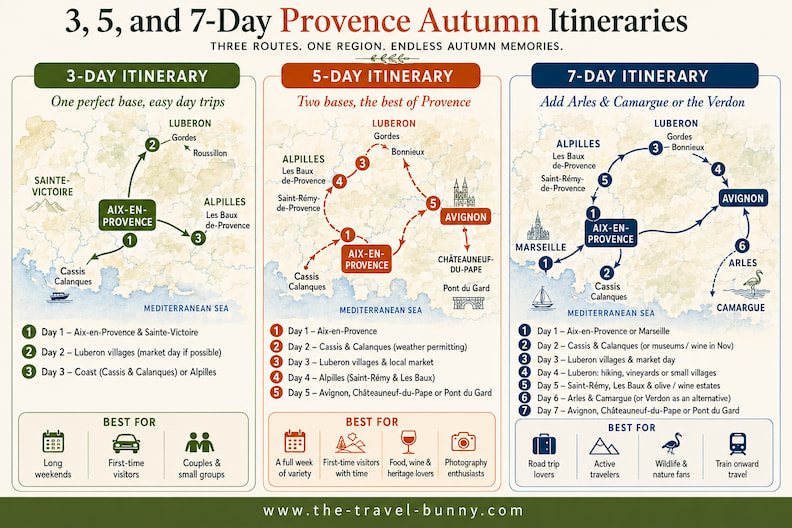
3, 5, and 7-Day Provence Autumn Itineraries
Three days are enough for one small part of Provence. Five days let you connect two neighboring areas without turning the rental car as accommodation. Finally, seven days are enough to enjoy the coast, vineyards, villages, and one larger city, provided you resist the urge to cross the region every morning.
We do most of our local exploring in spring and autumn, and I would plan these routes the same way. Fixed-date markets and festivals go into the calendar first. Hiking, boat trips, and mountain roads stay flexible until the forecast becomes clear.
Three-day Provence autumn itinerary
My three-day Provence autumn itinerary would use Aix-en-Provence as a base in September or October. Aix has you restaurants and museums open in the evening, while the Luberon and Mediterranean coast are within reasonable day-trip range. You can also link Aix with the Luberon and Alpilles through vineyard country.
- Day 1 is to visit Aix-en-Provence. Walk the old center, visit Cézanne’s sites if your dates fall before their seasonal closing dates, browse the market, then leave the afternoon open for Sainte-Victoire or a nearby wine estate.
- Day 2 is a Luberon autumn itinerary in miniature. Pick two villages. Gordes and Roussillon pair well, and Bonnieux and Lourmarin are another sensible combination. You can try to visit on market days, with Gordes on Tuesday, Roussillon on Thursday, Lourmarin on Friday, and Apt on Saturday.
- Day 3 depends on the month. In September or early October, I would head toward Cassis and the Calanques. Later in October, the Alpilles are a better choice. In November, I would replace the coast with Avignon, Arles, or wine country unless the forecast promises a bright Mediterranean day.
A Provence September itinerary should keep swimming and the coast high on the list. September still has summer temperatures along much of the Mediterranean, while grape harvest activity gives inland days a seasonal focus. The vendange and Les Voiles de Saint-Tropez are two of September’s major seasonal events.
Five-day Provence autumn itinerary
A five-day Provence autumn itinerary lets you enough time for two bases. I would spend two nights around Aix-en-Provence, then three around Avignon, Saint-Rémy-de-Provence, or the western Luberon.
- Day 1 stays in Aix-en-Provence.
- Day 2 is for going south toward Cassis in September or October, with a Calanques walk or boat trip according to wind and sea conditions.
- Day 3 moves you west through the Luberon. Gordes, Roussillon, Bonnieux, or Lourmarin are good destinations. Choose one local market or wine stop instead of racing through every famous village. Spend the night closer to Avignon or Saint-Rémy instead of driving back to Aix.
- Day 4 takes you to the Alpilles. Saint-Rémy-de-Provence, Les Baux-de-Provence, Maussane-les-Alpilles, and the surrounding olive and wine estates fit naturally together.
- Day 5 is spent around Avignon. The Palais des Papes and historic center fill part of the day, while Châteauneuf-du-Pape or the Pont du Gard make an easy addition outside the city. You can also book full-day excursions combining Gordes, Roussillon, Saint-Rémy, Les Baux, and Pont du Gard if you don’t have a rental car to access a broad part of western Provence.
This Provence autumn itinerary for 5 days combines coast, cities, villages, vineyards, and the Alpilles without changing hotels every night. I would skip Verdon unless you replace another area entirely. Adding Verdon on top turns your five-day trip into a collection of scenery seen through the windshield.
Seven-day Provence autumn itinerary
A seven-day Provence autumn itinerary allows you to add Arles and the Camargue or the Verdon. I would choose only one of these destinations, instead of trying to squeeze in both.
My 7-day Provence autumn road trip itinerary would start with two nights around Aix or Marseille, continue with two nights in the Luberon, then finish with three nights around Avignon, Saint-Rémy, or Arles.
- Day 1 introduces Aix-en-Provence or Marseille. Aix is great to admire Cézanne and gain an easy access to inland Provence. Marseille takes you to the famous Vieux-Port, museums, and Calanques access.
- Day 2 goes to Cassis and the Calanques in September or October. A November version keeps Marseille but swaps a long coastal day for museums, Aix, or nearby wine country if wind or rain looks poor.
- Day 3 moves into the Luberon. Choose a market according to the weekday, then pair the market village with one nearby stop. Gordes plus Roussillon or Bonnieux plus Lourmarin offers variety without having lunch while staring at a steering wheel.
- Day 4 stays in the Luberon for hiking, vineyards, or smaller villages. Autumn is one of the best seasons for walking in Provence, including routes through the Alpilles and other protected natural areas.
- Day 5 heads toward Saint-Rémy and Les Baux. Olive estates and vineyards give the route a stronger agricultural character in autumn, while Mouriès becomes particularly relevant around olive harvest season. You could book an autumn olive-grove visit around Mouriès.
- Day 6 belongs to Arles and the Camargue if wildlife, Roman heritage, or flat cycling routes appeal.
- Day 7 finishes in Avignon, Châteauneuf-du-Pape, or the Pont du Gard. Keeping the final night near Avignon is useful if you’re continuing north by train.
This Provence autumn itinerary for 7 days has another advantage. One outdoor day remains replaceable. If the Mistral ruins Cassis, you can move the coast later. If rain hits the Luberon, you can spend the day in Aix or Avignon. A week gives the forecast less power over the entire trip.
How I would change the route in October
A Provence October itinerary is the easiest version to balance. I’d give hiking a larger role, keep one coastal day, and use seasonal festivals or markets to decide where the rural days fall.
October also makes Collobrières and the Massif des Maures relevant because chestnut season takes over several Sundays. You could visit for the Collobrières chestnut festival, one of Provence’s signature October events.
I’d also keep the Verdon as an alternative. A good forecast gives you a pleasant hiking day, while poor mountain weather is an equally good reason to stay lower, where vineyards, villages, and cities offer plenty to do.
How I would change the route in November
A Provence November itinerary needs better bases. Aix, Avignon, Arles, and Marseille have plenty of evening options after smaller villages start reducing seasonal hours.
Late November also changes the food calendar. Aups opens its 2026 black truffle market on Thursday, 26 November at 9 am, with winter truffle sales continuing on Thursday mornings while production lasts. The market closes once the day’s truffles sell, sometimes well before noon.
A Provence wine and truffle tasting itinerary in fall is ideal from late November onward. Fresh winter black truffles aren’t a September or October attraction. I’d base this route around Avignon, the Enclave des Papes, or the Haut-Var.
The Travel Bunny’s local tip: Richerenches pairs wine and truffles particularly well. The village sits in the Enclave des Papes, where vineyards and truffle grounds occupy the same agricultural area. The grape harvest finishes by the time truffle season begins.
The annual Ban des Truffes takes place on the Saturday after 15 November, which places the 2026 opening celebration on 21 November. The program traditionally includes the truffle market, Confrérie du Diamant Noir procession, truffle omelet tasting, and cavage demonstration.
Extending the trip to 10 days
A 10-day Provence road trip in autumn finally allows you to add Verdon to your itinerary without stripping time from the Luberon, Alpilles, or coast. I’d spend two nights around Marseille or Cassis, two around Aix, two or three in the Luberon, then finish around Avignon, Saint-Rémy, or Arles.
These extra days also let you slow down around local market schedules. A village visited on its weekly market morning and the same village on a quiet afternoon are two different experiences. Provence’s regional tourism board maintains a current market calendar across the region, which is worth checking once your overnight bases are fixed.
I’d use the tenth day as weather insurance, without assigning another famous place months ahead. Autumn Provence weather requires a little slack in the schedule. One good Mistral, mountain storm, or irresistible long lunch has a way of editing ambitious itineraries for you.

Do You Need a Car? Road Trip vs Car-Free Provence
A car gives you a lot of freedom in rural Provence, especially for the Luberon, Alpilles, Verdon, wine estates, small villages, and autumn festivals. You can also choose to travel by train or bus for a trip centered on Aix-en-Provence, Avignon, Arles, Marseille, or the coast. The decision comes down to where you want to spend your time.
A Provence road trip is worth planning if villages and countryside dominate the plan. Gordes, Roussillon, Bonnieux, Eygalières, Mouriès, Les Baux-de-Provence, and smaller wine estates are easier to combine when departure times belong to you and not to a regional timetable.
Autumn improves the driving side considerably. In my experience, road traffic is still present, but lighter than during summer, and parking becomes easier in many places. A Provence road trip in autumn involves less time circling village parking lots and more freedom to stop when a vineyard, market, or roadside view deserves ten minutes.
A Provence road trip in October is especially practical because rural attractions, markets, wineries, and hiking areas are still active while summer congestion has largely eased. October also has enough daylight for drives between the Luberon, Alpilles, and coast without turning every return trip into a night drive.
Planning the best autumn road trip in Provence means keeping daily distances modest. I’d group Gordes and Roussillon together, Saint-Rémy and Les Baux together, and Cassis with Marseille to avoid bouncing between famous names scattered across the map. Provence looks small until you notice three separate mountain ranges and a string of departmental roads on your route.
A Provence autumn road trip by car also makes weather changes easier to absorb. A windy Calanques day becomes a wine-country day. Rain near Verdon sends you toward Aix or Avignon. A clear morning gives you permission to head back outdoors. Fixed transport bookings leave less room for these switches.
How to plan a road trip through Provence in autumn is simpler once accommodation follows geographic clusters. Two or three nights around Aix or Marseille, followed by the Luberon, then Avignon or Saint-Rémy, keeps repeated backtracking under control. I’d rather change hotels twice during a week than cross the same stretch of motorway every day.
Driving during the grape and olive harvests
Driving in Provence during autumn harvest means remembering that vineyard and olive roads are working agricultural routes. During vendange, tractors, trailers, estate vehicles, and harvest crews use roads visitors often treat as scenic shortcuts. Give agricultural vehicles room, avoid stopping across vineyard entrances, and keep private estate tracks clear unless signs invite visitors inside.
The nicest driving routes through Alpilles vineyards during harvest are between Saint-Rémy-de-Provence, Les Baux-de-Provence, Maussane-les-Alpilles, Mouriès, and Eygalières. You’ll find wine and olive estates along this area, including Mas de la Dame near Les Baux, Mas de Gourgonnier in Mouriès, and Domaine de la Vallongue near Eygalières.
Parking is also less irritating away from peak season. You can find free parking at the boulodrome in Mouriès and two large free parking areas at the western entrance to Eygalières. Les Baux-de-Provence is the awkward exception because the village attracts heavy visitor traffic well beyond July and August.
Provence without a car
A Provence autumn itinerary without a car is realistic only if you choose the right base. Aix-en-Provence, Marseille, Avignon, Arles, Cassis, Bandol, and many larger towns are on rail or regional bus networks. The difficulty begins when you try to combine several hill villages, isolated wineries, and trailheads in one day.
The Luberon has better public transport than its rural appearance suggests. Apt connects with Aix-en-Provence on ZOU line 909, Avignon on line 915, Gordes on line 917, Bonnieux on line 918, and L’Isle-sur-la-Sorgue on line 914. The Pays d’Apt tourism office also promotes a dedicated car-free stay based in Apt.
Roussillon is reachable by ZOU lines 917 and 989, with the stop at Place Jean Eynard near the village and Sentier des Ocres. Line 989 operates on demand across the Pays d’Apt area and requires advance reservation, so this is public transport with homework attached, not some city bus you casually catch after lunch.
Apt is an unexpectedly useful rural base for a Provence travel itinerary without summer crowds. You have bus access toward Gordes, Roussillon, Bonnieux, Avignon, and Aix, plus cycling routes through the ochre country. But a car-free Luberon trip requires advance organization.
The trade-off is frequency. Regional buses are for residents first and sightseeing itineraries second. A car-free day usually needs one main destination instead of three villages stitched together by optimistic transfer times.
Getting to Provence from Nice Airport in autumn
How to get to Provence from Nice Airport in autumn depends on your first base. Nice Côte d’Azur Airport links directly with the Grand Arénas transport hub, while Nice Saint-Augustin station is less than 500 meters from Terminal 1 and takes around seven minutes to reach on foot. Tram lines 2 and B connect both airport terminals with Grand Arénas free of charge.
For Marseille, TER trains run directly from Nice Saint-Augustin toward Marseille Saint-Charles, with the airport stating roughly one departure per hour on weekdays on the Marseille-Toulon-Nice axis. From Marseille, onward rail and bus connections cover Aix, Arles, Avignon, and other parts of western Provence.
To save time, check flights for Aéroport Marseille Provence.
Aix-en-Provence also has a direct regional option. ZOU Express line 60 links Nice with Aix-en-Provence, with a specific timetable published from September 1, 2026. The Nice Airport transport hub lists Aix-en-Provence line 60 among services departing from Grand Arénas, within walking distance of Terminal 1.
For Avignon or the western Luberon, take the train west instead of collecting a rental car at Nice and immediately spending several hours crossing the region. Pick up a car closer to the area where rural driving starts. The expensive vehicle then begins earning its keep at roughly the same moment public transport becomes inconvenient.
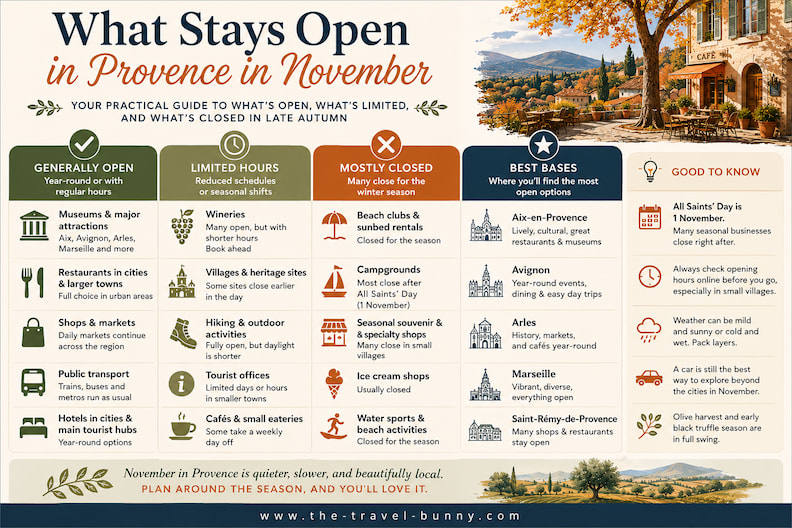
Where to Stay, What Stays Open, and What Changes in November
Where you stay in Provence in fall becomes more important as autumn advances. In September, you can still book coastal hotels, rural mas stays, and vineyard properties. October has the widest choice across the Luberon and Alpilles. November favors Aix-en-Provence, Avignon, Arles, Saint-Rémy-de-Provence, and Marseille, where year-round hotels and restaurants remove much of the guesswork.
My advice on where to stay in Provence in autumn is month-specific. Choose countryside in September and October if rural mornings, vineyards, markets, and hiking are central to your trip. Choose a year-round town from late October onward if dinner nearby, museums, shops, and flexible rainy-day plans carry equal weight.
The best villages to stay in Provence in autumn include Saint-Rémy-de-Provence, Bonnieux, Lourmarin, and Gordes. Saint-Rémy has the most year-round services of this group, Bonnieux and Lourmarin make excellent Luberon bases earlier in fall, and Gordes places you near Roussillon, Murs, and the northern Luberon, though accommodation there leans toward the expensive end.
Among the best small towns to stay in Provence in autumn, I’d add Apt and L’Isle-sur-la-Sorgue. Apt offers easy access to Bonnieux, Roussillon, Saignon, and eastern Luberon villages, and L’Isle-sur-la-Sorgue has restaurants, antiques, a major Sunday market, rail access, and easier connections toward Avignon.
Hotels I would shortlist for an autumn Provence trip
For Aix-en-Provence, Villa Gallici is an excellent year-round luxury choice. The hotel has 23 rooms and suites, private terraces or gardens in several categories, a restaurant, fitness area, sauna, hot tub, and spa. Cézanne’s Atelier des Lauves is only a few hundred meters away, so the location can easily be added to an autumn Cézanne itinerary without putting you in the busiest part of the historic center.
For a more central Aix base, Aquabella Hotel & Spa stays open year-round in the historic center. The property has 112 rooms, a sensory spa, restaurant, garden, and easy walking access to Cathédrale Saint-Sauveur and the old town. The outdoor heated pool closes after September, an important detail for October or November bookings, while the spa remains part of your stay.
In Avignon, La Mirande is a memorable splurge. The hotel is right by the Palais des Papes and occupies a historic cardinal’s residence, with 26 individually decorated rooms, period fabrics, a gastronomic restaurant, cooking classes, and the Table Haute chef’s table.
A Luberon stay looks quite different at Coquillade Provence. The estate spreads across vineyards, olive groves, and woodland near Gargas, with a large spa, cycling center, several restaurants, and its own wine estate. October 2026 includes a harvest weekend and a separate wellness retreat, so Coquillade is especially interesting for travelers who want accommodation tied directly to Provence autumn harvest season.
For the Alpilles, Le Vallon de Valrugues Hotel Spa & Villas is one of the best late-season choices. The property is open year-round and just a ten-minute walk from central Saint-Rémy. It has rooms, suites, seven private villas, a spa, heated indoor pool, sauna, hammam, and complimentary local shuttle. The outdoor heated pool normally stays open until 30 October, subject to weather.
A simpler Luberon base is Le Relais du Luberon in Coustellet-Maubec. This aparthotel is open from April through November and offers rooms plus studios with kitchenettes, along with secure private parking. Gordes, Fontaine-de-Vaucluse, L’Isle-sur-la-Sorgue, Apt, and Roussillon all sit within practical driving range.
This location is one of my more practical answers to where to stay in Luberon Valley during fall. Coustellet lacks the postcard drama of Gordes, but groceries, roads, parking, and central positioning become increasingly useful on a multi-day trip.
Traditional mas stays and autumn villas
Travelers wanting to rent a traditional Provencal mas in autumn should look at Le Mas de la Rose. The property occupies restored 17th-century buildings on a large estate near Eygalières, with olive trees, gardens, a pool, tennis, bicycles, a restaurant, and views toward the Alpilles. The 2026 season runs until 31 October, with private use available by request.
October is also financially more favorable there than September without needing to quote a changing nightly figure. Le Mas de la Rose places October private stays in a lower seasonal category than September, and minimum-stay requirements ease during October.
A luxury villa in Provence in fall is a better choice for families or groups who want separate bedrooms, a kitchen, private outdoor space, and fewer restaurant meals. Le Vallon de Valrugues has seven private villas beside Saint-Rémy with hotel services and spa access, which removes many drawbacks associated with an isolated rental.
The cost of luxury villa rentals in Provence in autumn usually falls after peak summer, with September often retaining stronger demand than October and November. I would compare heating, pool-heating dates, housekeeping, cleaning charges, minimum stays, and security deposits alongside the accommodation rate. A seemingly cheaper stone house loses some charm when November heating appears as an expensive extra.
The same applies to luxury villa rentals in Provence during autumn harvest. A vineyard or olive-country location gives easy access to estates and food events, while a serviced villa near Saint-Rémy or the Luberon avoids long drives home after dinner.
Provence villas for rent in September remain popular because warm weather still supports pools, terraces, and outdoor meals. Provence villas in autumn become better value later, though heated-pool dates and seasonal restaurant closures deserve closer attention after October.
Which month gives the best accommodation choice?
Provence hotels in September still operate close to summer schedules, particularly around Cassis, Bandol, Saint-Tropez, Hyères, and the Luberon. Availability improves after the school holidays, but wine events, weddings, warm sea temperatures, and late-season travelers keep desirable weekends busy.
Rural properties are still open and demand has eased after September, giving you a good choice among the best hotels in Provence in October. Coquillade Provence fits wine and cycling trips in the Luberon, Le Mas de la Rose proposes an Alpilles mas stay, and Saint-Rémy’s Le Vallon de Valrugues is a safer option for travelers planning to stay into late October.
The Provence hotels with the best autumn rates change by weekday and event calendar, so fixed examples age badly. Just remember the seasonal pattern: late October and November generally offer better value in cities and year-round resorts, while September retains much of its late-summer demand.
The best deals on Provence autumn accommodation also appear around longer stays. A weekly villa, aparthotel studio, or serviced apartment starts to make better sense once breakfast, parking, laundry, and restaurant meals enter the travel budget planning.
Where to stay for autumn color
Where to stay in Provence for autumn colors depends on your expectations. The Mediterranean coast offers limited foliage compared with northern or eastern Europe. Vineyards in the Luberon and Alpilles show a more powerful seasonal shift, while the Verdon and higher inland areas bring broader deciduous color.
Gargas, Bonnieux, Apt, and the surrounding Luberon countryside are good bases for vineyard color. Coquillade Provence is particularly well placed among vines near Gargas. For more intense forest color, I’d move toward the Verdon, while accepting cooler weather and fewer late-season hospitality options.
Restaurants worth knowing once November arrives
The best restaurants in Provence in autumn aren’t necessarily the same summer addresses with the prettiest terraces. By November, dependable opening days become part of the choices.
Les Caves Henri IV in Aix-en-Provence is located a short walk from Cours Mirabeau. In vaulted cellars dating from the late 15th century, you can savor Chef Thomas Roret’s cooking, centered on French seasonal cuisine. The restaurant is open from Tuesday to Saturday. Closed for lunch on Wednesday.
Le Gibolin is another useful November address. The small dining room sits in Arles’ historic center, the menu changes with the season, and service continues year-round from Tuesday to Saturday. Dinner is served from Wednesday to Saturday.
Saint-Rémy also keeps a reliable dinner option at Canto Cigalo inside Le Vallon de Valrugues. This restaurant serves lunch and dinner throughout the year, useful after an Alpilles day when smaller village kitchens have reduced their weekly openings.
These are the kind of Provence autumn restaurants I’d favor later in the season. To go out in the best restaurants open in Provence during November, build dinner plans around Aix, Avignon, Arles, and Saint-Rémy first, then add village restaurants only after checking their current weekly hours.
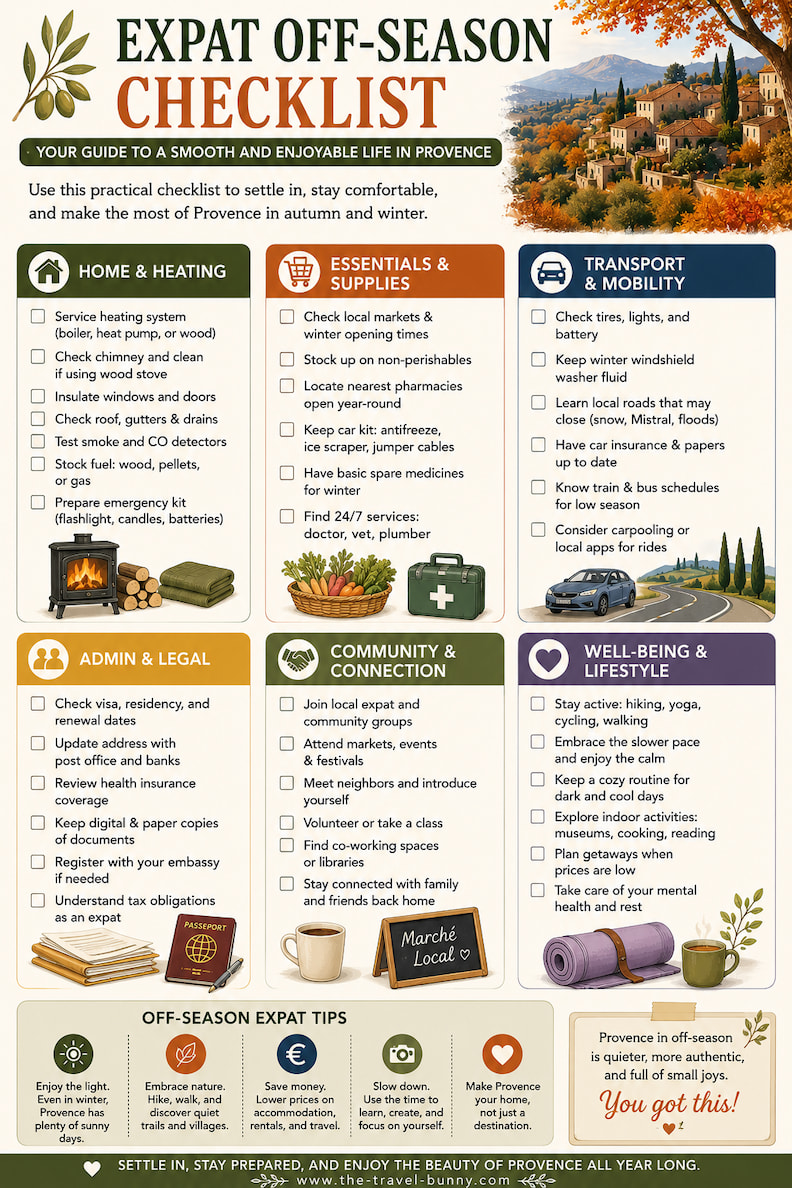
Longer stays and the autumn housing market
The expat housing market in Provence during autumn months deserves a different approach from a vacation booking. Autumn introduces furnished medium-term options alongside standard annual leases, especially for people staying several months for work, study, training, or a temporary professional assignment.
A French bail mobilité covers furnished accommodation for one to ten months for eligible tenants, including students, trainees, apprentices, and people on temporary professional assignments. The lease is nonrenewable and carries no security deposit requirement, although a guarantor remains possible.
The Travel Bunny’s local advice: For a one-month or longer stay, compare furnished apartments, aparthotels, villas, and eligible medium-term leases before extending a hotel reservation. Provence autumn accommodation becomes much easier to assess once the purpose of your stay is clear.
Where to stay in Provence in fall changes between September and November. September keeps rural and coastal choices wide, October is the sweet spot for Luberon and Alpilles properties, and November rewards a year-round base with dinner nearby, heating already sorted, and enough places open around you to survive a rainy Tuesday.
Crowds, Toussaint and Booking: When Autumn Is Not Quiet
Provence autumn crowds are nothing like July and August, but autumn isn’t uniformly empty either. In my experience, the biggest change arrives immediately after the rentrée, when families tied to the school calendar disappear from beaches, villages, and attractions. September then shifts toward couples, older travelers, grandparents with younger children, and locals taking advantage of warm weather without school-holiday traffic.
Is Provence crowded in September? Usually much less than summer, especially after the first week. The coast still attracts swimmers and wine regions remain busy around harvest events. Saint-Tropez is an obvious exception during Les Voiles de Saint-Tropez from 26 September to 4 October 2026. Around 250 yachts are expected, so accommodation and restaurants around the Gulf of Saint-Tropez require early booking during those dates.
You can enjoy Provence without crowds in September and October because school has restarted, and sea temperatures and daytime weather still favor outdoor plans. This is the period I like most locally. Parking gets easier, beaches are nearly empty, and village streets stop behaving as though everybody in Europe chose the same Tuesday.
October needs a little more nuance. Is Provence crowded in October? Most of the month is manageable, but event weekends and the French school break change individual places quickly. Chestnut festivals, wine events, markets, and major sailing dates create short local spikes rather than a region-wide return to summer conditions.
The Toussaint holidays in Provence starts after classes on Saturday, 17 October 2026, until school resumes Monday, 2 November. Aix-Marseille and Nice belong to Zone B, although the Toussaint dates are identical across metropolitan school zones in 2026.
I don’t notice a dramatic Toussaint crowd surge where I live in the Var. What I notice more is a small return of families and what seems like extra activity from people using second homes. Regional figures still show a genuine holiday effect. During Toussaint 2025, accommodation occupancy across Provence-Alpes-Côte d’Azur averaged 61%, while the first two weeks of October had already recorded stronger demand than the previous year.
The previous year showed the same basic pattern from another angle. During Toussaint 2024, regional hotel occupancy reached 63%, and tourist activity rose during the school break after a quieter September. International visitation also increased during the holiday period.
This is why the best time to avoid crowds in Provence is usually mid-September through the first half of October, outside major event weekends. Early November becomes quieter again once Toussaint ends, but shorter opening hours and seasonal closures become a bigger factor by then.
To plan a Provence travel itinerary without summer crowds, schedule visits to famous villages, markets, and coastal towns on weekdays where possible. Gordes on a non-market weekday, Cassis after the summer fire-access period, or Saint-Rémy outside Wednesday market hours will usually make an easier visit than the same places during their busiest weekly slot.
Is Provence expensive to visit in the off season? Usually less so than in peak summer, especially later in October and November, but autumn isn’t one long bargain period. September still carries strong demand along the coast and in wine country. Festival weekends, school holidays, and luxury properties also keep rates firm in specific places.
The best deals on Provence autumn accommodation tend to appear after the busiest September weekends and again once Toussaint ends. Compare several dates around the same stay and don’t assume a lower rate from the month alone. Moving a booking by two or three nights sometimes changes the picture considerably around festivals and school holidays.
The Provence hotels with the best autumn rates also tend to sit in year-round cities and larger towns once rural properties start reducing seasonal operations. Aix-en-Provence, Avignon, Arles, and Marseille give you broader hotel supply in November, while small Luberon or coastal properties increasingly close or limit opening days.
This is the real advantage of Provence off-season travel. You trade summer certainty for space. Yes, some restaurants close earlier, ferries thin out, and rural hotels reduce opening days, but roads become easier, villages get quieter, and reservations are less competitive outside holiday and event dates. For me, this exchange is worth it!
Autumn in Provence FAQ
If you’re choosing between September, October, and November, a few practical points decide your Provence trip faster than another list of villages. Weather, rain, swimming, harvest dates, truffles, clothing, the Calanques, transport, and late-season openings come up repeatedly because each month behaves differently.
Is autumn a good time to visit Provence?
Yes, although when in autumn is a good time to visit Provence depends on your priorities. September is best for swimming and harvest season. October favors hiking, vineyards, festivals, and quieter villages. November is better for cities, olives, early black truffles, and a much slower pace.
What is Provence like in autumn also changes sharply by month. September still looks like late summer. Octoberis in the middle. November brings shorter days, colder evenings, fewer seasonal businesses, and less visitor traffic.
What is the best month to visit Provence in autumn?
September is my best time to visit Provence in autumn overall. The sea is still warm, the grape harvest is underway, most seasonal businesses remain open, and the summer crowds have largely gone after the school rentrée.
The best month to visit Provence still depends on what you want from the trip. Choose September for swimming, sailing, vineyards, and warmer evenings. Choose October for hiking, food festivals, vineyard color, and road trips. Choose November for quieter cities, olive harvest, early black truffles, and a slower pace.
Is September a good time to visit Provence?
Yes, September is a good time to visit Provence. September has many of the advantages I like in June, but the Mediterranean has already warmed through summer. Tourist numbers drop after the rentrée, while beaches, restaurants, markets, wineries, and outdoor activities remain active.
Is October a good time to visit Provence?
Yes, October is a good time to visit Provence if hiking, food, vineyards, villages, and road trips rank higher than guaranteed beach time. Early October often remains warm on the coast, while inland vineyards begin showing more intense seasonal color.
I also think Provence is worth visiting in October because you have a broader choice of outdoor days than later in autumn. Warm weather still appears, but you need room in the schedule for rain.
Is Provence worth visiting in November?
Yes, with a different plan. Provence is worth visiting in November if you enjoy quiet towns, local food, olive oil, early black truffles, museums, and long lunches. I’d base myself in Aix-en-Provence, Avignon, Arles, Marseille, or Saint-Rémy rather than a tiny seasonal village.
Some countryside hotels, campgrounds, beach businesses, and restaurants reduce their schedules by then.
What is the weather like in Provence in September?
The weather in Provence in September is more like late summer rather than classic fall. At Marignane near Marseille, Météo-France’s 1991-2020 normal daytime maximum for September is 25.9°C. Inland valleys and higher areas vary, while evenings cool sooner than on the coast.
September still lets me wear my summer clothing comfortably outdoors.
What is the weather like in Provence in October?
The weather in Provence in October depends heavily on location and the week’s weather system. Marignane’s normal daytime maximum drops to 21.3°C in October, while higher areas such as Verdon and Mont Ventoux cool much faster.
For Provence in autumn weather and temperatures, dress in layers and plan outdoor days around the forecast. October afternoons aren’t all as warm as in September.
How cold does Provence get in autumn?
How cold Provence gets in autumn depends on altitude. The Mediterranean coast stays mild far longer than the Verdon, Ventoux, or Alpine foothills. Around Marignane, the normal daytime maximum falls from 25.9°C in September to 15.7°C in November.
How cold Provence is in November also depends on the hour. I’ve still worn a T-shirt during sunny November afternoons in the Var, then wanted warm layers once the sun dropped.
How rainy is Provence in October?
How rainy Provence is in October is less about endless drizzle and more about the possibility of concentrated heavy rain. Mediterranean episodes occur most often from September to mid-December and sometimes drop several months’ worth of precipitation within hours or days.
October is part of the main heavy-rain season in the southeast, but many October days remain dry and sunny.
Does it rain a lot in Provence in November?
November ais the wettest month on average across several regions, including Provence-Alpes-Côte d’Azur, although rainfall often comes in episodes rather than constant light rain.
I’d leave one flexible indoor day in a November itinerary instead of assuming three weeks of gray weather and cancelling the trip to Provence.
What should travelers expect from the Mistral in autumn?
Provence autumn Mistral wind means sudden changes in comfort and sea conditions. The Mistral is a dry regional wind with average speeds reaching 50 km/h and gusts of 80 to 100 km/h, occasionally higher.
A sunny Mistral day still requires a windproof outer layer, especially around Avignon, Arles, Marseille, the Alpilles, and the western Var coast.
What should I pack for Provence in autumn?
Your Provence autumn packing list starts with layers. Bring T-shirts, a light sweater, a warmer mid-layer for later autumn, a waterproof jacket, comfortable closed shoes, sunglasses, and something windproof for Mistral days.
Add hiking shoes for rocky trails and a swimsuit in September or early October. This is one trip where packing for the warmest forecast alone will punish you around dinner.
What should I pack for Provence in October?
What to pack for Provence in October needs greater range than September. I take T-shirts, long sleeves, a sweater, waterproof outer layer, closed walking shoes, and a light scarf or wind-resistant layer.
A swimsuit might still earns a small space in my bag. An October beach day remains plausible, especially early in the month.
What should I wear in Provence in autumn?
What to wear in Provence in autumn depends on month and altitude rather than fashion rules. September is often comfortable in summer clothes during the day, October requires dressing in layers, and November needs warmer clothing in evenings and mornings.
What to wear in Provence in September still includes sandals, dresses, shorts, and T-shirts on warm days, with one warmer layer for evenings.
What to wear in Provence in October shifts toward trousers, closed shoes, T-shirts under light knits, and a rain or wind layer.
When is grape harvest in Provence?
When is grape harvest in Provence varies by appellation, grape variety, ripeness, and yearly weather. September is peak vendange season in Provence, with some picking beginning in late August. However, 2026 visitor harvest activities are scheduled through September and into mid-October.
When does grape harvest start in Provence?
The grape harvest in Provence doesn’t begin on a single regional date. Coastal vineyards, hotter sites, grape varieties, and individual vintages ripen at different speeds.
A good planning window is late August through September, with later parcels continuing afterward. The exact start is decided according to ripeness and not according to a fixed tourism calendar.
How long does grape vendange last in Provence?
How long grape vendange lasts in Provence varies from estate to estate. Individual vineyards may harvest over several days or weeks, while the regional season stretches from late summer into October.
Château Pesquié, for example, schedules its 2026 harvest and biodynamic visitor workshop between 15 September and 15 October, with exact dates adjusted to the harvest itself.
Can tourists join grape harvest in Provence?
Yes. Tourists have a genuinely hands-on option at Les Pastras in Cadenet, in the southern Luberon. Their three-hour Grape Stomping in Provence experience runs from September 1 to 30, weather permitting. You pick grapes, learn how the fruit is grown and turned into wine, then climb into large antique oak barrels for the grape stomping itself.
Afterward, the farm serves a buffet with cheese, pâté, charcuterie, and red wine, followed by tastings of its olive and truffle oils. Choose this over a standard cellar visit if you want to take part in harvest season rather than watch someone explain it beside a stainless-steel tank.
When does truffle season start in Provence?
When does truffle season start in Provence depends on which truffle you mean. In the cold season, we are speaking about the winter black truffle, Tuber melanosporum.
The Provence truffle hunting season starts from mid-November, then strengthens through winter. Richerenches’ truffle market is scheduled from around mid-November to mid-March, while Aups opens its 2026 black truffle market on 26 November.
November is the early beginning, not peak truffle season.
When is olive harvest in Provence?
When is the olive harvest in Provence varies by variety, location, and the style of oil or table olive being produced. Some picking begins in late October, while many oil olives are harvested through November and into winter.
At the Moulin d’Éguilles near Aix, local growers begin bringing olives from late October. In Hyères, L’Olive du Verger describes full maturity around the third week of November for one of its oils.
If you want to visit when olive harvest starts in Provence, late October is a useful earliest planning point, while November gives a much better chance of seeing active harvesting and milling.
Can you swim in Provence in October?
Yes, you can swim in Provence in October as long as you are aware of your tolerance for cooler water and check the weather immediately before your visit.
The average autumn sea temperature is around 20°C and the Indian-summer swimming period often continues into October. I’ve swum during the first week of October and found the water perfectly fine.
Is Provence still warm enough to swim in September?
Yes, Provence is still warm enough to swim in September along the Mediterranean coast. September is one of my favorite periods to go swimming in the sea because the water has retained summer warmth while the largest holiday crowds have left. September is comfortable for autumn swimming.
Are the Calanques open in October?
Yes, the Calanques are open in October under normal conditions. The annual Bouches-du-Rhône fire-risk access system runs from 1 June to 30 September. Outside those dates, the national park remains open year-round, although exceptional closures still occur.
I’d still check the official Calanques access information and weather on the day before hiking.
Is Cassis worth visiting in October?
Yes, Cassis is worth visiting in October if you want the village, Calanques, Cap Canaille, walking, photography, or a quieter coast.
September and October in Cassis offer milder temperatures and lower attendance, and October-November has attractive light outside holiday periods.
Swimming is still possible during warm spells, although hiking is the better reason to choose October over summer.
Is October good for sailing in Provence?
Yes, with flexible dates. October is good for sailing in Provence when the marine forecast is favorable. Holiday traffic drops and the sea retains warmth, but the Mistral still changes conditions quickly.
Around the Calanques, autumn doesn’t change anchoring rules. Boats must respect no-anchor zones, motor restrictions, the 5-knot limit within 300 meters, and Posidonia protection measures.
Where should I go for autumn colors in Provence?
Where to see fall colors in Provence depends on how much color you expect. The Luberon dresses in vineyard reds and golds around Gordes, Bonnieux, Ménerbes, and Roussillon. Verdon, Mont Ventoux, and higher inland valleys offer stronger deciduous change.
I wouldn’t choose the Mediterranean coast for foliage. After a dry Provençal summer, much of the coastal vegetation stays evergreen or already looks sun-scorched.
When do leaves change color in Provence?
When leaves change color in Provence varies by altitude and plant type. Vineyards start turning during October, while higher and cooler inland areas generally move earlier and more intensely than the coast.
Late October into early November gives better odds for broader color in the Luberon, Verdon, and Ventoux areas. The exact timing shifts with temperature, rainfall, and elevation each year.
I still miss the intense Romanian autumn colors I grew up with. Provence doesn’t reproduce that display on the same scale.
Does lavender bloom in Provence in autumn?
No. Lavender blooming in Provence in autumn is one expectation worth correcting before booking flights.
Lavender and lavandin flower between June and August, with major areas such as Valensole flowering around early summer. By autumn, commercial fields have been harvested.
Saffron replaces lavender as one of Provence’s violet autumn crops.
How many days do you need in Provence in autumn?
How many days do you need in Provence in autumn depends on the area you want to cover. Three days are ok for one base and nearby day trips. Five days allow you to fit two neighboring clusters. Seven days give you enough time for the Luberon, Alpilles, one city, and either the coast or Camargue.
I would plan ten days before adding Verdon and several coastal areas to the same road trip.
Do you need a car in Provence in autumn?
You need a car in Provence in autumn for rural villages and wineries. Gordes, Roussillon, smaller Alpilles villages, vineyards, hiking trailheads, and Verdon become easier to visit with a car.
Aix, Marseille, Avignon, Arles, and several larger towns are well connected by TER and ZOU services, so a city-based trip is realistic without driving.
Is Provence crowded in September or October?
September becomes noticeably quieter after French schools restart. October is quieter again outside festivals and the Toussaint school holiday.
I see the difference locally every year. Families disappear quickly after the start of the school year, parking becomes easier, and beaches calm down. Event weekends remain exceptions, especially chestnut festivals, wine events, and Les Voiles de Saint-Tropez.
What festivals happen in Provence in autumn?
September brings grape-harvest celebrations and wine events. October is heavy on chestnuts, honey, quinces, squash, and local produce. November moves toward new wine, olive oil, and black truffles.
For 2026, useful dates include Cotignac’s Fête du Coing on 25 October, Millévin in Avignon on 19 November, and the opening of Aups’ black truffle market on 26 November.
What stays open in Provence in November?
Large cities remain the safest November bases. Aix-en-Provence, Avignon, Arles, and Marseille keep museums, restaurants, shops, markets, hotels, and transport active year-round.
Small coastal resorts, campgrounds, seasonal restaurants, and countryside properties reduce opening days or close altogether. Check every rural restaurant and attraction individually before building a November day around one address.
Where should you stay for an autumn Provence trip?
September gives the broadest choice along the coast and in vineyard country. October is excellent for the Luberon and Alpilles. November favors Aix-en-Provence, Avignon, Arles, Marseille, or Saint-Rémy-de-Provence.
For a first trip, I would choose one or two bases rather than changing accommodation every night. Provence becomes much easier once the map stops dictating breakfast.
About the Author

Hi, I’m Mirela Letailleur, a Romanian-born travel writer living in Provence-Alpes-Côte d’Azur and founder of The Travel Bunny. I explore the South of France year-round, with particular attention to autumn in Provence, local markets, vineyards, harvest festivals, hill villages, hiking routes, and the Mediterranean coast.
My Provence travel advice comes from living here and watching September, October, and November change the region in different ways. I write about the practical details I use myself, from swimming into early October and planning around the Mistral to choosing quieter villages, seasonal food events, road trips, and places worth visiting after the summer crowds leave.
After planning your visit to Provence in autumn, check out these PACA travel guides on The Travel Bunny
Life in a French Village. The Realities of Moving to the South of France
Provence in Spring. A Comprehensive Local Travel Guide
Train des Pignes à Vapeur 2026: Best Steam Train Journey in France