
At about quarter past seven on a warm August evening, Mathieu and I turned off the road near Le Muy and followed a sign into what appeared to be an animal enclosure. The animals had evidently been granted the evening off. In their place stood a scattering of cars on dry grass, all parked with remarkable discipline considering the field offered drivers neither painted bays nor much guidance beyond the general expectation that everybody behave sensibly.
We had come to Château du Rouët for Les Musicales dans les Vignes, a summer festival that sends musicians into wine estates across Provence. That evening, Overjoyed was playing a Stevie Wonder jazz tribute. Wine started at 7:00 pm, the concert at 8:30 pm, and dinner occupied the useful territory in between. I have attended cultural events with far less convincing plans.
Les Musicales dans les Vignes de Provence
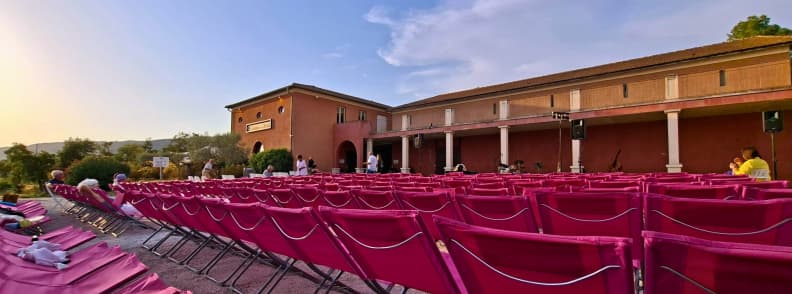
Château du Rouët was already familiar to us. Mathieu and I buy wine there regularly, and one of the estate’s emails had alerted him to the concert. I knew the caveau, the drive and the Villa Estérelle bottles promoted through the event. But I had never seen the domaine with three food trucks, an outdoor stage and several rows of pink canvas deck chairs arranged in front of it.
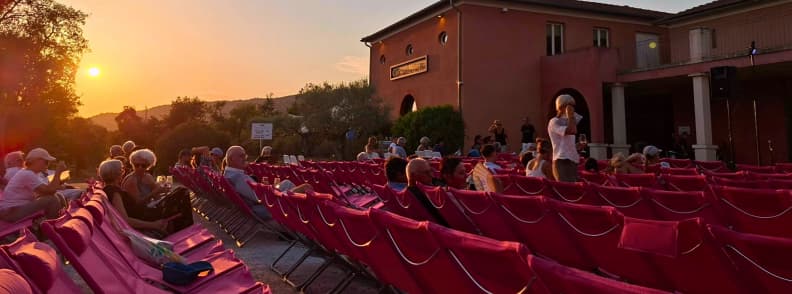
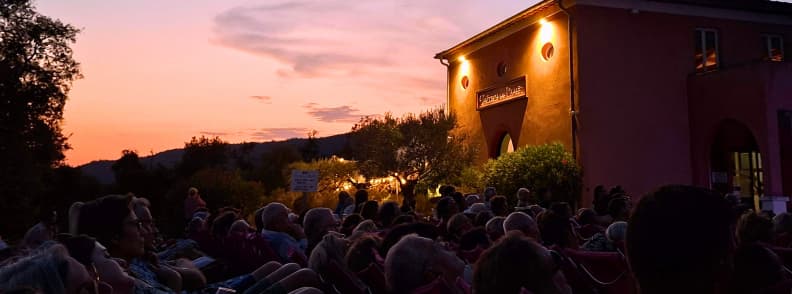
By the time Alexia Mornet began singing, our bottle of rosé was sitting beside us in a free ice bag, the heat had softened, and the audience had sunk so deeply into the chairs that several people appeared to have given up upright life altogether. The sun disappeared beside the stage. A little later, stars began appearing overhead.
This was my first vineyard concert in Provence with Les Musicales dans les Vignes and it surprised me in more ways than I had expected, as you shall see later in this post.
Keep reading to learn everything about our night at Château du Rouët. I’ll cover the practical details that influence the evening once you are actually there, together with the festival history, ticket prices, wine, food, seating, weather, accessibility and how I would choose among the many Provence vineyard concerts on the programme.
For us, it all started in a field full of parked cars and ended with Stevie Wonder under the stars. It’s a promising arc for any Thursday night!

Les Musicales dans les Vignes at a glance
The name Les Musicales dans les Vignes sounds grand enough to suggest a certain amount of ceremony, perhaps people in pale linen discussing vintages in hushed voices while somebody plays Debussy at a respectful distance.
Our evening at Château du Rouët was rather less solemn. We arrived, got offered a glass of wine, inspected three food trucks with increasing seriousness, ate in the shade, chose a couple of pink beach chair, and waited for a jazz quartet to start playing Stevie Wonder.
This, in practical terms, is the heart of the Les Musicales dans les Vignes festival. A Provence wine estate becomes an evening concert venue, and the hours before the music belong as much to the château as they do to the audience.
What is Les Musicales dans les Vignes? The official description is festival œnomusical itinérant. The phrase sounds slightly formidable in French, although the idea is wonderfully simple. The festival travels from vineyard to vineyard across Provence, pairing local wine with live music rather than gathering everybody on one permanent festival site.
Marie-Jeanne Chauvin founded the festival in the Var in 2013 with three domaines, three concerts and 600 spectators. By 2025, the official figures had reached 50 estates, 100 concerts and 25,000 spectators, which is a considerable expansion for an event that still manages to retain the intimacy of a single summer evening at a wine estate.
This contrast is one of the things I liked most. The numbers belong to a substantial regional festival, while the experience at Château du Rouët belonged to a much smaller scale. There were no vast crowds to cross, no sprawling grounds to decode, and no sense of spending half the evening traveling between one part of the event and another.
Our Provence vineyard concert consisted of one château, one stage, one audience, three food trucks and a wine bar close enough to remain useful throughout the evening. The larger festival almost disappears once you arrive at your chosen estate.
The current Les Musicales festival stretches across a broad part of Provence, with concerts around Dracénie, Fréjus, the Gulf of Saint-Tropez, Bandol, Aix, Sainte-Victoire, the South Luberon, Les Baux-de-Provence, the Cœur du Var, and Nice.
The music changes along with the vineyards. Jazz, classical music, gospel, soul, covers, and music from around the globe all appear across the programme, so one evening might involve jazz manouche at a family domaine while another brings opera to a grand château near Aix. This gives music in vineyards Provence festival a pleasing unpredictability. The label stays the same, while the place, wine, musicians and atmosphere shift from one date to the next.
The timetable is equally easy to understand. Doors usually open around 6:30 pm, the host estate pours the complimentary tasting glass, and the next couple of hours belong to wine, food, and the property itself. Most concerts begin around 8:30 pm (though some start at 8:00 pm), and last roughly ninety minutes, bringing the evening to a close at about 10:00 pm.
This timing suited us beautifully at Château du Rouët. We reached the estate around 7:15 pm, which gave us enough time to park, collect our wine, debate dinner at unnecessary length, and settle into our chairs before the first song.
This is also where the wine and music event in Provence idea becomes particularly attractive for travelers. You still have the day for the beach, a village, a museum, lunch somewhere that takes twice as long as planned, or several hours beside a pool. Then, as the afternoon heat begins to loosen its grip, you head toward a vineyard for dinner, wine, and live music.
For residents and expats, the same schedule turns Les Musicales dans les Vignes into an easy evening out during the working week. We went on a Thursday after an ordinary day of work, and by nightfall we were drinking rosé under the stars while Alexia Mornet sang Stevie Wonder. Thursday had improved considerably.
Is Les Musicales dans les Vignes worth it?
My answer is yes, provided you choose the evening with a little care. The attraction lies in the combination of artist and estate, and either side of that equation deserves attention.
At Château du Rouët, we already knew the domaine and regularly bought its wine, while Overjoyed gave us music we genuinely wanted to hear. By the time the sun disappeared beside the stage and the audience had gradually collapsed into the comfortable geometry of the beach chairs, the evening had developed its own slow rhythm.
For me, that is the best argument for this vineyard concert festival France visitors encounter across Provence. You spend enough time at the estate for the château to become part of the memory rather than a backdrop behind the musicians. I remember the bottle cooling beside us in its ice bag, Mathieu’s disappointment with the fries, the sometimes ridiculous comfort of the pink chairs, and the first stars appearing above the stage almost as clearly as I remember the songs. This is what convinced me.
I would happily choose another Les Musicales dans les Vignes evening, although next time I would begin by finding the artist I want to hear, and then see which vineyard is hosting them.
What is Les Musicales dans les Vignes?
If your first encounter with Les Musicales dans les Vignes comes through a château newsletter, as ours did, the name gives away surprisingly little. It might be a concert series, a wine event, a collection of summer parties, or something involving a string quartet and an alarming quantity of rosé. In fact, it’s a travelling festival that pairs musicians with wine estates across Provence, giving each domaine one or several evenings in which the vineyard becomes part concert venue, part wine bar and part summer gathering.
I understand the appeal better after attending one of their events in person. A conventional concert hall asks the audience to arrive, find a seat, and concentrate on the stage. Here, the evening begins long before the musicians appear. You have already tasted the wine, wandered through part of the property, eaten dinner, and formed an opinion about your chair by the time somebody picks up an instrument. At Château du Rouët, we had been on the estate for over an hour before Overjoyed began, so the place had already become part of the night.
This is what makes a vineyard music festival different from taking a normal concert and placing some vines behind it for decoration. The vineyard supplies its own personality. A family domaine hosting jazz manouche produces one kind of evening, while a grand château with an opera singer produces another. The festival itself describes pairings between five-star châteaux and opera, family estates and jazz, old vines and Brazilian rhythms, which gives the Les Musicales dans les Vignes programme a much broader character than the festival name first suggests.
My own introduction to it could hardly have been more local. Mathieu receives emails from Château du Rouët because we buy our wine there, and one of those messages announced the Château du Rouët Les Musicales dans les Vignes date with Overjoyed. He bought the tickets, I read the program, and a few weeks later the caveau I knew had acquired food trucks, pink deck chairs, and a jazz quartet.
How a Les Musicales vineyard concert evening is organized
Each date belongs to a particular estate and artist, so you book the evening rather than a generic festival admission. The standard schedule begins at 6:30 pm, when the gates open and the host domaine offers guests a complimentary tasting glass. The following two hours belong to wine, food, and the property, with the concert generally starting at 8:30 pm after an optional introduction to the estate. The average performance lasts around ninety minutes, bringing the night to an end at roughly 10:00 pm.
This timetable looked almost leisurely to me before we went. In practice, the time filled itself easily. We reached Château du Rouët around 7:15 pm, walked over from the parking field, collected our wine, and then spent an absurd amount of time studying three food-truck menus. There is something about being offered Greek food, Réunion food, and burgers at once that turns two hungry adults into an indecisive committee.
Once dinner was settled, the pace became even easier. We ate in the shade, returned to the wine bar for a bottle of rosé and chose our chairs while there were still plenty available. By the time 8:30 pm approached, we had done everything we wanted without ever checking the clock with anxiety. For anyone planning a first vineyard concert experience, this two-hour prelude is worth treating as part of the evening rather than dead time before the music.
The complimentary glass also gives the host estate a proper role. At Château du Rouët, we chose from red, white, and rosé, all from the estate. I started with white, Mathieu chose rosé, and we later bought a bottle of rosé for the concert. The château supplied free ice bags, which struck me as the kind of small decision made by somebody who has spent enough August evenings in Provence to know exactly what becomes urgent after sunset.
Food varies with the venue. Some estates have restaurants, while others bring in food trucks, so check the information for each individual date and venue.
If I were to attend another festival event, I would arrive around 7:00 pm again. Anyone keen to wander around the estate for as long as possible might prefer 6:30 pm, but we had enough time for dinner and wine with plenty of choice among the seats. By 8:30 pm, I wanted the concert to begin rather than another half-hour in which to reconsider my gourmet country burger.
Where Les Musicales concerts take place across Provence
The answer to where are Les Musicales dans les Vignes held covers a large piece of Provence. The festival began in the Var and expanded through wine areas including Dracénie, Fréjus, the Gulf of Saint-Tropez, Bandol, Aix, Sainte-Victoire, the South Luberon, Les Baux-de-Provence, the Cœur du Var, and Nice. The current programme groups concerts across the Var, Vaucluse, and Bouches-du-Rhône.
For travelers, I would use geography before romance takes over. Château photographs have a dangerous ability to persuade people that driving across half of Provence in August is an excellent idea. But the same road can appear considerably less poetic from behind a line of brake lights at 6:45 pm.
If you are staying around Saint-Tropez or Sainte-Maxime, begin with the Gulf and eastern Var dates. From Fréjus and Saint-Raphaël, estates around Le Muy, Dracénie and nearby wine country fit comfortably into an evening. Aix travelers have their own cluster around the city and Sainte-Victoire, while a Luberon stay naturally points toward the western program. The festival covers enough ground for most people to find a Provence vineyard concert within a sensible driving radius.
Our choice of Château du Rouët made particular sense because the estate sits near Le Muy, close to home, and we already knew the road. From Fréjus, the château is only 18 km away. Saint-Tropez lies 45 km away, while Cannes is 50 km, and Nice 75 km. For visitors spending their days on the Côte d’Azur, a vineyard concert Provence evening here provides an easy reason to leave the coastal strip and head into the Var for a few hours.
The estate itself also changes the experience far more than I had expected before attending. Architecture, grounds, food arrangements, wine, seating, and even the surface beneath your shoes vary from venue to venue. At Château du Rouët, we had gravel, grass, beach chairs, and a familiar bottle of rosé. Another Provence vineyard concert might involve a formal château garden, a restaurant terrace, or an entirely different view as the sun goes down.
So I would browse the Les Musicales dans les Vignes programme and venues with two questions in mind. Which artist do I want to hear, and which estate suits the part of Provence where I am staying?
Once those two answers agree, the rest of the evening becomes much easier to arrange.
My evening at Château du Rouët
When Mathieu booked the concert, we thought of it simply as an evening at Château du Rouët. We knew the estate, we knew the wine, and the idea of hearing a jazz tribute to Stevie Wonder there sounded good enough on its own. The name Les Musicales dans les Vignes meant little to me at the time. I only learned right before the concert started that our Thursday night was part of a much larger festival spread across vineyards all over Provence.
Arriving at the estate. road, parking and first impressions
Château du Rouët sits on the D47 Route de Bagnols outside Le Muy, far enough from the center for the last part of the drive to have a distinctly rural character.
Château du Rouët directions: From the A8 exit 36 at Le Muy, then toward Bagnols-en-Forêt for roughly 7 km. The exact Château du Rouët GPS coordinates are 43.512783, 6.616117 and you should save them before setting off for an evening event.
Once the summer light disappears, a precise pin is far more useful than trying to identify a vineyard entrance from the road while somebody in the passenger seat announces that the map says you arrived thirty seconds ago.
Our road to Château du Rouët was wonderfully uneventful. We approached at around 7:15 pm during the high season and met very little traffic, which surprised me because I had half expected the usual concert ritual of joining a slow procession of cars all heading toward the same gate. Instead, we reached the estate easily and soon saw a sign directing us toward the evening parking area.
The Château du Rouët parking arrangement made me smile. The sign sent us into an opened animal enclosure, where a semi-dry grassy field had been promoted for the evening to car park. The field offered grass rather than painted bays, yet everybody had parked in tidy rows with enough space between cars. Give motorists a supermarket car park covered in neat white lines and somebody will eventually create an abstract interpretation of parking. Give the same people an animal field in Provence and suddenly order prevails!
We chose a place farther from the entrance than most people needed to. This was deliberate. I value an easy departure after an event, so I would rather add a minute to the walk on arrival and have the car facing the right direction when everybody leaves. Even from our outer position, parking near Château du Rouët meant only a short walk to the concert area. That choice paid off later when we left almost immediately after the performance.
The ground changed along the way, which is one of those Château du Rouët location details that becomes far more useful than it sounds when you are standing in front of your wardrobe. The parking field was dry grass. Around the event area, we walked on gravel. I was wearing flats, but I saw thick heels would have coped, although platforms would have been easier. Stable sandals or flats like mine sailed through the whole evening. I was pleased with my own choice once I saw the terrain.
My Château du Rouët first impression yesterday evening came from how little effort arrival required. At 7:15 pm, the parking field still had plenty of room, the walk was short, and the event area was already ready for the night ahead. Ten minutes after leaving the car, we had stopped thinking about the car entirely, which is about the best compliment I can give parking at a summer event.
Wine tasting and dinner before the concert
The Château du Rouët wine tasting was pleasantly informal. We showed our tickets at the bar near the entrance and chose among red, white and rosé. I went for white, Mathieu for rosé. There was no commentary over the glasses, no solemn inspection of color against the evening light, no requirement to identify hints of elderflower or a childhood spent near an apricot tree. People collected their wine and carried on with the important business of deciding what to eat.
The wines served that evening came from the Villa Estérelle range, one of the Château du Rouët collections we already knew from buying wine at the domaine. The current estate range includes Villa Estérelle alongside cuvées such as 1840, Belle Poule, Fréjus Hermès, and Séverac. Our pre-concert tasting at Rouët therefore wasn’t an introduction to the château’s wine but a comfortable reunion with something familiar, which suited the evening perfectly.
Later, we returned for a bottle of rosé. At €5 for a glass and €15 for a bottle, the arithmetic required little discussion between us. The château also supplied free ice bags, one of those unglamorous details I appreciate far beyond decorative lanterns or another arrangement of potted lavender. The bottle stayed cold beside our chairs until the concert began, exactly as Provence intended.
The food at Château du Rouët required considerably greater thought. Three food trucks had arrived for the evening: Nectare & Ambroisie with Greek and Mediterranean dishes, La Kaz Renyoné with créole food, and La Cheese Cantine with gourmet burgers.
My attention went immediately to the Greek truck because I have spent years pursuing the gyros I remember from my many trips to Greece with a persistence usually reserved for missing persons. Then I read the ingredients. Mint and coriander had entered proceedings, so the trail went cold.
I moved to the Réunion menu with fresh optimism. I had been hoping for something close to the Créole food I know from La Réunion, then spotted curry where I expected cari. By now Mathieu had displayed the patient expression of a man who suspected dinner might eventually require a formal vote.
But the burger truck settled the issue. We ordered two country burgers with fries and carried them over to some shaded beach chairs. The burgers were tasty, but the potatoes divided the household. Mathieu wanted crisp fries and received soft ones, an outcome he regarded with the quiet disappointment of somebody whose evening had briefly suffered a personal betrayal. I liked them. Their texture had little ambition, yet the flavor was good, and I have always been willing to give a potato considerable freedom in how it conducts itself.
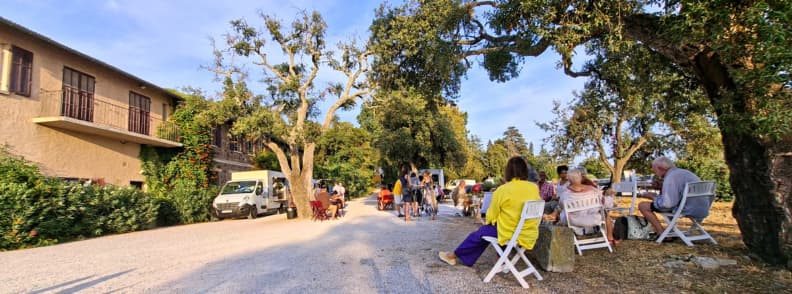
Tables were scarce enough that we ate from the beach chairs, balancing food and drinks while trying to maintain some appearance of civilisation. I was entirely at home. Years of eating on a sofa had trained me for this exact moment. Mathieu, who has been known to approach even pizza with a knife and fork, adapted with admirable courage.
This was a festival dinner in Provence at a wine estate, rather than a château dinner dressed up as one. You chose what appealed from the trucks, found a shaded place, opened the box, and ate while people arrived around you with glasses in hand.
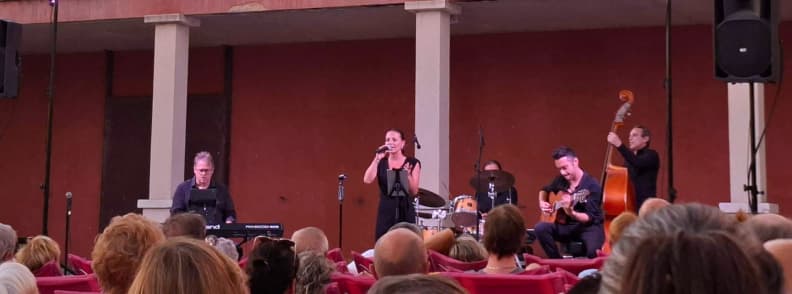
Overjoyed: Stevie Wonder reimagined through jazz
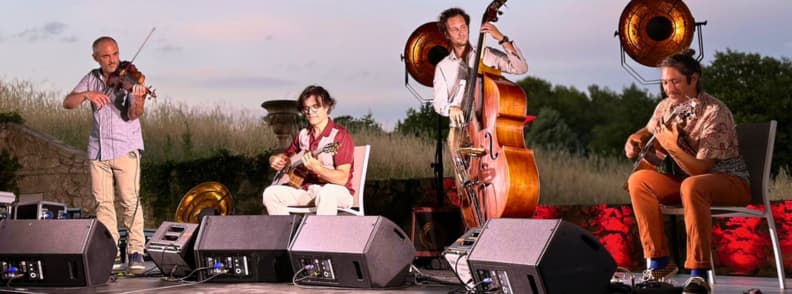
By 8:30 pm, dinner had disappeared, the wine bottle was cold beside us, and the last of the evening heat had started to lift. Then Overjoyed began. Promoted as Overjoyed, Hommage en Jazz à Stevie Wonder, the project’s program was built around groove, harmony, and improvisation, with Stevie Wonder’s songs carried into jazz territory. The official listing described a 90-minute performance, which sounded generous on paper but passed with suspicious speed once we were sitting there.
A Stevie Wonder jazz tribute sets itself a difficult task. These songs arrive with decades of memory attached to them. Even people who rarely play Stevie Wonder know the openings, the choruses, and the little turns in the melodies, so every new interpretation walks into a room already crowded with old ones.
Overjoyed approached them with enough freedom to keep my attention on the musicians in front of me. The melodies stayed familiar while the arrangements wandered into jazz, letting phrases stretch, rhythms loosen, and instrumental passages take their time.
Alexia Mornet made the strongest impression on me. Her voice had the range for the bigger passages and the control to pull back when the arrangements became quieter, which gave the songs shape instead of turning the whole performance into a succession of vocal fireworks. I had expected a good singer fronting a jazz tribute band Overjoyed. Several songs in, I was listening to her closely enough to forget I had arrived with any expectations at all.
This also explains why my Overjoyed concert review ended up much better than I had predicted when Mathieu booked the tickets. A tribute can easily become an exercise in recognition, where half the pleasure comes from hearing the opening notes and thinking ah yes, this one. Here, the recognition happened, then the music carried on somewhere else. Overjoyed let Stevie Wonder remain Stevie Wonder while allowing the quartet to play with the material. The Stevie Wonder reinterpreted jazz approach earned its place beyond nostalgia.
The vineyard suited the music almost absurdly well. The concert started with daylight still hanging around the stage, and during the performance the sky gradually darkened until stars became visible above us. By then the audience had settled into the chiliennes with glasses and bottles beside them, and the jazz tribute Les Musicales dans les Vignes pairing was perfect.
For me, the best part of the Château du Rouët Overjoyed evening came from that combination of familiar songs and an unfamiliar setting. I have heard Stevie Wonder countless times in cars, kitchens, shops, and on the radio. Hearing his music reshaped through jazz while sitting in a vineyard with rosé beside me and stars appearing overhead gave those songs a new place in my memory.
Sound, seating, crowd, and what surprised me
The Château du Rouët concert seating was the first thing that made Mathieu and me smile. Rows of pink chiliennes faced the stage, the low canvas chairs that look wonderfully inviting until you remember that eventually you have to rise from one. They reminded us immediately of our trips to Berlin, where somebody always seems to have placed a deck chair in an improbable location and persuaded several hundred people that this constitutes urban leisure. Here, at least, there were vineyards around us and a bottle of rosé within reach, which gave the arrangement a better case.
Our tickets were sold as placement libre, so seats were chosen on arrival rather than assigned in advance. We arrived early enough to have plenty of choice and eventually picked two beach chairs near the back, at the end of a row. This was less a strategic masterstroke than an instinctive desire to avoid climbing over strangers later, although within ten minutes I was congratulating us on our foresight.
The difficulty with this sort of outdoor concert seating becomes apparent once several adults have installed themselves. A chilienne places you low enough for your knees to begin considering a separate existence, and escaping from the center of a row involves standing, turning sideways, stepping around glasses, and relying heavily on the goodwill of everybody whose feet you are approaching. A little extra space between rows would have helped. Luckily, our aisle position spared us the full exercise.
There were ordinary white plastic chairs as well, and several older guests carried them over to sit beside friends in the beach chairs. This made sense because the audience at our concert leaned toward an older age group. Before I spotted the regular chairs, I had already started wondering how some guests would manage the final ascent from the canvas seats. My dad came to mind immediately. Standing for the ovation later required some determination from a few people, especially after an evening of wine, though everyone eventually emerged.
One guest had gone further and brought a pillow from home. I admired this enormously! Here was a person who had evidently attended enough summer concerts to move past optimism and into expertise. While the rest of us had arrived trusting whatever furniture awaited us, this person had brought extra neck support and was plainly several seasons ahead.
Our place near the side also turned out to give us an excellent view. Sitting directly opposite a stage often sounds like the obvious choice, yet the chiliennes changed the geometry. As people relaxed, they slid lower and lower into the fabric, so heads gradually descended instead of forming a wall in front. From where we sat, the stage remained clear throughout the performance. For anyone comparing seating arrangements at a vineyard festival, I would happily choose an aisle seat toward one side again.
The sound quality caught my attention during the first few minutes for the opposite reason. The volume came across rather strong at the start, enough for me to wonder whether the speakers had been set for an audience somewhere around La Bouverie. Soon afterwards the balance settled, and from then on Alexia Mornet’s voice and the instruments carried beautifully across the open space. The open-air concert sound suited the quartet especially well once darkness arrived, with the music reaching us clearly while the vineyard remained part of the evening around it.
I would describe the audience atmosphere as exceptionally relaxed, and the combination of wine and beach chairs surely deserves some credit. People leaned back, listened, and stayed remarkably settled through the performance. The usual outdoor-concert migration of people repeatedly getting up for drinks, changing places, and wandering through sightlines was minimal from where we sat. By the middle of the set, much of the audience had acquired the serene expression of people who had remembered that Friday existed but decided to deal with it tomorrow.
The festival crowd size was large enough to fill the seating area comfortably while still leaving space to move around. I prefer leaving it at what I actually observed rather than attaching a figure to the evening. The concert retained the intimacy of a relatively small gathering, which suited Overjoyed far better than a huge audience would have. When Alexia sang quieter passages, the whole place seemed to draw inward toward the stage.
The weather also behaved impeccably. The evening was warm when we arrived, then softened as darkness came, with still air through the concert. I wore a long sleeveless, backless dress, and remained comfortable until the end. The length had rather less to do with fashion than with my ongoing dispute with the mosquito population of southern France, which has shown an alarming commitment to me this summer while largely ignoring Mathieu. (I came home with two bites and I regarded this as success.)
Among the smaller festival surprises, phone reception was perfectly good. I answered some messages early in the evening and had enough signal for everything I needed. This is hardly the detail that sells concert tickets, yet anyone spending an evening at a rural wine estate and trying to coordinate with family, a babysitter, or friends might appreciate knowing it.
The toilets surprised me too, initially in a positive direction. Château du Rouët has proper permanent facilities, with toilet paper, soap, and paper for drying hands. After vineyard concerts where I have encountered dry toilets and temporary facilities, including at Le Mas des Escaravatiers, I was genuinely pleased to see a normal bathroom. Then I opened the door and encountered a smell of urine so determined that it appeared to have established permanent residency. Still, I preferred the plumbing…
The final surprise came after the applause. Guests had been asked to return their wine glasses to the bar, and many people did exactly that. Others walked toward the parking field still carrying them. While I was returning ours, I heard a college-aged girl ask her mother, So we take the glasses, yeah? The pair continued toward the cars, each holding a glass. And this is why we can’t have nice things!
Because we had parked with the exit in mind, we walked back across the grass, got into the car, and were on our way within minutes. After an evening of good music, cold rosé, and stars over the stage, that swift escape was the final small pleasure.

Why Château du Rouët is worth knowing
Long before Château du Rouët became a place where people drank rosé on beach chairs and listened to jazz under the stars, the domain had already lived through several quite different versions of Provence. The estate traces its beginnings to a Templar farm, followed by a period as a coaching inn beneath the Colle du Rouët, the red volcanic ridge rising behind the domaine. Before the French Revolution, a local marquis used the property for hunting and had vines and olive trees planted there. He even sent wine toward Versailles by boat along the Rhône, which gives Château du Rouët history a wonderfully improbable opening chapter.
The family story begins around 1840, when the ancestors of the present owners acquired Le Rouët together with over 1,000 hectares of forest. Wine had yet to dominate the estate. Maritime pine and cork provided much of the income, while the château itself gradually took shape later in the century. The large basins date from 1876, the Grande Maison with its painted Italian-school ceilings from around 1880, and the chapel from 1898.
Then, in 1927, fire altered the property in a way that still shapes the Rouët vineyards today. A huge wildfire swept across the Estérel, after which Lucien Savatier cleared broad firebreaks through the forest and planted them with vines and peach trees. Those planted corridors became the basis of the modern vineyard. What began as a way to defend the forest from another fire eventually helped define the wine estate people visit almost a century later.
Bottled Château du Rouët wines arrived after the Second World War. In 1945, René Savatier and estate manager Victor Trocello began selling the domain’s wine in bottles, while later generations expanded the vineyard and developed sales in France and abroad. The current family history now spans five generations, with Matthieu Savatier carrying the domaine forward.
The land itself gives the Château du Rouët estate much of its character. Over 70 hectares of vines stretch between the Gorges de Pennafort and the Gorges du Blavet, surrounded by cork oaks, maritime pines, cedars, and other Mediterranean vegetation inside the Colle du Rouet Natura 2000 area. The vineyards sit on red Permian sandstone and volcanic rhyolite, with other plots on alluvial and deeper clay soils. From the south-facing terraces, the vines receive the Mistral from one direction and maritime breezes from the Argens estuary from another.
This is also what makes the Château du Rouët background more interesting than the usual image of a Provençal wine château surrounded by photogenic vines. The vineyard grew partly from a response to wildfire, the soils belong to the red Estérel rather than the pale limestone scenery people often associate with Provence, and the surrounding forest remains part of the domaine’s identity. Even before tasting anything, you are standing in a landscape shaped by fire, geology, and several generations of stubborn agricultural persistence.
For anyone wondering why visit Chateau Rouet outside a concert night, the answer starts with that setting. The caveau opens throughout the year, the property produces AOP Côtes de Provence wines within the Fréjus production area, and visits to the estate take place by appointment during cellar opening hours. There are also guest houses within the domaine, surrounded by vines, olive trees and cork oaks.
I already knew Château du Rouët as the place Mathieu and I went to buy wine, which made learning the Rouët heritage afterwards rather satisfying. I had been coming for bottles and leaving with bottles, completely unaware that the vines outside owed part of their existence to a wildfire in 1927, or that wine from the property had once traveled toward Versailles. Apparently I had been treating a fairly eventful piece of Var history as a convenient local wine shop before moving from Bagnols.
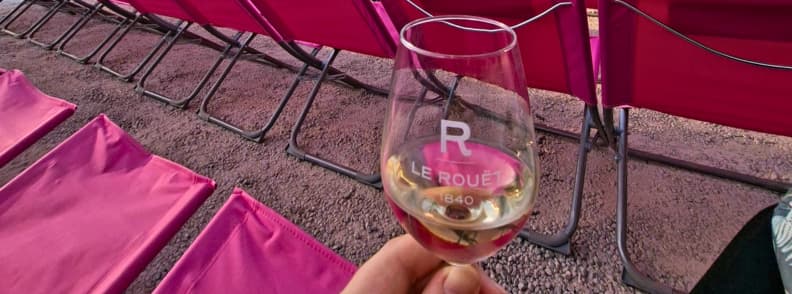
The estate and its Côtes de Provence wines
The Côtes de Provence Château du Rouët range is where the estate becomes easier to understand in the glass than on a geological map. Château du Rouët produces white, rosé, and red wines from its Fréjus terroir, and the current collection runs from the inexpensive Teres bottles through Villa Estérelle and 1840 to Belle Poule, Fréjus Hermès, and Séverac. We know Teres and Villa Estérelle best because we buy them regularly, and the latter was the range served during our concert. I think of it as the sensible middle of the château’s cellar rather than the grand bottle brought out to impress somebody’s father.
The Château du Rouët wine appellation sits within AOP Côtes de Provence, with part of the vineyard belonging to the Fréjus geographical designation. This matters because eastern Var has a different geological character from the limestone country farther west. Here the vines grow among red sandstone and volcanic rock, with maritime air coming inland from the Argens. The result is a wine estate firmly rooted in Provence, yet one whose scenery has far more rust-red rock and forest than the pale stone image people often bring with them.
The Château du Rouët vineyard varieties become particularly clear in Villa Estérelle. The white is 100% Rolle, the Provençal name for Vermentino. The current 2025 vintage has citrus, lime, and acacia aromas, followed by a fresh, persistent finish. It can be paired beautifully with oysters, grilled trout, and fresh goat cheese. This is also the Château du Rouët white wine I chose for my first glass at Les Musicales dans les Vignes, although I confess that at the time I was thinking rather less about acacia flowers than about dinner.
The Villa Estérelle rosé brings together three classic Rouët grape varieties, 50% Grenache, 40% Cinsault, and 10% Tibouren. The 2025 vintage is very pale, with cherry, blackcurrant, blackberry, and strawberry among the fruit notes. It goes well with an aperitif, Provençal dishes, and more exotic food. This was the bottle Mathieu and I bought after the tasting glass, partly because we already liked it and partly because €15 for a chilled bottle beside two beach chairs required very little philosophical reflection.
The red moves in another direction, with 80% Syrah and 20% Grenache. Château du Rouët gives it red-fruit and spice notes, with ageing in large wooden foudres and cement tanks after traditional maceration.
Looking across these varietals at Château du Rouët, the family resemblance comes from the estate while the character shifts considerably between colors. Rolle carries the white alone, Grenache leads the rosé, and Syrah dominates the red.
The other bottles are worth studying if you stop at the caveau for a proper Château du Rouët wine tasting. Belle Poule moves into a higher tier, with the current rosé blending Grenache, Syrah, and Tibouren, while the white remains 100% Rolle and comes from old vines with fermentation in new barrels. The current Belle Poule red is 90% Syrah and spends twelve months in barrel. In other words, walking up the range changes more than the label and price.
The rosés become especially interesting higher up. The 1840 cuvée uses 60% Grenache, 30% Cinsault, and 10% Tibouren, while Fréjus Hermès shifts heavily toward Tibouren at 50%, with Grenache and Syrah completing the blend. The estate produces only 5,000 bottles of the Fréjus Hermès rosé, compared with 100,000 bottles of 1840, which gives some idea of where the rarer end of Vins Château Rouët begins,
At the other end sits Teres, part of the Savatier Sélection, which I already knew as the more affordable range. The current Teres rosé costs €6.70 a bottle at the estate and combines Cinsault, Grenache and Tibouren. Keep it in mind if you’re visiting the caveau with the perfectly reasonable intention of buying several bottles rather than conducting a solemn one-bottle pilgrimage.
What I like about the Château du Rouët wine grapes is that the range gives a quick lesson in eastern Provence without turning the tasting into homework. Rolle, Grenache, Cinsault, Tibouren, and Syrah keep appearing in different proportions, and each cuvée pushes one of them forward. If you already enjoy Côtes de Provence rosé, tasting several bottles side by side here gives a much clearer sense of how dramatically the blend can shift while the bottles still come from the same estate.
Getting to Château du Rouët from Le Muy, Fréjus, Saint-Raphaël and Saint-Tropez
Getting to Château du Rouët from Le Muy is simple enough. The château sits outside the town on the D47 toward Bagnols-en-Forêt, about 7 km after the route leaves the built-up area. From the A8, take exit 36 across Le Muy and onto the Bagnols road. The official GPS coordinates are 43.512783, 6.616117, which I would save before leaving because vineyards have a tiresome habit of becoming much harder to identify after dark, when every gate begins to resemble every other gate and your phone announces with great confidence that you have arrived while you are still travelling at 70 km/h.
The last stretch is also where the Côte d’Azur begins to fall away. Le Muy disappears behind you, the houses thin out, and the road pushes into the wooded country between the Maures and the Estérel. I like this part of the route to Château du Rouët. Then the red rock and forest begin to take over, and by the time the château appears the evening has already acquired a different setting.
Getting to Château Rouët from Fréjus is especially convenient. Only 18 km away, it’s close enough to spend the afternoon beside the Mediterranean and head inland only when the heat starts easing. This is the pairing I would recommend to travelers staying around Fréjus. Beach or Roman ruins during the day, then shower, change, and drive toward Le Muy for wine and music. Provence is unusually good at allowing two completely different days to occupy the same twenty-four hours.
A Saint-Raphaël to Château du Rouët evening follows much the same pattern. Saint-Raphaël is glued to Fréjus so your drive will follow the same general corridor toward Le Muy, and Château du Rouët itself lists Saint-Raphaël among the useful railway stations for visitors to the estate. If I were staying there without a car, I would arrange the final transfer in advance, especially for the return after 10:00 pm. Rural vineyards become wonderfully romantic after sunset, but their usefulness as public-transport hubs remains rather limited.
The Saint-Tropez to Rouet trip deserves greater caution. The distance looks pleasantly manageable when viewed from the calm neutrality of a map, but smmer traffic around the Gulf of St Tropez has its own understanding of distance. Forty-five kilometers can be a short drive, a long drive, or the beginning of a personal argument with every vehicle between Saint-Tropez and Sainte-Maxime. I would leave early, allow plenty of time, and treat an unexpectedly smooth road as a gift rather than part of the plan.
For Château Rouet driving directions, I would therefore use the château itself as the destination rather than central Le Muy, save the coordinates before leaving, and give myself a comfortable margin before the concert. Fréjus and Saint-Raphaël make the easiest coastal bases, Le Muy is already on the doorstep, and Saint-Tropez requires a little more patience with the road. None of this is complicated, in truth. It simply helps to remember that the evening takes place at a wine estate in the Var countryside, rather than in a venue waiting politely beside a train station.
Coming from the coast or by boat
The first thing to know about visiting Château du Rouët by boat is that the château is firmly attached to the land. It sits inland near Le Muy, among forest and vines, so any sailing plan ends with the boat secured at the coast and the final part completed by road. This sounds obvious when written down, yet Mediterranean maps encourage a peculiar optimism in which anything 15 km from the sea begins to look practically waterfront.
If I were sailing to Château Rouët, I would favor Port Fréjus. It’s close enough for the transition from cockpit to concert to remain pleasant rather than becoming a second expedition. Port Fréjus accepts visitor reservations and publishes daily, weekly, and monthly berth rates for the 2026 season, which makes it a practical base for somebody planning the concert as a shore evening rather than hoping a berth somehow materialises at sunset.
Saint-Raphaël offers another sensible approach. The Vieux-Port sits in the heart of town and has 275 berths, with the marina facilities gathered around the central waterfront. From there, I would leave enough time for the road transfer toward Le Muy, especially after a sailing day when the harmless phrase we’ll leave the boat in ten minutes has a habit of turning into 45 minutes of showers, lines, bags, forgotten sunglasses, and somebody returning to check whether the gas is off. (That would be me!)
For sailors already based in the Gulf of Saint-Tropez, the calculation changes. A Saint-Tropez to Chateau Rouet by sea plan really means keeping the yacht in the Gulf and traveling inland from there. The road deserves a generous margin in summer. Sainte-Maxime also gives boaters a useful Gulf base, although its port is going through a major redevelopment during summer 2026, with new services gradually opening around the harbour.
This is why, among the marinas near Chateau Rouet, Fréjus would be my first choice when the concert itself drives the itinerary. The boat stays close to the coast, the inland transfer is short, and the evening still has enough breathing room for wine and dinner before 8:30 pm. Saint-Raphaël comes a close second, especially if you want to spend time there before heading inland.
The Château Rouët yacht version of Les Musicales dans les Vignes also needs one particularly unromantic piece of planning: the return. Wine is part of the evening, the concert finishes around 10:00 pm, and the boat remains several kilometers away behind a locked marina gate somewhere on the coast. I would arrange the driver or taxi before leaving the harbor, rather than standing beside a vineyard after the encore trying to solve the problem with diminishing phone battery and an increasingly optimistic interpretation of distance.
For me, the appeal of a French Riviera boat concert evening lies precisely in that change of scenery. I have spent enough time sailing the Mediterranean to appreciate what happens when you step ashore after a day dominated by water, wind, and the small domestic rituals of life aboard. A shower, clean clothes, and twenty minutes inland can make the same day seem to belong to somebody else. At Château du Rouët, the sea gives way to red Estérel country, forest and vineyards, then the evening can finish with wine and music under the stars.
What to expect at a Les Musicales dans les Vignes evening
A typical Les Musicales dans les Vignes night has a curious way of beginning like a wine tasting and ending like a proper concert, with about two hours in between during which everybody gradually changes purpose. At first people arrive carrying bags, sunglasses, and the faintly distracted expression of people still thinking about where they parked. They collect a glass, inspect the food, greet friends, wander around the estate, and begin the serious business of choosing where to sit. Then, somewhere around half past eight, food disappears, bottles migrate toward the chairs, and the crowd turns toward the stage almost at once.
What surprised me about the vineyard festival flow was how little the first half of the evening resembled waiting for a concert. At Château du Rouët, nobody stood around staring at the stage as if life had entered an interval. People were eating, talking, choosing wine, and settling into the estate. By the time the musicians appeared, the audience had already spent enough time there for the château to become part of the evening.
This is the vineyard concert expectation I would carry to another Les Musicales dans les Vignes date. Think of the evening as dinner and wine gradually giving way to music, rather than a concert with an unusually long opening period. The Les Musicales timeline gives the wine domain room to establish itself first, then hands the night over to the performers. In our case, that transition happened so smoothly that I only noticed it afterwards, when I realized the place where we had been balancing burgers on our knees an hour earlier had become quiet enough for Alexia Mornet’s voice to hold everyone’s attention.
The typical timeline and the arrival time I would choose
For me, the best arrival time for Les Musicales dans Les Vignes is around 7:00 to 7:15 pm, although the official Les Musicales schedule gives you a wider window, with doors opening at 6:30 pm. We reached Château du Rouët at about 7:15 pm and landed at the useful point in between eager first arrival and last-minute scramble. The food trucks were serving, the wine bar was ready, parking still looked almost extravagant in its availability, and the chairs had yet to inspire any competitive instincts among the audience.
That hour and a quarter before the music filled itself remarkably well. First came the walk from the car, then the ticket check, and our glasses of wine. After that came dinner, which in our case involved enough menu reading to suggest we were choosing a mortgage rather than a burger. We ate, returned for a bottle of rosé, installed it in its ice bag, and eventually settled in the same beach chairs we ate. By then, the light had started changing and 8:30 pm was approaching with perfect timing.
When to arrive at a vineyard concert: I would resist the urge to arrive at the first possible minute unless the estate itself is part of your sightseeing plan.
The Les Musicales dans les Vignes timeline leaves two full hours between opening and the concert because the organizers expect guests to spend that time at the domaine, tasting its wine and eating in the gardens or on the terrace. For somebody visiting Château du Rouët for the first time and keen to see the property at a slower pace, 6:30 pm makes sense. I already knew the estate, so an extra forty-five minutes would mainly have allowed me to reconsider the Greek food truck several additional times, an activity for which I had already shown considerable natural talent.
I would also leave a little margin between dinner and the concert. Food trucks develop queues in ways that remain mysterious until everybody becomes hungry at once, and choosing seats becomes less leisurely once an audience begins moving toward the stage in earnest. At Château du Rouët, our arrival time for the vineyard concert gave us time to do both comfortably. We had already eaten, bought our second round of wine. and sat comfortably by the time the musicians appeared, so the beginning of the concert arrived as the natural next part of the evening rather than a deadline we had spent an hour chasing.
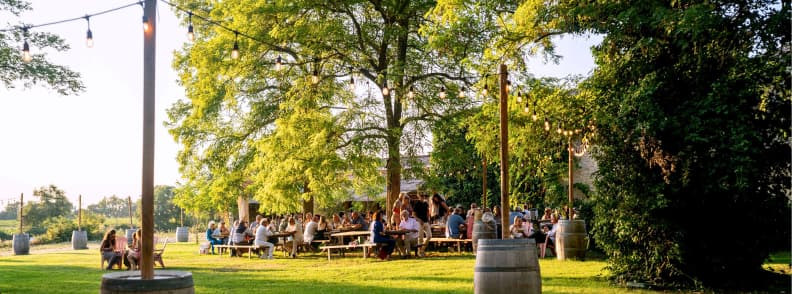
Wine, food, and what your Les Musicales dans les Vignes ticket includes
A standard Les Musicales ticket includes the concert and one tasting glass of wine from the host estate. The organizers describe that first glass as part of the welcome, with the period before the performance left open for eating and spending time around the property.
This is worth knowing before you arrive because the phrase wine festival has a way of encouraging optimistic interpretations. The wine tasting included with admission is a glass from the domaine, rather than an afternoon devoted to marching through the cellar with six glasses lined up in front of you.
Food belongs to the evening in a looser way. Guests are able to eat on site between arrival and the concert, usually in the gardens or on a terrace, while individual estates publish their own arrangements. Some dates bring in food trucks, as Château du Rouët did for us. Other estates have their own restaurant. So if vineyard concert food influences your choice, I would read the listing for the exact date rather than assume every château serves the same sort of dinner.
At Château du Rouët, our ticket covered the tasting glass and the concert. Dinner and later drinks were separate purchases. This suited me, I would rather choose my own meal and decide how much wine I want than pay a higher admission price for a fixed dinner somebody else selected. Extra glasses were €5 and the bottle of rosé was €15, which made the bottle an easy choice once we had settled in for the evening.
Anyone picturing a Les Musicales dans les Vignes open bar should think instead of a normal estate wine bar operating alongside the concert. Your first glass comes with admission, then further drinks at concerts are bought from the château. At Château du Rouët, the staff also handed out ice bags for bottles, a tiny act of foresight that became considerably more important once we were sitting outdoors in August with rosé beside us.
So when people wonder what’s included with a festival ticket, I would separate the evening into three parts. The concert is covered. The welcome glass is covered. Dinner and additional wine form the flexible part of the night. This arrangement keeps the food and wine at Les Musicales dans les Vignes pleasantly informal, and it also means two people at the same concert might spend very different amounts depending on how hungry or thirsty they are.
For me, it’s the right balance. The ticket gets you through the gate and gives the evening its first glass. After that, Provence takes care of the temptation…
Seating, Children, accessibility, and weather
The Les Musicales dans les Vignes seating arrangement depends on the vineyard, which is worth remembering before you form too fixed an idea from photographs of somebody else’s concert. Our Château du Rouët date used open seating or placement libre, with places taken on arrival and seated spots prioritised for ticket holders.
In our case that meant rows of low pink chiliennes, backed up by ordinary white plastic chairs for anyone whose knees regarded the former with suspicion. Another estate might bring another terrace, garden, or seating plan, so I would check the individual listing. But I will note that the beach chairs were in the event’s brand colors, so I guess they are a standard.
The Les Musicales dans les Vignes kids policy is generous. Children under 15 currently receive complimentary admission, subject to available seating, while ticket holders receive priority for seats. For families, the larger question is probably the hour rather than the price. Children at concerts are heading toward a 10:00 pm finish before the walk back to the car and the drive home. On a Provence holiday, where dinner has already drifted later, and bedtime has often surrendered several hours to summer, this might suit perfectly. But for a small child accustomed to falling asleep at eight, the second half of a jazz quartet has rather formidable competition.
I would therefore call Les Musicales dans les Vignes family-friendly for children who already enjoy music and cope happily with later evenings. The atmosphere we saw at Château du Rouët was calm, seated and relaxed, with plenty of time for dinner before the performance. The current free-under-15 policy also makes the festival unusually attractive for families wanting live music without buying a full adult ticket for every child.
Les Musicales dans les Vignes wheelchair access needs a more individual approach because these concerts take place on wine estates rather than purpose-built auditoriums. Some festival listings offer PMR pricing on presentation of supporting documentation, which shows that accessibility forms part of the ticketing system.
The ground itself varies from one domaine to another. At Château du Rouët, our route crossed dry grass in the parking field and gravel around the concert area. Anyone planning wheelchair access at a vineyard or using a walking aid would be better served by contacting the chosen château directly and asking about the distance from parking, the surface, accessible toilets, and the route to the seating area. A vineyard possesses many charms, but perfectly level flooring rarely leads the list.
That said, I did see participants in wheelchairs. However, I am in no position to evaluate how easy or difficult their experience was.
Weather deserves the same venue-by-venue attention. The festival’s sales conditions cover cancellation or a performance stopped within the first 30 minutes for weather, technical or safety reasons. In that situation, Les Musicales dans les Vignes offers a rescheduled date, another concert during the current or following season, or reimbursement of the e-ticket. Travel and accommodation expenses sit outside that reimbursement. This is the useful part of the Les Musicales dans les Vignes weather policy to know before booking accommodation around a single concert.
For a practical rain plan at Les Musicales dans les Vignes, I would check the forecast and the host estate’s communication on the day itself. Provence summer weather has a flair for extremes, from fierce afternoon heat to thunderstorms arriving with theatrical confidence. But our Château du Rouët evening behaved impeccably. The air was warm when we arrived, the temperature became more pleasant after sunset, and there was barely any wind through the concert. I spent considerably more time thinking about mosquitoes than meteorology, which, for an August outdoor concert in the Var, counts as excellent weather.
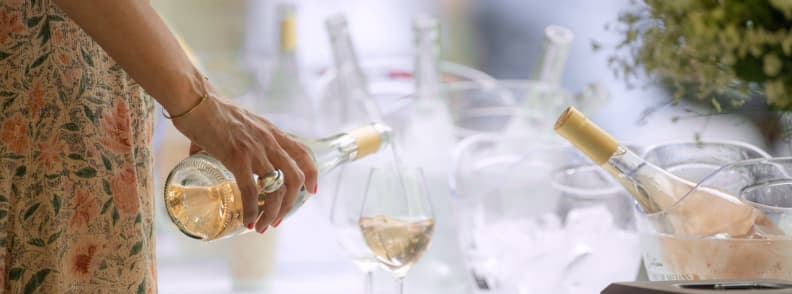
Tickets, prices, and how I’d choose a Les Musicales dans les Vignes concert
The Les Musicales dans les Vignes ticket price is modest enough to make browsing the program mildly dangerous. Most current 2026 dates start at €30, with some at €35, which places a vineyard concert cost in the territory of an ordinary dinner out rather than a major festival purchase.
Our Overjoyed evening at Château du Rouët cost €30 each, and after three hours at the estate, a glass of wine and a 90-minute concert, I never had the sensation that the ticket had taken an ambitious view of its own worth.
The slight danger comes once you open the full programme. Thirty euros is an easy amount to justify once. Then another evening appears with jazz manouche somewhere near Saint-Tropez, followed by a classical concert beneath Sainte-Victoire, then perhaps gospel in another château whose wine you have been meaning to try. This is where Les Musicales dans les Vignes passes begin look attractive, especially for residents, expats, and anyone spending a long stretch in Provence. The official festival currently sells two concerts for €55 and three for €80, both valid across the season, while five places for the same concert cost €105.
I would still resist choosing purely on price. A €30 ticket for music that leaves you cold remains €30 badly spent, even with a vineyard attached to it. When comparing Les Musicales dans les Vignes concerts, start with the artist, then look at the estate, then consider the drive. Price should come fourth. The festival covers enough of Provence for that order to be practical, and the difference between most individual tickets is small enough that I would rather spend an extra €5 on the evening I genuinely wanted.
For where to buy Les Musicales tickets, I would begin with the official festival website, because the current calendar ties each date to its vineyard, artist, and booking page. FNAC Spectacles also lists a large share of the 2026 program, with current dates running into late September. I would use those pages together, one for seeing the season as a whole and the other for checking the exact ticket listing.
I would hesitate to describe Les Musicales dans les Vignes simply as one of the budget festivals in Provence. The admission price is accessible, yet the attraction lies less in finding a cheap night out than in choosing the right combination of place and music.
Individual tickets, season passes, and current prices
The Les Musicales dans les Vignes individual tickets sit mostly at €30, with some 2026 dates at €35 depending on the estate and performance. Seen in isolation, €30 is the sort of sum people can spend in Provence on two cocktails and a plate of olives if they choose the wrong terrace, so I found the Les Musicales dans Les Vignes cost fairly easy to defend.
The passes become interesting once a second concert begins to tempt you. The official festival currently sells a Les Musicales pass for two concerts at €55 instead of €60, valid throughout the season. The three-concert Les Musicales multi-pass costs €80 instead of €90. The savings are small enough to remain sensible rather than spectacular, which is perhaps for the best. A €5 discount is unlikely to persuade anyone to spend an evening listening to music they dislike simply in order to achieve financial victory.
Groups get the best reduction. The current grouped ticket gives five places for one concert at €105 instead of €150, which brings the price down to €21 per person when all five places are used. If I were organizing a summer evening with friends, this is the Les Musicales dans les Vignes package I would notice first.
There is also a gift card valid across the season, which can be a nice gift for residents who know the festival and want to choose their own date later. For a traveler visiting Provence for a week, I would buy an individual ticket for the evening that fits best and leave it there. A vineyard concert booked around a holiday also has to fit weather, accommodation, and whatever other plans have already occupied the calendar.
I live nearby for the whole summer, so the two or three-concert pass might tempt me next year. That is where the festival’s scale starts to become apparent. One Thursday might be Stevie Wonder through jazz at Château du Rouët, another date might bring flamenco to Bormes-les-Mimosas, then a classical evening appears somewhere entirely different. The pass gives permission to treat Les Musicales dans les Vignes as a recurring part of summer rather than a single outing.
Jazz, classical, soul, gospel, and music from around the globe
One of the pleasant surprises in the Les Musicales dans les Vignes lineup genres is how little the festival ties itself to a single musical identity. The vineyard supplies the common setting, then the program wanders cheerfully from jazz to classical music, gospel, soul, covers, and music from around the globe. The official festival site lists each of those as a separate category, which means two Les Musicales evenings booked a week apart could have almost nothing in common musically beyond the wine waiting before the concert.
Jazz occupies a large and rather elastic corner of the programme. The current Les Musicales jazz festival dates include great jazz classics at Château Val Joanis and Domaine de La Croix and jazz manouche at Château Fonscolombe, Château La Mascaronne, and Château La Gordonne. Overjoyed’s Stevie Wonder program sits farther along the same spectrum, taking pop and soul songs into jazz arrangements rather than presenting a conventional tribute, with two more dates at Château Maravenne and Château Saint Hilaire. I would read the artist description before deciding that jazz tells you enough. It covers territory broad enough to take you from Django Reinhardt to Stevie Wonder without leaving the vineyard.
Classical music at Les Musicales dans les Vignes travels just as widely. The 2026 program includes Patrick Zygmanowski playing a program from Chopin to Mozart at Château Mauvanne, along with Hungarian Dances at Château de Saint-Martin and other chamber and recital evenings across the season. A classical concert in a vineyard also changes the character of the estate in a different way from jazz. I can easily see myself choosing one on a quieter night, especially at a château where the architecture and gardens suit music that asks people to sit still and listen rather than sway gently with a glass balanced beside them.
The Les Musicales dans les Vignes soul and gospel strand has its own personality. Gospel Var appears in the 2026 program, while another date pairs soul with gospel in Coudoux. These are the evenings I would expect to draw a livelier audience, especially once the music reaches the familiar songs people know well enough to sing under their breath. A vineyard audience already arrives relaxed after dinner and wine, so gospel and soul seem particularly well suited to the hour when daylight has gone and everybody has stopped worrying about how they look in a folding chair.
The world music festival Provence side broadens the choice again. Tango, flamenco, Brazilian music, and other international styles appear across current and recent programs, alongside Beatles evenings and French-song tributes. Piazzolla Tango appears at Domaine Sainte-Marie and Château La Castille, while flamenco dates appear at Domaine Pieracci and Château Barbebelle. The result is a festival calendar that like somebody has been given a collection of beautiful vineyards and asked What would sound good here after sunset?
Choose your vineyard according to where you’re staying
This is the point where I would stop admiring château photographs and look at a map. Les Musicales dans les Vignes stretches all over Provence, so geography should become part of the decision. Plus, summer roads here have a habit of turning a charming 40 km evening drive into a private test of character.
If I were staying around Saint-Tropez or Sainte-Maxime, I would begin with concerts near Saint-Tropez and the eastern Var rather than fall in love with an estate near Aix-en-Provence and then spend part of the evening staring at brake lights. The current program includes venues around Bormes-les-Mimosas, Vidauban, Le Muy and other parts of the Var, which gives the Gulf of Saint-Tropez plenty of realistic choices without turning dinner into a motorway strategy meeting.
From Fréjus or Saint-Raphaël, Château du Rouët is a very good option. For anyone searching concerts near Saint-Raphaël or a festival near Le Muy, I would favour this eastern cluster first, then compare the artists. A vineyard twenty minutes away with music you genuinely want to hear beats a supposedly grander estate that requires ninety minutes of summer traffic in each direction.
Aix-en-Provence and Sainte-Victoire have their own group of dates, and this is where the program starts to resemble several regional festivals stitched together. Current 2026 listings include Château Gassier at Puyloubier, while Pertuis gives Luberon-side travelers access to Château Val Joanis. Farther west and south, the program reaches Saint-Cyr-sur-Mer and Bormes-les-Mimosas. If you are already staying in one of those areas, I see little reason to cross Provence purely because another château has a prettier photograph of its terrace.
This is how I would choose a Les Musicales location now that I understand the festival. First, I would decide how far I am willing to drive after 10:00 pm. Then I would look at the artists within that radius. Only after those two decisions would I start comparing estates, wines, and scenery. This order lacks romance, yet romance tends to survive the evening better when nobody has spent two hours in traffic before the first glass of wine.
For residents and expats, the calculation becomes even easier. A search for Les Musicales dans les Vignes near me makes far better sense than trying to rank the entire program from best to worst. Someone living in the Var can follow several dates through the summer while keeping each evening local, which is exactly how I would use the festival now that I know how widely it spreads.
The best Les Musicales dans les Vignes venue, then, is rarely an absolute. It’s the vineyard where the artist interests you, the drive suits your evening, and the estate itself adds something worth arriving early for. Château du Rouët happened to tick all three boxes for us, which is a far better reason to choose a concert than prestige alone.

What to wear and bring to a vineyard concert
What to wear to a vineyard concert seems straightforward until you remember that a vineyard is still agricultural land, however elegant the château on the label. At Château du Rouët, the car park was a dry grassy field and the concert area was mostly gravel, so the evening began with the sort of ground that takes a personal interest in footwear. I wore a long sleeveless, backless dress, and stayed comfortable from our arrival through the end of the concert. Had mosquitoes shown less enthusiasm for me this summer, I would happily have worn something shorter.
For vineyard concert clothing, I would aim for the middle ground between a summer dinner and an outdoor event. A dress, skirt, light trousers, or jumpsuit all suit the setting. The audience at Château du Rouët dressed casually enough for burgers and deck chairs, while the wine estate gave the evening enough glam for clothes you would happily wear to dinner afterwards. This is about as close as I would come to a dress code for a vineyard festival. Wear something you like, then give far greater thought to what is happening below the ankle.
Shoes are where the evening starts making demands. I saw thick heels could manage the grass reasonably well, and platforms would have been better. Flats, espadrilles, or stable sandals would have made the whole route easy. Delicate stilettos belong to another branch of Provence, one involving paved terraces, valet parking, and people who never have to cross an animal enclosure on the way to their seats.
The Travel Bunny’s Concert Tip: For an outdoor concert outfit in Provence, I would choose the shoes first and let the rest of the outfit negotiate around them.
Now let’s discuss temperature. The evening started warm and became pleasantly cooler after dark, with still air throughout the concert. My sleeveless dress remained comfortable until we left. A light cardigan or wrap could still earn a place among your vineyard concert essentials, especially on a breezier night or later in the season, though mine would have spent that particular evening folded in my bag. Provence in August tends to make layers look like unnecessary pessimism at 7:00 pm and inspired foresight a few hours later.
As for what to bring to a vineyard concert, the useful list is smaller than the sort of packing guide written by somebody preparing for a three-day expedition. A refillable bottle for water, mosquito repellent, sunglasses, a light layer according to the forecast, your phone, and a small bag cover most of the evening. The trick is remembering that every object you bring eventually competes with a wine glass, dinner, and whatever you plan to carry back to the car.
My ideal vineyard concert packing list follows a principle I learned long ago while traveling: every item should be useful enough to deserve being held while somebody hands you a chilled glass of rosé.
My practical vineyard-concert checklist
A vineyard concert checklist sounds faintly excessive until you remember where the concert is taking place. A theatre provides a roof, level floors, fixed seats, toilets, air-conditioning, and usually somebody nearby who knows where everything is. A vineyard provides… vines. The rest depends on the estate, the weather, and how generously the local mosquitoes have interpreted your presence. I would still travel light, because by the time you add a wine glass and dinner to your hands, every unnecessary object begins to acquire considerable weight.
The first thing in my bag would be a refillable water bottle. From what I saw, Château du Rouët allowed refilling your water bottle, which proved useful on a warm August evening when wine had already entered proceedings. Water is one of those vineyard concert essentials that receives little attention in photographs and becomes increasingly interesting after the second glass of rosé.
Mosquito repellent would come next, and in my case rather urgently. I wore a long dress partly for protection, and still came home with two bites. Anyone at least similarly popular with insects should apply repellent before settling into a chair, because swatting at your ankles during a quiet jazz passage attracts attention for all the wrong reasons.
Shoes deserve their own place on any Provence festival checklist. Our route crossed dry grass with dry dung in the parking area, and gravel around the stage, so stable sandals, espadrilles, flats, or platforms would all have suited the ground. Thick heels also manage reasonably well. The beautiful pair whose heels resemble knitting needles belong to an evening where the car park has been introduced to concrete.
I would carry sunglasses and sunscreen for an early arrival. A typical Les Musicales dans les Vignes concert starts at 6:30 pm, which still leaves plenty of August sun hanging over a Provence wine estate. A light cardigan or wrap belongs in the bag according to the forecast, especially later in the season when an evening that begins in heat has several hours to reconsider its temperature.
Your ticket and a valid photo ID also belong among the items to bring to a concert. The festival’s current sales conditions state that e-tickets are personal and that guests must carry valid official photo identification for entry checks. They also say the e-ticket is valid for the specific place, date and time purchased, and admission after the concert begins is no longer guaranteed.
In practice, at Château du Rouët, they checked our names on a guest list, and we received green paper tickets that we showed at the wine bar.
A small crossbody bag is about the right size for the remaining outdoor concert supplies. Mine would hold my phone, repellent, sunglasses, tissues, and whatever personal medication I needed. I would resist filling it simply because empty space exists. At some point during the evening, one hand will contain wine and the other will contain food, and suddenly the large tote bag that seemed wonderfully practical at home starts behaving like a third person.
My phone was enough for photographs. For anyone bringing a larger camera for an outdoor concert, I would check the individual estate’s rules first, especially around professional-looking equipment. You could spend some time photographing the place before the music starts. The wine bar, food trucks, chairs, fading light, and vineyard tell far more of the evening’s story than twenty nearly identical pictures of a distant stage.
I would leave binoculars for a concert at home. Our seats near the back still gave us a clear view, and the event space was intimate enough to watch the performers easily. I would also leave the foldable chair for a concert in the car when the event listing confirms seating. Our event at Château du Rouët supplied chiliennes and standard chairs, which meant carrying another one across the field would have been an impressive amount of effort devoted to duplicating furniture.
The same goes for a concert picnic blanket. At our date, the event area was gravel and seating already existed. Food came from the announced trucks, so a personal picnic setup would have added luggage without improving dinner. For food to bring to a concert, I would check the specific event page first. A vineyard with three food trucks requires a different plan from an estate offering a restaurant meal or another catering arrangement.
Rain deserves one final glance before leaving home. A compact waterproof layer earns space in the bag when the forecast looks uncertain, while the festival’s terms explain the options following a weather-related cancellation or an interruption during the first 30 minutes. For ordinary summer weather, I would rather carry one light layer than arrive equipped for an Alpine rescue operation.
The Travel Bunny’s concert packing list stays short: ticket, photo ID, water bottle, mosquito repellent, sunglasses, sunscreen, sensible shoes, a light layer, phone, tissues, and personal medication. Add a clear plan for the drive home if wine forms part of the evening.
Everything else has to justify taking up a hand that might otherwise be holding rosé.
How to turn the concert into a full Provence evening
A Provence evening itinerary built around Les Musicales dans les Vignes is almost embarrassingly easy because the concert already takes care of the part of the day when holiday plans often begin to lose coherence. By six o’clock, somebody is hungry, somebody wants a shower, everybody has acquired sand somewhere inconvenient, and the noble intention to find somewhere nice later has started to look less like spontaneity and more like poor administration. A vineyard concert fixes all your problems. You know where dinner will happen, where the wine comes from and what time the musicians begin.
I would therefore treat the concert as the final act of the day and plan backwards from 7:00 pm. We’ll take Château du Rouët as an example. Halfway between the Côte d’Azur and the Var hinterland, it gives you an unusually broad choice for the hours before the music. Spend the afternoon by the Mediterranean around Fréjus or Saint-Raphaël, then shower and head inland. Stay in the countryside and spend the day around Bagnols-en-Forêt, Roquebrune-sur-Argens, or another nearby village, then drive toward Le Muy as the heat begins to drop. Either way, the Provence travel plan concert gains a pleasing change of scenery between afternoon and evening.
For me, the coast-to-vineyard version has particular appeal. You can spend several hours swimming or walking beside the sea, then twenty or thirty kilometers inland the day has changed completely. Salt and beach clothes give way to a dress and proper shoes, the blue Mediterranean disappears behind forest, and eventually somebody hands you a glass of Côtes de Provence. As a Provence dinner music combination, this requires remarkably little organizational talent for the amount of holiday atmosphere produced.
I would also resist filling the hours after the concert with ambitious post-concert activities. Most Les Musicales dans les Vignes performances finish around 10:00 pm, by which point you have already eaten, tasted the estate wine, and listened to ninety minutes of music. The natural continuation is a short drive back to your accommodation, perhaps followed by one last drink on a terrace if the evening still has some life in it. Provence has plenty of nights for bars, promenades, and late dinners. A vineyard concert already gives one evening a complete shape.
That is how I would extend a vineyard concert evening in practice. Give the afternoon one destination, leave enough time to change, and reach the château around 7:00 pm, then let the vineyard take over from there. The result is a full Provence night out after concert in which everything actually belong together, instead of an itinerary assembled by somebody determined to squeeze six attractions into the same sunset.
Disclosure: Some of the links on this page are affiliate links. This means that at no extra cost to you, The Travel Bunny will earn a small commission if you click through and make a purchase. Thank you!
Where to stay near Château du Rouët and what to combine nearby
If I were building a whole night around the concert, I would start with the obvious answer to where to stay near Château du Rouët and sleep at the château itself. The estate rents four places inside its own hameau (La Grande Maison, La Réserve, Le Studio, and Le Grenier de Victor), all surrounded by vines, olive trees, and cork oaks. Guests also have access to the pools, tennis court and paths through the property. After a concert ending around 10:00 pm, there’s something deeply attractive about watching everybody else walk toward their cars while your own evening requires only a walk across the domaine.
The four guest houses at Château du Rouët suit quite different trips:
- La Grande Maison is the big one, a 300 m² house dating from around 1880 with six bedrooms and space for 12 to 14 people. Booking La Grance Maison makes sense for a family gathering or several couples who have reached the dangerous stage of saying Why don’t we all go away together?
- La Réserve sleeps four in two bedrooms and has a terrace opening onto the park.
- Le Studio sleeps two to four in a compact, air-conditioned space inside a former Templar commandery.
- Le Grenier de Victor suits a couple, with a double bedroom, kitchen, terrace, and the caveau about five minutes away on foot.
That last detail would probably finish the argument for me. Staying at a Provence vineyard accommodation where the wine shop lies five minutes from the front door has an appealing internal logic, especially after spending the previous evening drinking the same estate’s rosé under the stars. Château du Rouët’s gardens add their own distractions, with a large basin dating from 1876, lotus and water lilies, an outdoor pool looking toward the Rocher de Roquebrune and paths through the grounds. I could quite happily spend the following morning there doing very little of consequence.
For travelers who prefer a hotel, Le Domaine de Saint Endreol Golf & Spa Resort is the nearby alternative I would put first. Its four-star residence sits at La Motte and combines rooms and longer-stay accommodation with an 18-hole golf course, restaurant, and 2,000 m² spa. Château du Rouët places the golf about 4 km from its guest houses, which makes Saint Endréol one of the most practical hotels near Château du Rouët for a concert evening. Pluss, a spa afternoon followed by wine and jazz would be an impressively efficient use of a day!
As for things to do near Château du Rouët, I would resist creating a heroic list. The immediate area already gives you several very different choices. Le Muy has one of the largest markets in eastern Var and sits between the Maures and Estérel, with walking and cycling country around it. Bagnols-en-Forêt is along the same road beyond the château and makes a good inland stop before an evening event. The estate itself recommends it as the first perched village on the route toward Seillans, together with walks through the surrounding countryside.
If I wanted history before the concert, I would visit Fréjus. The town carries Roman remains through its center, alongside medieval heritage, and the surrounding area includes the Étangs de Villepey and the coast. This gives a day around the attractions near Château du Rouët a pleasing progression. Roman stones in the afternoon, a drive inland, then Côtes de Provence and jazz after sunset.
For nature, I would explore the Estérel side of the area and save enough energy for the evening. The red massif dominates this corner of the Var, with cork oaks, pines, and the ochre rock that also surrounds Château du Rouët. The château’s own grounds look toward the Rocher de Roquebrune, recognizable when you move between villages and estates.
My own choice would be simpler. I would stay at Château du Rouët, wake up among the vines, and spend the next morning by the pool before going to the caveau. After a night involving Stevie Wonder, rosé, and several unsuccessful attempts by strangers to rise elegantly from beach chairs, a quiet morning seems the proper sequel.
Les Musicales dans les Vignes FAQ
If you are considering Les Musicales dans les Vignes for the first time, the questions that matter tend to appear only once you start planning the actual evening. How much are the tickets? How early should you arrive? What happens in the rain? Is wine included? Are children welcome? What sort of shoes survive a vineyard car park? This Les Musicales dans les Vignes FAQ gathers the practical answers I would have wanted before our Château du Rouët concert, together with the current Les Musicales dans les Vignes festival info, ticket rules, and schedule details that are worth checking before you set off.
What is Les Musicales dans les Vignes?
Les Musicales dans les Vignes is a traveling wine-and-music festival that spends the summer moving from one Provence vineyard to another. Each date pairs a host estate with a concert, then gives guests the early evening to taste the domaine’s wine, eat on site, and settle in before the musicians begin around 8:00-8:30 pm. The festival started in the Var in 2013 with three vineyards and three concerts, then grew into a program of around 50 estates and 100 performances spread across Provence.
The clever part is that the château remains central to the evening. You might hear jazz manouche at a family domaine one week and opera at a grand estate the next, with gospel, soul, classical music, Brazilian rhythms, and covers appearing elsewhere on the calendar.
The official programme now reaches areas from the Gulf of Saint-Tropez and Fréjus to Aix, Sainte-Victoire, the Luberon and Les Baux-de-Provence. So if someone asks me what is Les Musicales dans les Vignes festival, I would describe it as a summer concert series where Provence supplies a different vineyard, wine, and backdrop every night.
Where does Les Musicales dans les Vignes take place?
The festival moves through wine estates across Provence, with current and past venues around Dracénie, Fréjus, the Gulf of Saint-Tropez, Bandol, Aix-en-Provence, Sainte-Victoire, the South Luberon, Les Baux-de-Provence, and the Cœur du Var. The 2026 calendar includes dates across the Var, Vaucluse, and Bouches-du-Rhône, so the easiest approach is to open the current Les Musicales dans les Vignes programme, find your part of Provence, and then compare the artists within a sensible driving radius.
When does Les Musicales dans les Vignes take place?
The main concert season runs through summer into early autumn. Current FNAC listings for Les Musicales dans les Vignes 2026 extend from late July through 26 September 2026, with vineyards and artists changing throughout the calendar.
What time does a Les Musicales evening start?
Most current concerts begin at 8:00 or 08:30 pm, while the vineyard opens earlier for wine and food. I would treat 8:30 pm as the hour when you should already be seated with dinner finished, and the bottle safely installed beside you, rather than the moment to begin wondering where you parked.
What is the best time to arrive at Les Musicales dans les Vignes?
I would aim for 7:00 to 7:15 pm. Our 7:15 pm arrival at Château du Rouët gave us ample time for the tasting glass, dinner, a bottle of wine, and a good choice of seats before the 8:30 pm concert. Anyone keen to spend longer around the estate could arrive from the opening time.
How long does a Les Musicales concert last?
The festival describes an average performance of around 90 minutes, which usually takes a 8:30 pm concert through to roughly 10:00 pm. For us, the timing was almost ideal. Long enough for the music to become the center of the evening, short enough to leave before sitting in a beach chair became a permanent lifestyle choice.
How much do Les Musicales dans les Vignes tickets cost?
Current Les Musicales dans les Vignes ticket prices start at €30, with some 2026 concerts listed at €35. Our Overjoyed evening at Château du Rouët cost €30 per person.
Where do I buy Les Musicales dans les Vignes tickets?
The official festival website carries the current calendar and booking routes, while FNAC Spectacles lists many individual dates. I would start with the official Les Musicales dans les Vignes programme, choose the vineyard and artist, then book from the event page attached to your date.
Are Les Musicales tickets refundable?
The current sales terms describe e-tickets as personal and tied to the specific venue, date, and time purchased. For a cancellation or a performance interrupted within the first 30 minutes because of weather, technical problems or safety concerns, the organizer offers a rescheduled date, another concert during the current or following season, or reimbursement of the e-ticket. Travel and accommodation expenses stay outside the reimbursement.
What happens if it rains at Les Musicales dans les Vignes?
The festival terms cover weather-related cancellation and early interruption. In those cases, the organizer offers the choices above, including another concert or an e-ticket refund. I would still check the host estate’s communication on the day itself, since every concert occupies different grounds and Provence thunderstorms have an impressive sense of timing.
Is wine included with a Les Musicales ticket?
Yes, the standard evening includes a tasting glass from the host estate. At Château du Rouët, we chose between red, white and rosé before buying further wine separately.
Is dinner included with a Les Musicales ticket?
Dinner is a separate purchase. At our Château du Rouët date, three food trucks handled the evening meal, while the ticket covered the concert and the first tasting glass. Other estates use their own catering arrangements, so the individual concert page deserves a quick check before arrival.
What food is served at Les Musicales dans les Vignes?
Food changes from estate to estate. At Château du Rouët, Nectare & Ambroisie served Greek and Mediterranean food, La Kaz Renyoné offered Réunion dishes, and La Cheese Cantine handled burgers and hot dogs. We eventually chose the country burgers after devoting far greater intellectual effort to dinner than the situation required.
Is seating reserved at Les Musicales dans les Vignes?
Many current events use placement libre, meaning guests choose among the available seats on arrival. Our Château du Rouët concert was seated with open placement, so arriving earlier gave us a wider choice.
Are children allowed at Les Musicales dans les Vignes?
The festival currently offers complimentary admission for children under 15, subject to seating availability and priority for ticket holders. For families, the bigger consideration is the 8:30 pm start and an evening extending to around 10:00 pm. A child already accustomed to late Provence summer evenings will have an easier time than one whose eyelids begin negotiations at eight.
Is Les Musicales dans les Vignes suitable for wheelchair users?
Accessibility varies with the vineyard. Château du Rouët had dry grass between the parking area and event entrance, followed by gravel around the seating. Anyone using a wheelchair or walking aid should contact the chosen estate before booking and ask specifically about parking distance, ground surfaces, toilets, and access to the seating area.
Is parking available at Les Musicales concerts?
Parking depends on the host estate. Château du Rouët had signed on-site parking in a grassy animal enclosure, with a short walk to the concert area. At 7:15 pm we found plenty of space, and our decision to park near the outer edge gave us an extremely quick departure later.
What should I wear to Les Musicales dans les Vignes?
Dress as you would for a relaxed summer dinner, then choose shoes for a vineyard. Grass, gravel, and uneven ground make stable sandals, espadrilles, flats, platforms, or thick heels far easier than delicate stilettos. I wore a long sleeveless dress and stayed comfortable through the entire August evening.
What should I bring to a vineyard concert?
My essentials are a refillable water bottle, mosquito repellent, sunglasses, sunscreen for an early arrival, stable shoes, a light layer according to the forecast, your ticket, photo ID and a small bag. The current festival sales terms also instruct guests to carry valid photo identification with the e-ticket.
Do I need to print my Les Musicales e-ticket?
The current official sales conditions specifically instruct guests to print the e-ticket on blank white A4 paper and bring official photo identification. I would follow the instructions sent with your own ticket, since finding out beside the vineyard entrance is a poor moment to develop strong opinions about printers.
Is Les Musicales dans les Vignes good for a date night?
For me, yes. The evening already contains most of the ingredients people usually assemble separately: a wine estate, dinner, sunset, and live music. At Château du Rouët, the bottle of rosé, low chairs, and stars above the stage made the night intimate without requiring anybody to create romance on purpose.
Which Les Musicales vineyard should I choose?
I would choose the artist first, then the vineyard, then the drive. The program spreads far enough across Provence for geography to shape the evening, and a château within an easy journey home has a considerable advantage after wine and a 10:00 pm finish. The best Les Musicales dans les Vignes venue is the one where the music interests you and the location suits the place where you are staying.
How do I contact Les Musicales dans les Vignes?
The official Les Musicales dans les Vignes festival website provides its current program, booking routes and contact information. For questions involving accessibility, children, pets, unusual seating requirements or a particular estate, I would contact the organizer or host vineyard directly before buying the ticket.
My Opinion on Les Musicales dans les Vignes after the Château du Rouët concert
Only after the concert did I properly realize that our evening at Château du Rouët belonged to something much larger. Until then, Les Musicales dans les Vignes had been little more than a name attached to the event Mathieu found in the château newsletter. We had gone because we knew the estate, liked its wine, and fancied hearing Stevie Wonder reworked through jazz.
I learned about the vineyard concert festival right before the concert. Then, at home, I started reading about it, and found a whole summer program scattered through vineyards across Provence. It was rather like enjoying dinner at what you assume is a good neighborhood restaurant and learning afterwards that there are fifty branches, except in this case every branch has a different château, different wine and different musicians.
That discovery changed my Château Rouët impressions in an interesting way. Our evening had never behaved like part of a large festival. It had remained stubbornly local from beginning to end, right down to the grassy parking field, the château wine we already buy, and the people carrying their own pillows to the concert. Yet behind it sat an organization sending artists through estates across the Var, Vaucluse, and Bouches-du-Rhône all summer. I love this contradiction! Les Musicales dans les Vignes has grown large enough to offer serious choice while each audience still spends the night inside one vineyard, with one stage and one set of musicians.
My Les Musicales dans les Vignes at Château du Rouët concert review therefore goes beyond saying that we had a lovely evening. I would return because the concert gave me something I value increasingly in Provence, an experience rooted in the place where it happens. The wine came from the estate around us. The changing light belonged to an August evening in the Var. The music arrived at exactly the right moment, after dinner and before full darkness, and by the time the stars came out I had forgotten entirely that a few hours earlier I had been having an ordinary Thursday.
For my Les Musicales dans Les Vignes overall review, I would resist choosing another date because of the château alone. After Overjoyed, I understand that the artist deserves equal weight. A vineyard gives the evening its character, while the musicians decide what you remember when you drive home. At Château du Rouët, those two sides happened to suit each other beautifully.
About the Author

Hi, I’m Mirela Letailleur, founder of The Travel Bunny and a travel writer based in the Var, in the arrière-pays of the Côte d’Azur. I spend my time exploring Provence as a resident, from local wine estates and village events to festivals like Les Musicales dans les Vignes. Château du Rouët is part of my everyday map, and Mathieu and I regularly buy wine there, so attending its 2026 concert with Overjoyed gave me a rare chance to experience a familiar domaine in a completely different way.
I write first-hand guides for travelers, expats, and locals who want the practical details for the best evening out in Provence. My coverage of Provence vineyard concerts, Côtes de Provence estates, and events such as Les Musicales combines local knowledge with what I actually saw, heard, tasted, and experienced on the ground, from parking and seating to wine, food, timing, and the atmosphere after sunset.
After reading my Les Musicales dans les Vignes Provence guide, check out these articles on The Travel Bunny
Complete Guide to Foire de Brignoles: Dates, Parking, Program, and Best Things to Do
Complete Cotignac Travel Guide. Provence’s Cliffside Village with Quince Markets, Royal Miracles & Troglodyte Caves