
I visited Villa Aurélienne Fréjus at the end of September 2026 during the Festival de la Photographie Surréaliste et Créative. My first visit inside the villa was after a couple of years of knowing Parc Aurélien from stroller walks with my son. I already knew the tall pines, uphill paths, playground, and Roman aqueduct remains, but I had been wanting for some time to discover the Villa.
Visiting Villa Aurélienne in Fréjus
Villa Aurélienne is in Fréjus on the French Riviera or Côte d’Azur, surrounded by a large wooded park. The exterior immediately looked Italian to me. Inside, the size surprised me, along with the natural light, double staircase, and exhibition rooms. Contemporary photography filled these rooms during my visit, while photographs from previous festival editions lined the uphill approach through the park.
I’d include Fréjus Villa Aurélienne in a weekend around the city, especially during an exhibition, concert, or cultural event. I wouldn’t travel across the region just to see the villa, but if you’re staying nearby, I’d visit if I were you. The park also can be visited during a tour of Fréjus Roman heritage, and families have the playground waiting outside when younger visitors decide they’ve had enough culture. My toddler reached this decision much earlier than I did!
In this guide on The Travel Bunny, I’ll cover what I saw inside Villa Aurélienne, what deserves your attention, the park, parking and access, how long to allow, and what the photography festival added to my visit. For current visitor information, check the Villa Aurélienne official website before setting out, especially when strong winds or temporary events affect access.
Villa Aurélienne
My first visit to Villa Aurélienne Fréjus began under the tall pines of Parc Aurélien, a place I already knew after many stroller walks here while waiting for my son’s appointments at the physiotherapist across the street. The villa is uphill, so the building stays partly hidden among Mediterranean vegetation as you get near it. Palms, pines, and enormous agaves line the way. Near the top, the trees open shortly around a bench and an inland view before the villa finally comes into sight.
The park changes the arrival completely. Villa Aurélienne occupies the top of a 24-hectare botanical park, with remnants of the Roman aqueduct lower down. It’s a very diverse site, with pine woodland, orchid grassland, and Mediterranean flora among the habitats. During my visit, I saw people walking dogs, parents with children, locals exercising, and families heading toward the playground.
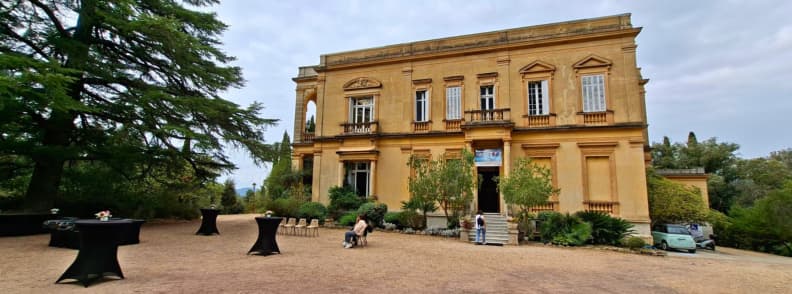
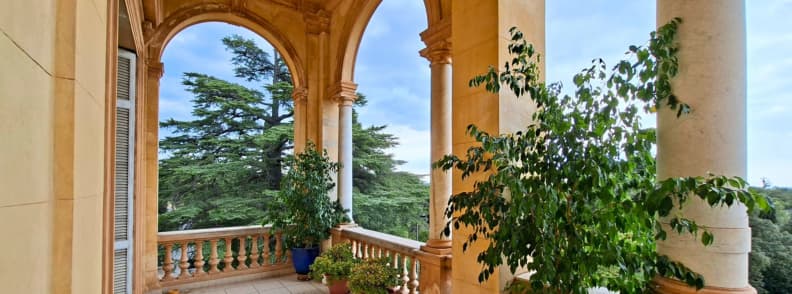
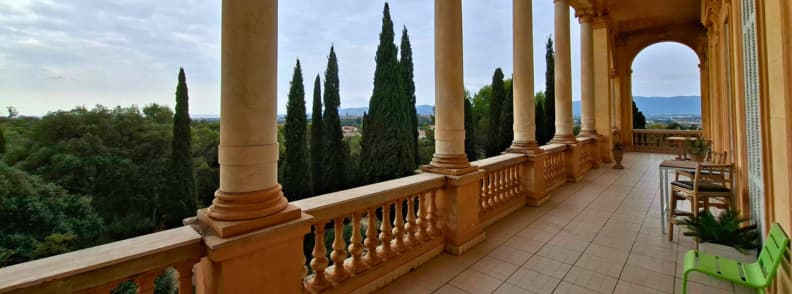
Then the house appears. Fréjus Villa Aurélienne has an unmistakably Italian appearance from outside, with long superimposed galleries, columns, and a pale facade above the greenery.
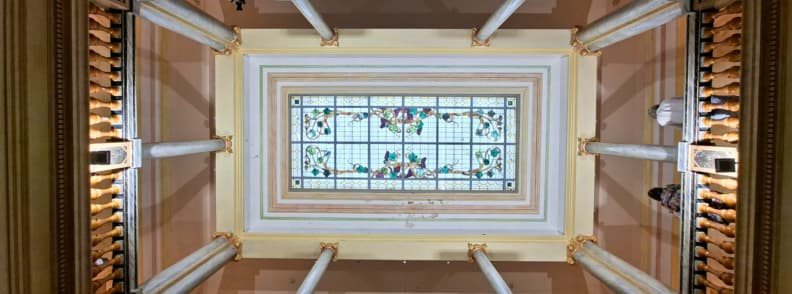
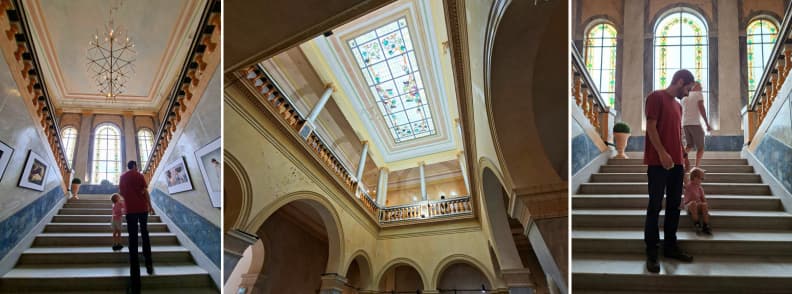
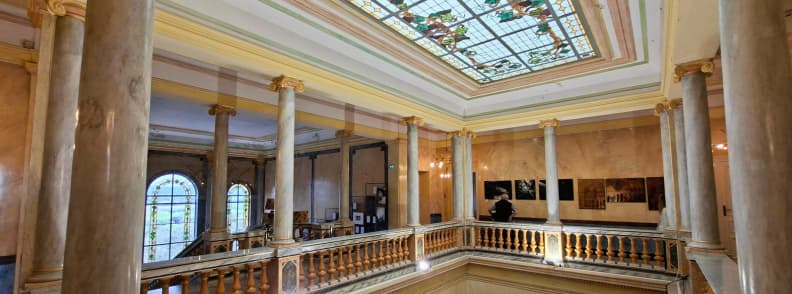
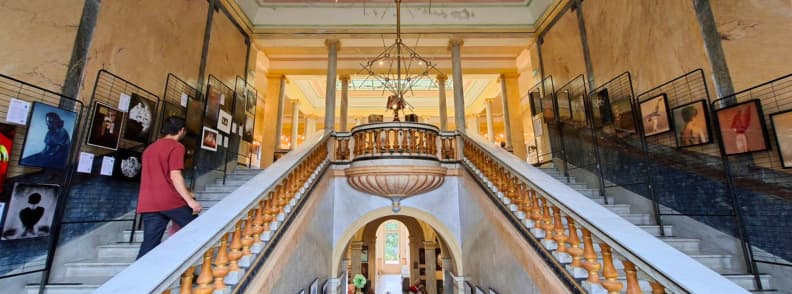
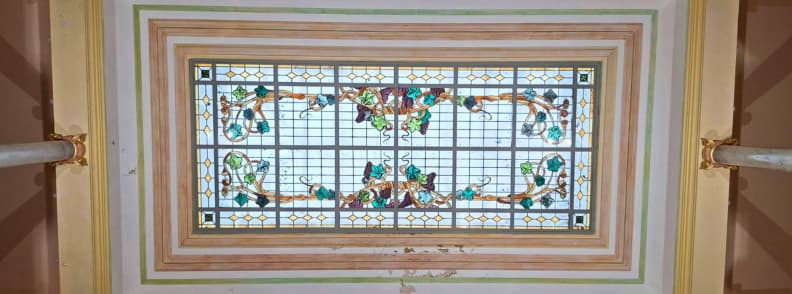
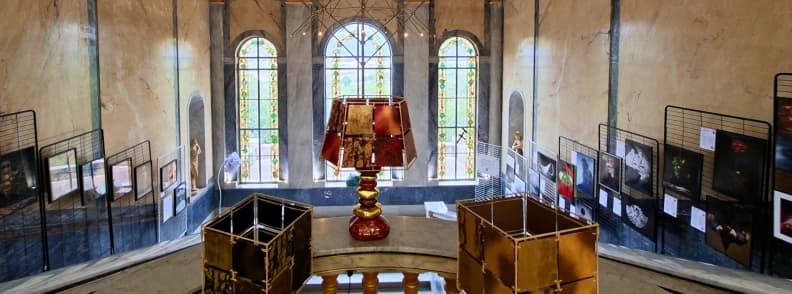
Inside, the villa seemed much larger than I had expected. The central space rises beneath a glass-covered ceiling, daylight drops in from above, and a double staircase climbs beside large stained windows overlooking the park. Parts of the interior reminded me of the Casino in Constanța, Romania.
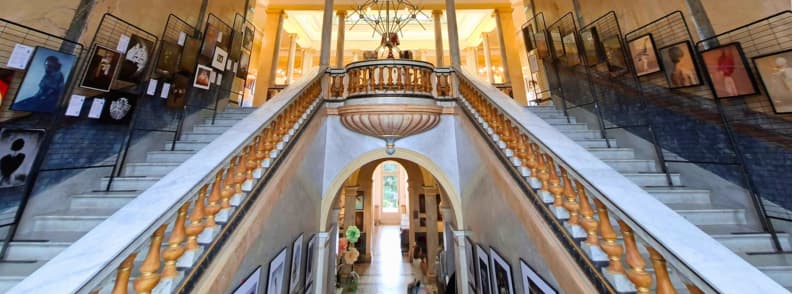
During the photography festival, framed images occupied room after room, while mirrors, windows, marble, and the staircase kept competing for my attention. A few patches of peeling plaster were also visible when you looked up.
The villa has a different character depending on what’s happening inside. The Fréjus Tourist Office currently limits ordinary interior access to guided visits and temporary exhibitions, while Parc Aurélien stays freely accessible, apart from closures during violent winds. An exhibition or concert is the best reason to time your visit, in my opinion.
For a weekend in Fréjus, add Villa Aurélienne to your itinerary, especially when the doors are open for a cultural event.
Is Villa Aurélienne worth visiting?
Yes, especially if you’re already spending a weekend in Fréjus. I wouldn’t cross the Côte d’Azur just to visit this villa, but I’d happily add it to a day around Fréjus. The park, Roman aqueduct remains, and 19th-century house make it an easy cultural stop, while an exhibition or concert provides the best reason to go inside.
The best time to visit Villa Aurélienne Fréjus is during a cultural event. The Fréjus Tourist Office currently limits regular interior access to guided visits and temporary exhibitions, so timing has a direct effect on what you’ll see.
I went during the 2026 surrealist photography festival, when the rooms were full of contemporary art and the villa played a role in the exhibition. I sometimes noticed works of art first in the old mirrors. Elsewhere, sunlight from the glass ceiling, the double staircase and the large windows pulled my attention away from the frames. The building and the exhibition kept interrupting each other, but in a good way.
The visit also has an easy rhythm. I wandered through some rooms several times, stopped at pieces I liked, and spent more time around the central staircase without ever finding the villa crowded. Outside, the wooded park gave my husband and toddler somewhere to retreat once our son’s interest in surrealist photography faded off. The playground was his day’s highlight.
Families should visit Villa Aurélienne because the park adds space for walking and playing. Architecture and photography fans have an even clearer reason to visit. If the villa is closed, consider Parc Aurélien as a pleasant addition to discovering Roman Fréjus.
My Villa Aurélienne Fréjus visitor review: Go if you’re staying nearby, and try to visit when something is happening inside. The venue is interesting on its own, but after seeing its rooms filled with photography, I suspect I’d find them oddly empty without all those frames.
My experience visiting Villa Aurélienne during the surrealist photography festival
I had known Parc Aurélien for years before I finally went inside the villa. When Willy was a baby, his physical therapist had an office across the street, so I spent a lot of time walking nearby with the stroller. The 2026 Festival de la Photographie Surréaliste et Créative finally gave me a reason to see what was behind the Villa’s doors. My husband and Willy came with me, although his patience didn’t last long.
Arriving through Parc Aurélien
We drove into Parc Aurélien, something I hadn’t done before. I used to park at the supermarket across the road because the small parking areas near the building with the physical therapist, a dentist, and a bank filled quickly. There is generous free parking inside the park, plus spaces closer to Villa Aurélienne for visitors with disabilities. The entrance is clearly marked, and once through the gate, getting our bearings was easy.
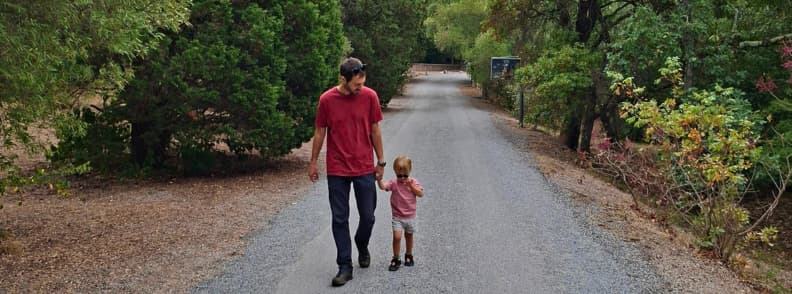
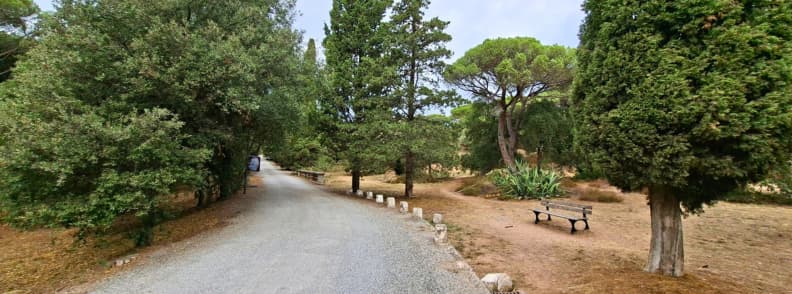
The walk uphill starts among the tall trees I’ve always liked here. Mediterranean parks often come with clipped planting and formal paths. Parc Aurélien has a looser, forested character. Pines rise overhead, palms appear between them, and some of the agave plants have reached absurd proportions. The wide concrete path climbs steadily toward the villa, but the gradient is manageable. Willy walked on his own, but a stroller would have been easy on the route we took.
During the festival, banners with photographs from previous editions marked the path to the villa, so the exhibition began before we reached the building. I liked this idea. During the event, these outdoor displays also remain visible while the park is open, even when the villa’s doors are closed.
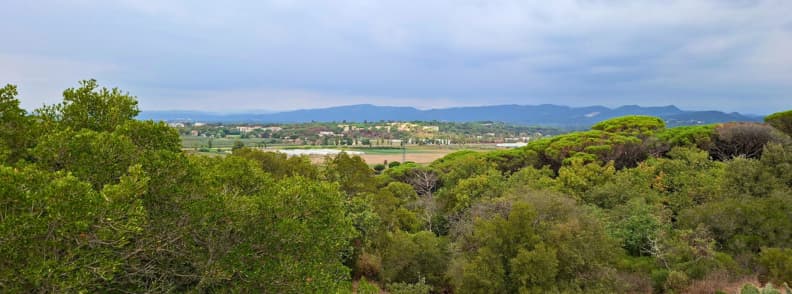
At the top, I stopped near a bench slightly off the path, where the vegetation opens onto an inland view. The panorama isn’t anything special, but still worth a peek, in my opinion. A little farther on, after passing a barrier and continuing across the gravel in front, Villa Aurélienne finally comes fully into view. Seeing the house emerge above all those trees is one of the pleasures of arriving on foot.
My immediate association was Italy. The long columned galleries and pale facade explain why once you know the architectural background. But more on that later.
What caught my attention inside the villa
The interior surprised me with its size. Villa Aurélienne covers about 1,700 m², with rooms arranged around a central peristyle court beneath a glass roof.
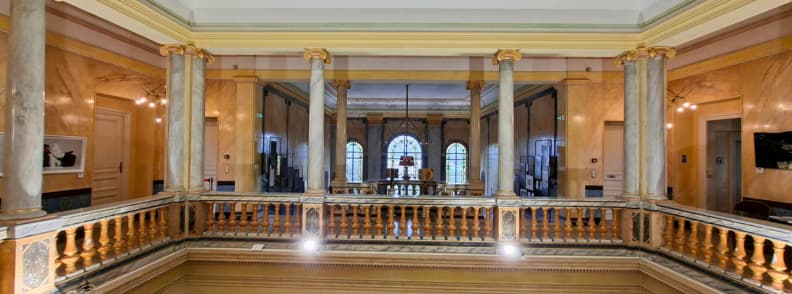
The central space was my favorite part. Sunlight came through above, lighting the ceiling and the open levels around the atrium. From there, balconies frame the space, while the large double staircase rises at the northern side of the house. Huge stained windows beside the stairs bring the park back into view. I kept stopping there over and over.
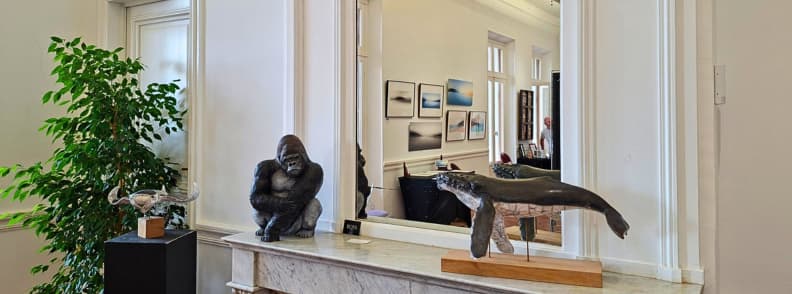
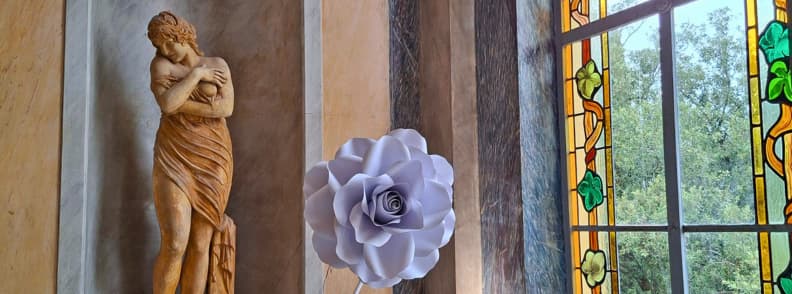
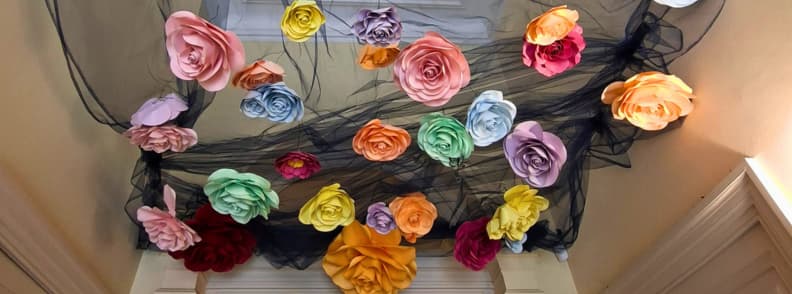
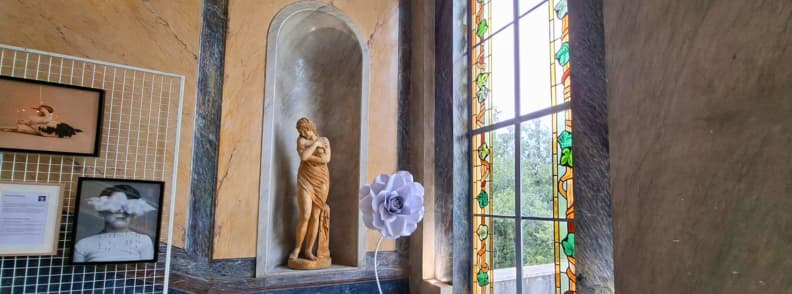
The villa became part of how I discovered the exhibition. Several times I noticed a work of art reflected in huge mirrors before turning toward the original. In another corner, a large flower artwork stood near a statue and the window by the staircase. The art, old interior, and daylight came together particularly well there. I photographed the corner from several positions because each angle changed the relationship between them.
The exhibition also encouraged wandering. I never identified a strict route, and I crossed some spaces several times. Certain rooms seemed organized around related ideas. One included images examining what people carry in their bags and cars. Other areas were closed to visitors, so my exploration stopped wherever the open doors stopped.
Villa Aurélienne looked good overall, but I noticed many areas of peeling plaster high in a few corners. I found them sad in a house with such elaborate interiors, even though they didn’t dominate the rooms.
What the festival adds to the experience
The 2026 festival brought together 47 artists after receiving over 200 applications from 27 countries. Entry was free, and the program covered staged portraits, photomontage, historical photographic processes, digital creation, underwater photography, pinhole photography, installations, and mixed techniques. Inside the villa, those categories became rooms full of images I wanted to inspect from close up, from across the room and, occasionally, from the wrong angle on purpose.
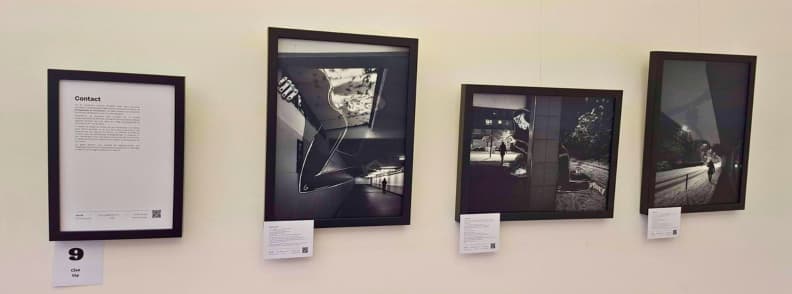
One series (number 9) rewarded exactly that behavior. From one position, I saw a dark, sad photographic scene. I shifted sideways and an oversized illustrated girl appeared, seeming to poke at the people in the image. The changing picture made me smile because the effect reminded me of the little image cards I found inside chocolate croissants as a child in the Balkans. Move the card, and another picture appeared. Sophisticated photographic exhibition meets childhood pastry surprise. My brain apparently files visual techniques wherever space is available.
Meeting artists in the rooms changed the atmosphere as well. Some stood near their displays and talked with visitors about their photographs. Artist information, prices, flyers, business cards, and occasional printed cards sat beside the displays. The villa remained fairly quiet, but never museum-silent. People talked, compared images, and stopped for explanations.
Voting added a small participatory element. At the entrance, we received free tickets where visitors could write the number of a favorite artist. A ballot box waited near the exit. There was barely a queue during our visit, so the process took little time.
The festival also included a Van Gogh sous la Mer photo studio, where visitors posed inside a Van Gogh-inspired underwater scene as part of the 2026 event. I watched an elderly couple have their photo taken among jellyfish, sunflowers, and a Van Gogh-style backdrop. A printed souvenir photo cost €2 during my visit, and I wanted one with Willy.
But we missed our chance! Before my husband returned with him from the park, the photographer went outside for an artist event. Willy had reached the point where waiting beside an unattended photo set ranked somewhere below almost every alternative available to a toddler. So we went to the playground instead.
This little failure also sums up why the location served our family well. I stayed inside longer while my husband took Willy outdoors to enjoy the park. The festival fascinated me, but Willy preferred moving around, and we both got to do what we wanted, thanks to my husband and the venue.
Villa Aurélienne history
Villa Aurélienne’s history starts in 1889, when Château Aurélien was built. James Hiscutt Crossman, heir to a wealthy London brewing family, commissioned the residence on a hill between the Reyran valley and Valescure. Fréjus heritage records attribute the design to Henri Lacreusette, an architect based in Saint-Raphaël who also designed villas and hotels around Saint-Raphaël, Valescure, and Saint-Aygulf.
Villa Aurélienne in Fréjus was built as a grand vacation residence. It was the sort of property wealthy French and foreign families were building around Fréjus and Saint-Raphaël in the late 19th and early 20th centuries, drawn in part by the mild winters of the Côte d’Azur. Seen in this context, the Fréjus Belle Époque villa tells a different part of the city’s story from the Roman monuments below the hill.
Crossman’s ownership was brief. He ran into financial trouble and appears to have gained little enjoyment from the expensive house he had commissioned. By November 1891, the property had passed to Madame Lepel-Cointet, a wealthy Parisian widow. She revived Château Aurélien after a period of neglect and turned it into a social address, receiving members of the Côte d’Azur’s fashionable circle. Henri Rouart, his son Eugène, and writer André Gide were among the artists and guests associated with the house during this period.
After Madame Lepel-Cointet sold the property around 1905 or 1906, Château Aurélien passed to Henri-Félix Gourio de Refuge.
The decisive name change came in 1913, when Parisian banker Charles Cambefort bought the estate and renamed it Villa Aurélienne. This name survived every owner who followed.
The property later passed through Cambefort’s family to the Schweisguth family. Jacqueline Schweisguth married Maurice Couve de Murville in 1932, decades before he served as French prime minister under Charles de Gaulle in 1968 and 1969.
Couve de Murville used Villa Aurélienne as a vacation home and particularly enjoyed caring for its trees. This detail seems fitting in a property where the surrounding park still has such a strong presence.
The City of Fréjus acquired Villa Aurélienne in 1988, ending roughly a century of private ownership. The municipality rehabilitated the building while retaining its late-19th-century character and adapted it for public cultural use. The villa, its park, and the small ornamental structures known in French garden history as fabriques were added to the supplementary inventory of historic monuments in 1989. The Parc Aurélien had already received protection as a natural site in 1964 and 1966.
The change from private residence to municipal cultural venue explains the Villa Aurélienne visitors encounter today. Its former reception rooms now host exhibitions, concerts, performances, conferences, and other cultural events. The villa’s history hasn’t ended with preservation behind a rope. People are still filling the rooms, only now most of us don’t need an invitation from a Parisian widow to enter.
Why the villa is called Aurélienne
The name Villa Aurélienne comes from the Via Aurelia, the ancient Roman road that passed near the property. The house began life as Château Aurélien in 1889, and when Charles Cambefort acquired it in 1913, the residence became Villa Aurélienne, keeping the link with the Roman route close to the estate.
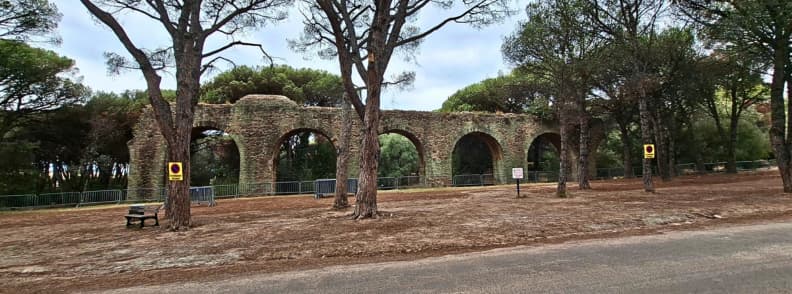
The Roman reference fits Fréjus. Ancient Forum Julii was an important Roman settlement, and you encounter its past across the modern city in the amphitheater, theater, and aqueduct remains. Sections of the Roman aqueduct are still stangind inside Parc Aurélien. I passed them near the playground, where two millennia of local history sit within sight of children climbing around on considerably newer structures.
The name also creates an interesting contrast with Villa Aurélienne architecture, which looks toward Renaissance Italy. Its southern facade has stacked galleries with marble and limestone columns, while the arched and rectangular openings known as serliennes repeat along the sides. Fréjus heritage authorities compare the facade with Andrea Palladio’s Palazzo Chiericati in Vicenza.
Architecturally, Villa Aurélienne is the Fréjus Neo-Palladian villa, with a rectangular plan organized around a peristyle courtyard covered by a glass roof. It is one of only two examples of a Palladian villa in France, the other being Château de Syam or Villa Palladienne de Syam, in the Jura, Bourgogne-Franche-Comté.
What architectural details to look for during your visit
Start outside, preferably from the south side. The stacked galleries of marble and limestone columns are the clearest expression of Villa Aurélienne’s Palladian influence. The resemblance with Andrea Palladio’s Palazzo Chiericati in Vicenza lies in the ordered rows of columns and open galleries, which help explain why my first thought on approaching the house was Italy.
Around the sides, look out for the serlienne, a Renaissance architectural motif combining a tall arched opening with lower rectangular openings beside it. The name comes from Italian architect Sebastiano Serlio. Once you recognize the pattern, you’ll spot versions of it across the villa’s lateral bays.
Inside, spend time in the central peristyle courtyard beneath the glass roof. Rooms on the ground floor and upper level surround this space, which might be why the interior seemed larger to me than I expected from outside. The daylight from above also changes your perception of the columns, balconies, and upper galleries. During the photography festival, I kept returning here even when I had already seen the art displayed nearby.
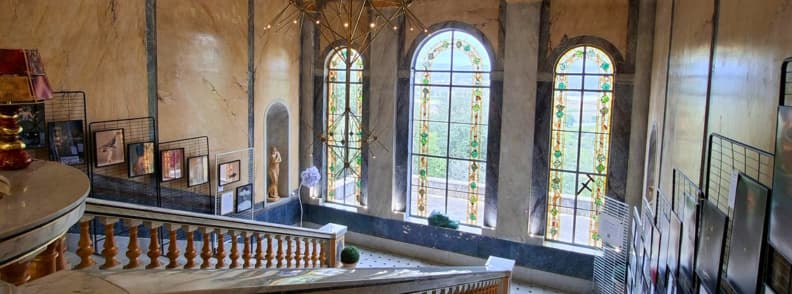
The northern side contains another detail worth slowing down for. A large turning staircase rises in two straight flights beside three tall bays facing the Estérel. This was one of my favorite parts of the house! The windows bring trees and daylight into an interior filled with stone, columns, and decorative surfaces, while the staircase gives several perspectives across the central space.
Some of the expensive materials are easy to miss when an exhibition fills the rooms. Watch the floors, fireplaces, and woodwork as well as the walls. The original decorations include black marble flooring, marble fireplaces, and fruitwood marquetry. Other surfaces use painted imitation finishes on walls, pillars, and columns. The mix is interesting because an expensive late-19th-century residence didn’t require every surface to be what it appeared to be.
The southern reception rooms deserve attention for their relationship with the grounds. They were arranged toward the terrace and garden, including a salon with an alcove. The architecture repeatedly directs your eyes outside, which is easy to appreciate after walking uphill through Parc Aurélien. The house rises above the surrounding vegetation instead of separating itself from the park.
Villa Aurélienne’s scale also hides in an oddly bureaucratic detail. The official heritage brochure records 79 taxable openings across a house of about 1,700 m². This number sounds like something invented by a tax inspector with plenty of free time, but inside it translates into what I remembered most clearly after the staircase: light!
Parc de la Villa Aurélienne
The Villa Aurélienne park covers 24 hectares around the house, with Mediterranean vegetation that has retained a relatively spontaneous character. Pines, cedars, strawberry trees, myrtle, cistus, and old roses grow across the property, together with rarer seasonal plants. This botanical garden represents 90% of the biotopes found in Fréjus.
The tall trees are what I like most here. Parc Aurélien has the scale I sometimes miss from the large parks in Bucharest. The vegetation becomes dense enough in places to give the park a forest character, despite being inside Fréjus.
The Villa Aurélienne gardens aren’t arranged as a single formal garden around the house. Parc Aurélien includes a botanical route, a jardin bouquetier traditionally devoted to flowers for cutting, and small ornamental structures known as fabriques. The botanical collection focuses on vascular plants from Provence-Alpes-Côte d’Azur, and protected species grow within the grounds. Picking plants is prohibited!
You don’t need botanical knowledge to enjoy the route. My attention was drawn by the height of the trees, the changing vegetation, and the way the villa gradually appears near the top of the hill. The main asphalt paths also make the climb easy with a stroller. Willy walked during our latest visit, but I had spent plenty of times pushing his stroller around this area when he was a baby!
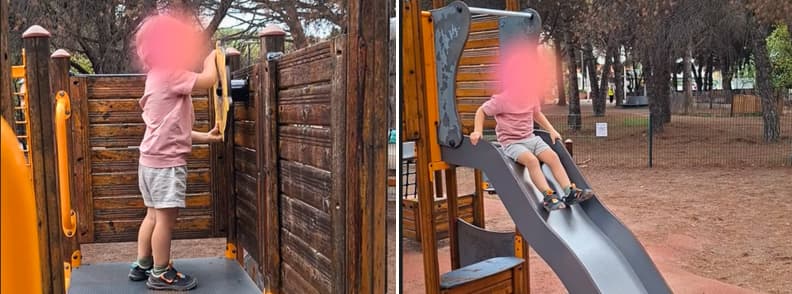
Families have a fenced playground lower in the park and our son was considerably keener on that after leaving the photography exhibition. The playground itself is nice, although the wooden equipment had a very strong treatment smell during our visit. Whatever had recently been applied to the timber was strong enough for me to notice immediately, which I didn’t appreciate in an area intended for children.
The playground also puts one of Fréjus’ oldest structures into an oddly ordinary setting. Remains of the Roman aqueduct stand directly across the path. Children play a few steps from masonry belonging to the ancient water system of Forum Julii. I’ll cover the aqueduct separately below because the surviving structures deserve closer attention.
Parc Aurélien also has the everyday rhythm of a neighborhood park. I saw people exercising, parents walking with children, and plenty of dogs. Dogs are officially allowed in Parc Aurélien, provided they’re kept on a leash, although some of the dogs we’ve seen weren’t wearing one. Still, the rule is worth knowing and respecting before arriving with your pup, especially since the grounds cover a substantial area and have protected vegetation.
Roman aqueduct remains in the park
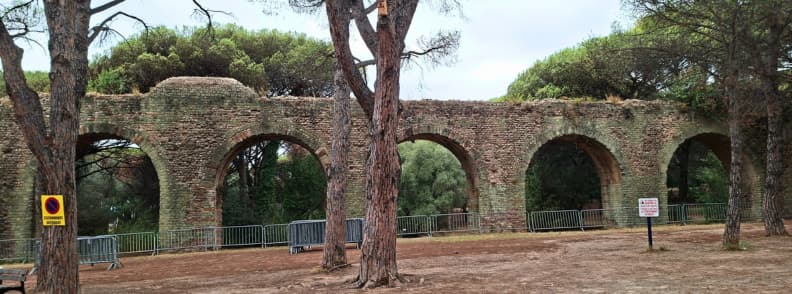
The Roman aqueduct in Fréjus once carried water about 42 km from springs at Montauroux and Mons to the Roman city of Forum Julii. Built in the 1st century AD, the system crossed a total elevation difference of 481 meters. Much of the channel ran underground, with arches carrying the water across valleys and lower ground.
Parc Aurélien marks an interesting point along its route. Here, the aqueduct emerged from the ground before continuing toward the Sainte-Croix plain in a long sequence of 86 arches. Nine arches survive within the park and another ten remain on the plain.
I first noticed the remains directly across the path from the children’s playground. It’s an odd pairing, but in a good way. On one side, children are climbing and running around. On the other, Roman masonry belongs to an infrastructure system built almost 2,000 years earlier.
But what you see today includes substantial restoration, especially work carried out in 1941 using small blocks of green sandstone. Even the reconstructed vault doesn’t reproduce the exact dimensions of the ancient water channel, or specus. Knowing this helps separate the surviving Roman structure from later repairs without considering every visible stone as ancient.
The aqueduct is also a good reason to pair a visit to Villa Aurélienne with the Roman sites elsewhere in Fréjus. The amphitheater, Roman theater, Porte des Gaules, and scattered aqueduct remains belong to ancient Forum Julii, while the villa dates from 1889. At Parc Aurélien, those two periods occupy the same walk, with Roman arches below and a 19th-century residence farther uphill among the trees.
How to visit Villa Aurélienne
Plan the park and the villa as two separate visits sharing the same address. Parc Aurélien opens daily, while access inside Villa Aurélienne depends on guided tours, exhibitions and cultural events.
Villa opening hours vs park opening hours
Villa Aurélienne opening hours change with the cultural calendar. The interior opens during guided tours organized on specific dates between 10 am and 12 am by the Tourist Office and during temporary exhibitions.
Special events can replace the ordinary exhibition hours completely. I visited during the 2026 Festival de la Photographie Surréaliste et Créative, when the villa opened from 10 am to 7 pm from 26 September to 3 October, then from 10 am to 5 pm on 4 October. In other words, check the event program when you’re visiting for a specific exhibition.
Villa Aurélienne park opening hours follow a separate schedule. Winter hours are from 7 am to 6 pm. In summer, the park is open from 9 am to 7 pm on weekdays and from 9 am to 6 pm on weekends. Entry to the park is free.
Weather adds another variable. Parc Aurélien closes during strong winds. This is especially relevant on the Côte d’Azur, where a sunny forecast often comes with a strong Mistal. A closed park also removes access to the villa, so check local conditions before driving across the Var for a scheduled event.
Villa Aurélienne Tickets, free access, and guided tours
Villa Aurélienne tickets depend on what you’re visiting: a temporary exhibition, a special event, or a guided heritage visit.
Special events publish their own admission rules. The 2026 Festival de la Photographie Surréaliste et Créative was free throughout its nine-day run, including access to the photography displays inside Villa Aurélienne.
The Villa Aurélienne guided tour in Fréjus is the paid option for visitors who want the history and architecture explained by a guide. Villa Aurélienne tickets are €8 for adults, €6 for ages 12 to 26 and free for children under 12. The tour is in French, and the meeting point is at the Fréjus Tourist Office before continuing to the villa.
The official Villa Aurélienne guided tour booking page takes reservations online, and places are limited. I’d book ahead, since guided access is only on selected dates and very limited hours. For groups, the Tourist Office can also arrange private visits on request.
Parc Aurélien is free to enter. You don’t need a ticket to walk through the grounds, follow the botanical paths, see the Roman aqueduct remains, use the playground or walk around the exterior of Villa Aurélienne. You also have free parking inside the park.
Accessibility
Villa Aurélienne accessibility information mentions wheelchair access with assistance and the option to drop a passenger directly in front of the site. Visitors who need vehicle access closer to the villa should speak with the guard at the entrance to Parc Aurélien.
During my visit, I also saw parking closer to the villa for disability card holders. The regular park paths I used were paved and easy with a stroller, but the distance from the main parking area still adds an uphill walk.
A lift is available at Villa Aurélienne. I also saw an accessible toilet on the ground floor during my festival visit, alongside regular toilets on both levels.
Accessibility arrangements sometimes vary with exhibitions, concerts, and other events. It doesn’t hurt to check with the Fréjus Tourist Office before a visit if you need step-free access, close vehicle access, or specific assistance, especially since the villa opens according to its cultural program instead of operating as a daily museum.
How to get there and where to park
I found getting to Villa Aurélienne in Fréjus easy by car. The villa is inside Parc Aurélien, north of the historic center, at 85 Avenue du Général d’Armée Calliès, 83600 Fréjus, in the Var department. Drivers arriving via the A8 use exit 38 for Fréjus and Saint-Raphaël.
The Villa Aurélienne Fréjus address and parking details are pleasantly simple once you reach the park. Free parking is available inside Parc Aurélien, and I found the main parking area spatious even during our festival visit. I hadn’t known about this parking during the time when Willy had physical therapy across the road. Back then, I parked at the nearby supermarket because the tiny parking areas around the medical offices filled quickly.
GPS helped on our first drive into Parc Aurélien, although the entrance itself was clear once we reached Avenue du Général d’Armée Calliès.
Public transportation brings you into the Saint-Lambert area, served by bus lines 02, 09, 11, 14 and 16 from Fréjus bus stations. Check Le Bus Estérel Côte d’Azur before departure, especially on weekends or outside the summer timetable.
The walk from Fréjus train station to Villa Aurélienne is 2.4 km long. The final part heads uphill through Parc Aurélien, so allow extra time if you’re walking with small children or carrying photography equipment.
Driving remains the easiest option in my experience, especially for a family visit. Parking inside the park leaves you with a pleasant uphill walk through the trees before the villa appears near the top, instead of starting your visit with a hunt for a space on the surrounding streets.
Fréjus Festival de la Photographie Surréaliste et Créative
The photography festival was the reason I finally went inside Villa Aurélienne after knowing the park for years. The rooms become exhibition spaces for photographers from France and abroad, while the old staircases, mirrors, tall windows, and central gallery stay firmly in view. I loved this combination. Some images gained something from their surroundings, especially when I first caught them reflected in a mirror or framed by one of the villa’s windows.
What this Fréjus festival is
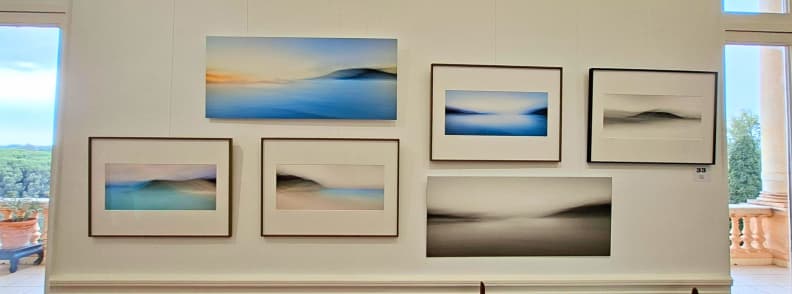
The International Festival of Surrealist and Creative Photography began in Fréjus in 2019. Conceptalia now runs the event in partnership with the City of Fréjus, with Villa Aurélienne as the exhibition venue. The 2026 edition received 210 applications from 27 countries and selected 47 artists.
Surrealist photography takes recognizable reality and deliberately interferes with it. A photographer might stage an impossible scene, combine separate photographs, alter scale, place a person somewhere unexpected, or manipulate an image until everyday logic can’t compute. The result still begins with photography, but documentary accuracy isn’t the aim.
Experimental photography pushes in another direction by playing with how an image is produced. The Fréjus surrealist photography festival includes processes such as photomontage, digital creation, underwater photography, pinhole photography, older photographic techniques, and mixed media. A photograph might depend on post-processing, an unusual camera method, physical intervention, or several techniques used together.
Creative photography is the broadest category here. The label leaves room for staged portraits, conceptual series, and manipulated images without forcing every photographer into a strict surrealist definition.
As a creative photography festival in France, this Fréjus event focuses entirely on surrealist, experimental, and creative photography and such dedicated European events are rare. Surrealism provides the center, while individual photographers interpret the idea in markedly different ways.
I appreciated this range during my visit. I didn’t need an explanation of photographic theory before enjoying the exhibition. Some pieces were immediately funny or strange. Others needed a second look before the idea became clear. Several artists were present beside their displays and talked with visitors, which turned a quiet walk through a beautiful old villa into something much less formal than a conventional gallery visit.
What I saw at the festival
I went to the festival expecting the photography to also interest my son, but my toddler had a different agenda. He wanted to explore the building, so my husband eventually took him outside while I continued the visit alone. The quieter second half of my visit gave me time to stop, read the artists’ notes, and go back to photographs I had rushed past earlier.
There was barely any queue, and the rooms never seemed crowded during my late-morning visit. Visitors talked quietly, and some artists stood near their displays explaining their ideas or specific art works. The atmosphere was informal enough to wander at your own pace. I never found a strict route through the villa, so I occasionally returned to some rooms.
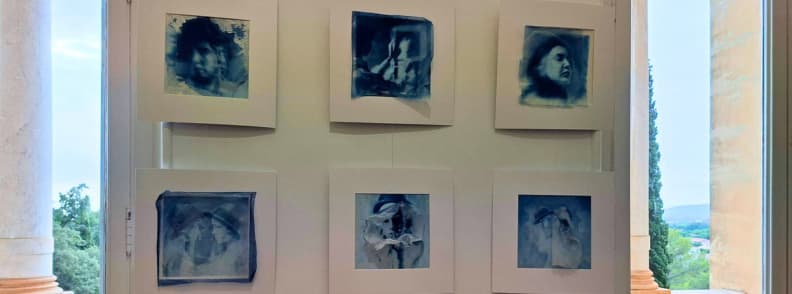
My favorite artist was number 21, JJ Jordan. His display included fragmented blue cyanotype portraits, with faces partly obscured, softened or broken across the surface. Jordan uses alternative photographic processes including cyanotype alongside layering and physical intervention in photographic images. I kept returning to those blue portraits, which explains why number 21 eventually went onto my public-vote ballot.
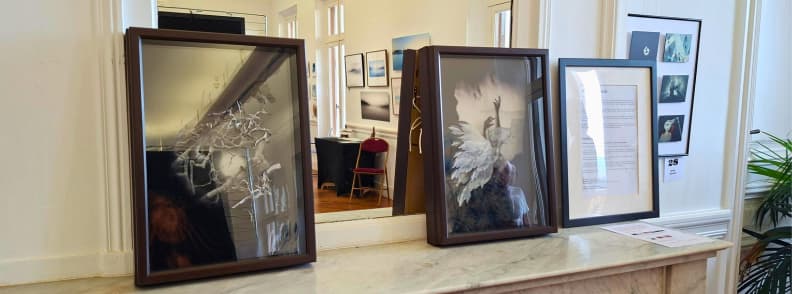
Number 47, Yuri Seki, was another favorite. Her IKEI series explores awe through ideas connected with animist sensitivity in Japan. Mountains, trees, stones, fire, water, and wind are presences carrying an invisible spiritual dimension. Her hand motif represents a trace of human presence reaching toward something beyond ordinary sight.
Number 9, Cloé Vié, completed my top three. Her Contact series combines black-and-white photography with illustration. She inserts an illustrated version of herself into photographs containing anonymous figures. The intervention changes her position from observer behind the camera to a visible participant attempting contact with the people she photographed.
These are the pieces whose appearances shifted as I changed my viewing angle. From one position I saw a black and white gloomy image. Moving sideways, a playful oversized illustrated girl appeared, poking into the scene. Her art made me smile.
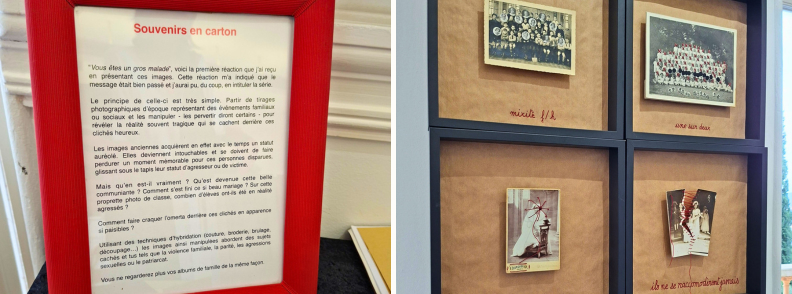
I also found interesting Chambre Six’s Souvenirs en carton, although I don’t remember the number. The artist took old family and social photographs and physically altered them through sewing, embroidery, burning, and cutting. The series challenges the almost sacred status family photographs acquire with age. Weddings, communions, and school pictures preserve smiling public versions of the past, while abuse, domestic violence, sexual assault, patriarchy, and silence might remain outside the frame. Chambre Six, the artist name used by Xavier V., deliberately disrupts those reassuring images to expose what a family album leaves unsaid.
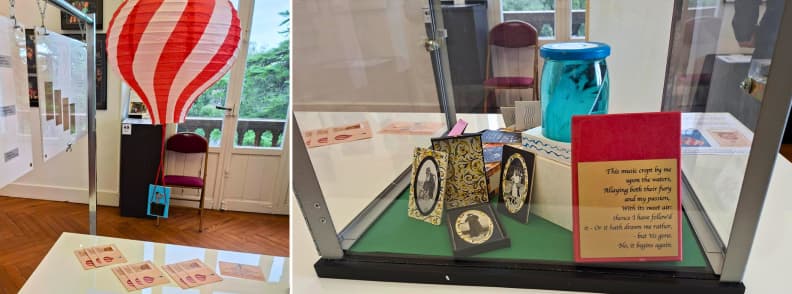
The festival also used Villa Aurélienne well. One of my favorite corners had a large flower beside a statue near a staircase window. I would happily visit Villa Aurélienne without an exhibition, but photography filling the rooms gave the old house another layer to explore.
Artists, exhibitions, workshops, and events
The main exhibition formed only part of the 2026 program. The festival also scheduled talks, creative workshops, artistic demonstrations, photography outings, artist meetings, studio sessions, audiovisual projections, and an awards ceremony across nine days. The official program also included Le Monde dans la poche, a display of contemporary photographic calling cards from the National Museum of Photography in Brescia, Italy, presented by Roberto Menardo.
Several events moved beyond looking at framed photographs. The program included a full-day photography outing along the coastal path, another day meeting artists from the Fréjus art circuit, wood-turning demonstrations by Lionel Gisquet, and three-dimensional painting demonstrations by Dana Robinson. Two staged photography studio sessions with a professional model were scheduled on 29 September, led by Fabien Licata. Those sessions required registration and cost €50.
Talks on photographic creation and color and an audiovisual projection of Portraits hybrides by the Génération Azur IA collective added another side to the festival. The final afternoon ended with the festival awards, following a week in which visitors also voted for their favorite photographer.
One activity I nearly tried was Van Gogh sous la Mer, a staged photo studio with an underwater Van Gogh theme. During my visit, a printed souvenir photo cost €2. I saw an elderly couple posing against the jellyfish, sunflowers and Van Gogh-inspired background, and decided I wanted a family version. But by the time my husband returned with our increasingly restless toddler, the photographer had stepped outside for another festival event.
Festival dates, opening hours, and admission
2026 FESTIVAL UPDATE, EDITION ENDED 4 OCTOBER 2026
The Fréjus photography festival dates for 2026 were 26 September to 4 October at Villa Aurélienne. The eighth edition lasted nine days.
The Fréjus photography festival opening hours for 2026 were 10 am to 7 pm from 26 September to 3 October. On Sunday, 4 October, the festival opened from 10 am to 5 pm.
The Fréjus photography festival was free in 2026. Admission to the main exhibition at Villa Aurélienne carried no charge throughout the festival. Selected activities had separate registration rules and fees, including the €50 professional-model studio sessions.
Dates, daily hours, and individual activities change with each edition. Check the official festival program before planning a future visit, especially if a workshop, talk, or photography outing is your main reason for going.
Disclosure: Some of the links on this page are affiliate links. This means that at no extra cost to you, The Travel Bunny will earn a small commission if you click through and make a purchase. Thank you!
What to do near Villa Aurélienne
Villa Aurélienne can be added to a Fréjus day, especially alongside Roman heritage. Among things to do in Fréjus, I’d head next to the historic center and the Roman amphitheater, linking the aqueduct fragments in Parc Aurélien with the larger story of ancient Forum Iulii. My Fréjus travel hub covers the wider area without squeezing every stop into one afternoon.
Among the best Fréjus attractions, the Roman sites deserve priority after Villa Aurélienne. Fréjus museums add useful context too. For example, the Archaeological Museum displays a model of Roman Forum Iulii, the Carrara-marble two-faced Hermes, and the Panther mosaic.
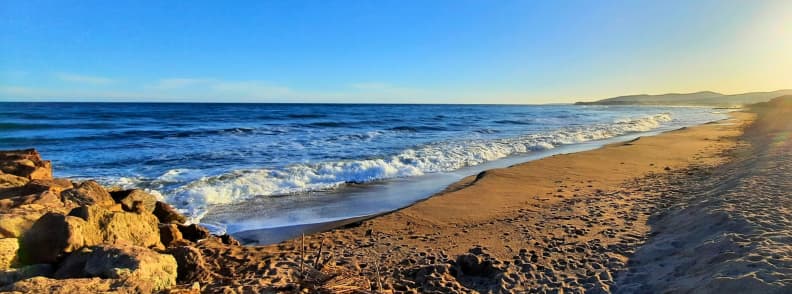
For a change from ruins and exhibition rooms, continue toward Port-Fréjus, Base Nature François Léotard, and the beach. Base Nature puts a large seaside park, sports areas, and Mediterranean sand in the same part of town, so the afternoon shifts easily from sightseeing to walking or swimming.
A Cannes to Fréjus day trip fits comfortably into one day. SNCF schedules show direct TER journeys from Cannes to Frejus from around 34 minutes, leaving enough time for Villa Aurélienne, Roman Fréjus and a late walk near the sea.
A Nice to Fréjus day trip requires a longer stretch on the train. SNCF schedules put the quickest train trip from Nice to Frejus at 1 hour 11 minutes. I’d allocate for Fréjus the full day from Nice, especially if Villa Aurélienne is paired with the historic center and Roman sites instead of racing back after the exhibition.
Villa Aurélienne FAQ
The park and Villa Aurélienne follow different access schedules, which explains most of the planning before a visit. Parc Aurélien opens daily under normal weather conditions, while the house welcomes visitors during temporary exhibitions, cultural events and guided tours. Here are the practical details I’d want before walking up the hill, including entry, parking, accessibility, dogs and the photography festival.
Is Villa Aurélienne free?
Villa Aurélienne in Fréjus is free to visit during temporary exhibitions, and access to Parc Aurélien is free. A heritage tour of the villa has a separate charge. Guided-tour prices are €8 for adults, €6 for ages 12 to 26, and free for children under 12.
Is the villa interior open to visitors?
The villa interior opens during temporary exhibitions, scheduled guided visits and cultural events. Villa Aurélienne doesn’t operate like a museum with unrestricted daily interior access. Ordinary interior visits are limited to temporary exhibitions and Tourist Office guided visits, so check the cultural calendar before making a special trip for the house itself.
When is Parc Aurélien open?
Villa Aurélienne Fréjus opening hours differ between the park and the house. Parc Aurélien is open daily in winter from 7 am to 6 pm. Summer hours are 9 am to 7 pm on weekdays and 9 am to 6 pm on weekends. Beware of park closures during strong winds!
Are guided tours available?
The Fréjus Tourist Office schedules Villa Aurélienne guided tours in Fréjus on selected dates. The heritage visit lasts two hours and is conducted in French. Places are limited, so advance booking is worthwhile. The meeting point is the Fréjus Tourist Office before departure for the villa. Groups also have an on-request option.
Is Villa Aurélienne accessible?
Villa Aurélienne accessibility information mentions wheelchair access with assistance, passenger drop-off in front of the site, and a lift inside the villa. I also noticed an accessible toilet on the ground floor during my festival visit.
Visitors needing vehicle access closer to the building should speak with the guard at the Parc Aurélien entrance. The villa stands uphill from the main parking area, so the closer vehicle access is worth arranging if the climb presents a problem.
Where is Villa Aurélienne?
Villa Aurélienne is inside Parc Aurélien, north of central Fréjus. The official Villa Aurélienne Fréjus address and parking listing is 85 Avenue du Général d’Armée Calliès, 83600 Fréjus.
Where do I park?
Free parking is available inside Parc Aurélien. I found the main parking area generous during the photography festival, followed by an uphill walk through the trees to the villa. I also saw closer spaces for disability card holders. Official accessibility guidance directs visitors needing vehicle access near the house to the park guard.
How long should I stay at Villa Aurélienne?
My answer to how long to stay at Villa Aurélienne is around two hours when the house has an exhibition and you also want a walk through Parc Aurélien. My festival visit fitted comfortably into roughly two hours without rushing. A dedicated Tourist Office heritage tour also lasts two hours.
A park-only visit depends on how much walking you want. I wouldn’t plan half a day just around Villa Aurélienne unless a festival, concert, or another event fills the schedule.
Are dogs allowed in Parc Aurélien?
Dogs in Villa Aurélienne park are allowed on a leash. Dogs are also permitted inside Villa Aurélienne while leashed, although special events sometimes impose different rules. Check event-specific information before bringing a dog into an exhibition or performance.
When is the photography festival?
The eighth International Festival of Surrealist and Creative Photography took place at Villa Aurélienne from 26 September to 4 October 2026. The festival takes place as a distinct annual event, so future dates need confirmation from the official program once announced.
Is the Fréjus photography festival free?
The Fréjus photography festival was free in 2026. Admission to the main exhibition at Villa Aurélienne cost nothing throughout the edition. Some optional activities carried separate charges, including the professional-model studio sessions priced at €50 in 2026. Future editions set their own program and activity fees.
My Thoughts on Villa Aurélienne
I’d recommend visiting Villa Aurélienne to travelers spending a weekend in Fréjus, especially anyone interested in architecture, photography, local history, or smaller cultural venues.
The best visit combines the villa with an exhibition, concert, or festival. Villa Aurélienne has enough architectural detail to hold my attention on its own, but art filling the rooms gave me reasons to slow down, look into corners and notice the building itself.
Families have another reason to go. Parc Aurélien adds space for a walk, a playground, and Roman aqueduct remains, so a child bored by an exhibition has somewhere else to go and other things to look at. Mine demonstrated this arrangement with impressive efficiency. The paved paths also make the park easy to explore with a stroller.
I’d skip a special trip across the Côte d’Azur just for the park. Parc Aurélien is pleasant, green, and useful if you’re nearby, but I don’t think the park alone is a major destination. The inland viewpoint didn’t impress me much either. Pair the park with Roman Fréjus, the villa, or another nearby stop and the visit becomes much better.
The villa deserves some criticism too. A few patches of peeling plaster caught my eye inside Villa Aurélienne, especially higher up and around corners. The building still looks good overall, but seeing visible deterioration in such an interesting historic interior saddened me. I hope those areas receive proper attention.
I’d return, and the photography festival gave me the reason. I enjoyed the exhibition enough to start thinking about the next edition before leaving the villa. I’d also like to see Villa Aurélienne during another cultural event, when different art and different light change how the rooms appear.
About the Author

Bonjour! I’m Mirela Letailleur, the Romanian-born travel writer behind The Travel Bunny, based in Provence-Alpes-Côte d’Azur near Fréjus. I write firsthand Fréjus and French Riviera travel guides shaped by local life, repeat visits, and detailed research into regional history, culture, events, transport, and family travel.
I’ve known Parc Aurélien since my son was a baby, and I finally explored Villa Aurélienne Fréjus inside during the 2026 International Festival of Surrealist and Creative Photography. My guide combines years of familiarity with the park, my own Villa Aurélienne visit, festival experience, and current information from Fréjus heritage and tourism sources.
After visiting Villa Aurelienne in Frejus, check out these local guides on The Travel Bunny
Fréjus International Air Festival. My Firsthand Guide to the Fréjus Kite Festival
Les Étangs de Villepey. Complete Visitor Guide to Saint-Aygulf, Fréjus
Hike to Étang d’Aubert & Col Aubert. Guide to Estérel’s Pink Water Lilies