
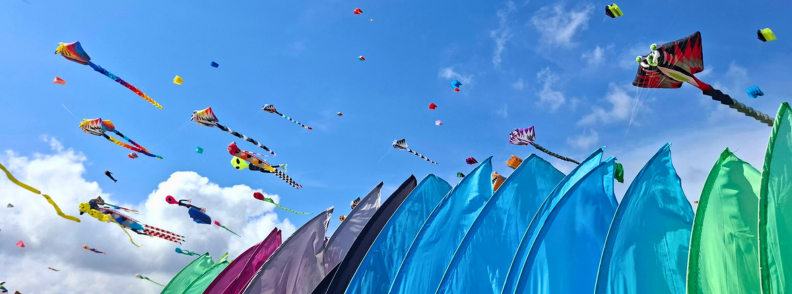
The Fréjus International Air Festival is a free French Riviera kite festival held at Base Nature François Léotard, beside the Mediterranean in Fréjus. The 2026 edition was from 18 to 20 September, from 10:00 am to 6:00 pm, with giant kites, Sportkite displays, family activities, and international kite pilots spread across the enormous former air base.
I’ve visited this Var kite festival twice, first in September 2025 and again on 20 September 2026, so this guide combines current official information with the practical details I learned on the ground.
My first Fréjus kite festival visit fell on my birthday. I came with my husband, our one-and-a-half-year-old son, my mother-in-law and my niece. A year later, my husband and I returned with our now two-and-a-half-year-old. William stared at the giant whale, loved the marine-animal kites, and decided several triangular ones were carrots. Professional kite design is open to interpretation when you’re two.
Festival International de l’Air Fréjus Guide
The English name creates some confusion. Festival International de l’Air or International Air Festival Fréjus sound like names for a conventional aircraft show, but FIA Fréjus centers largely on kites, wind sports, and aerial displays. The official event page places the event under aerial sports, kite flying, free flight, and creative leisure activities. In plain English, this is an annual kite festival in Fréjus, France, with the scale and international participants of a major kite flying festival. It’s not a traditional military airshow, despite its location. (More on that later!)
This Festival International de l’Air Fréjus guide from The Travel Bunny focuses on the details that affected our two visits: where we parked, when the kites were actually in the air, crowd bottlenecks, long activity queues, uneven ground with a city stroller, scarce shade, inadequate toilets, and the picnic that saved us a long wait for food with an impatient toddler. What follows is my complete guide to the Fréjus International Air Festival, especially useful for first-time visitors, families and expats planning a day at this Côte d’Azur festival.
Festival International de l’Air at a Glance
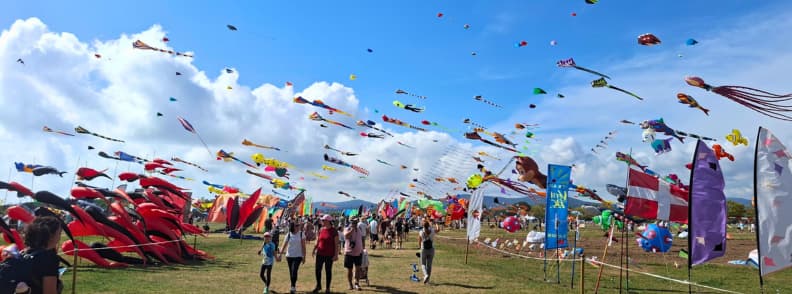
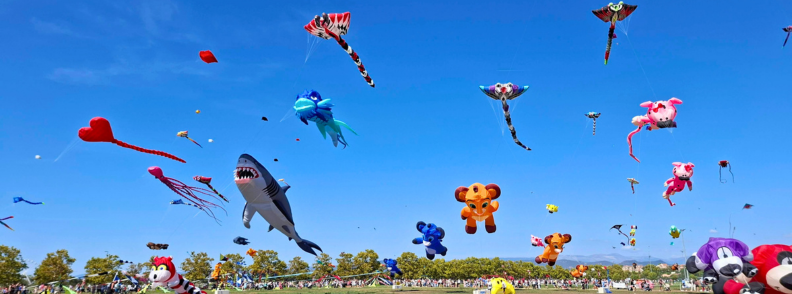
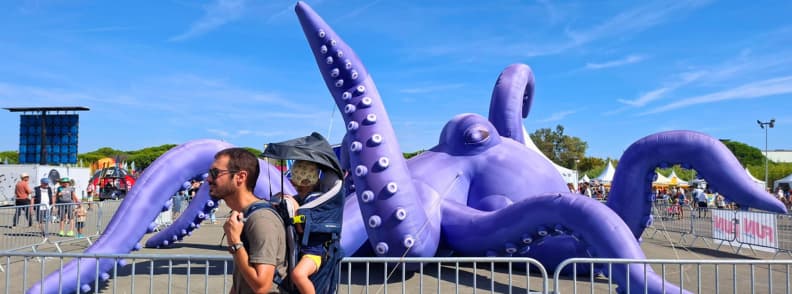
In 2026, the Festival International de l’Air à Fréjus took place from Friday 18 to Sunday 20 September, with free entry from 10 am to 6 pm each day. Its location is always the Base Nature François Léotard, a 135-hectare park beside the Mediterranean, with enough open space for giant manta rays, whales, and octopuses to float high above the crowds.
For a free festival in Fréjus, the scale is considerable. The 2026 Festival International de l’Air Fréjus program included giant XXL kites, the French Sportkite Championship and International Open, Cloud Kisser, a Drone Zone, children’s workshops, concerts, and food areas. The FIA Fréjus program had activities across several zones, so what happens at the Fréjus air festival changes as you walk. One field held synchronized sport kites tracing tight patterns, another drew eyes upward toward huge single-line creations, then a queue formed around an activity a child had spotted before the parent had time to assess the wait.
The Fréjus kite festival 2026 program spread across three days, but for the main attraction there was no timetable, you just had look up. On my Sunday visit, the giant kites started rising one by one around 12:30 pm, after an unexpectedly sparse sky before noon. Once airborne, the marine animals became the easiest landmarks. My son watched the whale in complete awe, while I was happy to see the manta rays again after 2025. The full weekend program schedule for the Fréjus kite festival added workshops and demonstrations around those displays, but families with toddlers should decide early how much time they want to surrender to queues.
The Fréjus Tourism website is the main place to check for the current Festival International de l’Air information. The Fréjus Tourist Office listing also includes contact details if you need to confirm something before your visit.
For the Fréjus air festival map and access, enter Base Nature François Léotard in your navigation app. The François Léotard Base Nature has a large free parking area, and the festival page adds temporary event parking farther inside the site. Our own experience was less tidy. We parked near the train station in 2025 and near the police station in 2026, with the second drive slower but followed by a shorter walk.
Things to do at the Fréjus kite festival extend well beyond watching giant shapes drift over the field. In 2026 there were Sportkite competitions, drone and flight activities, children’s workshops, concerts and places to eat, though I’d still put the kites first with a young child. What to see at Base Nature François Léotard becomes obvious from a distance once the sky fills. The free kite festival has plenty happening on the ground, but the simplest part remains the best: finding a clear patch of field, looking up, and waiting to see what the wind lifts next.
What Is the Festival International de l’Air?
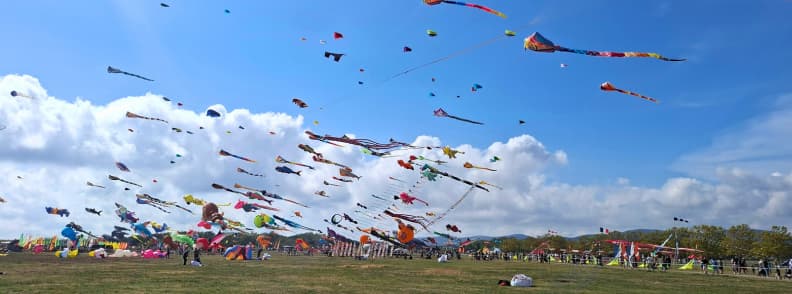
The Festival International de l’Air in Fréjus is an annual, free kite-centered event held at Base Nature François Léotard beside the Mediterranean. The 2026 program added giant XXL kites, Sportkite competition, a Drone Zone, children’s workshops and concerts, so what happens at the Fréjus air festival extends well beyond standing in a field watching one kite at a time.
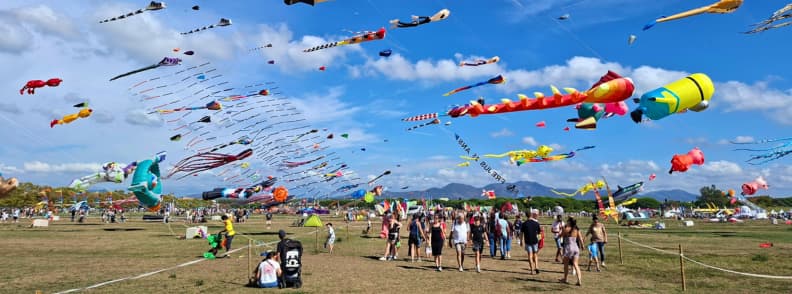
The Base Nature kite show is still the part you notice first. On my 2026 visit, all sorts of kites floated over the field, and my two-year-old stared at the “animals in the sky” in complete awe. The Fréjus beach kite display is on the broad Base Nature grounds beside the beach, leaving the giant creations plenty of open sky above the crowd, and offering the sea breeze to stay afloat.
This French Riviera kite festival has an international cast in the air and a much more local crowd below. I heard mostly French around me, along with some Italian and Romanian. As a free festival in Fréjus, it also attracts people who come for a few hours with children, a picnic blanket, and no grand plan beyond looking up.
What makes the Fréjus kite festival unique has less to do with a specifically Fréjus identity than with the sheer amount of space available. I’ve attended smaller events at the Base Nature, and FIA occupied a larger part of the site and drew heavier crowds. I don’t think the concept itself depends on Fréjus. Give those kites another enormous, breezy field, and they would still fly. Base Nature has the Mediterranean, the beach, pine trees, and the scale needed for one of the larger Fréjus outdoor festivals. This coastal setting also places it naturally among Fréjus beach events, even though the main flying areas are off the sand.
Things to do at the Fréjus kite festival extend beyond the giant displays, while what to see at Base Nature François Léotard starts with whatever the wind has managed to lift overhead. The annual kite festival in Fréjus, France combines spectacle, sport, family activities, and an international group of kite flyers in one sprawling site.
Is It an Airshow or a Kite Festival?
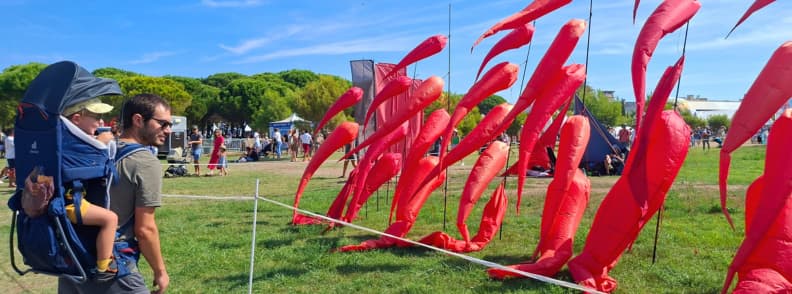
It’s a kite festival. The English translation, International Air Festival, sounds as though jets should be roaring over Fréjus, but the main spectacle comes from giant and acrobatic kites. The official program centers on kite flying, Sportkite competition, free flight activities, drones and flight simulators.
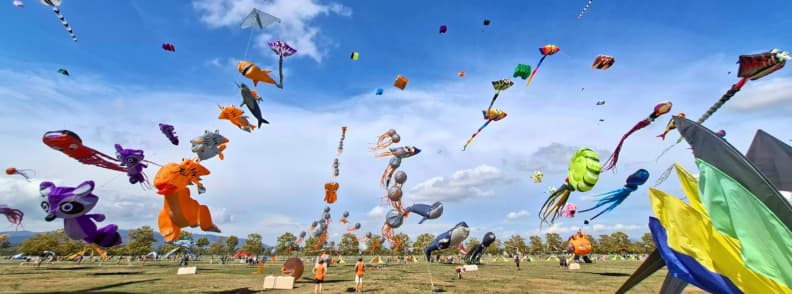
The scale of this air festival in France becomes clear once the wind cooperates. During my visits, enormous kites floated above Base Nature François Léotard, sometimes high enough to be visible well before we reached the festival grounds. This giant kite festival provides the spectacle most visitors remember, especially children. My two-year-old was transfixed by the whale, and several triangular kites were confidently identified as carrots, which he adores!
The faster displays happen closer to the ground. Fréjus acrobatic kites include two-line, four-line and multi-line Sportkites flown individually, in pairs and in teams, with synchronized routines and technical maneuvers. These Fréjus aerial acrobatics come from kite pilots, not aircraft pilots. The competitive acrobatic kite show takes place alongside the giant single-line creations.
The Fréjus International Air Festival is an international kite festival with several air-related activities around it. The 2026 program included the FIA Drop Zone with drones and a flight simulator, while the FFVL area covered free-flight activities. This aerial show in Fréjus stretches beyond kites, although the latter remain the visual center of the festival.
When Is the Next Festival International de l’Air?
This annual kite festival in Fréjus, France is one of the larger Fréjus events in September.
At this time, the next edition has no confirmed dates yet. The Festival International de l’Air 2027 dates haven’t appeared on the Fréjus Tourism calendar, but save this article and return at the end of spring to check for updates.
2026 Dates, Hours, and Free Entry
The Festival International de l’Air Fréjus dates 2026 were Friday 18 to Sunday 20 September, with the festival open from 10 am to 6 pm each day at Base Nature François Léotard. Admission was completely free for all three days, including the giant kite displays, Sportkite competitions, and family entertainment.
These generous Fréjus air festival opening hours leave plenty of time for a short visit, but I wouldn’t rush to Base Nature to see kites at 10 am. We arrived before noon on Sunday and initially found surprisingly little in the air. Between about 12.30 pm and 1 pm, the giant kites began rising one by one. I recommend arriving early enough to avoid the worst parking traffic, then plan to stay through lunchtime and into the afternoon.
The Fréjus kite festival 2026 program included giant XXL kites, Sportkite competitions, the Drone Zone, workshops, concerts, and other activities spread across the site. We skipped the long activity queues with our two-year-old and concentrated on the kites, which gave us plenty to watch without planning the day around a fixed timetable.
Free parking at the Festival International de l’Air included the regular large Base Nature parking area plus temporary event parking farther inside the site. In practice, the roads around the festival were slow when we arrived in 2026, so we parked near the police station and walked about ten minutes. Free parking is useful only if reaching it doesn’t eat half your available time.
What Changed from the October Editions?
For years, the Festival International de l’Air was associated with late October. The 2024 edition was scheduled for 26 and 27 October, while the 2025 festival moved to 20 and 21 September and the 2026 edition followed on 18 to 20 September. This kite festival in France shifted from October to September by 2025.
Fréjus Tourism hasn’t published an explanation for why the Fréjus air festival moved to September, so the reason remains unclear. My guess is the weather. September on the French Riviera is usually warm enough for long days outside, while October weather becomes less stable, which is an obvious concern for an event built around wind conditions and things staying safely in the air. Moving the festival earlier also places it before the quieter French Riviera off season, when beach days and outdoor events are part of life on the coast.
I prefer the kite festival September timing as a visitor. On both of my visits, the weather was sunny and windy enough to spend hours outside, with hats, sunglasses and sun protection still earning their place in the bag. The old kite festival October program would have carried a greater chance of cooler or wetter conditions, although autumn weather on the coast isn’t necessarily bad.
Among Fréjus autumn festivals, FIA is now scheduled closer to the tail end of summer than deep autumn. We could even call it a Fréjus Indian summer festival.
My Experience at the Fréjus Kite Festival
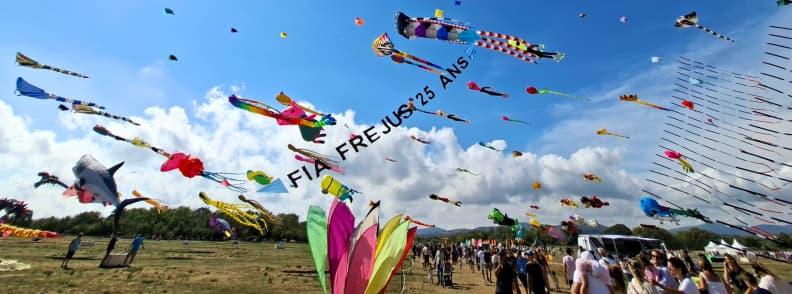
I’ve been to the Festival International de l’Air twice, in September 2025 and again in September 2026. My first visit happened to fall on my birthday, with my husband, our one-and-a-half-year-old son, my mother-in-law and my niece. A year later, we returned with William at two and a half. This Fréjus air festival review comes from visiting the event at two different stages of toddler life, which turned out to be useful research in ways I hadn’t planned.
The first year we brought a city stroller. The second time we chose a hiking carrier, packed a picnic, and stayed longer. These two visits changed what I would recommend to another family, especially around walking, queues, food, and how much of the program is realistic with a small child.
My Fréjus kite festival family guide is based on what we actually managed to do, not on everything listed in the program. Our toddler has decided waiting in line is a personal insult, so we avoided queuing anywhere else besides the toilets.
What stayed with me both years were the giant marine kites. I recognized the manta rays from our first visit, while William was completely absorbed by the whale in 2026. Around us were mostly French families, with some Italian visitors and vendors, plus Romanian voices I caught a couple of times. The pilots and participants gave the event its international character.
Fréjus Air Festival review from a visitor: What makes the Fréjus kite festival unique for me is the combination of huge flying space, giant kites overhead, and a crowd that makes this look like a local family outing.
By 2026, FIA Fréjus had reached its 26th edition. This explains some of the scale, but longevity hasn’t eliminated the rough edges. My Fréjus air festival first-hand experience includes things I liked enough to return for and several practical annoyances that official listings understandably spend less time discussing.
Is the Fréjus kite festival worth visiting? For families, locals, expats and anyone already spending time in eastern Var or the Côte d’Azur, I think so. I’d drive an hour for it, and we already plan to return. But I wouldn’t book a flight to France solely for the festival, and anyone who dislikes crowds or expects a highly serviced event will have a different day.
The next parts of this complete guide to the Fréjus International Air Festival compare my 2025 and 2026 visits before getting into the practical details a Fréjus International Air Festival first-time visitor will actually need.
My First Visit in 2025. Birthday Kites and a Toddler in a Stroller
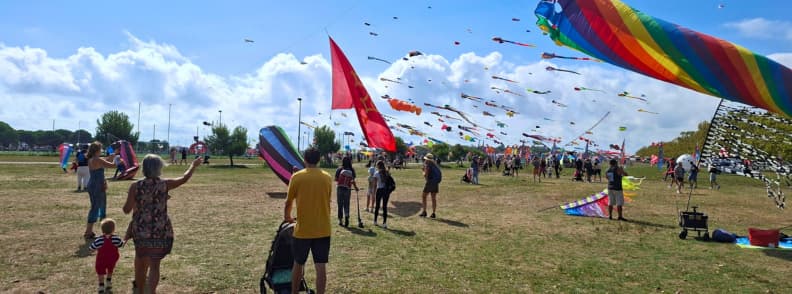
My Fréjus air festival 2025 review starts on 21 September, my birthday, with five of us heading to Base Nature François Léotard: my husband, our one-and-a-half-year-old son, my mother-in-law, my niece, and me. We arrived around noon, parked near Fréjus train station and walked about 15 minutes. The kites appeared above the horizon long before we reached the festival grounds, which shows how large some of them are. The Festival International de l’Air 2025 was on 20 and 21 September that year.
Our 2025 Fréjus air festival experience was simple. We came with a city stroller, walked over to the flying fields, and spent our time watching the kites. We skipped the workshops and other activities completely. With a toddler, a multi-generational group, and no ambition to inspect every corner of the program, that was enough.
The stroller was the first practical lesson from the Fréjus kite festival 2025. The paths were manageable, but the ground around the kite fields was too uneven, so we ended up carrying the stroller several times. I would bring a larger-wheel stroller for this terrain, or a carrier for a child small enough to use one.
What I remember most clearly are the giant marine animals overhead, especially the manta rays. They were the kites I recognized immediately when we returned in 2026 Seeing the same shapes in the same location again in 2026 made the festival feel familiar before we had even reached the main field.
This first visit also explains why I wanted to return. My first-hand experience at the Fréjus air festival wasn’t built around competitions, workshops, or a carefully planned timetable. We walked in, looked up for a while, and went home having seen something unusual enough to remember a year later. Something that made me feel like a child again on a day when I was adding another year to my age. And that was enough to make me feel attached to this event.
Returning on 20 September 2026. Bigger Crowds, Picnic Shade, and a Whale Overhead
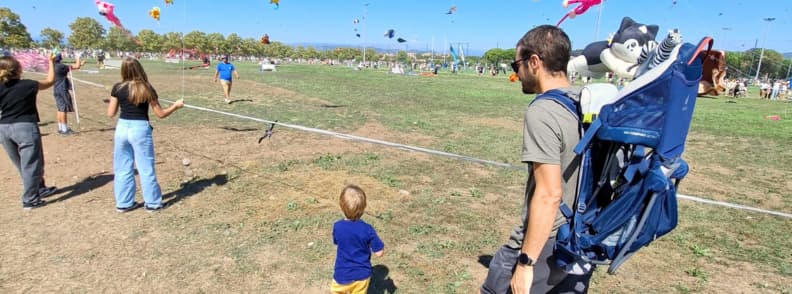
Our 2026 Fréjus Air Festival experience started before noon, with my husband, our two-and-a-half-year-old son, and a hiking carrier instead of the stroller. We parked near the police station, about a ten-minute walk from Base Nature, but reaching that area by car was slow. Fréjus had several major events on 20 September, including the European Heritage Days and T100 French Riviera, and plenty of cars around us weren’t heading toward the Air Festival at all.
The strangest part came when we reached the flying fields. There were surprisingly few kites in the air! We heard people nearby mention a storm warning, although I hadn’t seen any warning and never found an official explanation on the festival’s Facebook page. Around 12.30 pm to 1 pm, the kites began rising one by one.
Our Fréjus air festival 2026 experience was much easier once we stopped trying to fit any activities into it. The queues were huge and everywhere, including for a real military plane cockpit we would have liked William to sit inside. But waiting in full sun with a two-year-old for a brief turn held little appeal. So while he walked around with my husband, I stayed in line and bought him a small swallow kite for €5. I carefully chose it to match his size after his aunt was lifted by her large kite as a child. A €6 polystyrene airplane also came home with us for garden throwing. (The prices were lower than I had expected.)
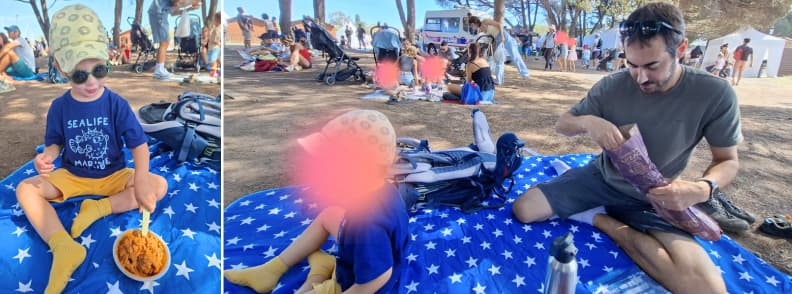
Packing our own picnic was one of the best decisions of the day. Food stalls had long lines, while we spread a blanket under the pine trees near the playground and ate without waiting for anything. It was William’s first picnic!
After lunch, he went a bit to the playground meant for his age, but we quickly took him away because it was very crowded and a lot of children were left unsupervised by their parents. While climbing, a kid pushed past William, stepping on his hands, so we left to avoid anything worse happenning.
We stayed at the festival until around 3 pm, then left while there was still time for our son’s nap, which preserved the afternoon for everyone involved.
Any honest visitor review of the Fréjus kite festival at Base Nature also needs to mention the toilets. There were too few restrooms for such a large crowd, the queues were long, and the facilities we found were dirty and awkward with a small child. My Fréjus air festival 2026 review is still positive overall because the kites were worth returning for, but this is exactly the sort of ordinary detail that changes a family day out.
Next year, we’re already considering arriving with our camper, partly for easier parking the night before attending, and partly for the luxury of knowing exactly where the clean toilet is!
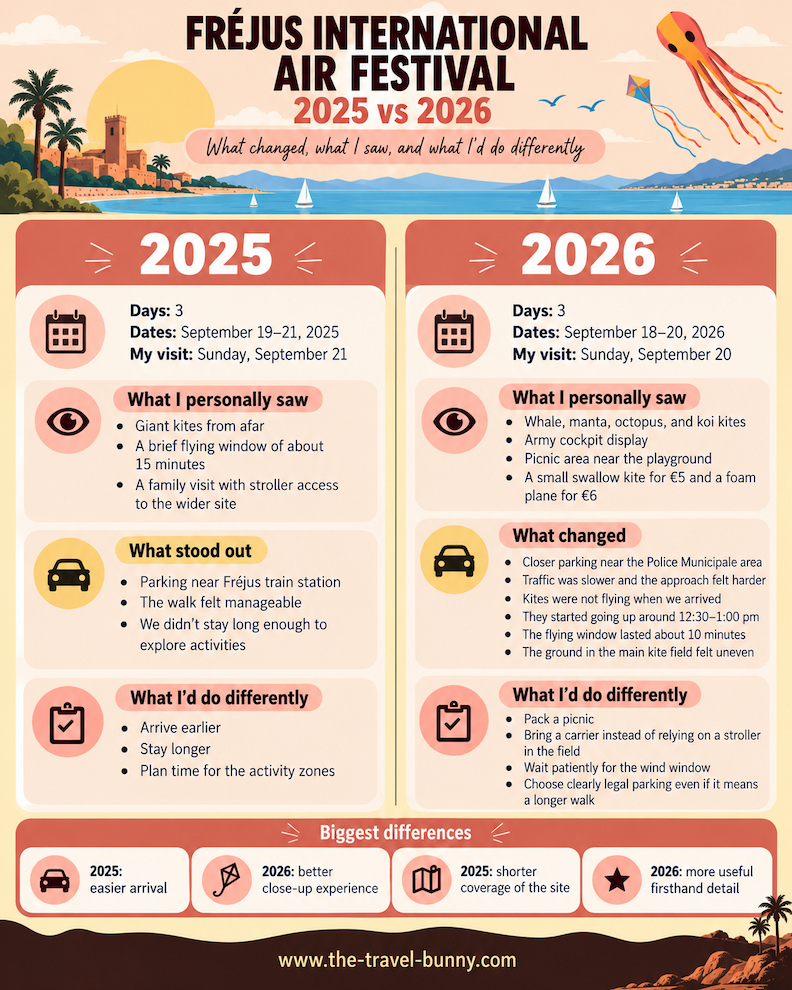
Fréjus Air Festival 2025 vs 2026. What Changed for us
What changed between 2025 and 2026 was mostly scale. My 2025 Fréjus air festival experience was a simple family visit focused almost entirely on the kites. By 2026, the festival seemed bigger, busier and packed with more activity around the flying fields. The calendar expanded too, from two days on 20 and 21 September 2025 to three days from 18 to 20 September 2026.
| Fréjus Air Festival 2025 review | Fréjus Air Festival 2026 experience | |
|---|---|---|
| Festival length | Two days | Three days |
| Who I visited with | Husband, 1½-year-old son, MIL, and niece | Husband, and 2½-year-old son |
| Parking | Near Fréjus train station, about 15 minutes on foot | Near the police station, about 10 minutes on foot, but slower to reach by car |
| Toddler transport | City stroller, awkward on the uneven field | Hiking carrier, much easier |
| Overall impression | Calmer and centered on watching the kites | Bigger and busier, with more happening around the kite areas |
| Kites | I remember seeing more in the air | Fewer overall in my impression, especially before lunchtime |
| Activities | We skipped them | More noticeable, but queues were long |
| Food | We didn’t plan around it | We brought a picnic and avoided the food queues |
| Crowds | Busy, but easier to move around | Crowded throughout our visit, especially at alley junctions and near the food area |
My 2026 Fréjus air festival experience also showed how much a year changes when you’re traveling with a toddler. At one and a half, William spent much of the first visit in the stroller. At two and a half, he walked more, rode in the hiking carrier when needed, had some favorite kites and told us about them, and had enough opinions about some kite shapes to identify several as carrots.
The festival itself has also expanded around the main flying displays. The FIA Drop Zone returned in 2026 after its first edition in 2025, and the 2026 program added a dense mix of Sportkite competition, workshops, drone activities, concerts, and other entertainment.
My own impression was slightly paradoxical. There seemed to be more happening on the ground, yet fewer kites overhead.
This Fréjus air festival first-hand experience across two consecutive editions also clarified what makes the Fréjus kite festival unique for me. The program changes, the crowds change and our family visits certainly change, but I came back for the same thing I remembered from 2025: enormous marine animals floating above an open field while children below argue confidently about what shape they are.
What You’ll See at the Fréjus Air Festival
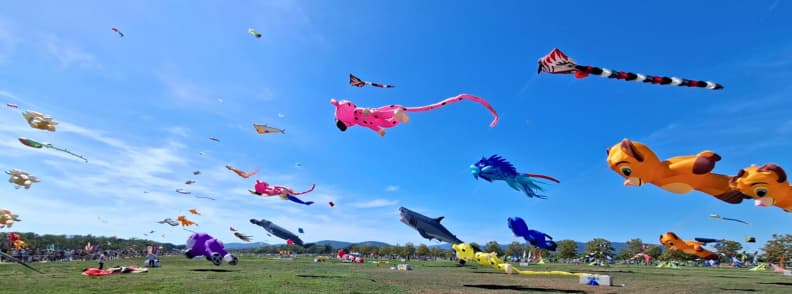
What can you see at the Fréjus kite festival? Start with the sky. The most obvious sight are the Fréjus giant kites, with enormous shapes drifting above Base Nature François Léotard. On my visits, the marine animals were the shapes I kept watching, they were my favorites, and the koi-shaped kites reminded me of Japanese koinobori. From a distance, the Fréjus beach kite display looks almost detached from the crowds below, with huge figures suspended over the Mediterranean coast.
Closer to the flying fields, the pace changes. Fréjus kite demonstrations include synchronized Sportkite routines, technical flying, and team displays, while the larger single-line creations move much more slowly overhead. The contrast is part of the event’s appeal. One moment you’re watching a kite ballet with precise Fréjus aerial acrobatics, the next you’re staring at a whale moving at the speed of a thoughtful cloud.
The kite show in Fréjus also spreads beyond one field. The 2026 program included giant XXL kites, Cloud Kisser, the Drone Zone, free-flight activities, children’s workshops, wind gardens, concerts, and other entertainment. The kite demonstrations are the backbone of the event, but the wider program turns the Base Nature kite show into a full-day outdoor festival if you want to stay longer.
Calling FIA a giant kite festival is accurate but incomplete. The giant kites do most of the visual heavy lifting, while the competition fields bring faster, tighter flying into the mix. Drones and other air-based activities widen the program, but the festival is still defined by Fréjus giant kites and aerial performances, and not by aircrafts.
Base Nature gives this Fréjus outdoor festival a lot of space, so the large numbers aren’t as opressive as in smaller locations. The Base Nature Fréjus event spreads across open fields beside the sea, with pine shade, activity zones, and plenty of distance between areas to make comfortable shoes a good idea. Crowds still bunch up at path junctions and around the busiest attractions. The Fréjus air festival family activities range from watching the kites to workshops and hands-on displays, but long queues quickly change the plan when you’re visiting with a small child.
Among the best things to do at the Fréjus kite festival, I’d put the flying displays first, obviously. What to see at Base Nature François Léotard starts overhead, then branches into Sportkite, Cloud Kisser, drones, wind installations and concerts. How much of that you attempt depends on your children’s ages, your tolerance for waiting and how long you want to stay.
Giant Kites, Sportkite, and the Flying Displays
The Fréjus giant kites and aerial performances divide the sky into two very different spectacles. Over the main fields, there is the exhibition of XXL kites from Europe and around the world, with enormous single-line creations drift slowly above Base Nature François Léotard. These are the giant kites Fréjus is known for, including the marine animals I kept watching on both visits.
This is the part that earns FIA its giant kite festival reputation. Giant kite flying is easy to appreciate even if you know nothing about the sport. You stand back, look up, and wait to see what rises next. Some designs are sculptural, some recognizably animal-shaped, and some change character every time the wind catches them differently. The artistic kites Fréjus brings together are as much about design as flying skill.
Sportkite is where the pace changes completely. A sport kite is steerable, allowing pilots to fly precise figures, synchronized routines, and choreographed sequences. The Fréjus acrobatic kites move so fast that watching them demands a different kind of attention from the slow-moving XXL animals. At their best, the kite demonstrations become a kind of kite ballet, with pilots flying individually, in pairs or in teams.
The Fréjus Sport Kite championship 2026 combined the French Championship with the International Sport Kite Open. There were individual, pair, and team competitions using two-line and multi-line kites, with commentary by longtime FIA speaker Mikael Azé. You may also see this event referred to as the Championnat de France Sportkite Fréjus, International Sport Kite Open Fréjus, or FFVL Sportkites Fréjus.
These competitive displays are the real Fréjus aerial acrobatics. Tight turns, crossings and formations replace the slow movement of the giant kites, giving the Fréjus kite competition a sportier atmosphere. If the XXL whales and manta rays are the part children point at from across the field, Sportkite is where you stop and watch what the pilots are doing with the lines.
Cloud Kisser, Drone Zone, and the Other Things Happening on the Ground
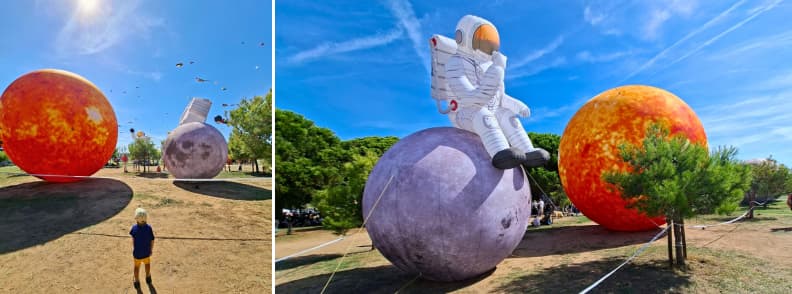
The Cloud Kisser Fréjus challenge was one of the more unusual ideas in the 2026 program. Inspired by Roland Garros’s nickname, the aim was to put 1,500 kites into the sky across the three festival days. The printed leaflet directed participants to the FFVL zone, where Imagin’Air and the regional league ran a kite-making workshop. The Cloud Kisser kite challenge in Fréjus was presented as a collective record attempt, which gave the smaller homemade kites a rather ambitious job.
The Cloud Kisser challenge hit its 2026 target of 1,500 kites across the three-day festival.
The FIA Drop Zone occupied the Espace Caquot and returned after its 2025 debut. The 2026 Fréjus Air Festival drone zone featured Light Track Drone Show sessions using mini-drones indoors, with illuminated courses and precision flying at 11 am, 2:30 pm, 3:30 pm, 4:30 pm, and 5:30 pm. A flight simulator sat in the same area.
The Fréjus drone show was an indoor technical display, not a large evening spectacle over Base Nature. Anyone expecting a nighttime drone show in Fréjus would have been waiting in the darkness long after the festival closed!
The Fréjus Air Festival Drop Zone also explains why drones appear so prominently in descriptions of FIA, although visitors shouldn’t confuse the programmed displays with permission to launch their own. Drone flight restrictions around Base Nature Fréjus still follow French aviation rules. The DGAC prohibits open-category drone flights over gatherings and in public space within built-up areas, and directs pilots to the Géoportail restriction map before flying. In other words, an aerial acrobatics and drone show at the Fréjus air festival is an organized activity, not an invitation to add your personal drone to an already crowded sky.
To discover everything without walking, you could hop on the free FIA Express, a Petit Train ride around the former naval aviation base. These guided visits around the former naval air base in Fréjus are a good way to connect the modern festival with the site’s aviation past.
Children’s Workshops, Wind Activities, and Concerts
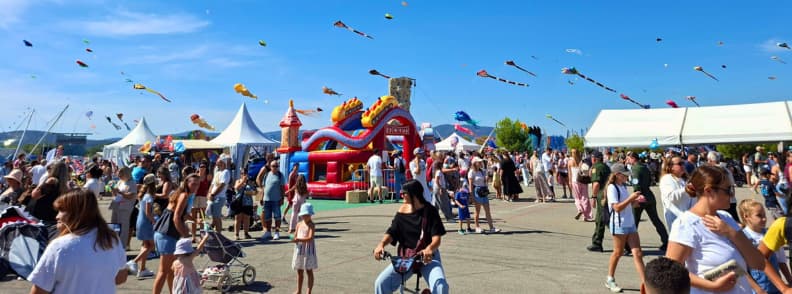
The family program at FIA is broader than a few token craft tables. In 2026, there were over 25 free workshops and activities for children aged 5 to 12, spread across four zones at Base Nature. The children’s workshops at the Fréjus International Air Festival ran from 10 am to 12:30 pm and again from 1:30 pm to 6 pm, with no extra charges.
The kite workshops were the obvious starting point, with children making and learning to fly their own kites. Other activities included recycled mobiles, wind chimes, windsocks, clay objects, travel notebooks, boomerangs, micro-rockets, graffiti, and weather-themed experiments. There was enough variety here to make FIA a genuine kite festival for children, especially once they reach primary-school age and have the patience to wait their turn.
This last part is worth emphasizing. All the queues were long during our Sunday visit. We skipped almost everything with our two-and-a-half-year-old and spent our time watching the kites instead. I’d make the same choice again with a toddler. Visiting Fréjus with kids becomes easier once you accept that seeing everything is unnecessary. Older children should get much more from the Fréjus air festival children’s workshops, especially if they enjoy making things or trying a new sport.
Wind also gets to play without a kite attached. The Fréjus wind gardens use moving decorations and wind-powered installations, while the wider program included boomerang, land sailing, wingfoil, kite buggy and other demonstrations. Calling FIA a wind festival in France would sell the kites short, but wind is everywhere once you start paying attention to what is moving.
The Fréjus kite festival concerts 2026 took place under the pine trees, a convenient place to escape the sunny open fields for a while. Friday brought La Camerata Vocale at 5 pm, Saturday had the youth “Explore ton talent” showcase at 3 pm, and Sunday featured a 3 pm concert presented by the Casino de Jeux de Fréjus. These free concerts during the Festival International de l’Air added a place to take a break in the afternoon, with music under the pinède while giant kites continued flying a short walk away.
For families, I’d still plan the day around the sky first. The workshops, wind activities, and concerts are useful extras, especially for older children, but the giant kites are the part everyone in the family gets to enjoy together without joining a queue.
How Long Should You Spend at the Festival?
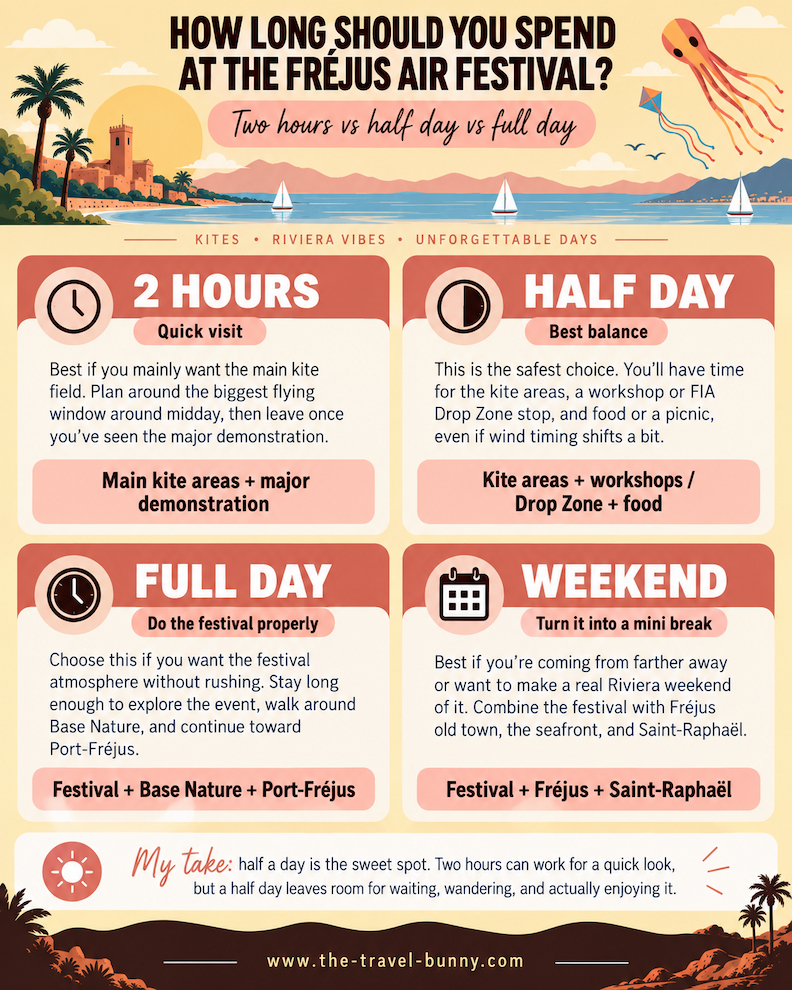
For most visitors, a half-day is enough. Two hours covers the main flying fields and Sportkite displays. Three to four hours leaves time for lunch, stalls, and a slower exploration of Base Nature. A full day is better reserved for families with older children who want workshops, competitions, and afternoon entertainment. This is how long to spend at the Fréjus kite festival, in my opinion.
Our 2026 visit lasted about three hours. We arrived before noon and left around 3 pm for William’s nap, after watching the kites, wandering through the site, browsing a few stalls, and having our picnic under the pines. With a two-and-a-half-year-old, I wouldn’t plan a full festival day. He was perfectly happy with the flying displays and lunch outside, while the long activity queues held little appeal at his age.
A Fréjus kite festival family itinerary changes once children reach primary-school age. I’d keep the morning for the kite fields, eat before the main lunch rush, then choose one workshop or activity for the afternoon. Trying to tick off the entire program turns a relaxed outdoor festival into a timetable, and FIA is much nicer when you leave room to stop because something unexpected has appeared in the sky.
A one-day itinerary for the Fréjus air festival only needs the whole 10 am to 6 pm window if the program itself is your main reason for coming. Competition followers, older children and visitors interested in several workshops have plenty to fill the day. Everyone else has room to combine FIA with another part of Fréjus.
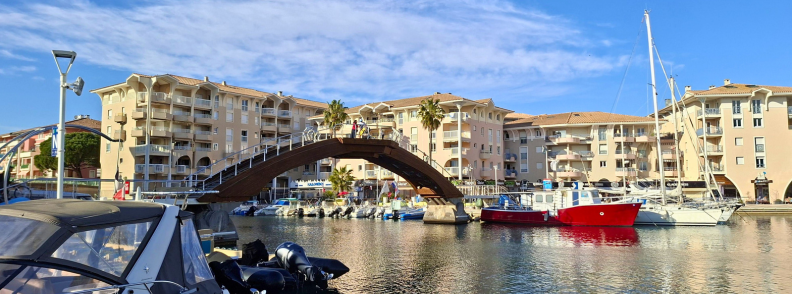
The easiest one-day Fréjus itinerary with the air festival pairs Base Nature with Port-Fréjus. I often walk along the marina when I come to this part of town, and the port is close enough to add a waterside walk, beach stop or dinner without crossing Fréjus again by car. Among the things to combine with a Fréjus kite festival day trip, Port-Fréjus is the obvious low-effort addition.
For a weekend itinerary with the Fréjus air festival and Port-Fréjus, I’d separate them. Give FIA half a day, then leave the marina and beach for later or the following day. You’ll see the festival properly without spending eight hours trying to extract maximum value from a free event.
Best Arrival Time and How to Avoid the Worst Crowds
The best time to visit the Fréjus kite festival is near opening if you’re driving. FIA opened at 10 am in 2026, and arriving early means a better chance of reaching the area before the roads around Base Nature slow down. In 2025, we parked near Fréjus train station and walked about 15 minutes. In 2026, we found a closer space near the police station, but the drive to it took longer. Closer parking didn’t mean a quicker arrival.
There’s one catch behind what time should I arrive. An early start helps with traffic, but the sky does its own thing. On Sunday in 2026, surprisingly few kites were flying before noon. They began appearing gradually around 12.30 pm. I heard people mention a weather warning, but I never found an official explanation, so I’d treat that as one day’s experience, not a timetable for future editions.
That Sunday, the best time to photograph kites in Fréjus came later, once the larger shapes were back overhead. The open fields make phone photography easy, and I rarely had to wait long for a clearer view. Popular barriers and viewing points filled up, but a short walk usually changed the angle.
Fréjus kite festival crowds bunch up around specific choke points. The busiest areas we saw were path junctions, activity queues, food stands, and the main viewing spots. Away from those, Base Nature opens up quickly.
How to avoid crowds at the Fréjus kite festival: Arrive early, bring lunch, skip queues that look too long, and keep moving until you find a quieter edge of the field.
I’d also check the wider calendar of Fréjus weekend events before setting off. FIA shares the town with other September events, and road access changes faster than the festival program does. For a large free family event on the French Riviera in September, a little flexibility goes a long way.
My plan next time is the same one I wish I’d used from the start. I want to get there early for the drive, then let the wind decide when the sky becomes interesting.
Getting to Base Nature François Léotard
The Festival International de l’Air takes place at Base Nature François Léotard, the vast former naval air base on the Fréjus seafront. The 135-hectare park stretches between Port-Fréjus and the Mediterranean, with enough open ground for several kite fields, activity areas and thousands of visitors.
For GPS, I’d enter Base Nature Fréjus by name. Online, there are conflicting street numbers for the site, so the venue name is safer than relying on a copied address. Once you’re close, festival signage and the flow of people make the final approach obvious.
How to get to Base Nature Fréjus depends on how much event-day traffic you want to deal with. You can arrive by car, bus, bicycle, or on foot, and the next parts cover each option in detail. Driving requires the most planning.
The Fréjus air festival map and access plan is worth checking before you set out. The 2026 Base Nature map marked separate entrances and parking areas, along with the giant-kite fields, workshops, food, toilets, first aid and children’s meeting points. Distances across the grounds are longer than they first appear, especially with a young child.
Once you know how to reach Base Nature Fréjus kite festival, allow a little extra time between leaving the car and reaching the flying fields. Our walk took around 15 minutes in 2025 and about 10 minutes in 2026. Neither was difficult, but FIA is a large Base Nature Fréjus event, so arriving at the edge of the park doesn’t mean you’ve reached the part you came to see.
Outside festival weekend, what to see at Base Nature François Léotard includes the beach, playgrounds, skatepark, picnic areas, and sports facilities. I know the site mostly from beach visits and local events, and FIA changes its character completely. Open recreational ground becomes a patchwork of kite fields, crowds, and temporary activity zones.
Disclosure: Some of the links on this page are affiliate links. This means that at no extra cost to you, The Travel Bunny will earn a small commission if you click through and make a purchase. Thank you!
Driving and Festival Parking
The 2026 FIA map listed four free parking areas. They were Parking Base Nature, the temporary Parking Événementiel inside Base Nature, Parking Luna Park, and Parking Aqualand. The map specifically labels all four as free and encourages visitors to follow the event signage once they reach Fréjus.
The regular Base Nature parking is the obvious first choice, but I wouldn’t make getting the closest space a mission. The Base Nature parking is free from 1 September to 30 June, so the September festival falls inside the free period. The event parking was added deeper inside the site for FIA, while Luna Park and Aqualand provided two useful alternatives on the western side of Base Nature.
My own experience changed how I think about Festival International de l’Air Fréjus parking. In 2025, we parked near Fréjus train station and in 2026, we found a closer space near the police station (and both are marked on the map below). Personally, I’d take a slightly longer walk over crawling toward Base Nature in traffic.
Where to park for the Fréjus kite festival: Try Parking Base Nature or the event lot while traffic is still moving. If the approach is already backed up, Luna Park or Aqualand gives you another option instead of circling the same roads hoping a space appears. The map is worth saving on your phone before leaving home because these four parking areas are easier to understand visually than from road signs alone.
The festival brochure warned visitors to expect heavier traffic at the entrances and exits during peak periods and that matched our Sunday visit. The difficult part was the final stretch toward the festival. Arriving earlier in the morning offers a better chance of avoiding that slow approach, especially if you’re coming with children and carrying picnic gear, a stroller, or a carrier.
The same brochure also recommended public transport, cycling, and carpooling when practical. I’d take this suggestion seriously if you’re staying nearby. FIA is free, the Base Nature Fréjus festival parking is free, and this naturally attracts a lot of drivers to the same few roads at roughly the same time.
I saw motorhomes parked around the site in 2026, which makes arriving the evening before tempting for a future visit. The festival map, though, identifies visitor parking and not overnight motorhome areas. I wouldn’t treat the four free FIA car parks as confirmed overnight motorhome parking unless the next edition publishes this permission specifically.
Fréjus International Air Festival Parking & Arrival Map
Use this map to locate Base Nature François Léotard, the four official FIA parking areas, Port-Fréjus, public transport access, and the areas where I parked during my 2025 and 2026 visits.
The four numbered markers follow the official FIA parking plan. My personal parking markers show where I parked during my own visits and are not official festival parking recommendations. Legal roadside spaces on Rue des Batteries are limited.
Train, Bus, Walking, and Cycling
Fréjus kite festival public transport is a good alternative to driving, especially if you’re staying along the coastal rail line. Fréjus has its own TER station, local buses serve Base Nature, and the city also points visitors toward marked pedestrian and cycle routes. For anyone planning how to visit the Fréjus air festival without a car, the train is the option I’d check first.
Fréjus station is close enough to walk the final stretch. A Fréjus kite festival by train trip also removes the slowest part of the drive, right next to Base Nature once festival traffic builds.
The Fréjus kite festival from Saint-Raphaël is especially easy by TER. SNCF has direct trains between Saint-Raphaël Valescure and Fréjus taking as little as two or three minutes, although not every departure is direct. If you’re sleeping in Saint-Raphaël, I’d check the timetable before reaching for the car keys.
Nice to Fréjus transport by train is also straightforward. SNCF schedules include direct TER services taking around 1 hour 10 minutes to 1 hour 15 minutes, with stops through Antibes, Cannes, and Saint-Raphaël. That puts a day trip from Nice to the Fréjus kite festival well within reason, and the same coastal line also makes FIA accessible from Cannes.
Local buses serve Base Nature from central Fréjus and nearby towns, according to the official venue page. I’d check Estérel Côte d’Azur Le Bus shortly before the festival because routes and seasonal timetables change. For Fréjus air festival public transport, that last local connection is useful if you don’t want to walk from the station.
Walking from the marina is even simpler. The Port Fréjus to Base Nature walking distance is very short because the two are beside each other along the seafront. If you’re staying around Port-Fréjus, I wouldn’t involve a car at all. A walk into the festival is easier than joining traffic for such a small transfer.
Base Nature cycling is another good local option. There are marked cycle routes leading directly into the park, and the flat seafront setting is well adapted to arriving in Fréjus by bike. The Base Nature bike paths also make cycling useful if your accommodation is elsewhere around Fréjus or Saint-Raphaël and you’d prefer to skip the parking hunt entirely.
FIA Express. What It Is and When to Use It
The FIA Express is a free Petit Train that runs inside Base Nature during the festival. It’s easy to mistake the name for a parking shuttle, but the Base Nature festival shuttle is really a short ride around the event site, aimed at visitors who want a break from walking or a different view of the former naval air base.
In 2026, the free FIA Express Fréjus departed about every 30 minutes from 10 am to 12 pm, then again from 2 pm to 5 pm. The printed festival map marked a single FIA Express stop near the central part of the site, so I wouldn’t plan around a hop-on, hop-off circuit with several convenient boarding points.
The Festival International de l’Air free tourist train is most useful if you’ve already spent a few hours crossing Base Nature, have young children with tired legs, or want to see the site without adding another long walk. The park is huge, and distances between the kite fields, workshops, and activity areas add up quietly.
The FIA Express Fréjus is an extra once you’re inside, not part of your arrival plan. The Fréjus festival tourist train doesn’t replace the walk from Fréjus station, Port-Fréjus, or an outside parking area. It starts helping after you’ve reached the festival, which is an important distinction if you’re planning the day with small children.
Visiting by Boat or Staying at Port-Fréjus
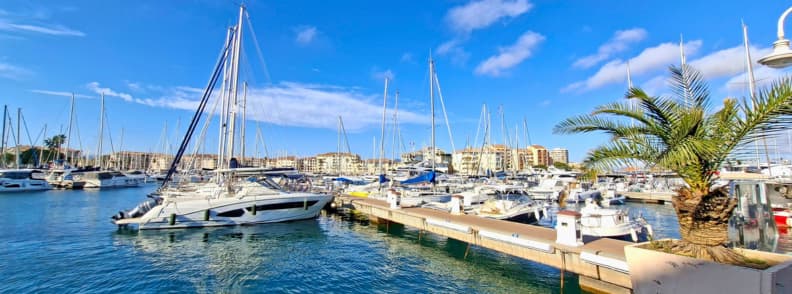
Port Fréjus marina is right beside Base Nature, which makes FIA unusually convenient for sailors and anyone staying around the harbor. The port has 895 berths, accepts boats up to 40 meters and with a maximum draft of 3.5 meters. Restaurants, beaches, and the festival grounds are all close to the pontoons.
I’ve done plenty of Fréjus sailing outside festival dates, and this is one occasion when arriving by boat has a genuine practical advantage. Sailing to Base Nature Fréjus means berthing at Port-Fréjus and walking to FIA from there. There is no special festival landing on the beach, and I wouldn’t plan on approaching the event directly from the water.
The marina is well equipped for an overnight stop. It has shore power, water, showers, toilets, fuel, wastewater facilities, Wi-Fi and laundry. Port Fréjus marina is a useful base if FIA is a part of a longer Côte d’Azur sailing trip.
But I wouldn’t come just for the Fréjus kite festival from the sea. You might spot the XXL kites offshore when conditions cooperate, but the interesting detail is on land, where the separate flying fields, competitions and activity zones come into view. The boat is your transport and accommodation here, not the best seat in the house.
For a weekend itinerary with the Fréjus air festival and Port, the pairing is easy. Spend part of the day at Base Nature, then walk back toward the marina for dinner or the beach. Other Port Fréjus activities fit naturally around the festival without another drive across town.
Berth availability and Port Fréjus maritime access deserve a check before arrival, especially on a busy September weekend. Visiting yachts should contact the harbor authority, and temporary navigation restrictions sometimes apply around major coastal events.
Berthing, Walking to the Festival, and Maritime Rules
Arriving by boat is straightforward if you berth at Port-Fréjus first. Visiting yachts need approval from the harbor authority before entering. The 2026 port regulations ask crews to contact the capitainerie in advance with the boat’s dimensions and planned arrival and departure times, then call again on VHF Channel 9 when entering the harbor. Berths depend on availability, so I’d arrange Fréjus yacht docking during the festival before turning up at the entrance.
Once tied up, the rest is easy. Port-Fréjus and Base Nature are beside each other, so the walking distance from Port Fréjus to Base Nature varies mainly with the position of your berth. You leave the marina on foot and head toward the festival grounds. This short Port Fréjus to Base Nature walking distance is the main reason arriving by yacht is very practical during FIA.
I’d choose the marina over trying to improvise mooring near Base Nature Fréjus for the festival. Nearby anchorages exist along the Gulf of Fréjus, but an anchorage adds dinghy access, weather, and local restrictions to a day that’s simpler from a berth. For sailing access to Port Fréjus during kite festival weekend, the marina puts you ashore exactly where you need to be.
Check the Préfecture maritime orders before sailing. In 2026, an order restricted navigation, anchoring and diving off Fréjus and Saint-Raphaël from 17 to 19 September for the T100 Esterel Côte d’Azur, overlapping the first two FIA days. The restriction came from another event, which is precisely why checking only the kite festival program is insufficient for Port Fréjus maritime access.
I wouldn’t build the day around where to watch the Fréjus kite festival from the sea. I’ve sailed this coast outside FIA dates, and although the largest kites should be visible offshore when they’re high enough, the festival is designed to be experienced from Base Nature. From land you see the scale, the separate flying fields and the competition areas. Offshore, you mostly get colorful shapes at a distance.
So if you’re wondering can I watch Fréjus kite festival from the sea, think of the water as the approach, not the grandstand. Berth at Port-Fréjus, walk over, spend your time under the kites, then return to the marina when you’ve had enough sky.
Practical Advice Before You Go
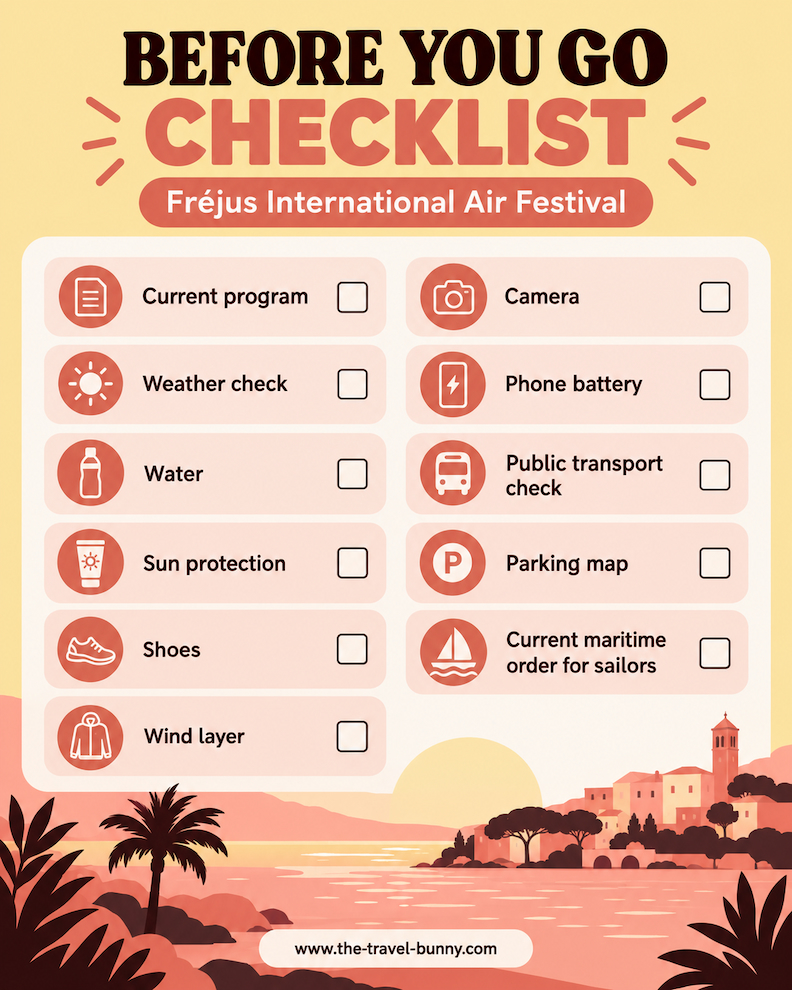
For first-time visitors, the Fréjus International Air Festival is easier with a few basics packed before you leave. Base Nature is large, exposed and windy, with plenty of time spent walking or standing in the sun. My what to bring to Fréjus kite festival list is short: water, sunscreen, sunglasses, a hat, comfortable shoes, and something to sit on if you plan a picnic.
For what to wear to a kite festival in Fréjus, I’d choose light layers and shoes made for walking. September on the coast is often warm and sunny, but the wind over the open fields changes how comfortable you stay after a few hours.
Bringing your own lunch is one of my best family tips. There is food at Festival International de l’Air Fréjus, but the queues were long during our Sunday visit. We packed a picnic and ate under the pines near the playground, which gave William a proper break without waiting at a food stand. Base Nature also has dedicated picnic areas, so food stands and picnic areas at Base Nature Fréjus give you a choice depending on how much you want to carry.
You can picnic at Fréjus kite festival. Next time, I’d head toward the grassy area near the stadium instead of sitting on bare earth. There was still pine shade, but the ground looked much nicer for spreading out a blanket with a child.
Dogs are common around Base Nature, and I saw plenty during FIA. The park itself accepts dogs and has a dedicated dog area, so there is dog-friendly access at Base Nature Fréjus air festival. Still, check the latest event information before bringing one.
Practical information for Festival International de l’Air Fréjus: plan for sun, wind, walking, crowds and pauses. With children, bring enough food and water to avoid unnecessary queues and don’t build the day around every activity on the program. This approach has served us better than trying to squeeze everything into one visit.
Food, Water, Toilets, Shade, Strollers, and Accessibility
Food at Festival International de l’Air Fréjus is easy to find, but I’d still bring a picnic. The food areas were among the busiest parts of the festival during our Sunday visit, with long lines around lunchtime. We ate under the pines near the playground instead, which gave William space to sit, eat, and reset without waiting in another queue.
Base Nature has official picnic areas and two permanent places to eat, so the food stands and picnic areas at Base Nature Fréjus leave you several options.
I’d also carry enough water for the time you plan to stay. Wee brought our own refillable bottles from home, but I didn’t notice any drinking fountains while walking around FIA in 2026. Refreshments were available from vendors, but relying on a busy stand every time a child gets thirsty is an unnecessary complication.
The toilets were the worst part of the 2026 festival for me. The event map showed only two toilet zones across a huge site, and the ones we reached had long lines and were dirty. They were awkward with a toddler too. They were the regular Base Nature toilets that exist year-round, but FIA places much heavier demand on the site than an ordinary beach or sports day.
Base Nature shade comes mainly from the pine trees. The flying fields themselves are exposed, so we deliberately used the pinède for lunch. I’d bring a hat, sunglasses, and sunscreen even on a windy day. The breeze makes the heat easier to tolerate, but it also makes several hours in full sun easy to underestimate.
I wouldn’t call FIA a perfectly stroller-friendly festival in Fréjus. In 2025, our ordinary city stroller was fine on the main paths, then became something we had to carry over uneven ground near the kite fields. In 2026, we brought our hiking carrier instead, which was much easier with William. If you’re coming with a baby or toddler, larger stroller wheels or a carrier give you more freedom to wander.
Wheelchair access at Fréjus kite festival is officially confirmed. Visitors using wheelchairs have independent access, and the Base Nature has hard surfaces, level routes, reserved accessible parking and drop-off close to the site. I also saw wheelchair users during our visit. The main practical issue is distance, since FIA spreads across a very large area.
Sun, Wind, Rain, and Festival Cancellation
Fréjus weather in September usually still means warm days, strong sun, and plenty of time outdoors. Both of my FIA visits, in 2025 and 2026, were sunny and windy. Base Nature is especially exposed once you leave the pine trees, so a pleasant temperature on the forecast doesn’t tell the whole story.
What to wear to the kite festival in Fréjus: I’d stick to light clothes, comfortable walking shoes and a light layer for the breeze. Add a hat, sunglasses, and sunscreen. Late-September sun on the coast still has some bite, even when the wind keeps you from noticing it.
Wind is part of FIA, but stronger wind isn’t necessarily better. Suitable wind conditions for the Fréjus kite festival vary according to what’s flying. Giant single-line kites, Sportkite routines, and other aerial displays all respond differently as conditions change.
Rain is the bigger warning sign. What happens if it rains at the Fréjus kite festival depends on the severity of the weather and the safety decisions made by organizers. A poor forecast might alter individual outdoor activities, while severe conditions have already wiped out an entire edition.
This happened in 2024. FIA was due to take place on 26 and 27 October, but organizers canceled the weekend after severe weather was forecast. The precedent is worth remembering when planning around weather at the Fréjus air festival, especially if you have a long drive or hotel booking attached to the visit.
I’d check the forecast the evening before, then check the Fréjus Tourism event page again before leaving home. September has been a much friendlier setting during my own visits, but FIA still depends on an outdoor coastal site, moving air and a sky safe enough to fill with very large kites.
Fréjus Kite Festival Photography Map
These are the areas I would use for photographing the giant kites at Base Nature, based on my visits and the 2026 FIA layout. Toggle the layers to compare wide-angle positions, telephoto angles, quieter viewpoints, family-friendly areas, foreground options, and the afternoon sun during my 2026 visit.
These markers are my photography guidance, not official FIA viewing areas. Flying fields, barriers, food stands and pedestrian routes can move between editions. Always remain outside marked flying zones and follow festival staff instructions.
Best Places to Watch and Photograph the Kites
The best place to watch the Fréjus kite festival is along the edges of the main flying fields, then move when the light or wind changes. FIA spreads several kite zones across the open center of Base Nature, so there is no single viewpoint worth fighting for. I usually found a better angle by walking another few meters instead of waiting behind a crowded barrier.
For photos of giant XXL kites at Fréjus Base Nature, distance helps. Step back far enough to fit the whole whale, manta ray or octopus into the frame, with some empty sky around it. The giant kites in Fréjus are enormous once you see them beside the people below, and including a little of the ground often shows their scale better than filling the frame with fabric.
My main Fréjus kite festival photography tip is to watch the background as much as the kite. From one side of a field you might have barriers, stalls, and spectators underneath. Walk around the perimeter and the same kite might sit against clean blue sky. Phone photography was easy during both of my visits, and I rarely had to wait long for a clearer composition.
Sportkite needs a different approach. Photo tips for taking pictures of stunt kites start with leaving extra room around the subject because these kites change direction quickly. Burst mode helps on a phone. A camera with a fast shutter speed is useful for sharper turns, crossings and team formations. Stand near the competition field if that is what you want to photograph, since the giant-kite areas move at an entirely different pace.
The best time to photograph kites in Fréjus follows the flying conditions, not a guaranteed hour on the program. On our Sunday visit in 2026, the sky was unusually quiet before noon and became much busier around 12.30 to 1 pm. Once the larger kites went up, the open field gave us plenty of angles. I’d check the sky first and the clock second.
The beach gives the Fréjus beach kite display a wider Mediterranean backdrop, but I prefer photographing from inside Base Nature. You see the size of the kites better, and you stay close enough to move between the giant displays and Sportkite competition. The official Fréjus Tourism page also identifies Base Nature as a regular kite-flying site outside FIA weekend.
You’re also allowed to bring and fly your own normal-sized kite during the festival, as long as you stay outside the barriered professional flying areas and keep hold of it while moving around. I saw space near the stadiums where people could practice too. I would leave giant kites to the professionals, for obvious reasons involving size, wind and the general desirability of remaining attached to the ground.
This also makes Base Nature one of the more practical spots to fly stunt kites in Var, France outside the professional zones. During FIA, give the marked competition and giant-kite fields plenty of room and use the open areas intended for visitors instead.
Why Base Nature Has Such a Rich Aviation History
The giant kites at FIA rise from ground with a much older relationship with flight. Base Nature François Léotard occupies the former Fréjus-Saint-Raphaël naval air base, created in the early 20th century and used for aircraft testing, training, and military aviation. Knowing that changes how you see the site. Those broad open spaces and surviving aviation structures were built for aircraft long before families started spreading picnic blankets beneath them.
The Fréjus aviation history of the site became especially important during World War I. From 1916, the base hosted the Commission d’études pratiques d’aviation, which tested equipment and techniques for French naval aviation. Experiments here included ways of operating aircraft from ships, giving the Base Nature aviation history a technical side that reaches beyond a former runway beside the sea.
The best-known story is Roland Garros in Fréjus. On 23 September 1913, Roland Garros took off from Fréjus for Bizerte in Tunisia and completed the first nonstop aerial crossing of the Mediterranean. He covered roughly 760 km in 8 hours and 7 minutes. Today, a monument at Base Nature commemorates the flight, making the history of aviation at Base Nature François Léotard easy to connect with this one specific event.
Another survivor is the Caquot hangar, built in 1935 for aviation use. It remains one of the clearest physical reminders of the former naval air base in Fréjus and now hosts events instead of aircraft. I like that continuity. FIA fills the same site with Sportkites, drones, and enormous flying animals, while the hangar quietly explains why an air-themed festival belongs here in the first place.
The military base closed in 1995, and the land later became the public Base Nature François Léotard. Today, sports grounds, cycle paths, beach access, and recreation areas occupy a place shaped by decades of aviation. The Fréjus military aviation base has disappeared as an active installation, but its scale still defines the park.
FIA occasionally brings that past closer to visitors through the guided tours of the former naval air base in Fréjus aboard the FIA Express. These short rides are useful if you want to understand the ground beneath the festival as well as the spectacle above it. The kites may be temporary, but aviation story is built into the place.
Where to Stay and What Else to Do in Fréjus
For the Festival International de l’Air, I’d stay near Port-Fréjus or Fréjus-Plage. You’re close to Base Nature, the beach, and a long choice of restaurants, and you avoid starting festival morning with another drive toward the busiest roads. The historic center is a better base if Roman Fréjus interests you as much as FIA, but for pure festival convenience, the coast wins.
Where to Stay Near Base Nature Fréjus
L’Oasis Hotel is my pick for travelers who want somewhere small, quiet, and close to the sea. It’s about five minutes on foot from both the beach and Port-Fréjus, with air-conditioned rooms, family rooms, a terrace, minibar fridges, and free private parking subject to space. It also offers secure storage for bicycles and motorcycles. Among the hotels near Festival International de l’Air Fréjus, this has the nicest balance for me. It’s close enough to walk around the port and beach, but tucked away from the waterfront traffic.
I’d choose Atoll Hotel Restaurant if festival access is the main priority. It’s on Boulevard de la Mer, only 100 meters from the beach and Port-Fréjus, with air conditioning, family rooms, free on-site parking, and its own Italian restaurant. You arrive, park, and have little reason to move the car again until departure. For where to stay near Base Nature Fréjus, especially with children or picnic bags in tow, that simplicity is persuasive.
Hôtel l’Arena is the one I’d pick if you want the weekend to include visiting Fréjus beyond the festival area. The hotel is in the historic center, with a garden, outdoor pool, family rooms, and a French restaurant on site. The Roman amphitheater, cathedral quarter, and old streets are much closer from here than from Port-Fréjus. You give up the walk-to-FIA advantage, but gain a better base for sightseeing once the kites come down.
These three are the choices I’d make among Fréjus hotels near Base Nature. L’Oasis fits a quieter beach break, Atoll is the practical festival base, and l’Arena belongs to a broader cultural weekend. For Fréjus accommodation near the beach, I’d stick with the first two.
Camping near Fréjus kite festival is another realistic September option. Camping de Saint-Aygulf Plage stays open until 31 October 2026 and is by the sea, while Camping La Plage d’Argens remains open into November. Neither is beside FIA, so you still need transport to Base Nature, but they fit travelers turning the festival into a longer coastal stay.
Where to Eat Near Base Nature
After several hours around food stalls and kite fields, Port-Fréjus is where I’d go for dinner. There are 13 Port Fréjus restaurants, including brasseries, pizzerias, traditional cooking, and beach restaurants. You’ll also find ice cream shops, bars, and takeaway options around the marina, so the area is useful with children who have reached the end of their festival patience.
If your stay includes Thursday morning, the Port-Fréjus market is from 7 am to 1 pm throughout 2026. The wider local market calendar also includes the historic-center market on Wednesday and Saturday, Fréjus-Plage on Tuesday, Friday, and Sunday, and Saint-Aygulf on Tuesday and Friday. This gives you several local Provençal markets near Base Nature Fréjus without building a separate excursion around one.
What Else to Do in Fréjus After the Kite Festival
For things to do in Fréjus beyond FIA, I’d start with the Roman city. The amphitheater dates from the late first century and once held up to around 12,000 spectators. Fréjus also preserves sections of its Roman aqueduct, theater, and city gates, while the cathedral and cloister shift the story forward into the medieval period.
The historic center deserves a few hours instead of a drive-through, even if the drive is slower during events. It gives a Fréjus visit some depth beyond beach and festivals, especially for visitors who arrive from Nice, Cannes, or Saint-Tropez and know Fréjus mainly as a coastal stop.
For something easier after FIA, stay near Base Nature. The Base Nature coastal park covers 135 hectares, with 80 hectares of natural space alongside sports and leisure areas. The adjacent sandy beach stretches over 2 km, so this is the obvious best beach near Fréjus kite festival for convenience.
Base Nature is a good beach for families who value space. You have sand, sea, playgrounds, picnic areas, cycle paths, and room to spread out. I wouldn’t choose it over every smaller beach or creek in the wider Var purely for scenery, but after FIA I would choose it for convenience.
For nature, head farther west to the Étangs de Villepey at Saint-Aygulf. These wetlands are where the Argens freshwater system meets the Mediterranean and support protected plants, birds and other wildlife. The marked walk is family-friendly and includes an observation platform, which makes it a quieter counterpoint to a crowded festival morning.
Fréjus With Kids After FIA
To visit Fréjus with kids, I’d keep the second half of the day simple. Beach time, the Base Nature playground, an ice cream around Port-Fréjus, or a walk beside the boats all demand less energy than another ticketed attraction.
This is also how I’d plan a Fréjus family holiday around the festival. Let FIA be the busy part. The permanent Base Nature Fréjus family activities give children somewhere to move afterward without another queue, schedule, or entrance gate.
If you stay for two nights in Fréjus, add the old town on another morning and Villepey on another afternoon. This gives your family enough variety without filling every hour with organized entertainment.
Why September requires a Full Weekend
The French Riviera in September is excellent for this kind of trip. Sea temperatures are still comfortable, the heavy August traffic has started easing, and many coastal businesses remain open. FIA lands in that useful gap where summer has loosened its grip but autumn hasn’t shut the coast down.
Fréjus also has plenty of September activities for an extra night. Weekly markets continue, cultural sites remain open, and the local calendar often includes several Fréjus events on the same weekend. FIA can be added naturally into a broader French Riviera autumn stay instead of needing to carry an entire trip by itself.
A Fréjus Itinerary for One Day or a Weekend
For a Fréjus itinerary in one day, I’d spend the late morning and early afternoon at FIA, then walk toward Port-Fréjus. Have dinner around the marina and add the beach only if everyone still has energy.
A weekend itinerary with the Fréjus air festival and Port has a better rhythm. Give FIA half a day. Keep Port-Fréjus and the beach for later. Use the next morning for the Roman center, then choose Villepey or another stretch of coast before heading home.
This is also why I’d stay overnight if you’re coming from farther away. A day trip from Nice to the Fréjus kite festival is perfectly realistic by train, and a day trip from Saint-Tropez to the Fréjus festival is possible with extra transport planning. An overnight stay turns FIA from a long return trip into an excuse to spend two days around a part of the Var that deserves time beyond the kite fields.
Festival International de l’Air FAQ
Planning a visit to the Festival International de l’Air in Fréjus often comes down to practical details: when to arrive, where to park, what to bring, how long to stay, and what changes if the wind or weather turns. I’ve gathered the answers below from my own visits, current festival information, and the details I wish I’d known before my first trip to Base Nature François Léotard.
What is the Festival International de l’Air in Fréjus?
The Festival International de l’Air, usually shortened to FIA, is an international kite festival at Base Nature François Léotard in Fréjus. Despite the name, this is not an aircraft airshow with fighter jets or aerobatic planes overhead.
Giant artistic kites form the main spectacle, alongside Sportkite competition, wind installations, drones, workshops, concerts and other activities related to flight. The 2026 edition included giant XXL single-line kites from France and abroad, the French Sportkite Championship and International Open, Cloud Kisser, mini-drone shows and over 25 activities for children.
When is the Festival International de l’Air in Fréjus? When is the next Festival International de l’Air?
The most recent FIA took place from 18 to 20 September 2026. For now, Fréjus Tourism hasn’t published dates for 2027, so I wouldn’t book a future trip around an assumed September weekend yet.
Older editions often took place in October. The move into September had already happened by 2025, when FIA ran on 20 and 21 September.
What time does the Fréjus kite festival open? What time does the Fréjus air festival start?
FIA ran from 10 am to 6 pm each day in 2026. Those are opening hours, not a promise that the sky will look equally busy for all eight hours. Kite flying depends on the wind.
We arrived before noon on Sunday in 2026 and found surprisingly few large kites airborne. They gradually returned from around 12.30 to 1 pm. I never found a confirmed explanation, so I wouldn’t turn our experience into a rule about the best hour for future editions.
Is the Festival International de l’Air free? Is there an entry fee for FIA Fréjus?
Yes, FIA Fréjus has free admission. The 2026 festival required no general entrance ticket, and the main displays, Sportkite competition, concerts and many family activities were free.
You still need a budget for food, drinks, souvenirs or kites. In 2026, we bought our son a small swallow kite for €5 and a polystyrene plane for €6.
Where is the Fréjus International Air Festival held?
FIA takes place at Base Nature François Léotard, beside Port-Fréjus and the Mediterranean. Base Nature covers 135 hectares, with natural areas, sports facilities, beach access and large open spaces well adapted to kite flying.
The festival itself occupies several separate zones, so arriving at Base Nature is only the beginning of your walking.
What address should I use for Base Nature?
I would enter Base Nature François Léotard, Fréjus as the destination instead of trusting one street number.
Current official Fréjus pages disagree. The FIA event listing gives 1996 Boulevard de la Mer, the main Base Nature page gives 1196, and the parking page gives 199 Boulevard de la Mer. The venue name is the safer GPS search.
Where should I park for the Fréjus air festival? Where can I park near Base Nature Fréjus?
The 2026 FIA parking map listed four free parking areas: Base Nature, Parking Événementiel, Luna Park and Aqualand.
Regular Base Nature parking is free from 1 September through 30 June. July and August are paid.
My own two visits taught me not to chase the shortest possible walk. In 2025, we parked near Fréjus station and walked roughly 15 minutes. In 2026, we parked closer, near the police station, yet traffic made the drive much slower. I preferred the easier approach and longer walk.
Is parking free at Base Nature Fréjus?
Yes, outside July and August. The municipal parking page states that Base Nature parking is free from 1 September through 30 June. FIA therefore falls within the free period when held in September.
Festival parking arrangements still change from one edition to another, so use the current-year FIA map once published.
What is FIA Express?
FIA Express is the free Petit Train operating inside Base Nature during the festival. The 2026 printed program scheduled rides roughly every 30 minutes from 10 am to noon and again from 2 to 5 pm.
The train takes visitors around the former naval aviation base and helps cover a site that becomes surprisingly large once you start moving between kite fields and activity zones.
FIA Express is an internal festival ride. It is not a shuttle connecting remote parking lots to the entrance.
How do I reach Base Nature without a car?
Fréjus has a railway station, local buses and cycling routes, so driving is optional. The official Base Nature information points visitors toward the Estérel Côte d’Azur bus network and notes direct pedestrian and cycling access.
In 2025, I walked from near Fréjus station to the festival in roughly 15 minutes. Train passengers arriving from Saint-Raphaël, Cannes, Antibes or Nice avoid the parking hunt entirely.
Can I walk or cycle to Base Nature from Port-Fréjus?
Yes. Port-Fréjus and Base Nature are next to each other. The marina is therefore one of the easiest bases for a festival weekend, especially if you stay nearby or want dinner at the port afterward. Base Nature and nearby beaches are among the amenities surrounding the marina.
Cycling is equally practical. Base Nature has dedicated cycle routes, and the flat coastal setting helps.
Is the Fréjus air festival good for children?
Yes. Families are a major part of FIA, and I think children are the audience most likely to get a full day out of the program.
I’ve taken William twice. At 1.5 years old, he mainly watched the giant kites. At 2.5, he walked around much more, chose favorites and became very enthusiastic about the whale. Toddlers don’t need an elaborate schedule here. Big animals floating over their heads already do quite a lot of the work.
Older children have a much richer program. FIA 2026 advertised over 25 free workshops, initiations and activities aimed mainly at ages 5 to 12.
What activities are available for children?
The 2026 program included kite making, wind socks, recycled mobiles, boomerangs, micro-rockets, weather activities, graffiti, clay work, climbing and other hands-on workshops. Drone activities, skate demonstrations and wind sports expanded the program beyond kites.
The catch is popularity. We saw substantial queues on Sunday, including one activity we wanted to try but abandoned because the line sat in full sun.
With a toddler, I’d concentrate on the kites, picnic and open spaces. Primary-school-age children are better placed to exploit the workshop program.
Is FIA stroller friendly?
The current regional event listing marks FIA as accessible with a stroller, and the main circulation routes support that description.
The field edges tell a slightly different story. In 2025, our ordinary city stroller became awkward on uneven ground close to some kite areas, and we carried it several times. In 2026, our hiking child carrier was much easier.
A stroller with larger wheels is the better choice if you want freedom beyond the paved routes.
Is Fréjus kite festival wheelchair accessible?
Yes. The official FIA listing states that the event is independently wheelchair accessible. Base Nature also has hard surfaces, level access, adapted toilets and reserved accessible parking.
I saw wheelchair users at the festival in 2026. The main practical consideration is distance. FIA spreads across a large park, so an accessible surface doesn’t make the site small.
Are dogs allowed at Fréjus kite festival?
Yes. The current Estérel Côte d’Azur FIA listing specifically marks animals as accepted. Base Nature also has a fenced dog park with a water point.
I saw plenty of dogs during FIA in 2026. Keep the kite fields, crowds and long flying lines in mind when deciding if your own dog will enjoy the outing.
The adjacent beach has separate rules, so check those before combining FIA with beach time.
Is there food at Festival International de l’Air?
Yes. FIA has food and drink vendors, and the current Fréjus festival page specifically mentions eating on site.
The Sunday queues were long during our 2026 visit, especially around lunchtime. Anyone visiting with a small child will understand why I rate a sandwich already inside the backpack rather highly.
Is picnicking allowed at the Fréjus kite festival?
Yes. Base Nature has picnic areas, and bringing lunch was one of our better decisions in 2026.
We spread our blanket under the pines near the playground. Next time, I’d head toward the grass near the stadium, where I noticed another shaded spot with a nicer surface.
What should I bring to Fréjus kite festival?
My short list is water, sunscreen, sunglasses, a hat, comfortable walking shoes and a light layer for the wind.
Add a picnic blanket if you’re bringing lunch. With a toddler, I’d also bring plenty of snacks and either a sturdy stroller or child carrier.
I didn’t notice drinking fountains while walking around FIA in 2026, so I prefer arriving with enough water for the visit.
What happens if it rains during the Fréjus kite festival? Can bad weather cancel the Festival International de l’Air?
There is no published automatic rule saying a certain amount of rain triggers cancellation. The flying program is explicitly dependent on favorable aerological conditions, so individual displays may change as conditions change.
Severe weather has canceled the entire festival before. FIA 2024 was scheduled for 26 and 27 October, then canceled because very poor weather was forecast and organizers cited safety.
I would check the forecast and current Fréjus Tourism updates on the morning of a doubtful visit, especially before a long drive.
How much wind does the kite festival need?
There is no single published wind-speed threshold for FIA. Giant single-line kites, two-line Sportkites, four-line kites and other designs all use different wind ranges.
The 2026 program was explicitly subject to favorable wind conditions. A breeze helps, while excessively strong or unstable conditions may reduce flying activity.
That unpredictability is part of watching a real kite festival. The printed schedule tells you what pilots hope to fly. The wind still gets a vote.
How long should I spend at the Fréjus kite festival?
Allow around three to four hours for a first visit.
Two hours is enough if you mainly want to see giant kites and watch some Sportkite. Half a day leaves room for lunch, stalls and a few activities. Families with children old enough for the workshops may stay considerably longer.
We stayed roughly three hours in 2026, from before noon until around 3 pm, then left for William’s nap. I didn’t leave thinking we had cut the visit short.
What time should I arrive at FIA Fréjus?
Arrive near the 10 am opening if parking is your priority. Early arrival helps with the drive and gives you time to orient yourself before peak crowds build.
I wouldn’t promise that 10 am delivers the fullest sky. Our 2026 Sunday visit did the opposite, with better flying around lunchtime.
Think of arrival time and kite activity as two separate decisions. The first is under your control. The second belongs to the wind.
How do I avoid the biggest crowds?
Go early, move away from congested junctions and avoid buying lunch at the busiest time.
During our 2026 Sunday visit, crowding was concentrated around food areas, activity queues, path intersections and popular viewing points. The outer edges of the kite fields were often easier.
FIA is a large family event. Peak weekend hours will still be busy, and parents should keep close track of small children in the densest areas.
What are the best viewing areas?
The field edges around the giant-kite zones give the best overall views. I wouldn’t spend the entire visit planted behind one barrier. Walk around the perimeter until the sun, background and flying direction line up better.
Step back for the giant XXL kites. The distance helps you see the whole animal and puts people underneath for scale.
For Sportkite, move closer to the dedicated competition field. The experience is different there because precision, formations and pilot control are the point.
Where should I photograph the kites?
For giant-kite photography, I prefer a wider frame with open sky and some ground underneath. A whale looks considerably larger when tiny humans remain visible below it.
Phone photography was easy during both of my visits. Moving a few meters often removed stalls, heads or barriers from the background.
For stunt kites, leave extra space around the subject because direction changes are fast. Burst mode helps on a phone. A fast shutter speed helps with sharper action on a camera.
Can I fly my own kite at Fréjus festival?
Yes, if it’s an ordinary kite that stays under your control. Visitors fly their own kites outside the barriered professional areas, provided the kite is small enough to hold while moving around.
There is also space around the stadiums where people practice.
Stay well clear of professional giant-kite lines, Sportkite competition areas and any marked restricted zone. A child-sized kite and a professional inflatable whale belong to different departments of ambition.
What is Cloud Kisser?
Cloud Kisser is FIA’s participatory kite challenge. In 2026, the target was 1,500 kites across the three festival days, up from a target of 1,000 during the two-day 2025 edition.
A post-event Nice-Matin report said at least 1,500 kites took part, so the 2026 target was reached. That number refers to participation across the event, not 1,500 kites hovering simultaneously over Base Nature.
What is Sportkite?
Sportkite is precision and acrobatic kite flying as a competitive discipline.
The 2026 FIA hosted the French Championship and International Sportkite Open, with individual, pair and team competition involving two-line, four-line and multiline kites.
Watch for controlled figures, synchronized movement, abrupt changes of direction and team formations. Sportkite is the part of FIA that most clearly shows how far kite flying moves beyond holding a string on a beach.
What can you see at the Fréjus kite festival?
The headline sight is the giant XXL kite exhibition, with huge single-line creations from France and abroad. During my visits I’ve seen manta rays, whales, octopuses and koi-shaped kites filling the sky.
Around them, FIA adds Sportkite competition, wind gardens, children’s workshops, free-flight activities, drone demonstrations, boomerangs, street art, themed Toons Zones, concerts and other programming. The mix changes by edition.
One useful correction from 2026: the 10-meter Goldorak advertised in the program was a giant inflatable installation in a Toons Zone, not an airborne Goldorak kite.
Where is the official Festival International de l’Air program?
Use the Fréjus Tourism Festival International de l’Air pages and check the year on every program or map before relying on the document.
There is no separate dedicated FIA website that I would place above the Fréjus Tourism information.
Can I arrive at the Fréjus Air festival by boat?
Yes. Port-Fréjus is beside Base Nature, so visiting by boat is entirely realistic if you secure a berth first.
Port-Fréjus has 895 berths, accepts vessels up to 40 meters and a maximum draft of 3.5 meters. Visiting skippers should arrange their berth through the harbor instead of planning an improvised landing near the festival.
Once moored, walk from Port-Fréjus into Base Nature.
Can I watch the Fréjus kite festival from the sea?
The largest kites will be visible offshore, but the sea is not the best festival grandstand.
FIA is designed around land-based viewing fields. From inside Base Nature you see the relationship between the kites and pilots, follow Sportkite, visit workshops and stalls, and move between activity zones.
I’ve sailed this stretch of coast outside FIA dates. If arriving by boat, I would berth at Port-Fréjus and walk into the festival.
Where should I stay for the Fréjus Air festival?
Port-Fréjus and Fréjus-Plage are the easiest areas for a festival stay. They keep Base Nature, the beach and restaurants close together.
Atoll Hotel Restaurant is especially practical for proximity, family rooms and parking. L’Oasis Hotel offers a smaller, quieter base a few minutes from the beach and marina. The historic center is the better choice if Roman Fréjus is a major part of your weekend.
I wouldn’t choose accommodation solely by driving distance. Being able to walk to dinner after a crowded festival day has value too.
What else should I do in Fréjus on festival day?
The easiest extension is Port-Fréjus, followed by the beach. Both are next to Base Nature and require little extra transport.
If you have a full weekend, add the historic center with its Roman amphitheater, cathedral and cloister. For a quieter nature outing, the Étangs de Villepey wetlands at Saint-Aygulf deserve another half-day.
I prefer FIA as part of a Fréjus weekend instead of trying to squeeze every local attraction around the kites in one afternoon.
What is the history of Base Nature François Léotard?
Base Nature occupies the former Fréjus-Saint-Raphaël naval aviation base. The naval airfield was created in 1912, later expanded beyond 150 hectares, and became important for pilot training and aircraft development. The base was dissolved in 1995, with the site later reworked as Base Nature François Léotard and inaugurated under that name in 2007.
Several traces remain, including the former seaplane ramp and the Caquot hangar dating from 1935.
This history gives FIA an unusually appropriate home. The site was dealing with things leaving the ground long before the first giant octopus arrived.
What did Roland Garros do at Fréjus?
On 23 September 1913, Roland Garros departed from Fréjus and made the first nonstop aerial crossing of the Mediterranean to Bizerte in Tunisia.
The Musée de l’Air et de l’Espace records a journey of around 760 km in 8 hours and 7 minutes aboard a Morane-Saulnier type aircraft. A monument at Base Nature commemorates the flight.
Is Fréjus one of France’s major kite festivals?
Yes, Fréjus belongs among the established international kite gatherings in France, with international pilots, giant-kite exhibitions, organized competition and a history stretching across over two decades.
Estérel Côte d’Azur currently describes FIA as the third-largest French gathering for kite enthusiasts. I would treat that specific ranking as the destination organization’s own description because no published national measurement accompanies the claim.
Its identity is clearer than any ranking anyway. Fréjus offers a substantial international kite event on the Mediterranean, with free entry and a strong family program.
How does Fréjus compare with Berck and Dieppe?
Berck and Dieppe are larger, longer kite-focused destination festivals. Fréjus is shorter and easier to fold into a Côte d’Azur trip.
Berck-sur-Mer’s 2027 Rencontres Internationales de Cerfs-Volants will run for nine days, from 17 to 25 April.
Dieppe’s 2025 International Kite Festival also ran for nine days, from 13 to 21 September, attracting 385,785 visitors according to city figures. The next edition has been announced for September 2027.
Fréjus ran for three days in 2026. Its appeal lies in the combination: international kite flying, Sportkite, family activities, Mediterranean weather, beach access, Port-Fréjus and the historic city within the same short break.
What changed between FIA 2025 and 2026?
The festival grew from two days in 2025 to three days in 2026. The 2025 edition ran on 20 and 21 September, while 2026 expanded to 18 through 20 September.
The Sportkite headline also changed. FIA 2025 featured international competition connected with world-championship selection, while 2026 hosted the French Championship and International Sportkite Open.
Cloud Kisser grew too, from a 1,000-kite target over two days in 2025 to 1,500 across three days in 2026.
From the ground, my 2026 visit seemed bigger and busier, with many activities surrounding the kite fields. Oddly, I had the impression of seeing fewer kites than in 2025, especially before noon on Sunday. That’s my observation from two visits, not an official attendance or kite total.
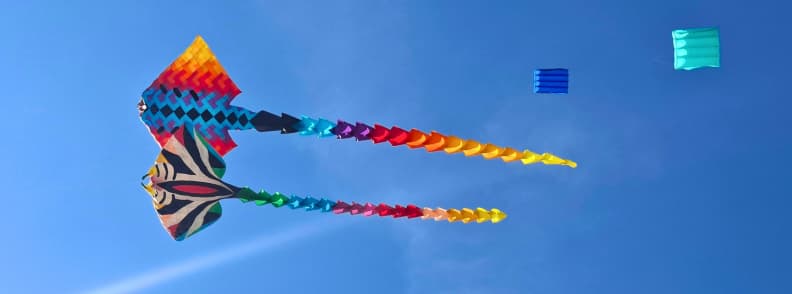
Is the Fréjus Kite Festival Worth Visiting?
After attending twice, I think the Fréjus kite festival is worth visiting. I’d drive around an hour specifically for FIA, and I plan to return.If you’re traveling here, Fréjus is better as a weekend planned around FIA, Port-Fréjus, the beach, and the old city. I wouldn’t book an international trip to France solely around the festival, though.
My Fréjus air festival review from a visitor: FIA isn’t a perfectly choreographed attraction where every display appears on cue and every practical detail runs smoothly. Wind changes the sky, popular workshops develop long queues, and the toilets disappointed me badly in 2026. Yet I left both visits wanting to come back.
What makes the Fréjus kite festival unique is how little effort it takes to see something genuinely unusual that makes you feel like a child again. Admission was free again in 2026, and Base Nature had enormous kites above the former naval aviation base beside the Mediterranean. Around them were Sportkite pilots, children making kites, concerts, and families picnicking under the pines.
My two visits also showed how different FIA looks from one year to another. In 2025, we concentrated almost entirely on the kites and I remember the sky seeming fuller. In 2026, the festival seemed bigger and busier, with many more activities around the flying fields, yet fewer kites in the air during part of our Sunday visit. That is personal observation, not an official comparison, and exactly the sort of variation I’d expect from an outdoor event ruled partly by wind.
FIA is a great family festival in France because younger children don’t need to understand anything before enjoying it. William was 1.5 on our first visit and 2.5 on our second. Giant flying animals were enough entertainment at both ages. In 2026, the carrots and the whale won!
Older children gain even more from the workshops and activities, so I’d place FIA high on my list for Fréjus with kids. It also has one major advantage for family budgets: general admission is free. This makes it an easy free family day out in France, especially if you bring a picnic and resist the temptation to treat every activity as compulsory.
Adults without children still have plenty to watch. Sportkite brings genuine technical skill, the giant creations are excellent for photography, and the aviation history of Base Nature gives the location another layer. You do need to accept that this is a family-heavy event. If children, strollers, and activity queues irritate you on principle, an afternoon at FIA is unlikely to convert you.
I’d also recommend this festival to local residents and expats who want a September outing without turning the day into a major expedition. As Fréjus expat events go, FIA has the advantage of being visual and easy to enjoy even if your French is limited. The crowd I heard around us was mainly French, with some international visitors and vendors mixed in.
Crowd tolerance is the main dividing line. The 2026 Sunday was busy from before noon until we left around 3 pm. Food areas, activity queues, and path junctions became congested, while the outer edges of the flying fields were easier. Someone who hates large public events should arrive early and keep the visit focused.
The other weak point is infrastructure under pressure. My visitor review of Fréjus kite festival Base Nature would be dishonest without mentioning the toilets. Food queues were long, too, so packing lunch improved our day considerably.
Weather adds another element of unpredictability. FIA needs workable wind, but stronger or unstable conditions also affect flying. The 2024 festival was canceled after severe weather was forecast, so this is one event where checking conditions before leaving home is smart, especially with a long drive attached.
Among the best kite festivals in France, Fréjus occupies a different category from Berck-sur-Mer and Dieppe. Those are larger destination festivals with longer programs and a deeper concentration of kite culture. I can’t pretend FIA competes with them on scale.
Fréjus has a different advantage. This is a giant kite festival in the South of France where you finish watching the sky and walk toward the Mediterranean. Port-Fréjus is beside Base Nature, with the beach just beside it, and Roman Fréjus close enough to fill another half-day. This combination gives this French Riviera kite festival a very good reason to exist beyond its size.
Is the Fréjus International Air Festival worth visiting for first-time visitors? Yes, especially if you’re already on the Côte d’Azur or elsewhere in the Var. Plan half a day, arrive early if you’re driving, bring water and lunch, and let the wind decide how much time you spend staring upward.
I’d return with William, and my current plan for another edition is even more practical. I’d like to arrive the evening before with a camper, park nearby, wake up without fighting the morning traffic and, after the 2026 toilet experience, enjoy the almost decadent luxury of having our own clean bathroom!
This is where my Fréjus air festival first-hand experience leaves me. FIA has rough edges, but it also gives families a free afternoon beside the Mediterranean with giant creatures floating overhead, serious kite pilots showing what the sport looks like at competition level, and enough room to wander until someone needs lunch, a nap, or both.
For me, the rough edges aren’t a reason to skip FIA. They’re simply part of planning the day properly. I went back once already, and I expect I’ll go back again.
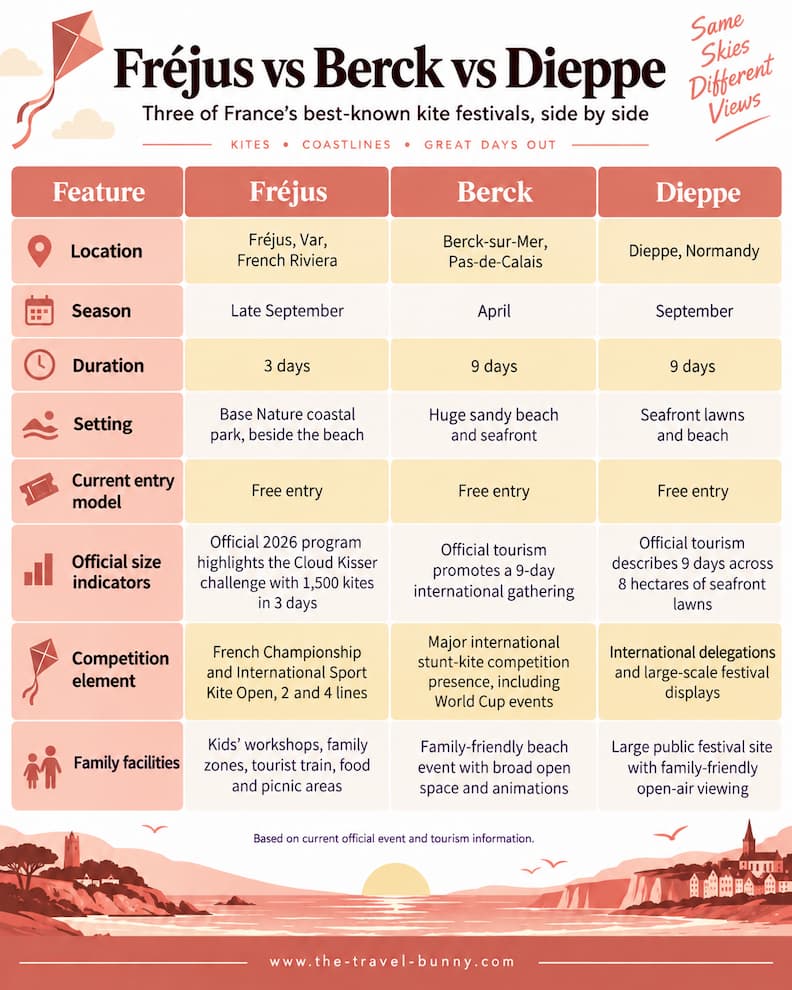
About the Author

Hi. I’m Mirela Letailleur, the travel writer behind The Travel Bunny, based in Provence-Alpes-Côte d’Azur and regularly exploring Fréjus, Saint-Raphaël and the wider Var with my family. I’ve visited Base Nature François Léotard many times and attended the Festival International de l’Air Fréjus in both 2025 and 2026, experiencing the Fréjus kite festival firsthand with a young child.
I write my French Riviera travel guides from repeated local experience, then verify practical details against current official sources. For this Festival International de l’Air guide, I’ve combined two years of personal visits with detailed research into the program, parking, transport, accessibility, weather, family activities, giant kites, Sportkite and the aviation history of Base Nature.
After planning your visit to the Fréjus Festival International de l’Air, check out these guides on The Travel Bunny
Autumn on the French Riviera. A Local’s Guide to the Côte d’Azur in September, October, and November
Les Étangs de Villepey. Complete Visitor Guide to Saint-Aygulf, Fréjus
Les Musicales dans les Vignes de Provence. What It’s Really Like at a Vineyard Concert