
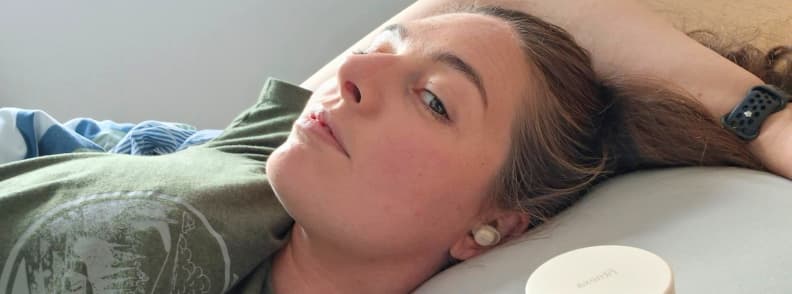
Most sleep-earbud reviews become less useful at exactly the point when the product becomes interesting, which is after the first comfortable night.
My Fitnexa SomniPods 3 review changed after several nights. My first impression was unusually positive. The tiny Fitnexa sleep earbuds fitted securely straight from the box, stayed put while I moved my head, and sounded way better than I expected from something designed around sleep.
Then my right ear started hurting. After the second night, I switched to a smaller fit on that side. The soreness lasted longer than the short adjustment period I had expected. Extended wear also left the skin around my ear cannal drier while increasing the amount of moist earwax I noticed, an awkward combination I already associate with wearing earbuds for long stretches.
This changed how I use the SomniPods 3. I no longer wear them through the night at home. Instead, I use them before sleep to watch a series, scroll TikTok for a while, or listen to music without disturbing my husband. I still appreciate them when I want strong sound isolation, especially around snoring. And I would pack them for a noisy hotel.
There is another reason I stopped wearing them all night. A few times, my toddler woke and my husband heard him before I did. I heard nothing. For a product sold partly on its ability to shut out nighttime noise, that is impressive performance and an important warning in the same sentence.
The software story also changed during my testing. The companion app on iOS is now called DUVA. I received no warning I noticed before the change, struggled to find the new app, had to log in again, and later started seeing inconsistent behavior with Auto Mode. Fitnexa’s own support pages still refer to the Fitnexa App, while Apple’s current listing calls it DUVA: Sleep & Recovery. DUVA’s website now places SomniPods 3 beside the upcoming DUVA ONE system, scheduled for November 2026.
So this isn’t the review I would have written after night one. It’s a more useful one. 🙂
Fitnexa SomniPods 3 Review
Disclosure: Fitnexa gifted me the SomniPods 3 for review. There was no requirement for positive coverage. The opinions, fit problems, software complaints, and recommendations below are mine. This article also contains affiliate links. If you buy through one, I may earn a commission at no additional cost to you.
Are Fitnexa SomniPods 3 worth it?
Yes for specific people, but my recommendation is narrower after extended wear.
| Best for | My verdict |
|---|---|
| Snoring beside you | Excellent isolation in my testing |
| Watching or listening in bed beside a partner | One of my favorite uses |
| Side sleepers | Promising, but fit needs testing over several nights |
| Hotels and noisy rooms | Strong travel use case |
| Daytime noise reduction | Useful |
| Parents who must hear a young child | I would no longer wear them overnight |
| Sensitive ear canals | Proceed cautiously |
| Buyers wanting simple software | The DUVA migration weakened my confidence |
| Clinical sleep tracking | Look elsewhere |
I found Fitnexa’s SomniPods 3 best for noise isolation, sound quality, compact size, and discreet pre-bed listening.
The downsides were the long-wear lack of comfort in my right ear, reduced awareness of my toddler, and the changing software ecosystem.
Fitnexa’s main store advertises SomniPods 3 at $159.99 during its Fall Sleep Sale, below the $189.99 regular price. Promotional checkout pages sometimes show lower totals, so I would check the live price before ordering.
My best use cases
Buying them for snoring, hotel noise, or bedtime listening?
Those are the situations where SomniPods 3 were the best for me. If they match what you need from sleep earbuds, check the Fitnexa price before deciding.
Check the current SomniPods 3 price →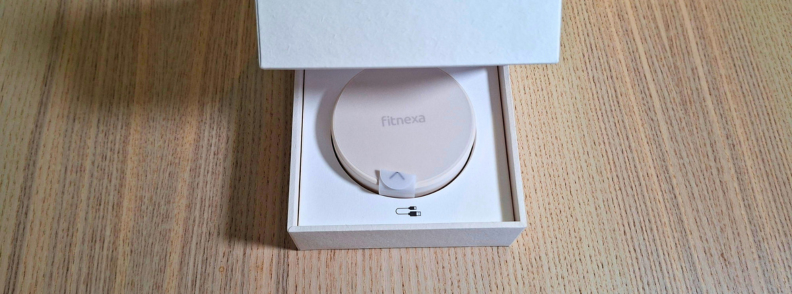
Fitnexa SomniPods 3 Specs and Price
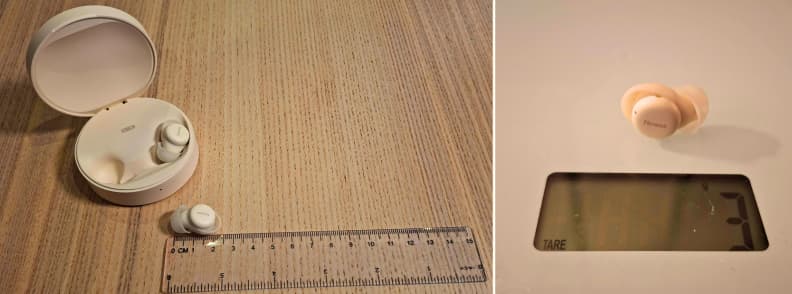
The SomniPods 3 weigh 3.3 g per earbud and are 9.9 mm thick. Fitnexa’s earbuds have Bluetooth 5.4, 4.6 mm drivers, Hybrid ANC, a 10-band EQ, sleep monitoring, IPX4 water resistance, USB-C charging, wireless charging, and support for SBC, AAC, aptX, and LDAC.
Diving deeper into SomniPods 3 sound quality, Qualcomm independently lists SomniPods 3 as QCC3091-powered earbuds supporting Snapdragon Sound, aptX Adaptive, aptX Lossless, LDAC, and Hi-Res Audio.
Fitnexa’s battery figures are:
| Use | Fitnexa claim |
|---|---|
| ANC off | Up to 12 hours (but the app never showed me that much) |
| Continuous ANC | About 6.5 hours |
| Bluetooth audio | About 9 to 10 hours |
| Auto Mode | About 9 to 11 hours |
| Case total | Up to 48 hours |
| Quick charge | 10 minutes for about 1.5 hours |
These remain manufacturer figures. I didn’t complete a clean drain-to-zero Fitnexa SomniPods 3 battery life test since they updated their app.
The Fitnexa SomniPods 3 price puts them among the best sleep earbuds under 200 dollars on paper. The $159.99 US offer undercuts Soundcore Sleep A30’s $199.99 US positioning and Ozlo Sleepbuds 2 at $279. (Prices change, so check checkout totals before deciding.)
Fitnexa offers a 30-day return period for eligible direct purchases and an 18-month commercial warranty on the main device. EU consumer rights provide a minimum two-year legal guarantee for faulty goods, separate from a manufacturer’s commercial warranty.
EU buyers should also check the final tax-inclusive checkout price. Fitnexa states that VAT is calculated according to destination and that import duties and customs-clearance fees are covered for EU shipments.
Check before you decide
See what SomniPods 3 cost today
Fitnexa changes prices and promotions, so I would check the current offer before judging whether SomniPods 3 are worth the money for you.
Check the current SomniPods 3 price →
What Comes in the Box
My Fitnexa SomniPods 3 unboxing quickly made one thing clear: a large share of the package is devoted to getting the earbuds comfortable in your ears. Together with the two SomniPods 3 and their charging case, Fitnexa supplies 10 silicone ear tips in two shapes and five sizes, plus four pairs of ear wings, including the set already fitted to the earbuds.
The large fitting kit is important and my own experience eventually proved why. I initially thought the preinstalled combination was perfect. The earbuds stayed locked in place while I jumped, tilted my head, opened my mouth, and yawned. I had never had a pair of earbuds settle so securely on the first attempt! But two nights were enough to change my opinion.
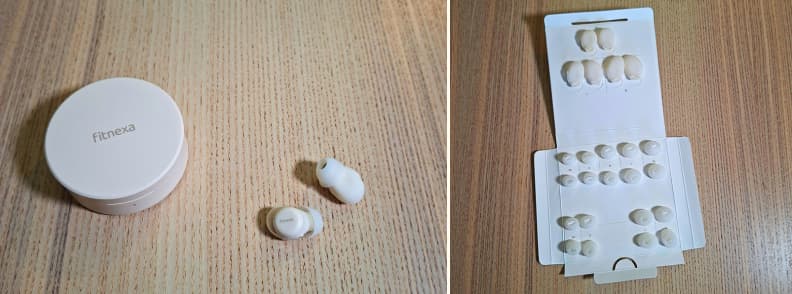
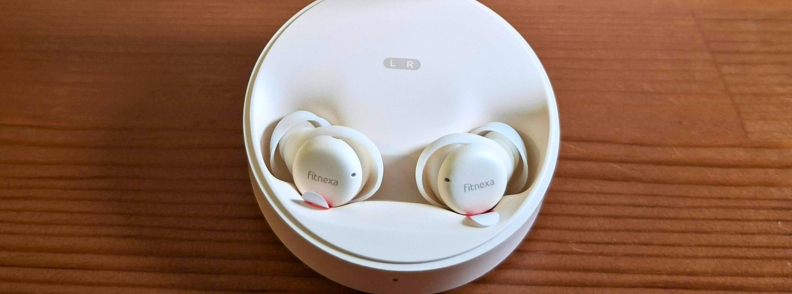
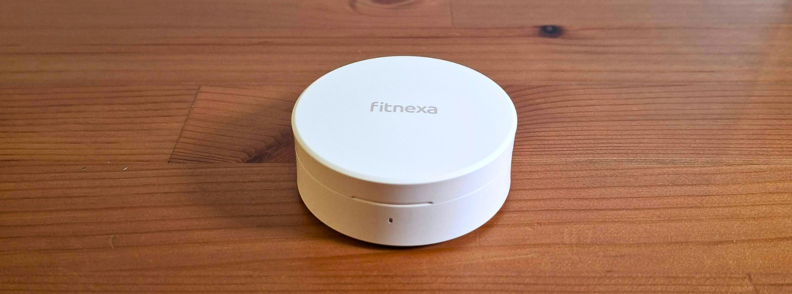
The charging case is a low, rounded puck with the earbuds resting inside, left and right markings between them, and a status light on the front side. Charging comes through USB-C or a wireless charging pad. The box also includes a USB-A to USB-C charging cable, but no wall adapter, so you’ll need a USB power source of your own.
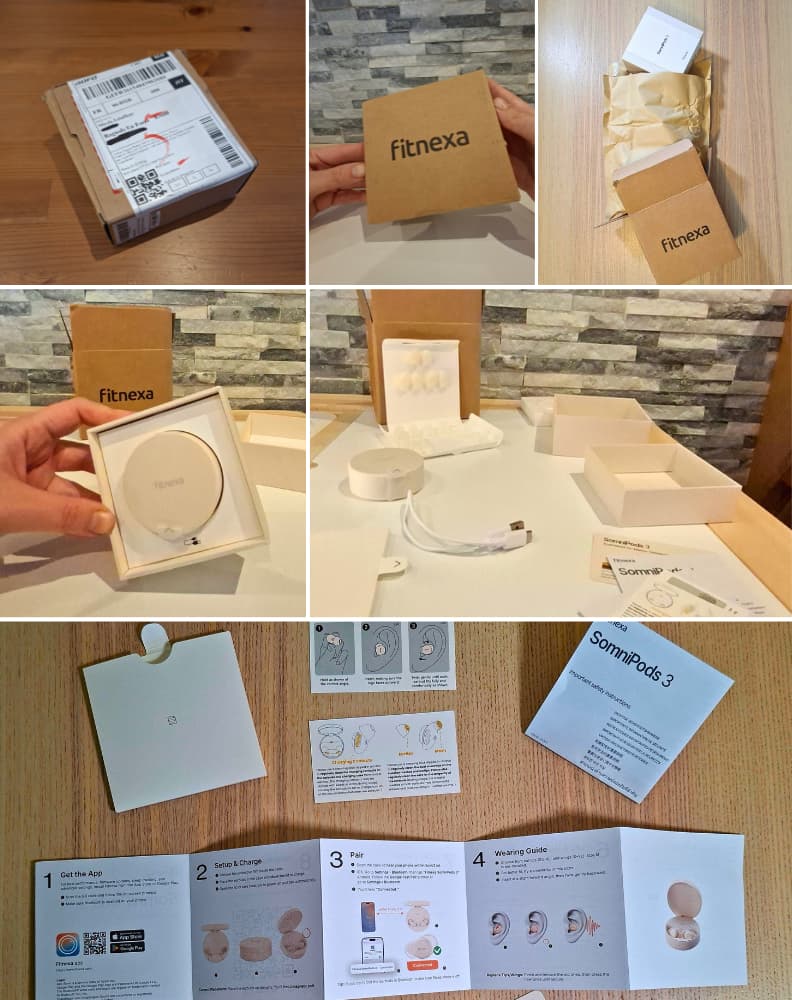
During my SomniPods 3 unboxing, I also found a Quick Start Guide, which becomes useful almost immediately because these earbuds have several modes and touch controls to learn. Setup starts by removing the protective film, charging the earbuds, opening the lid near your phone, and pairing via Bluetooth.
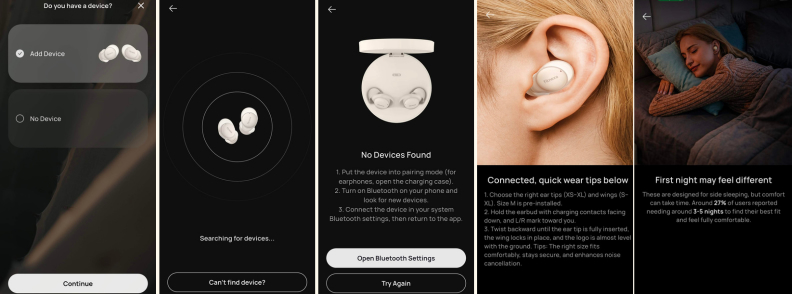
The Fitnexa app handles firmware updates, sleep data, noise-control settings, and the deeper configuration options later on.
What Fitnexa Claims vs What I Verified
Fitnexa advertises up to 42 dB peak noise reduction through Hybrid ANC, plus passive isolation and sound masking. The company also promotes SomniPods 3 for side sleepers, snoring, traffic, aircraft cabins, shift workers, and noisy apartments.
I verified excellent isolation against snoring and good isolation during ordinary listening. I also verified Bluetooth streaming, offline sounds, the adjustable EQ, touch controls, rapid charging behavior, sleep tracking, and app-based ANC controls.
The biggest disagreement between Fitnexa’s marketing and my experience concerns the all-night comfort. The low-profile shell reduces pillow pressure, but low profile doesn’t guarantee that your ear canal and surrounding skin will tolerate the fit for several consecutive nights.
How I Tested the SomniPods 3
I didn’t want to publish a Fitnexa SomniPods 3 review after two weeks, while the earbuds were still new to me and every feature was competing for attention.
I have used SomniPods 3 over several nights, repeated bedtime listening sessions, daytime noise reduction, snoring exposure, and controlled simulations of travel noise at home.
I also used them naturally on evenings when I wanted to watch a series beside my sleeping husband, quick TikTok sessions before bed, music, charging them after forgetting to put them away before falling asleep, and dealing with companion app.
My travel testing has an important limitation. I currently travel almost everywhere with my toddler, usually without another adult. I can’t try to fall asleep on a plane or train while I am solely responsible for him in a crowded public place.
So I recreated transport-style background noise at home, which was safer and easier to repeat. My controlled tests included low transport hum, hotel-style background noise, voices, music, household noise, sudden sounds, and snoring.
Real use supplied the details a controlled test misses: soreness, earwax, bedtime convenience, toddler awareness, charging habits, app changes, and the small annoyances that appear after the initial excitement has gone.
I didn’t perform a Fitnexa SomniPods 3 teardown. Opening the earbuds would destroy the pair Fitnexa gifted me and answer a different type of technical inquiry. My review concentrates on the product a traveler or sleeper receives and lives with: comfort, ANC, sound masking, audio, battery life, sleep modes, the app, sleep tracking, charging, and day-to-day reliability.
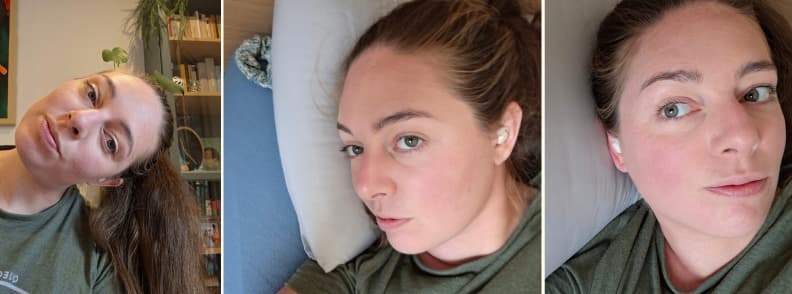
Comfort for Side Sleepers and how my opinion changed
My early Fitnexa SomniPods 3 comfort during side sleeping impression was excellent. The shells sat flatter than ordinary earbuds and the factory tips and wings seemed perfect.
The first night did little to challenge my assumption, so I thought everything was perfect. But after the second night, I had to reconsider.
The First Fit Was Secure, Then My Right Ear Started Hurting
The original fit impressed me with how stable it felt. I moved my head aggressively while awake, yawned, tilted from side to side, and never dislodged either earbud.
Overnight use exposed a different problem. After my second night, my right ear became sore enough that I switched to a smaller fit combination on that side. The pain lessened but didn’t disappear within the few-day adjustment period I had expected.
This is why my Fitnexa SomniPods 3 review for side sleepers now comes with a qualification: a fit that seems perfect while awake may still create pressure after several consecutive nights.
The smaller right-side fit solved much of the pressure issue, but introduced a different compromise. I lost that right earbud in bed once after downsizing it. Only once!
Still, the tradeoff is now obvious. The bigger configuration stays planted but hurts me. The smaller one is softer on my ear but has escaped once and has required more adjustment while awake, too.
This is a fitting problem worth knowing before you decide one night is enough to judge these earbuds.
Medium Pillow and Firm Mattress Testing
I sleep mostly on my side with a medium-firm memory-foam pillow and sometimes move onto my stomach on a firm mattress.
The shell creates less of a hard pressure point than ordinary earbuds. I still consider the low-profile shape well designed for pillow contact. My problem developed around the in-ear fit, not because a large plastic housing was digging into the pillow.
This distinction matters when evaluating comfortable earbuds for sleeping on your side. A slim shell solves only one source of discomfort. The tip, wing, canal pressure, skin response, and length of wear still matter.
I can’t describe SomniPods 3 as earbuds that don’t hurt during side sleeping without adding a small asterisk because they did start hurting my right ear after repeated use.
Interestingly, my left ear never forced the same change. However, Fitnexa’s app showed I tend to sleep more on my right side than my left side. Had I slept more on my left side, would I have had the same issues with my left ear?
Dry Skin, Moist Earwax, and Extended Wear
Long sessions also changed the skin around my ears. In my case, extended earbud use tends to dry the skin where the earbuds sit while increasing moist earwax. SomniPods 3 produced the same result after repeated overnight wear.
This sounds contradictory, but skin irritation and trapped moisture are separate issues.
Cleveland Clinic notes that sleeping with earbuds may contribute to pressure irritation, earwax accumulation, and trapped moisture inside the ear canal. France’s Ameli health service also notes that repeated use of in-ear headphones may increase earwax secretion in some people.
My experience doesn’t mean everyone will develop the same reaction. It just means I did. And once the soreness stopped being a temporary novelty and started becoming something I was planning around, overnight wear stopped being worthwhile for me.

Do SomniPods 3 Fall Out Overnight?
Do Fitnexa SomniPods 3 fall out while sleeping? Mine rarely did.
With the original fitting, retention was excellent. After switching my right ear to the smaller configuration, I found the right earbud loose in the bed only once. Luckily, it was easy to find.
That single incident doesn’t bother me as much as persistent ear pain would. With a choice between an occasional overnight escape and a larger tip that leaves my ear sore for days, I chose the smaller fit and accepted the search party in the sheets.
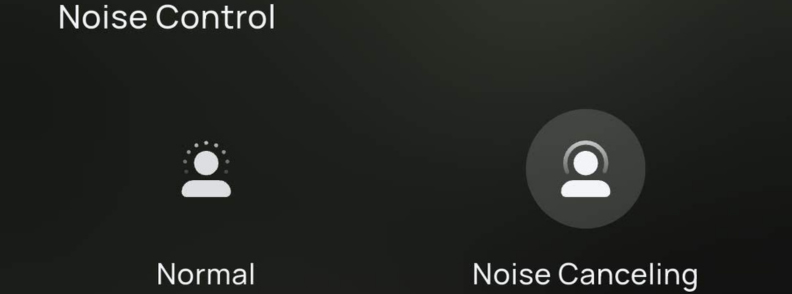
Noise Reduction. ANC vs Passive Isolation vs Sound Masking
SomniPods 3 have active noise cancelling, but ANC is only one part of their noise-control system. Fitnexa combines hybrid ANC with the physical seal created by the silicone tips and with sound masking through sleep audio. These three approaches target different kinds of noise, which is why I tested them separately instead of treating noise cancelling as one convenient catch-all. Fitnexa describes the SomniPods 3 as offering up to 42 dB of hybrid ANC, with actual performance varying according to fit and surroundings.
The SomniPods 3 ANC targets persistent low-frequency sounds, including the sort of hum produced by air-conditioning, traffic, and transport. The low-profile design changes the sleeping experience, but the underlying principle is familiar to that of other ANC sleep earbuds: microphones detect external sound and the earbuds produce an opposing signal to reduce part of what reaches your ears.
Passive isolation also matters. A good silicone seal physically reduces outside sound before electronics enter the picture. This is why fit affects SomniPods ANC performance as well as comfort. Noise blocking earbuds with a poor seal surrender part of their advantage before ANC even starts.
Then, sleep earbuds noise masking adds a steady sound that makes remaining disturbances less prominent instead of trying to cancel them. Fitnexa specifically promotes white noise and sleep soundscapes, while the SomniPods 3 also stream ordinary Bluetooth audio. This means you can use them as white noise earbuds or brown noise earbuds with the appropriate audio source. Most sleep sound earbuds rely heavily on this approach, sometimes without ANC at all.
SomniPods 3 sound masking with white noise therefore isn’t the same thing as active noise cancellation. ANC attempts to reduce incoming sound, masking adds another sound over what remains, and passive isolation blocks part of the sound mechanically. Fitnexa combines all three to protect you from noises like an air-conditioner, snoring, voices, and a door closing with equal success.
My Fitnexa SomniPods 3 noise cancellation test left me with a simple conclusion. Isolation is one of the product’s strongest areas. My experience was very positive against sustained noise and snoring.
Best fit for this problem
Trying to sleep through snoring or hotel noise?
This is where SomniPods 3 made the strongest case for me. The combination of ANC, passive isolation, and masking worked better than the sleep-tracking extras ever did.
See SomniPods 3 at Fitnexa →Snoring Test
Snoring ended up being one of the easiest SomniPods 3 claims for me to judge because the difference was obvious without a decibel meter.
Fitnexa SomniPods 3 for loud snoring performed well in my testing. With a secure seal, nearby snoring became less intrusive. I could still barely identify the sound if I paid attention to it, but I no longer had every change in rhythm dragging my attention back toward my husband beside me.
My Fitnexa SomniPods 3 snore masking efficiency test also clarified what each layer contributes. The silicone tips provide passive isolation before ANC enters the equation. ANC helps reduce lower, steadier parts of the sound. A sleep sound or other audio then masks some of what remains.
This is why SomniPods 3 noise cancellation for a snoring partner impressed me even though ANC alone doesn’t erase every frequency produced by snoring. Fitnexa itself describes SomniPods 3 as using Hybrid ANC, passive isolation, and built-in sleep sounds together.
According to my SomniPods experience, they belong among the best sleep earbuds for loud snoring, but I would buy them expecting very good reduction, not complete silence.
Do sleep earbuds actually block snoring? Good ones reduce how dominant snoring becomes. SomniPods 3 did exactly that for me.
Do SomniPods 3 block partner snoring? In my case, they isolated it well enough to make the sound much easier to ignore.
The SomniPods also performed well as earbuds that block a snoring partner because the physical seal contributed before I played any masking audio. This means I didn’t need to cover one loud sound with another loud sound.
Anyone researching how to stop hearing snoring with sleep earbuds should pay close attention to fit. A loose tip weakens passive isolation and also reduces ANC performance.
For sleep earbuds for partner snoring, I would therefore spend the first nights testing tip size before turning masking volume upward. Better sealing is a smarter first adjustment than louder playback.
My experience with snoring earbuds therefore stayed positive even after my opinion of all-night comfort changed. If your priority is snoring noise cancelling earbuds, SomniPods 3 combine enough approaches to deserve serious consideration.
Snoring is one of the situations where SomniPods 3 impressed me most. Check the current Fitnexa price before paying the regular $189.99 price!
Aircraft, Train and Hotel Noise Test
I travel with my toddler almost everywhere at the moment, often without another adult. Falling asleep on a plane or train while I am responsible for him in a crowded place is off the table.
So I brought the travel noise home. I recreated steady transport noise, hotel-style background sound, traffic, and nearby voices under repeatable conditions. A recording in my bedroom isn’t an aircraft cabin, and I’m not presenting one as the other. The value comes from hearing the same sound twice while changing the earbud setting.
Sleep earbuds for airplane cabin noise are mainly dealing with a persistent low-frequency background. That is where ANC has the clearest advantage. Fitnexa lists aircraft cabins, traffic, and air-conditioning among the environments targeted by its Hybrid ANC system.
The effect was convincing with steady noise. The background receded enough for my own audio to sit clearly over it at a reasonable volume.
Hotels are less tidy acoustically. My Fitnexa SomniPods 3 for hotel noise test included steady hum, voices, traffic, and sudden interruptions because real hotel rooms rarely offer one convenient sound source at a time.
I still rate SomniPods positively among sleep earbuds for hotel noise despite giving up on wearing them all night at home. A few nights in a loud room is a different use pattern from putting something inside my ears every evening for months.
Traffic varies too. Sleep earbuds for traffic noise at night need to reduce the constant road bed while leaving enough tolerance for individual vehicles passing at different volumes. SomniPods handled the steadier background better than isolated sharp sounds.
Trains fall somewhere between an aircraft and a hotel. Mechanical noise is predictable. Doors, announcements, luggage, conversations, and people moving around are the variables.
I would therefore include SomniPods 3 on my shortlist of best sleep earbuds for long-haul flights and hotel noise, with one important limitation from my own life. If I am traveling alone with my toddler, I need to be able to listen to him and everthing happening around us. I can’t use them to make myself less aware of him.
Battery Life and charging
I originally planned a neat laboratory-style Fitnexa SomniPods 3 battery life test with separate drain-to-zero runs for ANC, no ANC, and Auto Mode.
But my ears changed the test plan. Once repeated overnight wear continued to bother me despite sizing down, I stopped forcing full nights for the battery life test. But I had already taken enough screenshots before and after several sessions to document what happened during my real use.
These screenshots reveal something the advertised maximum hides: SomniPods 3 battery life changes substantially according to mode, playback, and what happens after sleep detection.
There is one constant across my overnight tests which makes the comparison cleaner: I always set ANC to remain on for one hour, then switch off. I didn’t leave ANC running continuously through the night.
Fitnexa quotes up to 12 hours in Sleep Mode, 9-10 hours of Bluetooth audio, 9-11 hours in Auto Mode, 6.5 hours with continuous ANC, and up to 48 hours with the charging case.
My own screenshots support the overnight Auto Mode range, though the remaining battery differed more between two comparable nights.
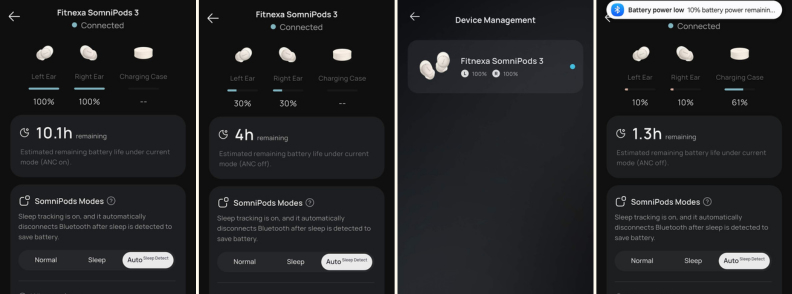
My Real Auto Mode Battery Results
My SomniPods 3 arrived very well prepared for immediate testing. Both earbuds showed 100% battery after unboxing, and the charging case was already at 96%. I could pair them, start experimenting, and postpone the charging. So:
- On the first day, at 23:03, both earbuds were at 100%. I had Auto Mode selected, ANC was active, and I had set ANC to switch off after one hour. The app estimated 10.1 hours remaining.
- At 07:52 the following morning, both earbuds still showed 30% after 8 hours and 49 minutes. This means the pair used 70 percentage points during a real overnight session and still had a useful reserve in the morning.
- Four nights later, I repeated a similar setup. At 23:20, both earbuds started again at 100% in Auto Mode with ANC active and the one-hour ANC timer selected. The app again estimated 10.1 hours.
- At 07:54 the following morning, both earbuds were down to 10% after 8 hours and 34 minutes.
I have two sets of data where everything starts charged at 100%:
| My Auto Mode test | Start | Morning check | Time elapsed | Battery left |
|---|---|---|---|---|
| Day 1 | 100%, Auto Mode, ANC on, 1 h timer | 30% L / 30% R | 8 h 49 min | 30% |
| Day 4 | 100%, Auto Mode, ANC on, 1 h timer | 10% L / 10% R | 8 h 34 min | 10% |
That is a meaningful result for sleep earbuds that last all night. Both documented Auto Mode sessions covered more than eight hours without either earbud dying.
Because the ANC timer was identical, the difference between 30% and 10% comes from different sleep detection, playback, Bluetooth behavior, volume, background processing, and other variables.
Auto Mode comfortably covered two separate 8.5-hour nights in my testing, but the battery margin at breakfast varied substantially.
What Happened During a Heavier Evening Session
I also have a shorter sequence sample, from a different time.
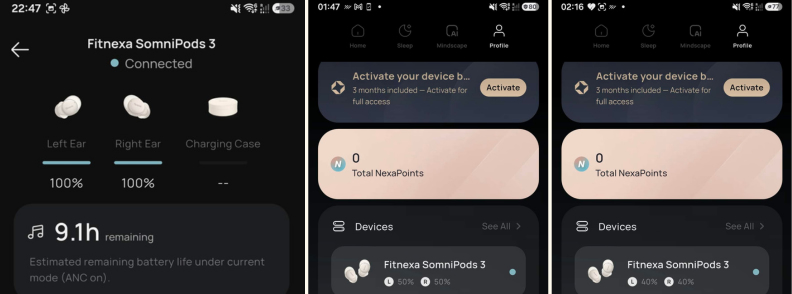
At 22:47, both earbuds were at 100%. Normal Mode was selected, ANC was active, and the timer showed 58 minutes and 40 seconds remaining before ANC switched off. In other words, this session followed the same rule I used throughout testing: ANC for the first hour, then ANC off.
- The app estimated 9.1 hours of remaining battery at the start.
- At 01:47, both earbuds showed 50%.
- At 02:16, both showed 40%.
So over 3 hours and 29 minutes, the displayed battery dropped from 100% to 40%.
This is not a continuous-ANC battery result. ANC was active for only the first hour, exactly as planned. It’s still useful because it documents a noticeably heavier drain during Normal Mode use than I saw during my better Auto Mode overnight result.
The difference also supports one of Fitnexa’s main reasons for Auto Mode. Once sleep is detected, Auto Mode disconnects Bluetooth and switches into the sleep-focused behavior shown directly in my app screenshots, which reduces unnecessary overnight activity.
The App’s Battery Estimate Changes With Mode
My screenshots also document how the app changes its remaining-time estimate according to the selected setup. At 100% battery, I recorded:
| Setting shown in my app | ANC | App estimate |
|---|---|---|
| Normal Mode | Off | 10 h |
| Normal Mode | On, with 1 h timer | 9.1 h |
| Auto Mode | Off | 11.1 h |
| Auto Mode | On, with 1 h timer | 10.1 h |
These are app estimates, not measured runtimes. They still illustrate why how long does the battery last on Fitnexa SomniPods 3 according to mode.
How long do SomniPods 3 batteries last? Up to 12 hours describes one configuration, but I’ve never seen that estimate in the app, only on Fitnexa’s specs. The highest estimation I could get with everything charged was 11.1 hours.
My battery verdict
I would buy them for Auto Mode, not their battery claim
Overnight Auto Mode worked better for me than long Bluetooth streaming. If that matches the way you plan to use SomniPods 3, check the current price before deciding.
Check price and availability →Would SomniPods 3 Last Through a Long Flight?
My battery tests make me feel comfortable packing SomniPods 3 for a long-haul flight, but I would plan on using the charging case during the trip.
Auto Mode covered both of my documented overnight tests. With ANC running for the first hour, I still had 30% after 8 hours 49 minutes on one night and 10% after 8 hours 34 minutes on another.
Streaming is a different story. While watching a series in Normal Mode, battery dropped from 100% to 40% in only 3 hours 29 minutes. This result is much lower than Fitnexa’s quoted 9 to 10 hours of Bluetooth playback.
So I would switch modes on a long flight according to what I was doing. Auto Mode looks capable of covering a long sleep period. Several hours of continuous Netflix, music, or other Bluetooth streaming requires a charging break.
The good news is that a flight naturally provides opportunities for a charging breaks. I would put the SomniPods back in their case while eating, going to the bathroom, or taking a break from whatever I was watching. I already know from everyday use that short top-ups are easy to fit into an evening.
And in my case, a 12-hour flight could never mean 12 hours of sleep anyway. Especially with a toddler beside me, and despite traveling with a second adult!
Charging Case and Real-Life Top-Ups
The Fitnexa SomniPods 3 charging case has been easier to live with than my habit of remembering to use it. More than once, I have become too sleepy to put the earbuds back in the case before falling asleep. The next evening, I return them to the case while I get ready for bed. By the time I want to watch something or listen to music, they have enough charge to be useful again.
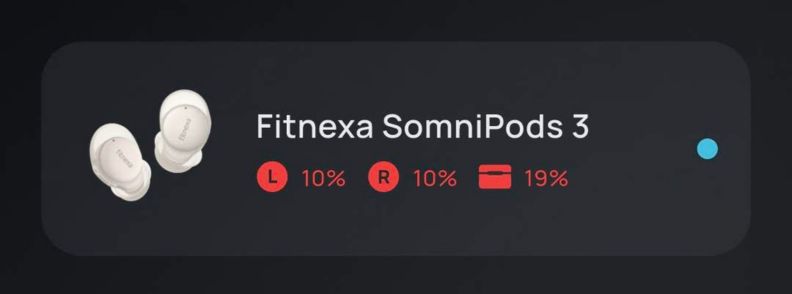
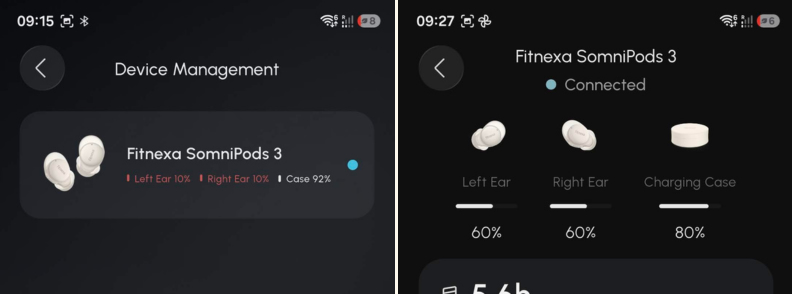
I finally tested that instead of relying on the vague impression that they charge fast. I let both earbuds run down completely, then put them into the case for exactly 10 minutes. The case started at 92%.
The DUVA app first showed both earbuds at 70%, then settled at 60% shortly afterward. The case had dropped to 80%. I therefore count the result as roughly 60% charge after 10 minutes from empty, with the case using 12 percentage points of its own battery.
Then I left the earbuds out and used them. The first part of the test ran in Auto Mode with ANC on. Later, I switched to Normal Mode, turned ANC off, and streamed at medium volume.
The right earbud died after 3 hours 4 minutes. The left lasted 3 hours 16 minutes.
This makes my SomniPods 3 10-minute quick charge test much more impressive than Fitnexa’s own claim of around 1.5 hours of playback from a 10-minute top-up. Mine lasted over twice that long, although this was a mixed-use test, not a controlled Bluetooth-only benchmark.
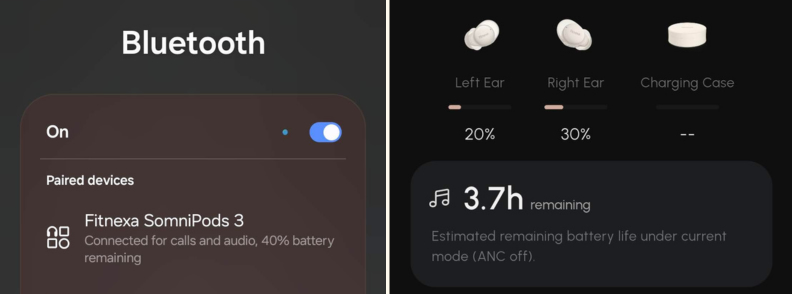
There was one odd detail. DUVA and my phone didn’t always agree on the remaining battery. At one point Android showed 40% while DUVA showed 20% in the left ear and 30% in the right. A few minutes later, Android dropped to 20% too. So I trust the shutdown times more than the estimated percentages. But this is something that would be much harder to track if you were to connect the earbuds to your laptop instead of your smartphone, though.
That is also why short charging windows have been enough for the way I use SomniPods 3 now. A quick charge while I shower gives me plenty of time for a series, music while gardening, or some late-night scrolling.
The Fitnexa SomniPods 3 charging case wireless charging support gives me another option. The case accepts USB-C and wireless charging. It’s something I appreciate more while traveling than at home.
Bluetooth, Offline Sounds, and Sleep Modes
The three listening modes sounded a bit complicated when I first opened the app. But after using them for a few weeks, I ended up giving each mode a very specific job.
Fitnexa SomniPods 3 Bluetooth streaming vs Sleep Mode. Normal Mode is what I use while I am still awake. My phone keeps streaming, so I watch a series, listen to music, or spend a little too long on TikTok while my husband sleeps beside me.
Sleep Mode is for the nights when I want the earbuds to turn into sleep gear, with sleep tracking and the built-in audio taking priority.
SomniPods 3 Auto Mode is between the two. I start with whatever is playing on my phone, and the earbuds switch behavior after detecting sleep. Like this, I can allow myself to dose off naturally. In the app, Fitnexa explains that Bluetooth disconnects at that point to save battery.
Fitnexa SomniPods 3 automatic sleep detection mode is also the only reason my overnight battery results look respectable beside my Bluetooth streaming result.
Sleep Mode is the option I use least because I no longer wear SomniPods through most nights.
Watching Series, Spotify, Podcasts, and Music Before Bed
Streaming music on Fitnexa SomniPods 3 turned out to be more useful to me than the sleep tracking. I like wearing the earbuds in the hour before bed, they’re the most comfortable earbuds I’ve owned for when I am awake! A couple of hours in my ears while awake is completely different from using them during sleep until morning.
I now watch a series without waking my husband. I listen to music. I scroll for a while. The isolation keeps dialogue clear without forcing me to raise the volume.
The touch controls remain one of the better details. My previous tiny earbuds had a talent for interpreting please sit properly in my ear as yes, absolutely, skip this track! SomniPods need a clearer tap, and I love this.
Connection Stability and Phone-Free Use
My first connection was the least elegant part of setting up the SomniPods 3. The Fitnexa app kept failing to complete the pairing, so after several attempts I left the app, opened my phone’s Bluetooth settings, connected the earbuds there, then returned to Fitnexa to finish setup. That detour solved the problem, and it also matches Fitnexa’s own pairing instructions for iPhone and Android.
The Fitnexa SomniPods 3 app for iOS and Android handles settings, sleep data, advanced controls, and software updates. Fitnexa is compatible with iOS 15 or later and Android 11 or later. Bluetooth still handles ordinary audio streaming, so the app and the Bluetooth connection have separate jobs.
Fitnexa SomniPods 3 app not connecting fix: Step outside the app and confirm the earbuds appear in the phone’s Bluetooth menu first. Fitnexa’s manual also points out one easily missed detail: Sleep Mode hides the earbuds from normal Bluetooth scans. If they suddenly seem to have vanished, switching Sleep Mode off is worth checking before starting a small personal feud with the pairing screen.
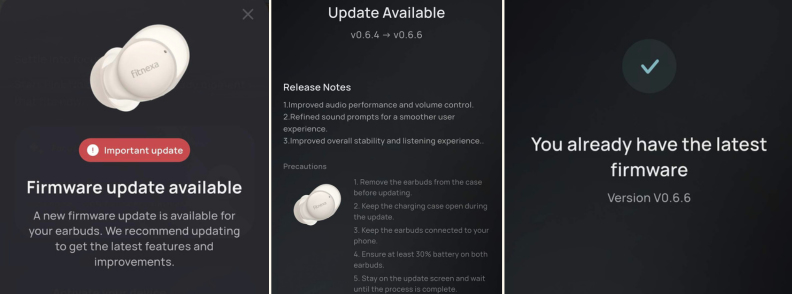
The same app handles a SomniPods 3 firmware update. Fitnexa places firmware controls under the app settings, along with advanced configuration. The Fitnexa SomniPods 3 firmware update process is to keep the earbuds connected to the app, open Settings, and follow the firmware prompt when an update is available.
Phone-free use is one of the SomniPods 3 features I find most relevant for travel. The earbuds carry three built-in tracks, ocean waves, rain, and wind. These SomniPods 3 offline sounds play directly from the earbuds, so SomniPods 3 offline sounds without a phone remain available after setup. Fitnexa also says the earbuds run offline during sleep, which removes dependence on hotel Wi-Fi, roaming data, or a phone sitting beside the bed all night.
Do SomniPods 3 work without internet? The built-in sleep tracks do. Ordinary Spotify, podcasts, audiobooks, and other streamed audio still depend on the phone and whatever connection the chosen service requires. SomniPods 3 also work without a phone for their stored sleep audio, although setup, firmware management, sleep data, and wider audio choices still belong in the Fitnexa app.
If Bluetooth starts misbehaving later, the official reset process is simple to remember. To reset Fitnexa SomniPods 3 sleep earbuds, place both earbuds in the charging case, leave the lid open, and hold the case button for eight seconds until the LED flashes amber three times. I tried doing this when they changed the app from Fitnexa to DUVA, because I had trouble connecting my earbuds to the new app.
A SomniPods 3 Bluetooth connection drops fix depends on where the problem starts. Troubleshooting begins by checking that Sleep Mode isn’t hiding the earbuds, then reconnecting through the phone’s Bluetooth settings, checking the app and firmware, and using the factory reset if the connection still refuses to cooperate.
Fitnexa App, Sleep Tracking, and AI Coach
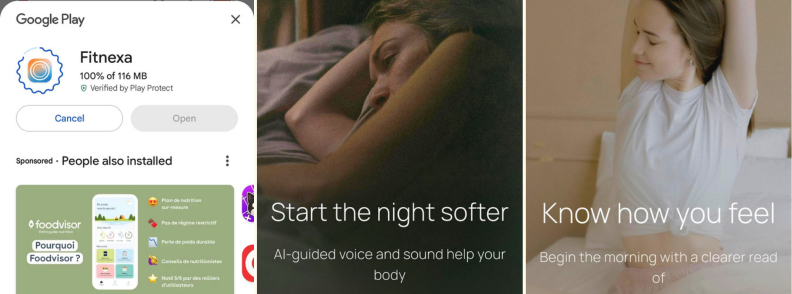
I installed the Fitnexa app and went through the full onboarding process, including questions about my sleep routine, goals, and personal factors which might affect sleep. One screen even asked about pregnancy, postpartum or breastfeeding, and menopause, with the option to decline answering. As a mom, I found it interesting that the app is factoring in these aspect, even though our breastfeeding journey was gently nearing its end at 2 years and 9 months.
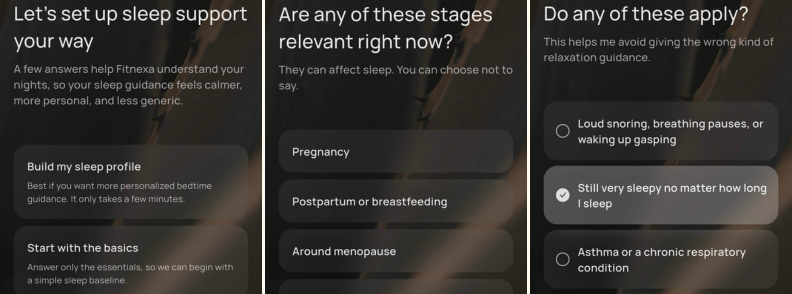
I chose the shorter setup route where possible, but even that asked for a lot of information, reminding me that these are smart sleep earbuds, not just Bluetooth headphones with a rain track attached.
The software changed while I was testing the earbuds. I started with the Fitnexa app, which controlled the listening modes, ANC, alarms, firmware, and Fitnexa app sleep tracking. I don’t have screenshots from that original app version taken during the nights I did the test, because I thought I could always go back to that information just as it was. However, I do have the sleep-history records I saved afterward, once Fitnexa became DUVA.
In truth, the change caught me by surprise. I went looking for the app I already knew, even panicked a bit when I didn’t see it in my phone again. I found DUVA instead, I had to google what it was, I was considering malware at that point. Luckily, it wasn’t the case.
I had to log into DUVA, but I didn’t have to fill in the sleep questionnaire again. However, I did struggle to pair the SomniPods 3 again. My first setup with Fitnexa had already taken several attempts before I paired the earbuds through my phone’s Bluetooth settings and returned to the app. Repeating part of that process after a rebrand didn’t improve my experience.
The unexpected switch to DUVA also changed how I think about long-term ownership. An app rebrand doesn’t shorten the physical life of the earbuds. Still, SomniPods 3 depend heavily on software for modes, sleep data, settings, updates, and the wider sleep tracker earbuds experience. Having that software change identity while I was still writing the review made the 18-month commercial warranty look less reassuring to me than it had at the beginning.
How Accurate Did Sleep Tracking Look?
My confidence in the surrounding software is difficult to measure. Over three consecutive nights, I tracked my sleep with the earbuds/app and my fitness watch/Google Health app.
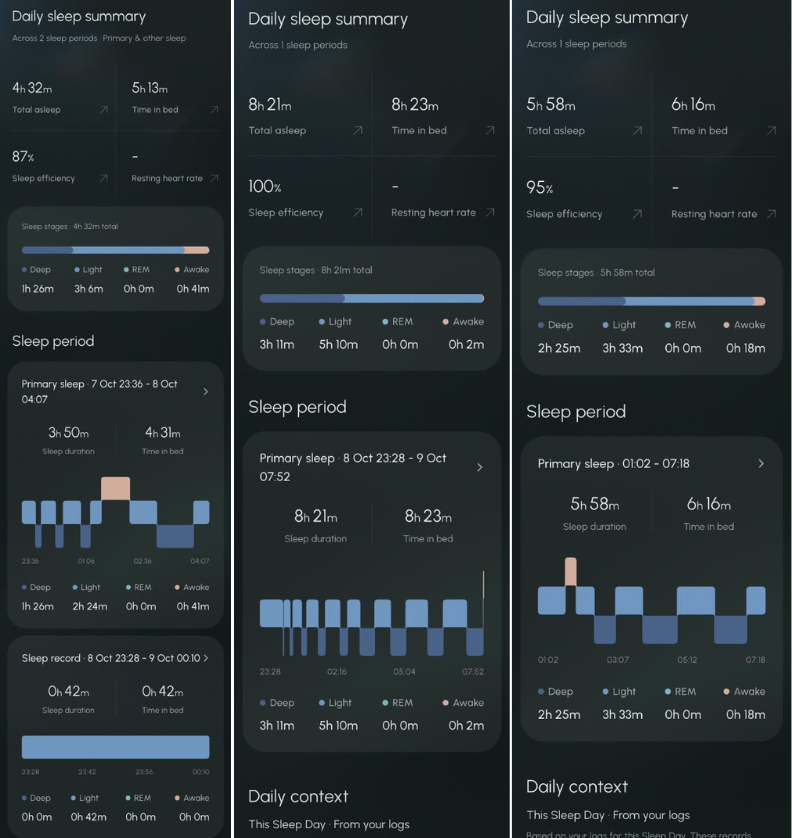
SomniPods 3 do not record REM as a separate sleep stage. The earbuds estimate awake, light sleep, and deep sleep, which DUVA then displays in the sleep history. So the 0 REM shown in my DUVA records show 0 REM because SomniPods 3 don’t track REM.
| Night | Google Health | Fitnexa history now in DUVA | Main difference |
|---|---|---|---|
| 1 | 7 h 18 min asleep, 1 h 09 min awake, 1 h 31 min REM, 4 h 16 min light, 1 h 31 min deep | Primary sleep only. 3 h 50 min asleep, 41 min awake, 0 REM, 2 h 24 min light, 1 h 26 min deep | DUVA stopped tracking around 04:07 even though I remained asleep until morning, so several hours of sleep are missing from its record. |
| 2 | 7 h 54 min asleep, 7 min awake, 2 h 02 min REM, 3 h 59 min light, 1 h 53 min deep | 8 h 21 min asleep, 2 min awake, 0 REM, 5 h 10 min light, 3 h 11 min deep | DUVA recorded 27 min extra sleep and moved a huge share into deep/light sleep |
| 3 | 5 h 14 min asleep, 33 min awake, 1 h 21 min REM, 2 h 25 min light, 1 h 28 min deep | 5 h 58 min asleep, 18 min awake, 0 REM, 3 h 33 min light, 2 h 25 min deep | DUVA recorded 44 min extra sleep, a lot less awake time, and again zero REM |
Day 1 exposed a problem. Google Health followed my sleep until around 08:08, which matches what actually happened. That’s kind of when my toddler wakes me up every day. DUVA’s primary record stopped at 04:07 even though I was still asleep. The missing hours are not awake time, they are sleep that DUVA failed to record.
DUVA also placed a separate 42-minute sleep period from the following night inside the same daily view, which makes the history harder to read at a glance. I excluded that second period from the comparison because it belongs to another night.
Day 1 was the worst result for Fitnexa SomniPods 3 sleep tracking accuracy. The issue wasn’t a slightly different interpretation of sleep stages. The app stopped tracking partway through a night I know continued for several more hours.
Days 2 and 3 give us the cleaner comparison. The start and end times are close, but the stage data is nowhere near close.
DUVA also records more deep sleep on the two complete comparable nights. On Day 2, deep sleep jumps from 1 h 53 min in Google Health to 3 h 11 min in DUVA. On Day 3, the difference is 1 h 28 min versus 2 h 25 min.
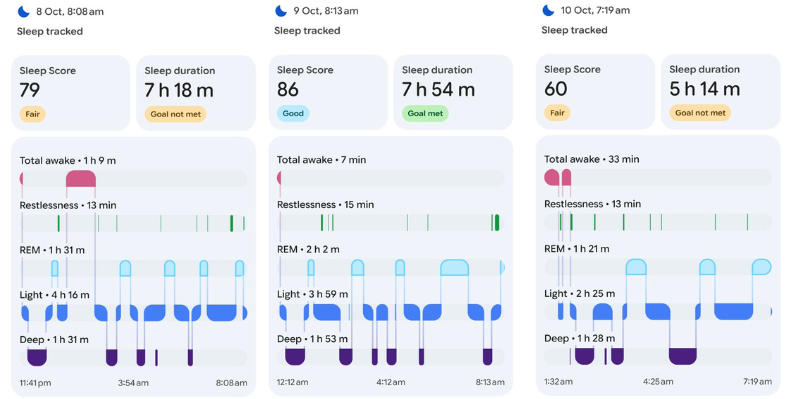
The awake estimates diverge too. Google Health saw 7 minutes awake on Day 2 and 33 minutes on Day 3. DUVA recorded 2 minutes and 18 minutes respectively.
So DUVA tends to describe these nights as longer and less interrupted, while assigning the sleep almost entirely to light and deep stages. Google Health detects substantial REM periods that DUVA/Fitnexa doesn’t show at all. Does it reinterpret it as something else and does it do it consistently? I don’t know.
I performed these nights while using the previous Fitnexa app. I did not save its sleep-history screens at the time. I don’t know if DUVA is displaying the original Fitnexa classifications unchanged or if the historical records were processed differently during or after migration.
My conclusion, based on the data I have, is that SomniPods 3 are ok to see the rough sleep duration and broad overnight patterns. But it’s not precise enough to become the reason to buy these earbuds.
Free Features vs Paid AI Plus
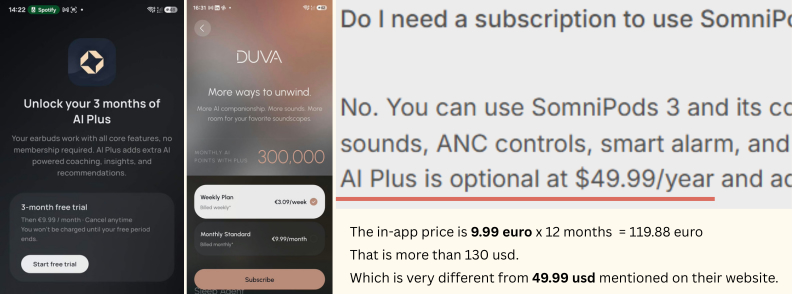
I was offered three months of AI Plus access when I first signed up. I left the offer untouched.
The SomniPods already carry a premium price, so I wanted to judge the included software before handing over payment details for another layer. By the time I had finished comparing the sleep records with Google Health, I had another reason to hesitate. DUVA had not earned enough confidence from me to justify giving another app even deeper health information.
That decision became irreversible, at least for now. When I returned later to look at the paid service again, the three-month AI Plus trial was gone from my account. DUVA now shows paid membership options instead.
On my app, the current screen offers €3.09 per week or €9.99 per month. The weekly plan is billed weekly. The monthly plan is billed monthly.
This is also where the pricing becomes confusing. Fitnexa’s SomniPods 3 product page still advertises AI Plus at $49.99 per year, while the DUVA app shown to me now uses much higher weekly and monthly pricing.
SomniPods 3 AI sleep coach subscription cost varies…? How does one benefit from the cheaper price advertised online vs. what is in the new app?
What AI Plus Adds
The company describes the paid Fitnexa sleep coach or Sleep Agent as the layer that takes sleep information further, with personalized AI guidance, deeper sleep insights, and longer-term trends.
DUVA now presents the premium service more broadly as an AI Recovery System.
My account shows several differences between Basic and Plus. Basic includes 1,000 AI credits per month and one default Sleep Agent voice. Plus raises that allowance to 300,000 AI credits, adds four voices, keyboard input inside Sleep Space, voiceprint recording, and access to over 100 member-only sounds.
The Sleep Agent is still rolling out gradually. DUVA states that access is currently limited to waitlist users who have been notified. I guess already paying members of the AI Plus are included.
So although SomniPods are marketed as AI sleep coach earbuds, part of the headline AI experience is not universally available yet.
The voiceprint feature also caught my attention. DUVA says recording your voice helps recognition and reduces the chance of nearby voices being mistaken for yours. Useful in theory, but also another piece of biometric-style information I would need a good reason to hand over.
Why I Did Not Activate AI Plus
My hesitation is not really about AI. The problem is trust in the data underneath it.
Across the three nights I compared, DUVA missed several hours of sleep on one night and Fitnexa SomniPods 3 ignore REM sleep. Google Health recorded REM every night, and I trust my Fitbit watch, I’ve worn it enough to know that it’s tracking things accurately.
If the underlying Fitnexa app sleep tracking is already giving me results I question, paying for an AI layer to interpret those same results feels backwards.
The app wants increasingly personal context too. During setup, it asks about sleep habits and health circumstances, including pregnancy, postpartum or breastfeeding, and menopause. Those questions have a clear reason in sleep analysis, and there is a “prefer not to say” option.
I already share health information with another ecosystem. The app (DUVA? Fitnexa?) did not prove accurate enough during my testing to earn a larger share of my data.
For me, the free version already covers the useful parts of the earbuds. The SomniPods subscription adds features I would only value after trusting the sleep analysis underneath them. I am not there yet.
The software change from Fitnexa to DUVA also made the paid plan less appealing to me. I had already bought into one connected ecosystem, then the app changed identity, I had to log in again, pairing became awkward again, and the original free trial later disappeared.
None of that proves the earbuds have a short lifespan. Still, with an 18-month commercial warranty, the experience did make the surrounding ecosystem feel less permanent than I expected from hardware at this price.
For now, Basic is enough. I get the earbud controls, sleep records, alarms, sounds, and the features I actually use. I also avoid paying for an AI interpretation of sleep data that hasn’t convinced me yet.
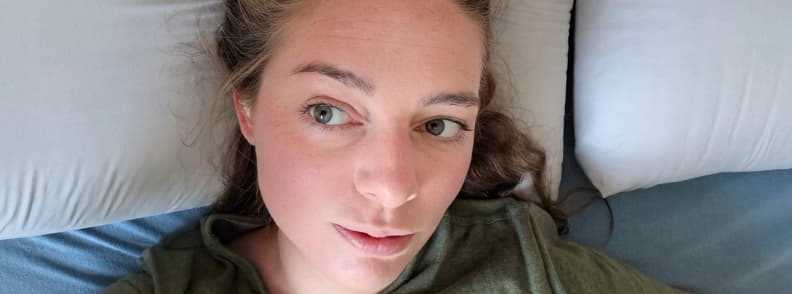
What I Like and What I Would Change about Fitnexa SomniPods
My Fitnexa SomniPods 3 pros and cons changed quite a lot the longer I owned them.
The early version of this section would have praised the fit first. But it’s no longer the case, since wearing them nonstop overnight doesn’t feel comfortable for one of my ears. Maybe my ear is special…?
Anyway, the best parts are noise isolation, sound quality, the low-profile shape, charging speed, and how useful the earbuds remain for shorter listening sessions. Most of my criticism now concerns long wear, battery performance during Bluetooth streaming, and the software wrapped around the hardware.
What I Like About the SomniPods 3
The noise isolation is the best part for me. ANC helps with the lower, steadier sounds, and the silicone seal handles part of the rest. Snoring beside me became easy to ignore. Steady household noise dropped too, which has been useful on afternoons when toy cars, nursery rhymes, a small piano, and two budgies have decided to throw me a concert.
I also like the SomniPods 3 sound quality. Series dialogue is clear, music sounds good, and the isolation means I don’t need much volume.
This is why this has become one of my main uses. I can watch a series in bed without bothering my husband. I can listen to music. I can scroll through TikTok before sleep. SomniPods 3 turned out to be better evening earbuds for me than all-night sleep earbuds.
The low-profile shape still gets credit. The outer shell doesn’t press awkwardly into my pillow the way larger everyday earbuds do. My comfort problem came later, from prolonged in-ear pressure, not from a bulky earbud body pushing against the side of my head.
The touch controls are another small positive. I didn’t have recurring problems with SomniPods 3 touch controls not responding. They need deliberate taps, which I prefer when I’m in bed. My other earbuds sometimes interpreted any small adjustment as a decsion to skip whatever I was listening to.
Charging speed impressed me once I tested it. My results were better than Fitnexa’s own quick-charge claim. Short top-ups suit the way I use SomniPods now perfectly. I rarely need a full night, I just need enough battery for a series, music while gardening, or an hour in bed before sleep wins.
What I Would Change
Long-wear comfort is my first problem. The SomniPods are small, but my ears still know something has been sitting inside them for hours. After repeated nights, my right ear hurt. The surrounding skin became drier, and I noticed increased moist earwax, something prolonged earbud use already tends to trigger for me. This ended my attempt to use them every night.
I would keep the current low-profile shell but improve the experience for prolonged wear, especially for sleep earbuds for side sleepers expected to stay in place until morning.
Bluetooth battery life disappointed me. Fitnexa advertises roughly 9 to 10 hours of Bluetooth audio. During my documented series test, both earbuds dropped from 100% to 40% in 3 hours 29 minutes. ANC had been active for only the first hour. Even with continuous ANC, battery life is supposed to be around 6.5 hours. That is a large gap.
Auto Mode performed much better overnight, so Fitnexa SomniPods 3 battery life depends heavily on how the earbuds are being used. I would like Fitnexa to publish realistic examples for streaming, Auto Mode, Sleep Mode, and ANC instead of leaning on maximum figures.
The app experience needs fewer surprises. I started with Fitnexa. Then the companion app became DUVA. I didn’t get any emails about this. I had trouble finding the new app, had to log in again, and pairing annoyed me.
DUVA now looks much richer than I remember from the old Fitnexa app. Depth isn’t the problem. It’s all about confidence. The differences between DUVA history and Google Health made me not want to feed the app additional personal health information.
Which is part of why the paid AI layer does not appeal to me yet. I was offered three months of AI Plus when I first signed up. left the trial untouched because I wanted to judge the included software first.
Later, that free offer was no longer available to me. DUVA now shows paid weekly and monthly plans, plus a larger AI Recovery System with extra credits, voices, member-only sounds, keyboard input, and voiceprint recording. Which is priced differently from what Fitnexa advertises online.
I already had reservations about sharing another stream of health data. After the sleep tracking failed to convince me, the AI coach hadn’t earned enough trust to ask for more. And at this hardware price, I would prefer better included software before another subscription enters the room.
The 18-month commercial warranty also feels short to me. The warranty doesn’t predict when the earbuds will fail, but it makes me wonder.
The unexpected app change also made me think harder about long-term ownership. SomniPods depend heavily on software for modes, updates, tracking, and settings.
Eighteen months of manufacturer coverage feels worrying beside a premium connected product whose software ecosystem changed while I was still reviewing it.
There is another odd detail here. My SomniPods 3 warranty card says 18 months, and Fitnexa’s website now states 18 months too. During my review, though, the website briefly advertised 24 months of warranty coverage before changing back to 18 months. The information currently matches what came in my box, but seeing the published warranty change while I was testing the earbuds did not inspire much confidence in the consistency of the product information.
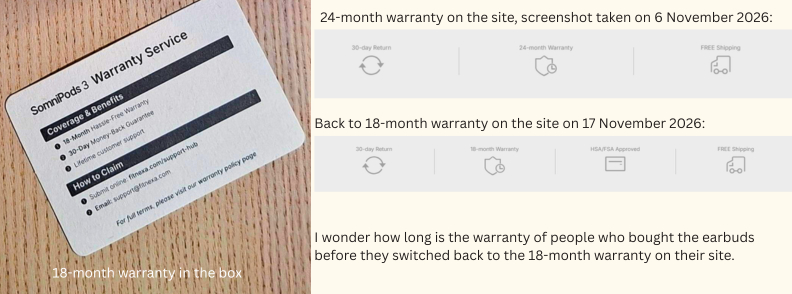
My earbuds came with an 18-month warranty card, so that is the coverage I assume applies to my pair. What I am less clear about is the warranty for people who bought SomniPods 3 while Fitnexa was advertising 24 months online. Does the warranty shown at the time of purchase matter? This is a good reason to keep a screenshot of the warranty shown when you order!
Auto Mode also needs better reliability. Since the move to DUVA, I have sometimes found the earbuds inactive when I expected them to be ready. Opening the app sometimes helps. On other occasions, I put them back into the charging case and take them out again.
I can’t prove the app migration caused the problem. All I can say is that I did not notice the same behavior earlier.
My final Fitnexa SomniPods 3 pros and cons therefore split neatly.
I would keep the isolation, sound quality, low-profile shell, deliberate controls, offline audio, charging speed, and flexible listening modes.
I would improve long-wear comfort, Bluetooth battery endurance, app continuity, Auto Mode reliability, sleep tracking, and warranty coverage. I would also improve communication, because I’ve found several conflicts between what is online and what I can find in the app or in my earbuds’ box.
The physical earbuds still impress me more than the app and the rest of the ecosystem built around them (or, better yet, around the new DUVA model launched by the company).
Who Should Buy SomniPods 3?
My testing narrowed the audience beyond everyone who sleeps on their side.
People Sleeping Beside a Snorer
This is my easiest recommendation! My husband’s became so much easier to ignore. ANC reduces the steadier part, the silicone seal adds passive isolation, and masking audio covers some of what remains. I would buy them for this before I bought them for sleep tracking.
Travelers With Noisy Hotels
Hotels are where SomniPods 3 make the most sense to me. Traffic, air-conditioning, corridor conversations, televisions through thin walls, and a snoring partner all land in one room occasionally. The earbuds give you ANC, Bluetooth audio, and three offline sounds without taking much luggage space.
They also make useful earbuds for napping when you’re somewhere safe, and without a child in your care.
People Who Listen in Bed Beside Someone Else
This became one of my main uses. I watch series, listen to music, or scroll for a while without waking my husband. The low-profile shell also sits against a pillow better than regular earbuds, even though prolonged wear eventually hurt my right ear.
SomniPods are also great for bedtime meditation, podcasts, or guided audio, because Normal Mode streams ordinary phone audio.
Light Sleepers Disturbed Mainly by Noise
I would consider SomniPods among the best sleep earbuds for sensitive light sleepers whose main problem is sound. Strong isolation helped me with snoring and household noise.
And the same isolation also stopped me hearing my toddler wake several times… Light sleepers who still need reliable nighttime awareness should keep reading.
Shift Workers and Daytime Sleepers
Daytime sleep brings traffic, deliveries, neighbors, children outside, and an entire world refusing to respect your bedtime. Fitnexa specifically markets SomniPods 3 for shift work and daytime noise. And they’re great when steady background noise is the main problem.
Side Sleepers Who Already Tolerate In-Ear Earbuds
The shape is truly good for side sleeping. The shell stayed low against my pillow, and my original fit stayed remarkably secure.
But I no longer recommend them to side sleepers without a caveat. After the second night, my right ear became painful. A smaller fit helped, although the soreness lasted and that earbud later fell out once.
So side sleepers should use the return period to test several full nights, longer than the 3-5 nights recommended when you launch the app fir the first time.
If you recognized your own nights here
SomniPods 3 are the best when noise is the problem
I would consider them for snoring, noisy hotels, private bedtime listening, and occasional difficult nights. Those are the situations where the hardware earned its place in my routine.
Check the current SomniPods 3 offer →Who Should Skip Them?
Some of my strongest reasons to skip SomniPods came from using them longer, not from reading the specifications.
Parents or Caregivers Who Need to Hear a Child
This is my clearest no.
My toddler woke several times. My husband heard him. I did not.
Fitnexa itself warns that ANC and passive isolation reduce awareness and advises removing the earbuds when you need to reliably hear a baby, doorbell, emergency alert, or traffic. If I am responsible for my son overnight, the SomniPods stay in the case.
People Prone to Ear Irritation
My right ear hurt after repeated nights. The skin around the area became drier, and prolonged use increased moist earwax for me.
The low-profile shell solved pillow pressure. But it wasn’t enough.
Anyone who already dislikes silicone tips for hours should look at sleep headphones vs earbuds before spending premium money on another in-ear device.
People Expecting All-Night Bluetooth Streaming
My own streaming tests disappointed me. Fitnexa currently quotes around 9 to 10 hours for Bluetooth audio and around 6.5 hours with continuous ANC. My results didn’t come close to this.
Auto Mode was better overnight, so this problem is specifically worth considering for people who want Spotify, audiobooks, podcasts, or video running for hours.
People Buying Mainly for Sleep Tracking
My three-night comparison with Google Health weakened my confidence here. DUVA (or Fitnexa?) even missed several hours of sleep on one night. Across all three nights, Google Health recorded REM sleep, while the earbuds aren’t even designed to track it.
I’d use SomniPods for rough patterns or estimates, not to draw clinical conclusions.
Still interested?
Good. Now you know what you are buying.
You have seen the comfort issues, battery results, software problems, and the parts I genuinely liked. If none of these deal-breakers above apply to you, SomniPods 3 are easier to recommend.
See the current Fitnexa offer →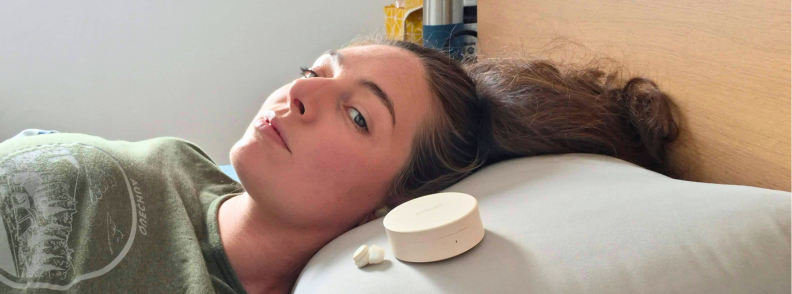
Fitnexa SomniPods 3 Review Verdict After Testing
My opinion of SomniPods 3 improved quickly, then became more complicated.
The hardware does a lot of stuff well. The earbuds are small, sit neatly against a pillow, isolate noise effectively, sound good, and recharge quickly. Snoring next to me is much easier to ignore. I also use them regularly for series and music without bothering my husband.
However, these smart earbuds didn’t become the all-night sleep earbuds I expected.
My right ear started hurting after repeated nights, so I moved to a smaller fit. This helped, although the soreness took time to disappear. I also stopped wearing them overnight after realizing I had missed my toddler waking several times while my husband heard him.
The software weakened the recommendation further. Fitnexa became DUVA during my review, which was a terrible user experience. Plus, the sleep-stage data did not match Google Health closely enough for me to trust it. And I know my Google Health data to be accurate. The move also made me think harder about long-term support, especially since my box says 18 months of warranty while Fitnexa now advertises 24 months online.
Battery performance is similarly mixed. Auto Mode covered my documented nights well. Bluetooth streaming fell well short of the advertised figure in my test. The quick charging, on the other hand, exceeded my expectations.
Are Fitnexa SomniPods 3 worth it?
Yes, but for a narrower use than I first expected.
I would buy them for snoring, noisy hotels, private bedtime listening, and occasional nights when outside noise is the main problem. I wouldn’t buy them primarily for sleep tracking, AI coaching, or nightly wear if my ears already disliked in-ear devices.
Are Fitnexa SomniPods 3 worth the money?
The physical earbuds come closer to earning the price than the software does. I trust the isolation, sound, compact shape, and charging more than the sleep-stage graphs or paid AI layer.
This leaves my Fitnexa SomniPods 3 worth buying in 2026 verdict at a qualified yes.
They earned a place in my routine. They just found a slightly different job from the one they were marketed for.
My final verdict
SomniPods 3 earned a yes for me
If you care most about strong noise isolation, a low-profile design, and listening in bed without disturbing someone beside you, the hardware makes a convincing case. But I wouldn’t buy them just for the sleep tracking.
Check SomniPods 3 price at Fitnexa →
Editorial Note: Fitnexa Reviewed Product Facts Before Publication
Fitnexa asked to see this review before publication for one stated purpose: to check basic product information and feature descriptions for factual accuracy. The company explicitly said my opinions and creative control would remain mine. I don’t normally send reviews to brands before they go live, but I agreed on that basis. Fitnexa received my draft on 6 November and replied on 11 November.
Their only requested correction concerned SomniPods 3 sleep tracking. Fitnexa clarified that the earbuds track three states, Awake, Light Sleep, and Deep Sleep. They are not designed to record REM as a separate stage. Therefore, I corrected the relevant comparisons in this review. They did NOT ask me to soften or remove my criticism.
Fitnexa did not address the AI Plus price discrepancy I documented between the app and its website. Nor did they comment on the warranty discrepancy in my draft. When I captured Fitnexa’s website on 6 November, it advertised a 24-month warranty even though the card supplied with my earbuds says 18 months. By 17 November, the website was showing 18 months again.
I do not know when that warranty information changed, why it changed, or whether my draft had anything to do with it. The timing makes me wonder, but I have no evidence connecting the two. I also don’t know which warranty Fitnexa applies to customers who bought SomniPods 3 while the website advertised 24 months. That’s why I have kept screenshots of the different claims and dated them in this review.
About Mirela Letailleur

Hello! I’m Mirela Letailleur, the travel writer behind The Travel Bunny, where I test travel gear around the way I actually move, sleep, and travel. For this Fitnexa SomniPods 3 review, I wore the sleep earbuds over repeated nights as a side and stomach sleeper, tested ANC against snoring and household noise, measured real battery performance, checked quick charging, and compared SomniPods sleep tracking with my existing Google Health data.
I also travel frequently with my young son, which changes how I judge sleep earbuds for flights, hotels, trains, and other shared environments. I care as much about hearing a child when needed as I do about blocking noise, and I do not treat manufacturer claims as conclusions. My reviews combine long-term use, controlled tests, family travel realities, and the small problems that usually appear only after the novelty wears off.
After reading this smart gear review, check out other reviews on The Travel Bunny
Timekettle W4 AI Interpreter Earbuds review. The best AI translation earbuds for travel in 2026?
LitONES VersaGlow V01 review. A portable light for travel creators and video calls
Ostrichpillow Go Neck review. The definitive guide for travelers and commuters