
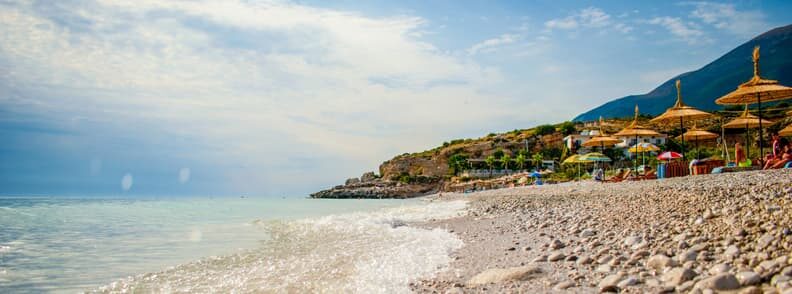
The best places to visit on the Albanian Riviera depend heavily on the trip you want. Dhërmi has beach clubs and higher prices. Himarë is a practical base for exploring several beaches without changing accommodation every night. Borsh stretches along a much longer shore, while Porto Palermo adds a castle, a protected bay, and one of the coast’s stranger Cold War remnants. Farther south, Sarandë and Ksamil put you closer to Butrint and the Greek island of Corfu. Treating all of them as interchangeable beach stops is a good way to spend an Albanian vacation packing and unpacking.
Places to visit on the Albanian Riviera
I’ve been writing about the Albanian Riviera since long before its current rush of hotels, beach clubs, and villa developments, and I’ve updated this guide for 2026. Some of the places I covered earlier, including Himarë, Porto Palermo, Borsh, Dhërmi, Llogara, Orikum, and Tragjas, have changed considerably around the edges. The mountains, bays, old villages, and occasional piece of Communist-era concrete remain considerably less interested in tourism trends.
The Travel Bunny’s Albanian Riviera travel guide focuses on the choices that shape an actual vacation: where to stay, which beaches deserve the detour, how long to spend along the coast, and where a famous name may be less appealing than the next place down the road. I’ll also separate the actual Riviera from the wider southern coast, because Albania Riviera travel itineraries have a habit of stretching north to Vlorë and south to Sarandë and Ksamil whenever convenient.
Disclosure: Some of the links on this page are affiliate links. This means that at no extra cost to you, The Travel Bunny will earn a small commission if you click through and make a purchase. Thank you!
Best Albanian Riviera Destinations. My Picks Before Your trip
Choosing where to go on the Albanian Riviera gets easier once you stop thinking of it as one continuous resort strip. Among Albania beach holiday destinations, Dhërmi, Himarë, Borsh, and Ksamil share the Ionian Sea, but they offer very different reasons to stay. A few kilometers can separate beach clubs and late nights from a long pebble shore, an old stone village, or a bay where a castle is the main attraction.
| Place | Best for | Beach type | Crowds | Car needed | Nights | My opinion |
|---|---|---|---|---|---|---|
| Dhërmi & Drymades | Beach clubs, nightlife, a stylish seaside stay | Pebble beaches and rocky sections | High in July and August | Helpful | 2-3 | Go here when the beach scene is a priority |
| Vuno, Gjipe & Jalë | Village stops, coves, hiking, swimming | Pebble coves | Busy at popular beaches in peak summer | Usually | 1-2 | Better explored as several distinct stops |
| Himarë & Livadhi | A practical base, swimming, restaurants, nearby beaches | Pebble beaches | Moderate, busier in peak summer | Helpful for nearby beaches | 3-5 | My best all-round base |
| Porto Palermo & Qeparo | History, quieter coastal time, old villages | Sheltered bays and pebble beaches | Low to moderate | Yes | 1-2 | Make time for the coast away from the busiest resorts |
| Borsh | A long beach, castle, slower beach days | Mainly rounded stones and small pebbles | Usually easier to spread out | Helpful | 1-2 | Pair the beach with Borsh Castle and Ujvara |
| Sarandë & Ksamil | Southern Albania, Butrint, Corfu connections, famous beaches | Small beaches and coves | High in peak summer | Optional in town, helpful for day trips | 2-4 | Treat them as a southern hub as well as part of a Riviera trip |
| Llogara | Mountain views, hiking, the approach to the Ionian coast | Mountain pass | Moderate at popular viewpoints | Yes | 0-1 | Stop here before descending to the coast |
| Orikum | Families, archaeology, the northern gateway | Long pebble beach | Busier with Albanian vacationers in summer | Helpful | 1-2 | Useful if your route includes Vlorë and the northern end of the coast |
The best part of Albania to visit depends on what you intend to do once you arrive. If swimming, mountain roads, coastal villages, castles, and short detours appeal to you, the Albanian Riviera is an excellent destination. But calling it the nicest part of Albania is inevitably personal, especially in a country that also has Berat, Gjirokastër, the northern Alps, and a long Adriatic coast.
The best place to visit in Albania also changes with the type of trip. Himarë is the place I’d choose as an all-round Riviera base from the destinations I’ve covered, while the best place to visit in Albania for a beach holiday could easily be Dhërmi, Borsh, or Ksamil depending on your tolerance for crowds, beach clubs, driving, and changing hotels.
Choosing where to go on the Albanian Riviera deserves a little thought before booking accommodation. The next parts of this guide break those choices down by geography, beaches, trip length, access, and the type of vacation each place handles best.
Where Is the Albanian Riviera?
The Albanian Riviera stretches along the southwestern coast of Albania, beside the Ionian Sea. Albania’s National Tourism Agency describes the coastal tourism route as stretching from Vlorë south to Sarandë and Ksamil, but it also places the start of the Riviera drive at Llogara Pass.
This small distinction explains why maps don’t always agree on where the Albanian Riviera is located. Vlorë belongs to the wider coastal route and is a useful northern gateway, while the scenery most closely associated with the Riviera begins after Llogara, around Palasë and Dhërmi, then continues through Vuno, Himarë, Qeparo, Borsh, Bunec, and Lukovë toward Sarandë.
The exact Albanian Riviera location therefore depends slightly on how narrowly you draw the boundary. For planning a trip, I find it more useful to think of Llogara as the threshold, Sarandë as the southern city hub, and Ksamil as the popular extension farther south. This also clears up the surprisingly slippery issue of where is Albanian Riviera territory and which nearby places belong in the same coastal itinerary.
The geography becomes much easier once you see it on a map. Mountains press close to the Ionian Sea for much of the route, which is why places that seem near each other in a straight line can involve winding roads, steep descents, and very different beach access.
Where is the Albanian Riviera? On paper, along Albania’s southwest coast. On the road, Llogara is where it starts to make sense.
The Official Route and Where the Riviera Really Starts
As we saw above, Albania’s Tourism Agency uses a wider coastal route than the name Albanian Riviera might suggest. Vlorë, Sarandë, and Ksamil can all appear in the same Riviera itinerary, while Llogara and Palasë mark the point where the characteristic Ionian stretch begins. This distinction is worth keeping because the Albanian coast covers a much larger area than the Riviera.
The Albania coastline belongs to two seas. The Adriatic Sea dominates farther north, while the Albanian Ionian coast begins in the southwest and continues toward the Greek border.
The geography of the Albania coastline, Adriatic and Ionian seas explains why the coast around Vlorë often gets grouped with the Riviera even though the scenery changes dramatically around Llogara. The Adriatic vs Ionian coastline in Albania isn’t a mere cartographic distinction. South of the pass, the mountains sit much closer to the water, beaches often lie below steep roads, and settlements are squeezed into a narrower strip between rock and sea.
Now let’s have a closer look at the terminology in Albanian. Bregdeti shqiptar means the Albanian coast in the broad sense, so it can refer to both Adriatic and Ionian shores. Bregu, by contrast, is commonly used for the coastal region associated with the Albanian Riviera around Himarë and the villages along this part of the Albanian Ionian Sea coast. In practical terms, what Bregu means in Albania is much closer to the Riviera than bregdeti shqiptar, which describes the country’s coast as a whole.
This also helps separate the Albanian south coast from the Albanian south Riviera. Southern Albania covers a wider territory that includes inland destinations as well as the coast. An Albania south coast travel route may therefore include places outside the actual French Riviera proper, while the Ionian coast of Albania around Llogara, Himarë, and Borsh forms its geographic core. It’s a small vocabulary lesson, but a useful one when accommodation websites, maps, and tourism brochures start drawing slightly different versions of Mediterranean Albania.
Albanian Riviera Map with Towns, Beaches and Travel Zones
A useful Albanian Riviera map needs to show something a simple road map tends to hide: which beaches, villages, and towns naturally fit together during the same part of the trip. Distances can look trivial on your screen while access roads, mountain slopes, and coastal detours tell a different story once you’re actually moving between them.
My interactive Albanian Riviera map with beaches below divides the coast into practical travel zones, from Vlorë and Orikum in the north to Sarandë, Ksamil, and Butrint in the south. You can filter the Albania Riviera map by area, then open individual pins for towns, villages, beaches, historic stops, and route points.
This also makes the wider map of the Albanian coast easier to understand at a glance, especially where the route shifts from the Bay of Vlorë toward Llogara and the Ionian coast. My map of Albanian Riviera highlights keeps nearby places together, so you can see which stops belong naturally in the same part of the trip.
THE TRAVEL BUNNY MAP
Albanian Riviera towns, beaches and travel zones
Use the zone buttons to split a long coast into trip-sized pieces. Tap any pin for the detail I’d want beside a map before choosing where to stop.
Map note: Pins mark the place itself, not a recommended parking spot or guaranteed access point. On this coast, that distinction can save a surprising amount of uphill walking.
Best Time to Visit and How Many Days You Need
The best time to visit the Albanian Riviera is usually June or September, when the sea is warm enough for swimming, the coast is lively, and July and August crowds haven’t taken over every convenient patch of beach. Peak summer brings the fullest choice of beach clubs and seasonal businesses, but also the highest accommodation prices, heavier traffic, and busier beaches.
The Albanian Riviera’s best time depends on what you want from the coast. Late spring and early fall favor road trips, hiking, old villages, and quieter beach days, while July and August make more sense if nightlife and the full summer scene rank high on your list. This makes the Albanian Riviera best time to visit a choice between atmosphere, heat, crowds, and price, not a single perfect month.
Plan five to seven days on the Albanian Riviera for a first trip. Three days can cover a small stretch if you choose one base and resist the temptation to collect beaches like fridge magnets. Seven days leaves time for several coastal towns and slower beach time, while ten days lets you add hikes, historic sites, boat trips, and a few mornings with absolutely no respectable reason to leave the water. How many days on the Albanian Riviera you need ultimately depends on whether you’re planning a beach break, a road trip, or a slower coastal stay.
Month-by-Month Weather, Sea, Crowds, Prices and What Is Open
Albanian Riviera weather follows a Mediterranean pattern, with hot, dry summers and wetter winters, but the calendar changes the coast in other ways too. A sunny afternoon is little consolation if the beach club you saved has packed away its loungers, the boat-trip desk is closed, and the last bus of the day left while you were still ordering lunch.
My table below uses the Himarë area as a practical reference point. Long-term climate averages put daytime highs around 29°C in June, 32°C in July, 33°C in August, 28°C in September, and 24°C in October. Average sea temperatures rise from about 21°C in June to 24°C in August, remain around 23°C in September, then fall to about 21°C in October. Rain also returns sharply after summer.
| Month | Air and sea | Crowds and prices | What is likely to be open | My take |
|---|---|---|---|---|
| January | Cool, wet, sea around 14°C | Very quiet, low-season rates | Year-round businesses in larger towns | Come for coastal scenery and day trips, not a beach holiday |
| February | Similar to January, with cool sea and frequent rain | Very quiet | Limited seasonal tourism | Better for a road trip than swimming |
| March | Milder days, sea still around 13°C | Quiet | Some accommodation and restaurants reopening | Good for walking and sightseeing |
| April | Around 20°C by day, sea still cool | Quiet | Seasonal businesses begin returning | Pleasant for ruins, villages, and hiking |
| May | Warm days, sea around 18°C | Light to moderate | Much of the coast starts waking up | Attractive if swimming isn’t the main event |
| June | Around 29°C by day, sea near 21°C | Busy but below peak | Beach businesses, restaurants, ferries, and tours largely active | One of the easiest months to recommend |
| July | Hot and dry, sea around 23°C | High crowds and higher prices | Full summer operation | Excellent for swimming, less appealing for spontaneous hotel hunting |
| August | Hottest period, sea around 24°C | Peak crowds and peak pricing | Full summer operation | Choose it for maximum summer atmosphere and book early |
| September | Around 28°C early in the month, sea near 23°C | Crowds ease as the month progresses | Strong early-month operation, gradual seasonal reductions later | Excellent balance of warm sea and easier beaches |
| October | Around 24°C by day, sea around 21°C | Quiet | Increasingly seasonal outside larger towns | Good for touring, less dependable for a classic resort stay |
| November | Cooler and much wetter, sea around 19°C | Very quiet | Mostly year-round local businesses | Better for sightseeing than coastal resort life |
| December | Mild by northern-European standards, wet, sea around 16°C | Very quiet | Limited seasonal tourism | Come with a road-trip plan and a rain jacket |
Albania’s beach season lasts roughly four to five months. Bars, restaurants, and minimarkets in smaller villages on the Southern Coastal Trail may close outside the mid-June to mid-September beach season. This doesn’t mean the Riviera shuts down on 16 September. It just means smaller places become less predictable once summer traffic disappears.
The Albanian Riviera in June is an excellent compromise. Days are already hot, rainfall is low, the sea has warmed enough for swimming for many people, and most seasonal businesses are open. Accommodation and beaches haven’t reached their annual pressure point yet. June also gives hikers and road-trippers longer days without quite the same midday heat found later in summer.
The Albanian Riviera in September has one major advantage over June: the sea has spent the entire summer warming up. Early September can still look like summer, while families tied to school calendars have started leaving and some of the pressure on beaches and roads begins to ease. By late September, however, smaller seasonal businesses may start reducing hours or closing for the year.
Albanian Riviera September vs June. June usually offers longer daylight, lower rainfall, and a coast ramping up for summer. September usually offers warmer water, fewer peak-season crowds, and a greater chance of unsettled weather as the month progresses. I’d choose June for hiking mixed with beaches, and September for swimming mixed with a slower coastal road trip.
The Albanian Riviera in October requires a different plan. Average rainfall rises considerably from summer levels, the sea cools toward 21°C, and the smaller resort areas become quieter. Sarandë remains the safest choice for year-round services, while accommodation and restaurants in smaller beach settlements become less dependable. October can still have excellent sunny days, but building an entire trip around beach clubs and boat excursions is optimistic in the way packing only one sweater for Scotland is optimistic (I’m looking at you, Mathieu!).
Corfu ferries don’t disappear with the beach season. There are several Sarandë-Corfu ferry departures continuing through October, with some Finikas Lines services listed into November and December, although departure frequency changes by date and operator. Check the timetable for your exact travel day instead of carrying a July schedule into autumn.
The Albanian Riviera in winter is a different destination altogether. November through March brings cooler temperatures, considerably higher rainfall, cold sea temperatures, and very little beach-oriented tourism. Sarandë and Vlorë have permanent populations and remain useful bases, while small resort settlements can become exceptionally quiet. Winter is better for archaeological sites, coastal drives, villages, and long lunches than for recreating a July beach holiday with extra clothing.
Taken together, Albanian Riviera weather by month points to three distinct versions of the coast:
- June through August for full summer operation
- September for warm-water shoulder season
- October through spring for quieter travel with progressively fewer seasonal services.
3, 5, 7 or 10 Days. How Long Should You Spend on the Albanian Riviera?
Three days is enough for one base and a handful of nearby beaches. Five days gives a short road trip some breathing room. Seven days is the length I’d choose for a first visit, while ten days lets you slow down enough to stop measuring the coast in check-in times.
| Trip length | Best for | What I’d do |
|---|---|---|
| 3 days | Short beach break | Pick one base such as Himarë or Dhërmi and stay close |
| 5 days | Beach holiday or compact road trip | Use two bases and concentrate on one half of the Riviera |
| 7 days | First trip, families, couples | Combine two or three bases with proper beach time |
| 10 days | Slow travel, sailing, honeymoon | Cover the coast gradually and keep several days deliberately light |
A three-day Albania beach holiday is best kept geographically small. Himarë is a good base because several beaches and historic stops sit nearby, but Dhërmi is an easier choice if most of the trip revolves around swimming and beach clubs. Trying to cover Llogara, Dhërmi, Himarë, Borsh, Sarandë, and Ksamil in three days produces an impressive collection of parking receipts and very little holiday.
Five days is better for travelers comparing Albania coastal holidays with other Mediterranean beach trips. Two bases are enough. You might spend three nights around Himarë and two farther south, or stay near Dhërmi before moving toward Borsh or Sarandë. Five nights also keeps accommodation costs under better control, which helps explain the appeal of affordable beach holidays in Albania without reducing the trip to a hunt for the cheapest room.
Seven days is the best trip length for a first visit. An Albanian Riviera itinerary for 7 days can combine beaches, villages, castles, one or two longer detours, and evenings when dinner doesn’t have to compete with another two-hour drive. Among the best beach holidays in Albania, a week on this coast gives you enough time to compare places instead of deciding that the first beach you saw must therefore be the finest.
A week also makes Albanian Riviera holidays much easier with younger travelers. Visiting Albania with children is simpler when you change accommodation once or twice instead of every morning, especially along a coast where beach access can involve slopes, pebbles, stairs, or longer walks. An Albanian Riviera family holiday should leave space for naps, slower meals, and repeat visits to a beach that everyone liked the first time.
The Albanian Riviera can be family friendly, but the exact base makes a large difference. Himarë has everyday services and several nearby beaches, while Borsh offers a long shoreline with room to spread out. Ksamil has shallow-looking postcard coves but becomes very busy in high summer. The best beach towns in Albania for families therefore depend on children’s ages, driving tolerance, beach access, and how much evening activity you actually want around you.
Albanian Riviera family holiday guide: Resist the urge to turn every day into an excursion. Seven nights with two bases usually makes greater sense than seven nights in seven places. Children have many admirable qualities, but enthusiasm for daily suitcase packing is rarely among them.
Ten days let you explore the coast properly. This is the length I’d favor for Albania Riviera holidays centered on slow travel, with time for Dhërmi, Himarë, Borsh, the quieter southern stretch, and Sarandë or Ksamil without racing between them. Holidays in the Albanian Riviera become noticeably more relaxed when a beach day can remain a beach day instead of doubling as a transfer day.
Ten days also suit travelers planning holidays to the Albanian Riviera with sailing or boat trips. Weather can move marine plans around, and an extra day ashore is much easier to absorb on a longer trip. The same applies to holidays to Albania’s Riviera that combine coastal driving with several boat-access beaches, because sea conditions and departure schedules deserve a little flexibility.
Couples can use those extra days differently. An Albanian Riviera couples romantic getaway doesn’t need a procession of famous stops to justify itself. A few nights around Himarë or Qeparo, slower lunches, a boat day, and time around Porto Palermo can make a better trip than chasing every recognizable beach name.
An Albanian Riviera honeymoon deserves even more time, especially if you’re combining the coast with another part of Albania. Romantic Albania is easier to appreciate when you’re staying long enough to find a favorite restaurant, return to the same beach, and occasionally spend a morning doing absolutely nothing.
Albanian vacations can be anything and everything from three-night beach breaks to multiweek road trips, so trip length should follow the kind of coast you want to experience. Package sites may sell holidays to the Albania Riviera as a single destination, but the reality on the ground is a chain of distinct bases, beaches, villages, and day trips. Seven days is a very good starting point, but ten is better if you have them.
Best Places to Visit on the Albanian Riviera
A photograph can tell you that the water is blue. But it can’t tell you that the beach is awkward to reach, the old village sits halfway up a mountain, or the place you planned as a peaceful base acquires several thousand extra neighbors in August. My best places to visit on the Albanian Riviera therefore earn their place here for specific reasons, not because they photograph so well from a drone.
Lists of Albanian Riviera cities tend to favor Sarandë and Vlorë, while the Albanian Riviera towns and villages between them often provide the more interesting decisions. And every so-called beach town in Albania deserves a closer look at the map before you reserve a room based on the name alone. You might find the historic settlement is uphill and the beach has developed into a separate little world below it.
I judge the best places in the Albanian Riviera by what they add to the trip: a beach worth making time for, a good base, an old village, a hike, a castle, a useful harbor, or enough everyday life to make several nights comfortable. This is also why my Albanian Riviera best places aren’t like a beauty contest. A quiet bay and a busy resort can both deserve a stop for entirely different reasons.
Albanian Riviera best places to visit are often connected by short distances and surprisingly different experiences, so choosing where to sleep can shape the trip as much as choosing what to see.
Some Albanian Riviera hidden gems are worth visiting because they offer a quieter setting, but being less known doesn’t automatically make a beach better. If reaching it takes half a day, the trade-off may not be worthwhile. In the sections below, I focus on what each destination offers, how much time it deserves, and which travelers are most likely to enjoy it.
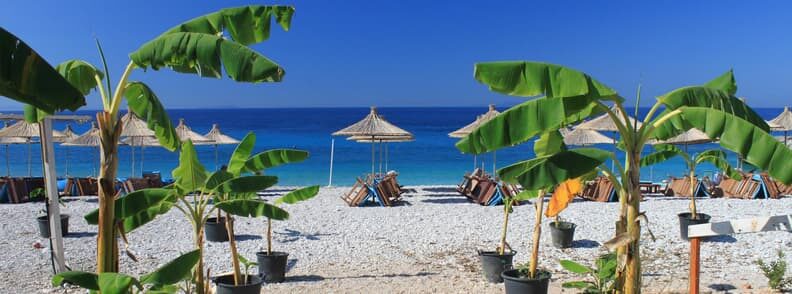
Palasë and Dhërmi. Beach Clubs, Big Scenery, and Higher Prices
The first impression around Dhërmi is… vertical. The old village sits high on the mountainside, the Ionian Sea flashes below it, and the beach strip has developed into a separate summer world of hotels, restaurants, loungers, music, and late nights. In Dhermi Albania, choosing accommodation by name alone can be a small act of optimism. Check the map carefully unless you enjoy beginning every beach day with a steep descent and ending it with the reverse.
Dhërmi Beach is one of the busiest and most developed beaches on this stretch of coast, with rounded stones, clear Ionian water, restaurants, bars, water activities, and a nightlife scene that becomes considerably louder in the middle of summer. Albania beach clubs here are part of why travelers come to this destination. Some of the most popular clubs around the Dhërmi beach zone are Flow, Sanur, Havana, Dua, and Yacht Club.
Dhermi Beach is a good choice if you want music, cocktails, dressed-up evenings, and a social beach scene on your vacation in Albania. This is where you will find some of the best beach clubs on the Albanian Riviera.
The atmosphere switches from lazy daytime swimming to an Albanian Riviera beach clubs party quickly once the sun drops, especially during peak-season weekends and music events. Anyone hoping for silence should book with the same care they would use beside an airport runway.
Drymades Beach is northwest of the main Dhërmi strip. It has the same mountain backdrop and pale pebble shoreline, but the beach spreads out differently, with bars and clubs scattered along a longer stretch. Drymades Beach Albania is calmer than central Dhërmi, though peak summer still brings music and a loud social scene.
Palasë Beach, just north of Drymades beneath the Llogara descent, is broader and generally calmer. The beach is made up largely of small pale stones, with the Ceraunian Mountains rising directly behind it. Resort development has changed Palasë considerably, but the scale of the bay still creates a different impression from the denser Dhërmi beach scene.
The best things to do in Dhërmi Albania extend well past relaxing on sunbeds. The old village has traditional houses and historic churches, while boat trips and coastal excursions reach places such as Pirate’s Cave and nearby coves.
The real choice, though, is simpler: stay around Dhërmi if you want your beach holiday mixed with nightlife and a busy summer atmosphere, choose Drymades for a slightly looser version of the same idea, and look toward Palasë when extra space appeals more than being near the center of the action.
Vuno, Gjipe, and Jalë Villages, Hiking, and Cove Access
Vuno Albania is above the Ionian Sea on the SH8, all stone houses, narrow lanes, and church roofs arranged across a steep hillside. The road passes straight through the village, which makes Vuno easy to treat as scenery seen through a windshield. But it deserves better. Shën Kolli and Shën Mëria churches sit among the old houses, and several walking routes leave the village toward the surrounding hills and coast.
Below Vuno, the geography becomes considerably less civilized. Gjipe Beach is where a limestone canyon opens directly onto the Ionian Sea, between Dhërmi and Himarë. The narrow gorge behind the beach is as important to the setting as the water itself, with pale cliffs closing around a cove of pebbles and sand.
Gjipe Beach Albania requires some effort to reach, which is part of its appeal and also something worth knowing before turning up in flip-flops with a small bottle of water.
The Gjipe Beach hike starts after leaving SH8 for the access road toward the coast. Regular cars should stop at the parking area above the beach, then the final descent continues on foot along a rough, rocky track. Depending on exactly where you park and your pace, expect a walk of 20 to 45 minutes downhill and longer for the climb back. Boat trips from Himarë provide an easier alternative, especially in the heat of July and August.
To hike down to Gjipe Beach from the main highway SH8, plan additional time before the usual beach trail even begins. The turnoff leads several kilometers toward the parking area, so walking the entire distance from SH8 turns your beach visit into a proper hike. Carry water, wear shoes with decent grip, and save some energy for the return. The uphill part arrives after the swimming, at precisely the moment the sea has persuaded your legs that their duties are finished.
Getting to Gjipe Beach by boat removes the climb but changes the experience. Arriving from the sea lets you see the Gjipe Beach canyon opening behind the shore, while walking in reveals it gradually from inland. Both approaches are beautiful. The choice comes down to heat, fitness, time, and how enthusiastically you regard a rocky uphill walk at the end of a beach day.
A short distance south, Jalë Beach has a very different personality. The cove is small, the water is clear, and summer comes with beach bars, camping, loungers, music, and a livelier crowd. Jalë Beach Albania is reached by a steep paved road branching from SH8 near Vuno, with tight bends on the descent and parking near the shore. Buses and furgons can leave you at the highway turnoff, but they don’t descend to the beach itself.
This difference makes the three places easy to remember. Vuno is the village above the road, Gjipe is the canyon beach that makes you earn your swim, and Jalë is the easier-to-reach cove with a better summer social scene. They are close together on the map, but combining all three in one hurried stop misses the point of each.
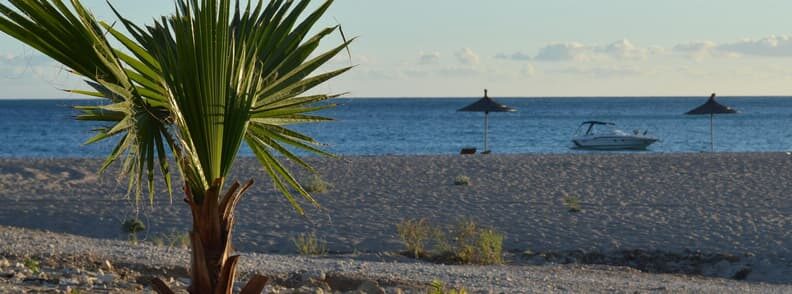
Himarë and Himara e Vjetër, The Best All-Round Base
Himarë has something the smaller Albanian Riviera stops struggle to provide: enough everyday life to make staying put easy. The modern town gathers around Spile and the waterfront, with a harbor, supermarkets, ATMs, cafés, restaurants, accommodation, and a promenade where an evening walk can replace another drive along SH8. You can swim before breakfast, eat without planning an expedition, and still have several very different beaches within easy reach.
This balance is why Himare Albania makes such a good base for several nights. Dhërmi has a better beach-club scene and Sarandë has the scale of a city, while Himarë sits comfortably between the two. The center remains small enough to explore on foot, summer boat trips leave for coves along the coast, and Livadhi, Potami, Llamani, Jalë, Gjipe, Qeparo, and Porto Palermo can all be easy day trips from town.
Spile Beach stretches by the promenade, so a swim can be followed by coffee or dinner without retrieving the car. As evening approaches, restaurant tables fill and people drift along the seafront for the traditional xhiro, the slow evening walk that remains one of the Mediterranean’s civilized responses to having eaten too much.
The older Himarë is somewhere else entirely. Himara e Vjetër, also called Old Himarë or the Himarë Castle quarter, occupies the hill above the modern town. Inside the old fortified settlement, stone lanes pass ruined houses, inhabited homes, churches, fragments of defensive walls, and sudden openings toward the Ionian Sea. Surviving sections of the castle complex date from several historical periods, with origins reaching back to antiquity.
Down by the water, Himara Albania is about beaches, boats, restaurants, and where to park. Up in the old settlement, the coast spreads below you and the Ceraunian Mountains close in behind it. The two halves belong together, but they shouldn’t be considered the same stop.
The Travel Bunny’s Albanian Riviera tip: Himarë is one of the easier Riviera bases for travelers who don’t want every day dictated by a car. The central beach, harbor, promenade, restaurants, and shops are walkable, and summer buses or furgons connect the town with other coastal settlements. A car still makes the surrounding beaches much easier to reach, especially when the destination sits below SH8 or at the end of a steep access road.
I’d plan at least three nights here on a first Riviera trip. That leaves time for the town itself, an evening in Himara e Vjeter, a boat or beach day, and one coastal excursion without turning Himarë into a place where you merely sleep between departures. It is the kind of base that quietly improves an itinerary by making fewer plans necessary.
Livadhi and the Beaches Around Himarë
The beaches in Himarë make the town especially useful as a base because they offer different beach day experiences. One has restaurants within arm’s reach, another has colder spring-fed water, another drops quickly into deep blue, and a couple demand either a boat or enough enthusiasm for walking in the sun.
Livadhi Beach is the one to choose when you want to stay put for hours. A broad crescent of pale pebbles curves beneath green hills, with Himara Castle visible above and the Ionian Sea opening westward in front. The developed stretches have loungers, cafés, and restaurants close to the shore, while quieter sections leave more room for towels and a slower afternoon. The beach’s length also absorbs summer crowds better than the small coves nearby.
The water at Livadhi Beach Albania remains shallow for a good distance before deepening, which makes it a perfect choice for families and less confident swimmers. Rocky headlands at either end add better snorkeling than the mostly pebble seabed in the center. Livadhi also faces west, so staying until evening comes with the considerable convenience of watching the sun disappear directly over the Ionian Sea.
Closer to Himarë, Potami Beach is smaller and very good for swimming. Freshwater springs enter the sea here, keeping the water unusually clear and noticeably cooler in places. On a hot afternoon this can be glorious. During the first few seconds after stepping in, different opinions may be expressed.
South of town, Llamani Beach is a small cove between rocky slopes. The water gets deep quickly, so stronger swimmers and snorkelers tend to appreciate it more than families wanting long shallows. You can drive there, which gives Llamani an advantage over the smaller coves that require walking or a boat.
Then, there are the beaches that make access part of the outing. Filikuri Beach is reached by boat or trail, while Akuarium Beach can be approached along the coast from the Livadhi side. These smaller coves trade facilities for rockier surroundings and clearer separation from the busy town beaches. Carry water and proper shoes if you’re walking. Beach sandals have many virtues, but loose coastal paths rarely love them.
The useful choice around Himarë is therefore less about ranking one perfect beach and more about matching the beach to the day. With several options this close together, there’s very little reason to spend the entire stay defending the same square meter of pebbles.
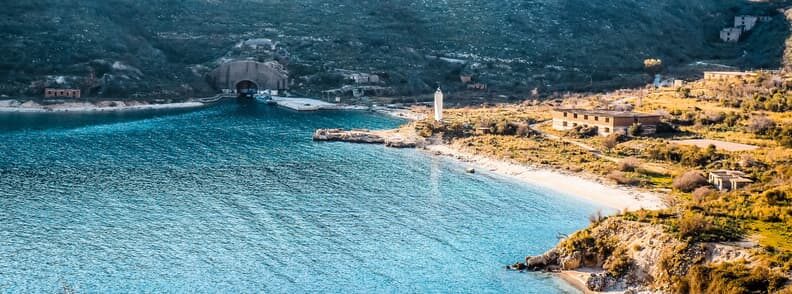
Porto Palermo Castle, Bay, and Boat Trips
Porto Palermo is the kind of stop that announces itself before you’ve parked. About 8 kilometers south of Himarë, the SH8 curves around a sheltered bay and suddenly a low stone fortress appears on its own small peninsula, with clear water on both sides and mountains rising behind it. The scale is wonderfully small. Castle, beach, bay, Cold War relics, and the coastal road are all crammed into a few hundred meters.
The fortress is associated with Ali Pasha of Tepelena and dates in its present form largely to the early 19th century, although the site’s earlier history is less certain. From outside, Porto Palermo Castle Albania looks squat and defensive. Inside, vaulted stone chambers lead into passages where the temperature drops and daylight quickly becomes scarce. Then you climb back onto the roof and the whole bay opens below you. A phone flashlight is useful downstairs, and sunglasses become useful again almost immediately upstairs.
The bay gives Porto Palermo Albania much of its character. A narrow causeway links the castle peninsula to the mainland, with a small pebble beach beside it, where swimming can be easily added to your castle visit. Boats are a regular sight in the enclosed water, but I’ll deal with Porto Palermo from a sailing and anchorage perspective later in my guide.
Across the bay, a huge concrete opening cut into the rock belongs to Porto Palermo’s Cold War history. The tunnel was built for military use during communist Albania and remains within a restricted military area, so admire it from legal viewpoints and leave urban exploration fantasies where they belong, preferably on someone else’s travel insurance policy. The entrance is visible from the coastal road and from the castle area.
Plan around one to two hours if you’re visiting the fortress and walking around the peninsula, longer if you add a swim. Parking is available near the causeway, and entrance to Porto Palermo Castle costs 300 ALL per person (roughly €3 in Albanian lek), payable in cash. Late afternoon is especially appealing because the exposed stone loses some of its midday glare and the bay is easier to appreciate without the fiercest heat.
I wouldn’t use Porto Palermo as a base. Its appeal lies in concentration. You can leave Himarë after breakfast, wander through a dark fortress, look across a former military bay, swim beside the causeway, and continue toward Qeparo without sacrificing the rest of the day. Few coastal stops pack quite so many places into such a small patch like Porto Palermo Albania.
Qeparo with Beach Below, Stone Village Above
Qeparo has a useful trick for anyone who thinks they’ve understood it from the coastal road. The settlement beside the sea is only half the place. Follow the road uphill and Qeparo Albania changes from beach promenade, guesthouses, and restaurant tables into stone lanes, old houses, church walls, fig trees, and views that explain why people bothered building a village up there in the first place.
Lower Qeparo is the easy half. Qeparo Beach Albania lies below the SH8 with a mostly pebble shore, clear water, a seafront promenade, seasonal restaurants, and accommodation close enough to make swimming the default activity here. The larger stones around parts of the waterline make water shoes useful, especially if your feet are strongly opinionated about pebbles, like mine are.
The old village above deserves separate time. Upper Qeparo old village, known locally as Qeparo i Sipërm or Qeparoi i Vjetër, is several kilometers uphill from the beach settlement. Narrow lanes weave between stone houses in various stages of occupation, abandonment, and restoration, with the Ionian Sea appearing unexpectedly between walls and rooftops. It’s still a lived-in village, so the lanes may look like an open-air historical site until somebody’s laundry reminds you they aren’t.
The road to Upper Qeparo climbs through a series of bends before ending near the edge of the old village, where exploring the interior streets continue on foot. Walking from the coast is possible, but the sustained uphill climb turns any casual visit into a proper hike, particularly under the hot July sun. Shoes with grip help on the stone paving, and carrying water is a must because services above are limited.
Qeparo is a good destination for travelers who want beach time without spending the entire day inside a resort strip. Porto Palermo is a short drive north and Borsh begins almost immediately to the south, so one or two nights here can easily be planned into a slower coastal route. Families may prefer accommodation near the beach, while anyone interested in architecture, old villages, or photography should make time for the climb above it.
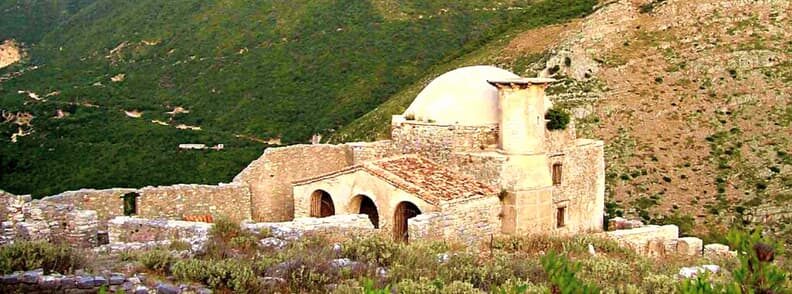
Borsh Long Beach, Castle, and Ujvara
Borsh village is above the coast, among olive-covered hills. The castle occupies a rocky height behind it, and the beach seems to keep going and going. At about seven kilometers, Borsh Beach Albania is the longest beach on the Riviera. Its shore is mostly rounded stones and pebbles, with the Ionian Sea stretching across the broad, open bay.
This length alone changes your summer experience. In Borsh Albania, restaurants, loungers, guesthouses, and beach bars cluster along developed sections, but walking farther along the shore can put noticeably more space between towels. It’s a good choice when the crowds around smaller coves start giving you anxiety.
High above the water, you can visit Borsh Castle or Sopot Castle for free. Fortifications have occupied the hill since antiquity, with later Byzantine and Ottoman rebuilding, and an Ottoman mosque still stands within the ruined walls. The final part is steep and exposed, so an early morning or late afternoon visit is kinder in summer.
Your climb is rewarded with a view that finally explains the scale of the beach below. From the ruins, the Borsh plain, olive groves, mountains, and long curve of the Ionian coast spread out beneath you. From Ujvara Restaurant, the walk to the castle entrance takes around 30 minutes using the shortcut toward the road. Proper shoes and water are worth carrying because shade becomes scarce higher up.
Borsh Ujvara or Ujëvara e Borshit is where water pours through and around a restaurant built into the cool, green slope beside the road. Ujëvara means waterfall in Albanian, and here the name is pleasingly literal. Tables sit beside rushing water, which can be wonderfully refreshing after the heat outside and also means nobody is coming here for monastic silence.
Ujvara Restaurant Borsh deserves a little caution, however. Recent visitors agree that the waterfall setting is memorable, but recent reviews on food, cleanliness, availability, prices, and service vary sharply. Some diners describe good fish soup, qofte, potatoes, salads, and friendly staff. Others report long waits, poor maintenance, dishes unavailable despite remaining on the menu, and pressure toward costlier choices.
Despite the lower Google rating, Ujvara restaurant still has 5 stars on Restaurant Guru, where it ranks second among the best seaside restaurants in Borsh with authentic Albanian food. Check the Ujvara Restaurant Borsh menu here before you settle at a table, especially if you’ve come with a particular traditional dish in mind.
Borsh is a beautiful destination on the Albanian Riviera, where you can swim along that unusually long shore, climb to the castle when the heat eases, then stop beneath the trees and running water around Ujvara.
Lukovë, Kakome, and Krorëza on The Quieter Southern Stretch
South of Borsh, the settlements on the Albanian Riviera start to thin out, the slopes grow quieter, and a beach may require considerably more commitment than spotting a blue patch below and turning the steering wheel. This is the area for travelers willing to trade convenience for space.
Lukovë has the easiest access. In Lukova Albania, the village is above the sea while several beaches lie below it, reached by roads branching down from SH8. Lukovë Beach has seasonal beach bars, restaurants, loungers, and parking, although the final distance can include rougher road sections depending on which part of the shore you’re heading toward. It’s less crowded even in summer compared with the busier resorts farther south.
Lukovë Beach sits beneath green hills, with pebbles underfoot and open views west across the Ionian. Some areas have organized loungers, but other sections remain wilder. It’s a good half-day or overnight stop if you’re driving between Borsh and Sarandë and would prefer your beach time without a soundtrack competing from three directions.
Kakome Beach is a more of a boat-access stop. The bay is farther south, enclosed by hills and cut off from easy public road access. A road descends toward the coast, but there is restricted land entry near the shore. This is why it’s easiest to see Kakome from a boat leaving Sarandë.
But this sea approach is part of Kakome’s appeal. The boat turns into a broad, sheltered bay with steep green slopes behind the pale shore and very little urban development in sight. Some summer businesses put out loungers or basic facilities, but don’t expect too much.
Krorëza Beach has no direct road access. You reach it by boat or via a demanding coastal hike, which has spared the beach from the steady traffic that follows an asphalt road. The cove is between cliffs and wooded slopes, with pale pebbles, clear water, and a few seasonal bars or restaurants operating during the busiest months.
A Kroreza Beach boat tour from Saranda is the simplest way to visit. Current 2026 group excursions commonly combine Krorëza with Kakome and other coves along the coast, with Krorëza usually receiving the longest beach stop. The hike is a separate undertaking and deserves proper shoes, water, and enough time for the return.
Drive to Lukovë, take a boat to Kakome, and reach Krorëza by boat or on foot. These beaches occupy the same quieter southern coastline, but each demands a different amount of planning. On this part of the Albanian Riviera, the road eventually lest the sea take over.
Sarandë, Ksamil, and Butrint. Albanian Riviera Base vs Separate Southern Hub?
South of the smaller Albanian Riviera villages, the coast changes quickly. Sarandë is a true city wrapped around a broad Ionian bay, Ksamil is a small beach resort farther south, and Butrint is an archaeological and natural site beside wetlands and the Vivari Channel. They sit close enough to share a few vacation days between them, but treating them as interchangeable stops makes poor use of all three.
Saranda Albania is the best base in the area. Apartment blocks climb the hills behind a long waterfront promenade, boats occupy the bay, and Corfu is visible across the water. Saranda beaches are convenient for a swim without even leaving town, but the greater advantage is having accommodation, shops, transport, and several major excursions within easy reach.
A Saranda to Ksamil trip is only about 14 to 15 kilometers long, which makes Ksamil easy to visit from the city. The difference on arrival is immediate. Ksamil Albania is built around small coves and intensely clear water, with beach bars, restaurants, loungers, docks, and little pockets of sand competing for a limited amount of shoreline. In midsummer, space becomes a commodity here.
Ksamil beaches are most seductive from the water, where pale shallows surround the small green islets offshore. On land, July and August bring the other half of the story. Ksamil Beach is too crowded in July and August for travelers hoping for a quiet patch of sand, especially around the central coves where loungers occupy much of the available space. June and September preserve much of the swimming appeal with fewer people between your towel and the sea.
Ksamil Islands are part of the attraction. Small boats, canoes, kayaks, and organized trips cross the short stretch of water from the resort. A Ksamil boat trip is one of the simplest ways to escape the density of the central beach for a while. The islands also make the bay seem larger from sea level, after an hour spent looking at it through a forest of parasols.
The Travel Bunny’s local tip: Stop at Mirror Beach near Ksamil, also known as Plazhi i Pasqyrave. It’s located north of Ksamil in the Sarandë area and it forms a separate cove between karst rocks. The water can take on the bright reflective color that gave the beach its name, especially in calm conditions.
Keep following the road south and the beach-resort atmosphere gives way to Butrint Albania, 20 kilometers from modern Sarandë. The ancient city passed through Greek, Roman, Byzantine, and Venetian periods, and its ruins stand among trees and water, away from the dense modern town. The theater, basilica, baths, gates, walls, and later structures reveal these layers gradually as you walk through the site.
Quick Butrint National Park guide: Butrint National Park includes Lake Butrint, wetlands, coastal habitats, and the Ksamil Islands, so archaeology occupies only part of the protected area. Plan enough time to walk slowly through the ancient city, especially in summer when shade becomes a valuable archaeological resource in its own right.
On the Butrint-Saranda route, Ksamil sits naturally between the city and the archaeological park. This makes the planning fairly simple. Choose Sarandë when city convenience and day trips come first, stay in Ksamil when swimming and beach time dominate the schedule, or visit Butrint on its own, preferably before the hottest part of the day. Together, these destinations form a southern hub attached to an Albanian Riviera trip.
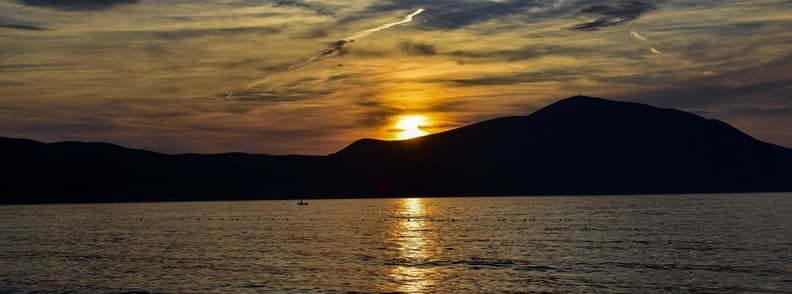
Vlorë, Orikum, and Llogara. The Gateway to the Riviera
Vlorë belongs in an Albanian Riviera trip, but it plays a different role from Dhërmi, Himarë, or Borsh. This is a sizeable coastal city stretched around the Bay of Vlorë, with apartment blocks, an urban waterfront, beaches, museums, traffic, and the long Lungomare promenade. Vlora Albania can make a good northern base, especially if you want city comforts before the road narrows and the smaller coastal settlements begin.
Albania declared independence here on 28 November 1912, and Vlorë retains several landmarks connected with that event, including Independence Square and the National Museum of Independence. This gives your overnight stop a purpose beyond dividing a drive into manageable pieces.
About 20 kilometers south, Orikum already has one foot in the city-facing Bay of Vlorë and the other pointed toward the Albanian Riviera. Orikum Albania has a marina, a broad beach, the nearby lagoon, and a noticeably lower-rise character than Vlorë. The mountains ahead become harder to ignore here. By the time you reach Dukat, the coast is no longer flat.
Ancient Orikum adds an unusual historical detour. The archaeological park preserves remains of Orikos, a port settlement founded around the sixth century BC, including defensive walls, paved streets, and a small ancient theater. The site is located beside Pashaliman Lagoon within an active naval area. Entry is through a military checkpoint requires an ID check.
A few kilometers inland, Tragjasi i Vjetër offers a very different detour. Old Tragjas is a ruined stone settlement above the modern village, with abandoned houses spread across the hillside and evidence of habitation in the area reaching back much further than the surviving buildings. The old village was destroyed during World War II and never rebuilt on the same site. Access is the awkward part: there are five kilometers of unpaved track from modern Tragjas, so 4×4 vehicles are better adapted.
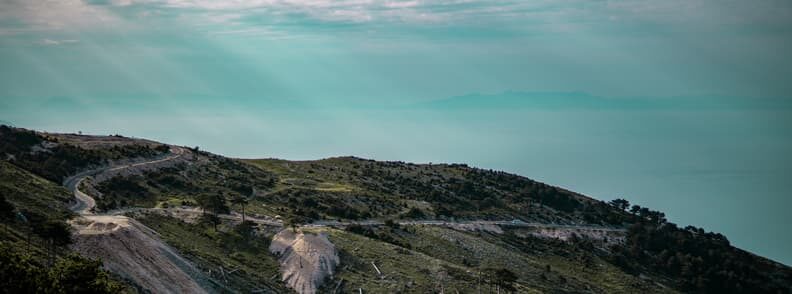
Then comes Llogara Pass. The old SH8 climbs through the Ceraunian Mountains to 1,027 meters, passing pine forest before reaching the high road above the Ionian coast. A beautiful Llogara Pass view takes in the descending switchbacks, Palasë far below, and a long sweep of coastline that appears almost absurdly close to the mountain. On a clear day, you can’t just pass through without stopping to admire all that is around you.
Driving Llogara Pass Albania has changed since the Llogara Tunnel opened beneath the mountain in 2024. Through traffic can now avoid the summit road, while the old pass remains available for the high viewpoints and mountain drive. The practical tunnel details can be found later in this guide.
Best Albanian Riviera Beaches Compared
Choosing among the Albanian Riviera beaches gets easier once you decide what kind of beach day you want. Gjipe has the canyon setting, Livadhi is easier with children, Borsh offers room to spread out, Dhërmi and Drymades combine clear water with organized beach service, and Ksamil has those pale shallows around the islets. The table below compares the coast by surface, access and parking, free space and facilities, family practicality, snorkeling and boat access, and summer crowds.
| Beach | Surface | Access & parking | Free space & facilities | Families | Snorkeling & boat access | Crowds |
|---|---|---|---|---|---|---|
| Palasë | White pebble, fine shingle | Paved access. Paid parking in developed areas, rougher free options farther back. | Free towel space reported. Plenty of sunbeds, umbrellas, toilets, and serviced areas. | Good. Some of the easiest accessibility on this coast, including ramps in developed areas. | Good snorkeling near rocks. Boat access available. | Moderate, busier around beach clubs. |
| Dhërmi Beach | Mainly smooth white pebbles | Paved descent from Dhërmi. Parking behind the waterfront fills quickly in summer. | Free areas remain, especially toward the ends. Extensive sunbeds, restaurants, bars, and toilets. Little natural shade. | Good for confident swimmers. Water becomes deep fairly quickly. Strollers are manageable along developed sections but awkward on pebbles. | Good snorkeling near rocky sections. Water taxis and coastal boats operate in season. | High in July and August. |
| Drymades | White pebble with some sandy sections | Road access through the Dhërmi area. Parking around hotels and beach clubs. | Some free towel space away from the main club rows. Many sunbeds and umbrellas. Toilets available through beach businesses. | Good, though stones and changing depth require attention with small children. | Good snorkeling at the rocky ends. Some coastal boat access. | Moderate to high in peak season. |
| Gjipe | Pebble and coarse sand | Rough road from SH8 to parking above the beach, followed by a 20–30 minute descent and a longer climb back. | Free towel space plus seasonal sunbeds. Very little shade. Basic seasonal toilets and showers. | Better with older children who can handle the hike. No stroller access. | Excellent snorkeling. Boats from Himarë are one of the easiest ways to arrive. | Moderate, rising when excursion boats overlap. |
| Jalë | Pebble with mixed sandy patches | Steep paved descent from SH8. Beach-level parking available. | Some free sections. Sunbeds, bars, restaurants, camping facilities, and toilets in season. | Good. Easy once you’re at beach level, though the bay becomes deep. | Very good snorkeling. Boat access available. | High in August, with a lively social scene. |
| Livadhi | Pebble with occasional sandy patches | Easy road access from Himarë. Gravel parking close to the beach. | Good amount of free space. Sunbeds and restaurants are concentrated in developed sections. Some pine shade at the quieter end. | Very good. Gradual entry over much of the bay. Strollers can reach the waterfront, though loose pebbles remain awkward. | Good snorkeling at both ends. Seasonal boats connect with Himarë. | Moderate, helped considerably by the beach’s length. |
| Potami | Pebble with some sandy patches | Paved coastal road from Himarë. Parking close to the shore. | Free spaces between organized areas. Sunbeds, restaurants, toilets, and some showers. Limited natural shade. | Very good. Gradual entry, though freshwater springs create noticeably colder patches. | Good snorkeling in clear water. Boat traffic is lighter than at Livadhi. | Moderate. |
| Llamani | Large pebbles and stones | Steep paved descent from SH8. Limited parking close to the beach. | Small free area alongside seasonal sunbeds. Little natural shade. Basic facilities at the beach bar. | Better for strong swimmers because the water becomes deep quickly. Poor for strollers. | Excellent snorkeling. Some coastal tours stop here. | Low to moderate. |
| Borsh Beach | Fine gravel, pebbles, rounded stones | Several roads descend from Borsh toward the shore. Informal parking is common. | Excellent free-space potential, especially away from developed areas. Sunbeds, restaurants, and toilets cluster around busier stretches. | Good. Plenty of room, though loose stones aren’t stroller-friendly. | Moderate snorkeling, improving around rocky areas. Boat access exists but driving is easier. | Low to moderate for its size. |
| Bunec | Pebble, with a softer seabed in places | Final approach can be rough. Parking is available near beach businesses. | Plenty of personal-towel space alongside organized sections. Restaurants and camping facilities provide toilets. | Good, though water shoes help. Strollers struggle on the approach and pebbles. | Good snorkeling. Some coastal excursions stop nearby. | Low to moderate. |
| Lukovë Beach | Pebble and shingle | Road descends from Lukovë, with rougher final sections reported at some access points. | Large free sections remain. Seasonal loungers, beach clubs, and basic facilities operate in summer. | Good once you’re there. Rough access and loose stones make strollers difficult. | Good snorkeling near rocks. Kayak, SUP, and coastal boat access available. | Low. |
| Mirror Beach / Pasqyra | Sand, pebble, karst rock | Narrow and uneven road descent. Paid parking above or near the beach. | Free space can be limited. Sunbeds dominate much of the small cove in peak season. Shade comes mainly from umbrellas. Facilities are limited. | Calm water can be good for children, but steep access and summer density make the beach less convenient for families. No stroller access. | Good snorkeling around the rocky sides. Boat access available. | High in July and August. |
| Ksamil central beaches | Fine sand, pale gravel, shallow sandy seabed | Easy road access through Ksamil. Parking is mostly private or linked to beach businesses. | Free towel space is limited in central coves. Extensive sunbeds, restaurants, umbrellas, and toilets. | Excellent shallow water, but peak-season density can make a family day surprisingly tiring. | Fair snorkeling close to shore, better around the islets. Excellent boat access. | Very high in July and August. |
| Krorëza | Pale pebble and sand | Boat or demanding coastal hike. No normal road arrival. | Plenty of open beach outside seasonal organized areas. Very little natural shade. Basic facilities operate only in season. | Better with older children because access is the main challenge. No stroller access. | Excellent snorkeling. Boat arrival is the standard option. | Low early in the day, moderate when excursion boats overlap. |
Among the wider Albania beaches, this Ionian stretch leans heavily toward stone. Anyone comparing Albanian Riviera pebble or sand beaches should expect mostly pebbles, shingle, fine gravel, or mixed shores, with sand becoming more common around Ksamil and a few southern coves. Water shoes are necessary here. Some of the best Albania beaches have exceptionally clear water partly because waves stir up less fine sediment than they would over a sandy seabed.
There is no single best beach on the Albanian Riviera. Gjipe has the best scenery, with a limestone canyon ending directly at the sea. Livadhi is easier for an uncomplicated family day. Borsh can absorb crowds better because the beach extends for kilometers. The best beaches on the Albanian Riviera in 2026 therefore depend heavily on access, crowd tolerance, and how much beach service you actually want.
What is the most beautiful beach on the Albanian Ionian coast? Gjipe is my top choice based on the setting itself, though it comes with a rocky hike, limited shade, and increasingly busy boat arrivals. Ksamil comes second for the pale shallow water around the islets, closely followed by Palasë and Drymades, which have the most beautiful combination of mountain backdrop and long Ionian shoreline. Beauty and convenience have refused to be on the same page, though.
The Drymades vs Gjipe choice is especially simple. Pick Drymades for easy road access, beach clubs, toilets, restaurants, and a full day on a lounger. Choose Gjipe for the canyon, the walk in, and a beach day where reaching the water remains part of the experience.
The supposedly hidden beaches of the Albanian Riviera also need realistic expectations. No matter what some bloggers claim, Gjipe hasn’t been hidden for years, and Krorëza now receives regular excursion boats. The label secret beaches of the Albanian Riviera is most useful for coves with difficult land access, such as Filikuri and smaller stretches reached from the sea, not for beaches that appear on half the tour boards in Sarandë.
Access to secluded beaches on Albania’s Riviera: The Albanian Riviera’s secluded beaches usually stay quieter because a normal car can’t reach the water, a hike is required, or boat schedules control visitor numbers. Any guide to the Albanian Riviera’s secluded beaches that ignores these details risks sending you toward a romantic-looking cove with a stroller, beach bag, and several rapidly deteriorating family relationships.
Compared with broader lists of the best beaches in Albania, the southern Ionian coast offers deeper water, rockier shores, and steeper access than many Adriatic beaches farther north. That is why the best Albania beaches on paper aren’t automatically the easiest places for toddlers or limited mobility. The best beaches Albania offers depend as much on the route from parking space to waterline as on the water once you arrive.
Albania Riviera beaches advice: Check the surface, access road, free towel space, and shade before choosing where to spend the day. Turquoise waters are the standard.
Where to Stay on the Albanian Riviera
Choosing where to stay on the Albanian Riviera isn’t an easy decision. A room can be geographically close to the sea but sit halfway up a steep hillside, while another can put you directly beside the beach but several kilometers from the village center. Check the actual road, gradient, parking, and walking route before booking. The little blue distance line on a hotel map has never carried groceries uphill in August.
Picking where to stay in Albanian Riviera towns also changes how much driving creeps into each day. Himarë has restaurants, shops, a promenade, and several nearby beaches within easy reach, while smaller settlements trade some convenience for quieter evenings and fewer buildings around you. Dhërmi offers a livelier resort atmosphere, particularly in summer, while Borsh and Qeparo are better for travelers seeking a slower, more peaceful stay.
Where to stay in the Albanian Riviera depends first on what you want outside beach hours. A lively waterfront is useful when you like walking out for dinner, and a guesthouse among olive trees has a completely different appeal when silence wins.
Where to stay on Albania’s Riviera in July and August: Accommodation becomes tighter and prices rise during the peak beach season, especially for short stays, so the cheapest room left at the last minute may also be the one halfway up a hill with no parking. You will find limited single-night availability and higher prices in midsummer.
There isn’t a single best place to stay on the Albanian Riviera for everybody. Himarë is the best destination when you want a practical base with everyday services and easy access to several parts of the central coast. A traveler who wants beach clubs and late evenings may prefer Dhërmi, while someone happier with a long beach and quieter surroundings may gravitate toward Borsh. These are different vacations next to the same turquoise water.
The best place to stay on Albania’s Riviera can also change during the same trip. Splitting your nights between two bases cuts down on repeated drives and lets you experience the coast after day visitors leave. This becomes increasingly useful on a route where a short distance on the map can include steep access roads, beach traffic, and enough bends to make an apparently quick dinner reservation unexpectedly ambitious.
I judge the best places to stay on the Albanian Riviera by four things before price: walking distance to the water, the gradient between the room and the beach, parking if I’m driving, and what remains open within walking distance after sunset. A sea view is lovely. But a sea view accompanied by 180 steps becomes a slightly different thing by day three…
Choose the best places to stay in Albanian Riviera towns: Decide first how you want your mornings and evenings to look, then pick the base that supports that rhythm. The coast is small enough to explore, but varied enough that sleeping in the right place can noticeably improve the whole trip.
Dhërmi vs Himarë vs Sarandë vs Ksamil vs Borsh
The choice becomes clearer if you think about the hour after sunset. In Dhërmi, music starts carrying along the beach. In Himarë, people drift onto the promenade for dinner and an evening walk. Sarandë keeps the pace of a small city. Ksamil remains wrapped around its beach restaurants and coves. Borsh spreads out along a much longer, quieter shore. They share the same Ionian water, but sleeping in each one produces a very different vacation.
| Base | Best for | Recommended stay | Main trade-off |
|---|---|---|---|
| Dhërmi | Couples, nightlife, beach clubs | Avaris Hotel, directly on Dhërmi Beach, with a private beach area, restaurants, bar, family rooms, and parking. | Higher summer prices and a busier beach scene |
| Himarë | Families, couples, longer stays | Seaside Hotel Himare, steps from Potami Beach, with family rooms, balconies, sea-view options, and parking. | Smaller nightlife scene than Dhërmi or Sarandë |
| Sarandë | No car, city services, day trips | Airstay Seaview Saranda, beside Sarandë Main Beach, with balconies, sea views, an elevator, and a very central setting. | Dense development and busy summer streets |
| Ksamil | Beach-first trips, families outside peak weeks | Hotel Meta Ksamil, a few steps from Ksamil Beach 9, with family rooms, restaurant, bar, balconies, and parking. | July and August crowding |
| Borsh | Quiet, budget, long beach days | Villa Noel Borsh, about a three-minute walk from Borsh Beach, with family rooms, balconies, garden space, and parking. | A car is much more useful here |
The Dhermi vs Himare decision is the easiest place to start. Dhërmi is the best when beach clubs, cocktails, music, and a more dressed-up summer scene are part of your vacation plan. Himarë offers a broader range for everyday life around the beach, so you can buy groceries, walk to dinner, arrange a boat trip, swim from town, and use the same base for several days without constantly reorganizing the schedule. I would choose Himarë for a first trip unless Dhërmi’s nightlife is specifically part of the attraction.
Himare or Saranda: which is better? Himarë wins for a Riviera-centered vacation because several beaches, villages, and coastal sights sit close around it. But Sarandë wins for city convenience. It has a larger range of accommodation, transport connections, shops, services, and organized excursions, plus straightforward access toward Ksamil and Butrint. Travelers without a rental car will usually find Sarandë easier, while travelers driving the coast gain more from Himarë.
The Ksamil vs Dhermi choice comes down to the beach day itself. Ksamil has smaller sandy coves, pale shallows, and the islands close offshore, which gives families and swimmers an easy day in the water. Dhërmi has a longer pebble shoreline backed by mountains, larger beach clubs, and a stronger evening scene. In July and August, both become busy, but Ksamil’s small coves make the crowding a lot harder to ignore.
The Travel Bunny’s accommodation advice: For a first visit, Himarë is the best area to base yourself on the Albanian coast for a week if you plan to explore several parts of the Riviera and don’t want to change hotels constantly. You can divide the week between nearby beaches, Porto Palermo, Qeparo, Borsh, Gjipe, Jalë, and slower days in town. Seven nights in Ksamil are better for a beach-heavy vacation, while seven in Sarandë favor day trips and city convenience.
The best place to stay in the Albanian Riviera without crowds is Borsh among these five, especially outside the busiest part of the beach and away from August weekends. Its seven-kilometer shore spreads people out in a way Ksamil physically can’t. But the compromise is transport. Restaurants and accommodation are scattered, and a car gives you much greater freedom once you want to leave the beach.
Dhërmi and Himarë lead my shortlist of where to stay on the Albania Riviera for couples, but for different reasons. Dhërmi fits a short romantic break built around a good hotel, beach clubs, long lunches, and evenings out. Himarë is better for couples who want several days of swimming, driving, walking, eating well, and changing plans without changing hotels.
Families win the most from Himarë’s flexibility. Central Spile Beach keeps swimming easy, Livadhi offers extra space, shops and restaurants are close, and several day trips remain short. Ksamil can be excellent for trips with younger children because of the shallow water, but July and August require a greater tolerance for crowds, reserved loungers, traffic, and busy restaurants.
Budget travelers have the widest room to maneuver in Himarë, Borsh, and Sarandë, depending on season and how close they insist on sleeping to the water. Dhërmi and Ksamil can become surprisingly expensive in peak summer, especially once parking, sunbeds, and beachfront dining start joining the accommodation bill. A cheaper room halfway up a hillside may save money on paper while quietly assigning your calves a training program.
Hotels, Villas, Apartments, and the All-Inclusive Accommodation
Albanian Riviera accommodation now ranges from family-run rooms and simple studios to private-pool villas and full-service beachfront hotels. The important part is knowing what you’re booking. A hotel beside the sea, an apartment 300 meters uphill, and a villa inside a resort development may all appear under the same destination name while producing very different vacations.
Albanian Riviera Hotels and Boutique Stays
The best Albanian Riviera hotels tend to earn their price through location, beach access, pools, breakfast, parking, or some combination of those. Small Albania boutique hotels can be especially appealing because they keep the scale intimate while adding the service you lose in a private apartment.
Dhërmi now has enough upscale inventory that the best hotels in Dhërmi cover two distinct settings. Empire Beach Resort ADULTS ONLY sits directly on the waterfront with a private beach, seasonal pool, restaurant, parking, and live entertainment, making it a good couples’ choice when the beach scene is part of the vacation. Zoe Hora takes the opposite approach in old Dhërmi, placing rooms and suites among the stone village buildings with pools, a spa, restaurants, and views down toward the Ionian. One puts you beside the music, while the other gives you a hilltop escape from it.
In Himarë, Rea Boutique Hotel occupies the harbor end of town, directly above the waterfront, with sea-view rooms, breakfast, restaurant service, and parking. It’s a useful example of an Albania beach hotel that lets you step outside and join town life immediately instead of spending the evening inside a resort compound.
Sarandë has a larger hotel market, but my recommendation here is Buzë Boutique Hotel. It combines a private beach, sea-view rooms, pool, restaurant, and parking along Rruga Butrinti.
The Travel Bunny’s hotel tip: Saranda hotel reviews are worth reading carefully for any property here, because street noise, uphill approaches, beach access, and distance from the promenade can change the experience even when two hotels appear close together on a map.
The best hotels in Ksamil require a slightly different calculation. Being 100 meters closer to a famous beach can add both convenience and summer noise. Hotel Luxury is 300 meters from Paradise Beach and includes family rooms, breakfast, parking, balconies, and airport-transfer service. This little bit of separation from the busiest waterfront can be useful in July and August.
Albanian Riviera Hotels vs Apartments
The Albanian Riviera hotels vs apartments decision becomes easier once you consider meals, laundry, parking, and the number of nights. Hotels make short stays simpler, but Albanian Riviera apartments become increasingly attractive after several days because a refrigerator, kitchen, washing machine, and proper sitting area start earning their square meters.
A good Albania apartment rental can also save money on breakfast and the occasional meal, especially for families. Himara Seaside Apartment, beside Prinos Beach, has a full kitchen, balcony, sea views, parking, and a separate living room. This is a different proposition from squeezing beach bags, wet swimsuits, and three people into one hotel room and pretending the balcony chair is adequate wardrobe infrastructure.
A Himarë guesthouse or apartment is also one of the more practical choices for a slower stay because the town has supermarkets, cafés, beaches, and daily services within a relatively compact area. Budget accommodation options in Himarë for long-term expats lean heavily toward apartments, studios, and Albania guesthouses, especially once peak summer demand eases. Himara Apartments, for example, includes kitchenettes, balconies, dining areas, parking, and a location a few minutes on foot from Spile Beach.
The broader Albania apartments rental market is useful for families, groups, digital workers, and stays of a week or longer. Check whether air conditioning covers every bedroom, whether the washing machine is private or shared, and whether sea view involves carrying groceries up several flights of stairs. Albania’s hills remain admirably indifferent to listing photography.
Albanian Riviera Villas for Privacy, Pools, and the Luxury Tier
Albanian Riviera villas is best for groups, families splitting the nightly cost, and couples willing to pay for privacy. The best villas on the Albanian Riviera often add a kitchen, outdoor dining, several bedrooms, parking, and either a pool or close beach access, which changes the economics once four or six people are traveling together.
Green Coast Resort & Residences 94 in Palasë is a large private villa with a kitchen, private pool, sea access, parking, and access to resort facilities. This Albania villa rental competes directly with luxury hotel suites once several guests divide the cost.
The market for private villas on the Albanian Riviera also extends into Himarë. Casa Del Sol – Luxury Villas has sea views, a pool, gardens, restaurant service, family rooms, and beachfront access. Among luxury villas in Himarë, it combines villa-style space with several hotel-like services, which can be useful for travelers who want privacy without cooking every meal themselves.
An Albania villas rental should always be checked for the exact unit included in the reservation. Some developments contain privately managed apartments, villas, hotel rooms, and residences under similar names. Confirm the address, number of bedrooms, pool arrangement, beach access, parking, and whether the photos belong to your specific unit.
Private villas are also one of the better choices for exclusive getaways in the Albanian Riviera, especially when privacy is the point of spending extra. You can have breakfast on your own terrace, swim without competing for loungers, and come back from the beach to a space that actually belongs to your group.
Luxury Hotels and Resorts in Palasë, Drymades, and Himarë
The upper end of the coast has changed quickly. Any Albanian Riviera luxury travel guide now needs to distinguish proper full-service hotels from residences, private villas, beach clubs with rooms, and properties using resort very generously.
Green Coast Hotel MGallery Collection in Palasë is one of the clearest examples of the new generation of luxury hotels on the Albanian Riviera. Opened in 2025, it has a private beach, infinity pool, multi-level spa, restaurants, fitness facilities, and sea-view rooms within the wider Green Coast development. It belongs firmly in the Albania luxury resorts category and with rates to match.
The market for luxury beach resorts in Palasë and Drymades Albania also includes properties such as Drymades Inn Resort, which combines a private beach with a pool, while nearby Dhërmi leans heavily toward boutique hotels and beach-club accommodation. The result is a coast where luxury can mean a spa hotel, an adults-only beachfront property, or a private residence inside a larger development.
The best resorts in the Albanian Riviera depend heavily on what you expect from the word resort. Green Coast is the clearest full-service luxury choice in Palasë. Rapo’s Resort Hotel in Himarë has a large pool, private beach, restaurant, parking, and family facilities near Potami.
Compared with the larger Albania resorts around Durrës and Golem, Albanian Riviera properties are smaller and more integrated into existing towns and beaches. This also separates many Albania beach resorts in the north from the more fragmented accommodation options along the Ionian coast.
Albanian Riviera All Inclusive. Check What the Package Actually Includes
The Albanian Riviera all inclusive market is surprisingly small. A 2026 investigation that contacted 14 Albanian properties found only five offering a traditional all-inclusive plan with meals, drinks, snacks, entertainment, and beach service. On the Albanian Riviera itself, this research identified Rapo’s Resort Hotel in Himarë as the only one.
An all-inclusive resort on the Albanian Riviera is the exception. Rapo’s has a private beach, outdoor pool, restaurant, bar, family rooms, and sea-view accommodation near Potami, although the standard public room inventory may display breakfast plans separately. Check the exact inclusions attached to your dates before paying, especially drinks, lunch, dinner, beach loungers, and cancellation conditions.
The broader all-inclusive resorts on the Albanian Riviera market is frequently muddied by properties offering half board, breakfast, or meal credits under similar promotional language. The same warning applies to Albanian Riviera all-inclusive resorts appearing inside package-holiday results. Read the meal-plan part, not the promotional headline.
This distinction becomes even more important with Albania all-inclusive offers sold by tour operators. Many true all-inclusive properties are around Durrës and Golem on the Adriatic coast, outside the Albanian Riviera covered in this guide. A cheap week in Albania and an Albanian Riviera beach vacation can be two geographically different products despite sharing the same country name.
A genuine Albanian Riviera package holiday can be good value when flights, transfers, accommodation, baggage, and any included meals cost less together than they would separately.
The Travel Bunny’s travel advice: Albanian Riviera holiday packages deserve a closer look when the headline says all-inclusive, because some rates cover only breakfast, beach access, or a reserved sunbed. Compare the exact inclusions with the cost of arranging each part of the trip yourself before booking.
Albanian Riviera Accommodation Prices 2026 and When to Book
Albanian Riviera accommodation prices in 2026 show how much the coast has moved beyond its old reputation for universally cheap rooms. July and August guesthouses and budget hotels cost €50 to €90 per night, mid-range hotels and good apartments €90 to €160, and boutique or upscale properties €180 to €350. Dates, location, room size, and direct beach access can push individual prices outside these ranges.
Albanian Riviera budget tip: Dhërmi and Ksamil are normally more expensive during peak summer, while Borsh, Himarë, and parts of Sarandë are better value. Apartments often become more economical for families because one unit can replace two hotel rooms and reduce restaurant spending.
The best time to book Albanian Riviera hotels for July and August is well before arrival. I recommend booking two to three months ahead for peak season, with popular Ksamil guesthouses and well-positioned mid-range hotels disappearing even earlier. Large villas, sea-view rooms, and beachfront units require earlier attention because there are simply fewer of them.
Outside peak summer, the calculation changes. May, June, September, and early October can bring lower nightly rates and a wider choice, although smaller seasonal properties may open late or close early. Sarandë has the most dependable year-round hotels, while the smaller Albanian Riviera beach settlements become much quieter once summer businesses shut.
The Travel Bunny’s recommendation: Choose the property type before chasing the lowest nightly rate. Hotels are convenient, apartments offer space, villas mean privacy, and the small number of genuine all-inclusive resorts are predictable.
How to Reach and Get Around the Albanian Riviera
On a map, the Albanian Riviera looks like one coastal road with beaches hanging off it. In practice, SH8 is only the spine. Villages are above the sea, beach roads drop steeply toward the water, and some coves finish with a walk, a rough track, or a boat. This geography explains why choosing transport changes the trip so much.
Most travelers get to the Albanian Riviera through Tirana, then head south toward Vlorë and the Ionian coast. Sarandë is the other major gateway at the southern end. Once you reach the coast, the question changes from arrival to mobility. A car lets you stop at viewpoints, old villages, castles, and beaches below SH8 without building the day around bus times.
Traveling to the Albanian Riviera from Tirana: Driving from Tirana to Vlorë takes around two hours in light traffic and from Tirana to Sarandë around four and a half to five and a half hours depending on route and conditions. Add a beach stop, lunch, or the old Llogara road and the clock becomes considerably less relevant.
Public transport can cover the main towns. Seasonal services and local buses or furgons connect places including Vlorë, Dhërmi, Vuno, Himarë, Borsh, and Sarandë, with extra departures in summer. They are perfectly usable for a town-to-town trip, but they become less convenient when the place you actually want to visit is several kilometers below the highway.
If your itinerary includes Gjipe, Drymades, Livadhi, Porto Palermo, Upper Qeparo, or several beaches in one day, a bus can place you in the right village. But it may still leave a steep descent, a taxi ride, or a substantial walk between you and the water. Renting a car buys flexibility here, although parking and narrow summer roads introduce their own entertainment.
This coast is better for moving slowly than for trying to check off beaches. Drive to the next base early, leave the car alone for a while, and spend the day exploring that part of the Albanian Riviera. The sea is often right there beside the road, but the cove you can see below may still involve a steep descent, a rough access lane, or a walk that makes five minutes on the map wonderfully optimistic.
Tirana Airport, Vlora Airport, and Corfu Ferry
The nearest airport to the Albanian Riviera depends on which end of the coast you’re visiting:
- Tirana International Airport is still the main operational gateway for Vlorë, Dhërmi, Himarë, and most road trips down the Albania Riviera.
- Corfu International Airport is surprisingly convenient for Sarandë and Ksamil because the Greek island is directly across the strait and has frequent ferry connections to Sarandë.
- Vlora International Airport looks perfectly placed on the map, but in 2026 the map is ahead of reality.
Most international flights to the Albanian Riviera still mean flying into Tirana or Corfu. Tirana offers a continuous road route through Albania, while Corfu replaces several hours of driving with an international ferry crossing. This can be especially attractive if your trip concentrates on Sarandë, Ksamil, and Butrint.
From Tirana Airport, private transfers and rental cars are the simplest options if you’re heading directly to the coast. The drive takes 2 hours 15 minutes to Vlorë, 3 hours to Dhërmi, 3 hours 15 minutes to Himarë, and 4 to 5 hours to Sarandë or Ksamil in normal conditions. Albanian Riviera airport transfers are widely available from Tirana, but traffic, summer beach congestion, and stops along the way can stretch these times.
Visiting the Albanian Riviera from Tirana Airport is easiest when the first overnight stop matches the part of the coast you actually want to explore. Driving straight to Himarë after an early arrival is realistic. Landing late and then aiming for Ksamil adds several hours behind the wheel at the least charming part of the day.
VLO STATUS
Scheduled passenger operations at Vlora International Airport has not started. The concession contract had the target operational date of 20 February 2026, followed by a 90-day contractual period ending 20 May. In August, the Albanian government began procedures to terminate the concession, while majority investor MABCO disputed that decision and sought negotiations. No dependable commercial opening date is available at this point. Do NOT plan a trip around an advertised VLO route without checking that scheduled passenger flights have actually begun!
The Vlore International Airport opening date has already moved enough times to deserve skepticism. Earlier airline plans included scheduled services that were later withdrawn, and the concession dispute has made further announcements less useful than an airport departures board with actual passengers on it. Until VLO enters normal commercial operation, Tirana remains the dependable airport for the northern and central Albanian Riviera.
The southern coast has another route entirely. Traveling to the Albanian Riviera from Corfu means flying into Corfu International Airport, transferring to Corfu’s New Port, then taking the international ferry to Sarandë. The crossing is so shirt that Albania can appear close enough to touch from parts of Corfu, but passport control and ferry check-in still turn it into a border crossing. My advice is to reach the international terminal at least one hour before departure.
The Albanian Riviera from Corfu ferry route becomes useful from late spring through early autumn, when operators add numerous daily departures. Schedules and vessel types change by date, so check the operator timetable for the exact day you travel.
A Corfu to Saranda ferry is one of the cleanest ways to begin a southern Riviera trip. You leave a Greek island, cross a narrow stretch of Ionian water, pass border control, and step out almost directly onto Sarandë’s waterfront. The reverse ferry Saranda Corfu route also runs throughout the season, with reduced frequencies outside the busiest months.
How to travel from Corfu to Saranda by ferry: Travel from Corfu Airport to the New Port, do the international ferry check-in, then head from Sarandë Port to your accommodation or board onward transport. A shuttle from Corfu to Sarandë sold as a single transfer may bundle some or all of those pieces, but there is no road connection across the strait. At some point, everybody gets on a boat.
A Corfu to Albanian Riviera day trip is easy to plan if Sarandë and nearby sights are the goal. Summer timetables offer multiple morning departures from Corfu and evening returns from Sarandë, which leaves several hours in Albania after border formalities. Trying to add Himarë or Dhërmi to the same day turns a short international hop into a long road excursion, so the day-trip version is best kept to Sarandë, Ksamil, or Butrint.
One final transport trap deserves clearing up. Despite online references to Saranda Kasamil ferry, there is no regular scheduled passenger ferry linking Sarandë and Ksamil. The two are connected by road, 15 kilometers apart, while local boats operate sightseeing trips and private excursions along the coast. Arriving in Sarandë by ferry from Corfu doesn’t mean you can continue to Ksamil on another public ferry.
Car, Bus, Transfer, Parking, and the Llogara Tunnel
A car opens up the Albanian Riviera in a way the main bus route can’t. SH8 links the coastal towns efficiently, but many beaches, old villages, castles, and viewpoints are above or below it. Public transport can take you from Dhërmi to Himarë or Himarë to Sarandë, but it can’t remove the last steep road to the beach, invent a bus stop at Gjipe, or rescue you from discovering that your accommodation is two kilometers downhill from where the driver leaves you.
Albanian Riviera Car Rental Tips for SH8 and the Beach Roads
An Albanian Riviera car rental is most useful when you’re changing bases, visiting several beaches, or staying somewhere outside a walkable town center. A normal small car is adequate for SH8 and the paved roads into the main settlements. Higher clearance becomes useful on rougher access roads, although a rental car still shouldn’t be treated as permission to drive down tracks intended for hikers, goats, or somebody else’s suspension…
My most useful Albanian Riviera car rental tips concern the contract as much as the vehicle. Rental companies in Albania set different minimum ages, license-history requirements, deposits, and rules for unpaved roads. So photograph the car at pickup, check what the insurance excludes, declare every driver, and get written permission before taking the vehicle across an international border or onto a ferry. Major rental companies in Albania specifically require prior authorization for cross-border travel.
Car rental in Saranda is convenient if you arrive by ferry from Corfu and plan to drive north afterward. If you didn’t book ahead, you can head to the rental desks around Sarandë Port, so you can clear passport control, pick up a car, and avoid carrying luggage through town before beginning the coastal drive.
A car rental in southern Albania also lets you combine the Riviera with inland places without returning to Tirana between them. One-way rentals may be available between branches, although fees vary, so check the return location before choosing the cheapest daily rate. A bargain becomes less impressive when returning the car requires half a vacation day.
Rent a car for the Albanian Riviera and explore the beaches, villages, and viewpoints that buses simply don’t reach. Check rental prices and availability here.
Driving Conditions Along the SH8 Coastal Highway in Albania
The driving conditions along the SH8 coastal highway in Albania are generally manageable for an experienced driver, with paved two-lane road over most of the Riviera. The demanding parts come from curves, elevation changes, narrow shoulders, local traffic, beach access roads, and occasional construction. In 2026, there are improvements and roadwork on parts of the Dhërmi-Himarë corridor, so allow some margin instead of building an itinerary around the number displayed by a navigation app.
Between Dhërmi and Himarë, SH8 goes high above the coast and curves around headlands before dropping toward town. The road is paved, but overtaking traffic and blind bends deserve attention. Several famous beaches then add their own access road, often steeper and narrower than SH8.
How long the Tirana to Albanian Riviera drive takes depends on where you stop calling it an arrival. The Tirana to Himara drive time is 3.5 to 4 hours without sightseeing stops in normal conditions. With lunch, traffic, or pauses along the coast, budgeting closer to 4.5 or 5 hours is more comfortable.
The driving time from Tirana Airport to Dhermi via Llogara Tunnel is 3 to 3.5 hours under normal conditions. Tirana Airport to Vlorë accounts for much of that distance, followed by SH8 toward Dukat and the tunnel before the final run to Dhërmi.
The Vlore to Saranda drive time along the coastal road is three hours without long stops. This figure becomes theoretical once Porto Palermo appears, somebody wants coffee in Himarë, and the beach below Borsh suddenly seems deserving of investigation. The full coastal drive is 120 kilometers and around three hours of pure driving.
Getting Around the Albanian Riviera Without a Car
Getting around the Albanian Riviera without a car is realistic if you choose your bases carefully. Himarë and Sarandë are the easiest places to manage on foot once you arrive. Buses and furgons connect the principal coastal settlements, while taxis can handle shorter gaps to beaches or accommodation away from the main road.
Quick Albanian Riviera public transport guide: There are several daily Tirana-Himarë services, and Himarë-Sarandë has multiple departures during the season. A separate seasonal shuttle also links Tirana, Vlorë, Dhërmi, Vuno, Himarë, Borsh, and Sarandë on selected days.
Departure times and seasonal frequency change, particularly outside June through September. Confirm your next leg shortly before travel, and ask whether the bus follows the coastal SH8 if you intend to get off at Dhërmi, Himarë, Qeparo, or Borsh. Some Vlorë-Sarandë services take an inland route instead.
Transfers fill the gap between buses and renting a car. They become especially practical for families, groups sharing the fare, late arrivals, or anyone moving between two accommodations with several suitcases. Once three or four people are paying separately for bus tickets, taxis to remote beaches, and transfers from bus stops, the apparent saving from avoiding a car can shrink surprisingly fast.
Albanian Riviera Parking Tips for July and August
The best Albanian Riviera parking tips are mostly about timing. In peak summer, arrive at the smaller popular beaches early. The easiest parking around Borsh, Potami, Livadhi, and Porto Palermo, while Dhërmi, Drymades, Gjipe, and Llamani fills fast on busy days.
In Himarë, leave the car at your accommodation when you can. Central beaches, restaurants, shops, and the promenade are walkable, while driving a few hundred meters to save ten minutes on foot can turn into twenty minutes spent inspecting parked cars for a gap that doesn’t exist.
Llogara Tunnel Open in 2026: What Changed
The Llogara Tunnel is open in 2026 and has been carrying traffic since 5 July 2024. The six-kilometer tunnel bypasses the old mountain crossing between Dukat and Palasë. This part of the route dropped from about 30 minutes to roughly seven minutes after the tunnel opened.
Is the Llogara Tunnel open for traffic in 2026? Yes. Older travel articles and route descriptions that still send every driver over the full pass are out of date. The tunnel is now the fast road toward Palasë, Dhërmi, and the Albanian Riviera south of Llogara.
The time saving changes the drive significantly, especially for anyone arriving after a flight or trying to reach accommodation before dark. It also means you no longer see the famous high viewpoint automatically. The tunnel goes under the mountain, which is excellent engineering and poor sightseeing.
How to Get to Llogara Pass Now That the Tunnel Bypasses It
Knowing how to get to Llogara Pass now requires choosing the old mountain road instead of following the faster tunnel route. From the Vlorë and Orikum side, continue toward Llogara National Park and stay on the road that climbs through the forest to the pass. The old road remains the scenic option, while the tunnel handles the quicker crossing beneath the range. The old route remains available as the free scenic alternative after the tunnel opened.
I would use the tunnel when time, weather, or a late arrival impose it, and take the pass if you can stop for a while. The old road climbs through pine forest before reaching the high viewpoints over Palasë and the Ionian coast. That view is worth making a deliberate detour for!
Exploring the Albanian Riviera by Boat or Sail
The coast looks different once the road disappears behind you. Cliffs that seemed a bit steep from SH8 become walls dropping straight into the Ionian, caves open beneath headlands, and small beaches suddenly have an obvious explanation for why nobody built a parking lot beside them. Sailing the Albanian Riviera or taking even one short boat trip adds a part of the coastline that a road trip simply can’t show.
Boat Tours From Himarë, Sarandë, Ksamil and Vlorë
Himarë and Sarandë are the most useful departure points for an Albanian Riviera boat tour, but they cover different parts of the coast.
Himarë boats head north past Livadhi, Jalë, Gjipe, sea caves, and onward toward Grama Bay, while shorter outings stay closer to the town and nearby coves. This three-hour Himarë boat tour with swimming stops includes coastal viewpoints, caves, swimming, and snorkeling. A longer Himarë to Grama Bay boat trip lasts 5.5 hours and continues past Gjipe, Palasë, and Saint Andreas Bay before reaching Grama.
Your Himarë boat tour booking should state the route, total duration, swim stops, group size, fuel inclusion, and what happens if sea conditions change the plan. The longer Grama routes spend much more time in open water than a short trip around nearby coves, so check the cancellation and rerouting policy before paying.
Sarandë is the main departure point for Albania boat tours toward Kakome, Krorëza, caves, and the quieter southern coastline. A Sarandë boat tour to Kakome, Krorëza, and hidden coves lasts six hours and includes a long stop at Krorëza plus shorter stops around Kakome and neighboring bays. A longer boat trip to Krorëza and Kakome beaches spends three hours at each of the two beaches.
Ksamil is better for shorter trips around the islands and nearby coastline. This Ksamil speedboat tour around five islands includes the Twin Islands and swimming time, which is enough to see Ksamil from the water without turning the entire day into a boat excursion.
Vlorë opens a completely different marine area. From here, boats head toward Sazan Island, Haxhi Ali Cave, and the Karaburun-Sazan Marine National Park. This Vlorë speedboat trip to Sazan, Haxhi Ali Cave, and Karaburun lasts four to five hours and includes swimming stops along the northern end of the coast. It fits especially well at the beginning or end of a Riviera road trip if you’re already spending a night around Vlorë or Orikum.
Kakome, Krorëza and the Beaches That Are Easier From the Sea
Kakome Bay boat access is the practical visitor option because straightforward public land access remains restricted. Boats leaving Sarandë regularly combine Kakome with Krorëza and smaller coves along the same stretch, so the awkward part disappears and the day becomes a sequence of swimming stops. The Sarandë trip to Kakome, Krorëza and the southern coves includes a stop at Kakome and a longer break at Krorëza.
Krorëza doesn’t have a normal road arrival either. It can be reached on foot by a demanding coastal route, but most visitors arrive by boat from Sarandë. Gjipe has a hiking route, while Grama Bay can also be approached overland, so neither can be described as literally boat-only. From Himarë, the boat trip to Gjipe Canyon and Grama Bay follows the coast past Jalë and Gjipe before continuing to swimming stops farther north.
This is one of the best reasons to mix road and sea during the same trip. Hike down to Gjipe when you want the canyon approach, then use a boat from Himarë to see cliffs, caves, and coves that read very differently from water level. Visit Porto Palermo Castle by road, then look back at the bay from the sea on a sailing or charter day. Along this coast, changing your angle often changes the place completely.
Sailing the Albanian Riviera and the Reality of Marina Infrastructure
Albanian Riviera sailing still has a frontier quality compared with Greece, Croatia, or Montenegro, and part of that comes from the limited marina network. Yacht infrastructure as limited, with Orikum providing the clearest established marina option on this part of the coast. Sarandë is a busy port and clearance point, while Vlorë’s marina development is unfinished.
Himarë has a harbor used heavily by local excursion boats, but it shouldn’t be treated as a full-service Mediterranean marina with guaranteed visitor berths, fuel, shore power, chandlery, showers, and restaurants lined conveniently behind the pontoon. Cruising here asks for a little more self-sufficiency.
Planning an Albanian Riviera sailing itinerary: Instead of hopping between large equipped marinas every evening, visiting yachts use a mixture of ports, anchorages, small quays, and sheltered bays. Sarandë and Vlorë are important for formal entry and practical services, while the coast between them is where the scenic part of the trip takes over.
Seeing the Albanian Ionian Sea coast by boat also puts the geography into perspective. The Ceraunian Mountains rise immediately behind sections of the shoreline, settlements appear high above beaches, and long stretches between Himarë and Sarandë remain lightly built compared with nearby Corfu.
Porto Palermo Anchorage and Other Overnight Stops
Porto Palermo anchorage is one of the best-known cruising stops on the southern coast because the bay cuts deeply into the shoreline behind the castle peninsula. You’ll find seasonal quay use inside Porto Palermo, although visiting skippers should check current local conditions before berthing.
There are several usable spots inside and around the bay:
- Porto Palermo – Land Line is currently marked as anchor permitted, with shore lines commonly used and a sand-and-seagrass bottom.
- Porto Palermos South Bay is also marked for anchoring and shore lines, although recent 2024 to 2026 skipper reports mention limited room and strong katabatic gusts spilling down from the hills.
The Cave of Porto Palermo entry, beside the former submarine area, is currently marked anchor forbidden, so I would keep well clear of that zone instead of treating the old military installation as another scenic mooring.
The same caution applies to where to anchor a sailing yacht along the Albanian Riviera:
- Anchoring is permitted in Himarë Bay, Qeparo Bay, and Kakome Bay, with Qeparo also showing mooring buoys.
- Around Ksamil, the exact position is important: the main Ksamil Islands anchorage is forbidden, while the southern side of the islands and the main beach area are listed as permitted.
- Sarandë is better treated as a port stop than a casually protected roadstead because the RYA specifically warns that its harbor is exposed to southerly winds.
Albania still has limited yacht infrastructure overall, so the exact anchorage, forecast, local restrictions, and current chart data deserve checking on the day instead of assuming the nearest blue bay on the map is automatically suitable.
Weather and Exposure Along the Ionian Coast
Summer conditions often bring afternoon sea breezes, while the steep mountains behind the southern coast can produce downslope gusts later in the day. There are katabatic winds along the Ionian coast, which is why a calm-looking bay at lunchtime shouldn’t be judged a safe anchorage for the night based on appearance alone.
Open beaches and roadsteads have different exposure from enclosed bays such as Porto Palermo. This doesn’t make any bay universally safe in every wind direction.
The Travel Bunny’s sailing tip: Before an overnight stop, check a marine forecast, current charts, and local information from the harbor or agent. A turquoise photograph remains impressively bad at reporting swell.
Yacht Entry Formalities in Albania
Foreign yachts entering Albania should plan for formal clearance at an authorized port. An agent is required for entry procedures at Vlorë and Orikum, while Sarandë has active yacht agents handling entry paperwork.
Have passports, vessel registration, insurance, and crew details ready before arrival, then confirm the current procedure with the chosen port or agent. Albania remains outside the EU, so arriving from Corfu is an international arrival even though the Greek coast is visible across the water.
Albanian Riviera Boat Rental and Yacht Charter Costs
My Albanian Riviera boat rental guide starts with one distinction that affects the price immediately: a private day boat for swimming and coastal stops is a different product from a yacht equipped for several nights at sea. Around Sarandë, private boat listings start at about €250 per day, with captain-included motorboats around €590 per day among the available options. See Sarandë boat rentals here.
The larger jump comes with cabins and overnight cruising. Sailing options serving Sarandë and Himarë include yachts from roughly €1,100 to €1,700 per week at the lower end, while newer sailing yachts appear around €3,200 to €4,200 per week. Catamarans can start around €3,700 per week and climb quickly with size, age, and specification. See Sarandë sailboat charters here or Himarë sailboat charters here.
This can give you an idea about Albanian Riviera yacht charter costs, but the headline rate is only the beginning. Check whether the skipper, fuel, final cleaning, provisioning, port charges, security deposit, and any cross-border paperwork are included before comparing boats. A €590 day boat with a captain and a weekly sailing yacht priced at €1,650 are completely different trips, even though both appear under yacht rentals.
For most travelers, one private boat day is enough to change the perspective of the coast. The road takes you through villages, castles, mountain passes, and beach towns. From the water, the cliffs become the coastline again, and coves that required an awkward road or long walk suddenly sit directly in front of you.
About the author

Mirela Letailleur is a Romanian travel blogger living in the South of France. She writes on The Travel Bunny travel blog about affordable travel in Europe. Creator of unique free travel guides and local travel expert. Problem solver. Wannabe coffee guru.
Other destinations to discover after the Albanian Riviera
Visit Berat Albania: a short travel guide
Why you have to visit Shkoder Albania
Tirana Albania’s colorful and creative capital