

I first bought SafetyWing Insurance when my travel plans stopped looking like a normal trip. I lived on a sailboat, crossed borders fast, and watched rules change overnight. When the first Covid-19 lockdown in France ended, we launched anyway, stocked food and water for two weeks, and tried to stay boring enough to avoid hospitals. Then, SafetyWing rolled out COVID coverage for new policies. I had an active plan, so I followed their instructions, cancelled, re-subscribed, and upgraded in minutes. The switch gave me peace of mind and, oddly, more freedom to stay out longer.
That experience shaped how I judge SafetyWing travel insurance. I don’t care about pretty dashboards or affiliate love letters. I care about what happens when you need care, how exclusions bite, and how billing behaves when your route changes. This SafetyWing review 2026 does exactly that. It answers the blunt questions people ask before they pay, like Is SafetyWing worth it?, Is SafetyWing good travel insurance? Is SafetyWing legit 2026?. My review also tackles the loud corner of the internet where SafetyWing reviews on Trustpilot sit next to posts yelling SafetyWing scam, often because someone bought travel medical coverage expecting full trip protection.
SafetyWing Travel Insurance
SafetyWing Insurance sells a model built for movement. Travelers comparing digital nomad insurance 2026 want something that keeps running when plans stretch, and stops when life pulls you home. That puts nomad travel insurance in a different category than classic international travel insurance. It leans hard into travel medical insurance with the flexibility of monthly travel insurance, which sounds simple until you hit home-country limits and realise the calendar matters. I ended up cancelling after our trip because we stayed in Romania long enough that the coverage stopped making sense for us. I cancelled fast and got refunded for unused time, no drama.
Disclosure: Some of the links on this page are affiliate links. This means that at no extra cost to you, The Travel Bunny will earn a small commission if you click through and make a purchase. Thank you!
Need flexible travel medical coverage that works when your route changes? SafetyWing Nomad Insurance is built for long trips, border-hopping, remote work, and all the messy in-between. Check SafetyWing Nomad coverage and get your quote here.

What is SafetyWing Insurance, and what it is not
What is SafetyWing depends on what problem you need solved. SafetyWing built insurance for people who move across borders often, work remotely, or stay abroad long enough that classic one-trip products stop fitting.
How does SafetyWing travel insurance work? SafetyWing sells travel and medical coverage that stays active through renewals, so your protection follows you when your route changes.
SafetyWing’s core travel product is SafetyWing Nomad Insurance. It targets medical problems and accidents abroad, plus a short list of travel disruptions, in one subscription-style plan.
A lot of confusion starts when readers expect full trip protection. SafetyWing’s travel plan focuses on travel medical insurance, not the expensive cancellation-first model many people associate with travel insurance.
SafetyWing also sells a separate health-focused product, which people search as SafetyWing Nomad Health, but which is actually called Remote Health. That product aims closer to long-term health coverage than short-term travel medical coverage.
If you want a simple mental model, picture two lanes. Nomad Insurance protects trips and extended travel, while Remote Health insurance addresses longer-term care needs, including for distributed companies and teams.
SafetyWing company background, from Startup to Infrastructure
Travelers often ask me who owns SafetyWing? Because trust matters with insurance. SafetyWing founder and CEO is Sondre Rasch. He describes the mission as building a country on the internet and a global social safety net.
That mission statement explains the product design. SafetyWing is built around borderless work, with a remote-first team and products aimed at global mobility rather than one-country life.
The origin story is linked to SafetyWing Y Combinator, the startup accelerator known for backing companies like Airbnb and Stripe. This detail matters because it signals early investor confidence and a technology-driven approach to insurance.
The company’s branding leans hard into SafetyWing by nomads for nomads. That line matters because it explains why the policy mechanics revolve around renewals, home-country limits, and buying while already abroad.
SafetyWing now pushes membership ideas like Nomad Citizen that extend beyond medical bills into lifestyle protection. This moves the brand away from a single product and toward infrastructure for borderless living.
For companies, SafetyWing sells insurance for remote teams under SafetyWing Remote Health. That product targets employers with distributed staff and contractors across many countries.
Who Is SafetyWing Designed For?
Long-term travelers pushed the rise of travel insurance nomads. These travelers move slowly across countries, work online, and rarely know their return date. Traditional policies require fixed travel dates and clear itineraries. SafetyWing insurance targets this lifestyle with coverage designed for people who remain on the road for months.
Remote professionals created another clear use case. Searches for travel insurance for remote workers and travel insurance for freelancers increased sharply as location-independent jobs expanded. Many people now build careers without a fixed home base. This shift created demand for remote work insurance that continues while working abroad and moving between countries.
Expats represent a slightly different profile. They live abroad for extended periods and often treat travel insurance as a bridge until local healthcare systems become accessible. This explains why expat travel insurance overlaps strongly with long-term travel insurance. These travelers want stability, not short vacation coverage.
Budget travelers and young explorers search for something similar but with lower price sensitivity to features. The classic example includes backpackers or students. That is where demand spikes for backpacker travel insurance, gap year travel insurance, and working holiday insurance appear in search demand. These travelers move frequently, stay in different countries for months, and need medical coverage that continues while plans evolve.
Older travelers form another growing segment. Longer retirements and remote lifestyles increased demand for travel insurance for retirees living abroad, because many policies restrict age eligibility or raise prices sharply. Policies designed as travel insurance for people over 60 long term help maintain medical protection during extended stays overseas. SafetyWing for seniors remains attractive because of its predictable billing and extended coverage model.
Families and couples traveling together face slightly different priorities. Parents often evaluate SafetyWing for families because the policy can extend across multiple destinations during long trips. Couples planning a year abroad often wonder how SafetyWing for couples works, since the subscription model keeps coverage simple while plans change.
Sailors represent a niche but important category. Offshore travel increases evacuation risk and distance from medical infrastructure. Travelers living on boats, like ourselves, often look for travel medical coverage that stays active across multiple countries and remote coastlines.
Key differences between SafetyWing and Traditional Travel Insurance
Travel medical vs trip insurance causes most bad purchases. Traditional travel insurance policies often lean toward protecting prepaid trip costs. SafetyWing combines emergency medical protection with several trip-related benefits, but the structure differs from many classic policies.
Traditional insurance products often highlight travel insurance trip cancellation as the main selling point. These policies focus on protecting prepaid trips such as cruises, tours, or expensive holiday packages. SafetyWing approaches protection differently because it assumes the traveler may already be abroad or moving frequently between countries.
Traditional plans also emphasize trip interruption insurance when a traveler must return home unexpectedly. SafetyWing also includes interruption coverage, but the framework centers on travelers who may not have a fixed return ticket or a single itinerary.
Many classic travel policies advertise compensation for travel insurance delays. These benefits reimburse meals or accommodation when flights are delayed for long periods. SafetyWing includes similar travel disruption protections but structures them around flexible travel patterns rather than rigid itineraries.
Luggage coverage appears in both models. Lost luggage insurance exists in SafetyWing plans as well as in traditional policies, though reimbursement limits and claim documentation rules differ between providers.
Liability protection matters more than most travelers realize. Personal liability travel insurance protects you financially if you accidentally damage property or injure someone abroad. SafetyWing includes liability coverage, though limits vary depending on the policy tier.
Frequent travelers often consider annual travel insurance. That model works well for several short holidays during the year, but becomes restrictive for travelers who remain abroad continuously.
Price comparisons can mislead. Some travelers choose cheap travel insurance, but low prices often hide exclusions, low medical limits, or complex claim procedures.
The reality is simple. The best travel insurance is the one that matches the way you travel, your health risks, and how long you expect to stay abroad.
How SafetyWing works as a monthly subscription
SafetyWing Insurance introduced a flexible structure that differs from traditional travel insurance policies.
SafetyWing 28-day renewal means the policy automatically renews every 28 days unless cancelled. This design allows travelers to stay insured even when travel plans change unexpectedly.
The system functions as a 28-day subscription model. Instead of choosing fixed start and end dates, coverage continues as long as the subscription remains active. Because billing cycles last 28 days, determining how much SafetyWing costs per month requires converting the cycle into a calendar month estimate.
SafetyWing Nomad Insurance vs Remote Health. Quick overview
SafetyWing offers two distinct product families designed for different lifestyles.
SafetyWing Nomad Insurance Essential focuses on emergency medical coverage for travelers and digital nomads who move between countries. It works well for long trips, backpacking routes, and remote workers who need flexible protection while abroad.
SafetyWing Nomad Insurance Complete expands the concept by integrating broader health benefits. This tier begins to resemble long-term international health coverage with additional medical services.
SafetyWing also created a separate product called SafetyWing Remote Health. This plan targets companies and distributed teams that want healthcare coverage for employees living in multiple countries.
These categories reflect different insurance needs. Remote health insurance behaves more like a traditional healthcare plan, designed for ongoing medical care rather than emergency travel protection. Travelers who move frequently often rely on nomad health insurance because it follows them between countries and adapts to a mobile lifestyle.
People who relocate abroad for longer periods may instead compare these options with expat health insurance, which focuses on stable long-term residence rather than continuous travel.
What SafetyWing doesn’t try to do
SafetyWing provides broad travel protection, but it’s designed around mobile lifestyles rather than traditional holiday packages.
For example, SafetyWing is not built primarily as trip cancellation insurance for expensive prepaid vacations. Travelers planning cruises, luxury tours, or large prepayments may prefer policies designed around cancellation benefits.
Some policies offer upgrades such as cancel for any reason travel insurance. These products provide maximum refund flexibility when travelers decide to cancel a trip without a covered reason. In many European markets, this type of protection appears under the name storno travel insurance. The focus remains on recovering prepaid trip expenses.
SafetyWing Nomad Insurance focuses on ongoing travel protection rather than refunding every prepaid booking. Travelers looking for full trip protection across all reservations may want additional cancellation coverage.
Need stronger trip cancellation, pre-existing condition support, or a different kind of policy than SafetyWing offers? Compare travel insurance alternatives here and find the right fit before you book anything expensive.
Disclosure: Some of the links on this page are affiliate links. This means that at no extra cost to you, The Travel Bunny will earn a small commission if you click through and make a purchase. Thank you!
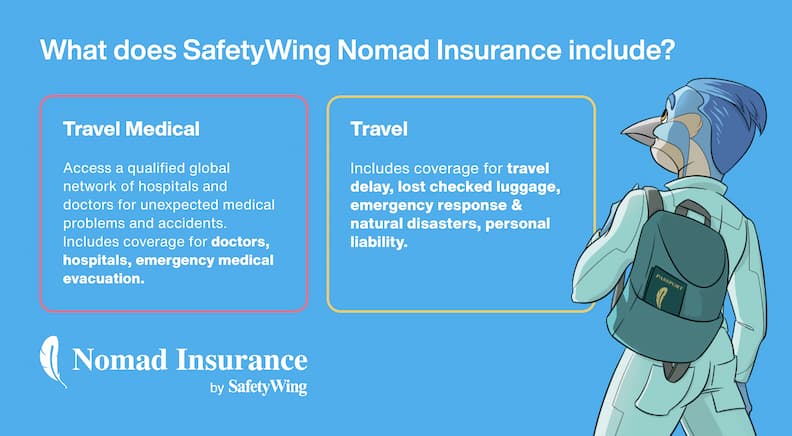
Comprehensive SafetyWing Coverage Explained
I bought SafetyWing for the boring nightmare scenario. One wrong step on a wet dock, one bad fever in a country where I didn’t speak the language, and suddenly I needed a plan that paid for care, not a plan that argued about fine print. And everyone was recommending SafetyWing Nomad Insurance. Once I checked the coverage, it seemed like the best fit for my husband and me.
To make it easier for others, in this section, I will answer what SafetyWing nomad insurance covers in plain language, with the parts travelers and expats trip over first.
Travel medical vs trip insurance (most readers misunderstand this)
Travel medical insurance pays for treatment when you get sick or injured abroad. Think doctor visit, hospital care, tests, and emergency transport, depending on the plan and the situation.
Trip insurance focuses on the trip itself. It usually targets prepaid losses and travel logistics like cancellations, missed connections, and interruptions, which matter most when you lock in expensive bookings.
SafetyWing includes some trip benefits, but it still lives closer to medical-first protection. That is why I separate it from full-on travel disruption insurance products built around refunds and cancellation-heavy itineraries.
Airport chaos sits in the middle. Travel delay coverage can reimburse essentials when a long delay forces you to sleep at the airport or pay for a last-minute hotel, and SafetyWing Nomad Insurance includes travel delay coverage as one of its travel benefits.
Baggage coverage feels comforting until you file a claim. SafetyWing Nomad Insurance includes protection for lost checked luggage, which helps with replacement basics when an airline loses your bag.
Leaving early hits harder than a delay. Trip interruption support matters when illness, injury, or a crisis forces you to change plans, rebook transport, or cut a route short.
Liability claims can ruin you faster than luggage loss. Personal liability coverage matters if you injure someone or damage property. Competitor analysis calls SafetyWing liability limits relatively low compared to some long-term travel insurers.
When you compare products, treat it as a debate between travel insurance vs medical insurance and decide which risk scares you more. Medical debt usually beats ruined hotel bookings in a fight.
Comparing the Tiers. Nomad Insurance Essential vs. Complete 2026
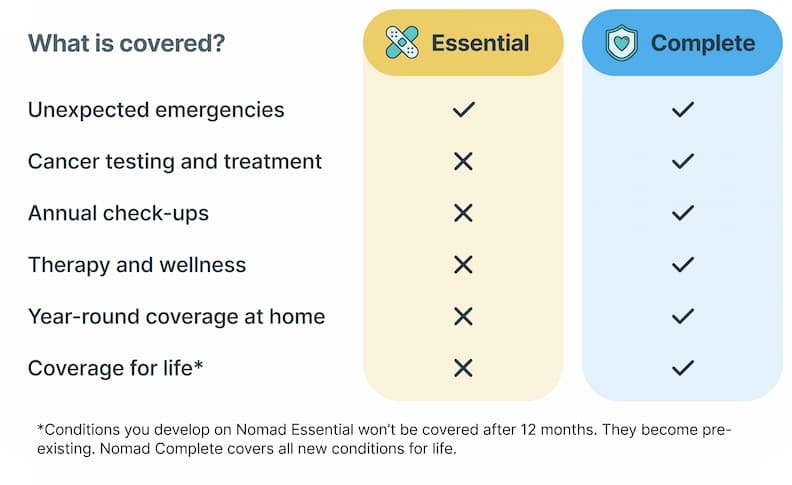
The cleanest way to choose a tier is to compare what happens after you exit “emergency mode.” SafetyWing Essential vs Complete is about how much ongoing care you expect while living abroad, not about how confident you feel today.
Nomad Insurance Essential targets unexpected medical problems and accidents during travel. It pairs medical coverage with travel benefits, which helps long-term travelers who still deal with airports and baggage issues.
Nomad Insurance Complete pushes closer to health coverage for people living abroad who want broader care, not only emergency care. It’s the tier to evaluate when you want more than getting through an ER visit.
To compare fairly, let’s focus on what the plan promises in plain terms. SafetyWing Essential coverage usually satisfies travelers who want emergency protection plus basic travel incident benefits, and who accept trade-offs like lower limits in some areas compared to premium competitors.
With the higher tier, read it like a health product, because it’s not a holiday add-on. SafetyWing Complete plan aims to bridge the gap between travel insurance and international health insurance, which is why it competes on routine-type benefits and longer-term use cases.
Coverage limits also change dramatically between the tiers. Essential includes an overall medical limit of $250,000, while Complete increases the annual medical limit to $1,500,000.
The key difference appears in the waiting periods. The SafetyWing Complete health insurance waiting period means some benefits only activate after you have held the policy for a defined time. Emergency accidents and sudden illnesses typically receive coverage immediately. Preventative care, maternity benefits, and some long-term treatments activate later.
These waiting periods exist in almost every international health plan. They prevent people from buying coverage only after receiving a diagnosis. That is why emergency care is usually available immediately, while benefits like maternity or certain complex treatments require several months of continuous coverage.
In practice, this means Essential acts as emergency protection from day one. Complete adds broader health benefits once the waiting periods pass and the policy behaves more like a traditional international health plan.
The Travel Bunny’s Tip: If you already suspect you will need routine care or maternity coverage, start the Complete plan earlier than you think. Waiting periods can block claims if coverage begins too late.
SafetyWing Essential. Travel Medical Insurance for Emergent Risks
SafetyWing Essential fits the traveler who wants solid protection for sudden problems while moving between countries, and who doesn’t want to predict an end date for a trip.
The core promise is emergency medical coverage for unexpected illness and accidents. This includes access to doctors and hospitals for problems you didn’t plan.
When things escalate, hospitalization abroad becomes the cost center. SafetyWing Nomad Essential Insurance covers expenses up to $250,000, which can cover many emergencies, but still falls short of the sky is the limit plans.
Urgent care starts in the emergency room, and ER coverage matters because ER bills stack fast. This is where a budget-friendly plan can still save you from a brutal out-of-pocket bill.
Evacuation is when people freeze. Medical evacuation exists to move you to the nearest appropriate facility when local care can’t handle your condition, and SafetyWing Nomad Essential includes emergency evacuation up to $100,000 as part of its travel medical benefits.
Travel Insurance Tip: Always distinguish medical evacuation from repatriation of remains (up to $20,000). Medical evacuation moves you to the nearest appropriate hospital while you are alive. Repatriation only applies after death and is a separate benefit with its own lower limit.
If you live out of a backpack and keep moving, SafetyWing is a nomad medical insurance that follows your route without locking you into one fixed trip length.
If you want flexible protection while traveling long-term, SafetyWing Essential remains one of the simplest options available. It covers unexpected medical care, hospital treatment, and evacuation while your trip evolves without fixed dates. You can start coverage in minutes and let it renew automatically while you travel. Get SafetyWing Nomad Insurance Essential here!
SafetyWing Complete. Integrating Global Health and Preventive Care
SafetyWing Complete targets travelers who are no longer moving like tourists but living abroad for long stretches. At that point, your needs change. Emergency treatment still matters, but so do regular doctor visits, diagnostics, and ongoing health care that can’t wait until your next flight home.
This plan behaves closer to global health insurance than a classic travel policy. Instead of covering only unexpected emergencies, it expands protection into everyday healthcare needs that expats and long-term nomads deal with while living overseas.
The biggest difference appears in the overall medical ceiling. SafetyWing Complete provides up to $1,500,000 per year in medical coverage, which includes hospital treatment, surgery, diagnostics, and specialist care. This higher limit moves the plan into the territory normally occupied by long-term international health policies.
SafetyWing Nomad Complete Insurance also adds preventative care benefits. The plan covers annual checkups, vaccines, and screening services with a limit of $350 per year. These routine services are designed to catch health issues early rather than waiting until they turn into emergencies.
Many travelers misunderstand routine care when choosing insurance. Emergency plans usually reject claims for ordinary doctor visits. SafetyWing Complete Insurance addresses this gap with outpatient treatment coverage up to $5,000 per year, which includes consultations, diagnostic tests, and prescribed treatment outside the hospital.
Serious illness requires deeper coverage. The plan includes support for cancer treatment abroad, including diagnostics and treatment within the overall medical limit. This matters for long-term residents abroad who can’t realistically travel home for treatment.
Long stays abroad also change mental health needs. SafetyWing mental health coverage under the Complete plan includes up to 10 therapy visits per year, which provides access to professional support during extended periods abroad.
Dental emergencies can become painful and expensive quickly. So SafetyWing Nomad Complete plan includes dental coverage for emergency treatment, designed to handle infections or acute dental issues that cannot wait until you return home. SafetyWing dental coverage handles urgent dental treatment with a $1,000 limit for emergency dental care.
Many digital nomads rely on screens and need reliable eye care. SafetyWing vision coverage is also included with the Complete Insurance plan, for eye examinations and prescription lenses under the preventative care framework.
Family planning also appears in the SafetyWing Nomad Complete plan. Maternity coverage becomes available after a 10-month waiting period, with up to $2,500 for pregnancy care, childbirth, and related treatment within the first 30 days after delivery. This waiting period prevents travelers from activating coverage only after pregnancy begins.
The Travel Bunny’s Tip: Before choosing SafetyWing’s Nomad Complete Insurance, check three things first. Your expected length of stay abroad, whether you will need routine doctor visits, and whether maternity or long-term treatment matters to you. If the answer to any of these is yes, Nomad Complete usually becomes the safer option.
If you plan to live abroad for months or years, emergency-only coverage stops being enough. SafetyWing Complete adds routine doctor visits, mental health care, preventative checkups, and stronger medical limits while still following your nomadic lifestyle. Instead of waiting for problems to become emergencies, you stay covered for everyday healthcare wherever you live next. Explore SafetyWing Complete and start your coverage here!
Medical coverage. Hospitals, Emergency Care, Evacuation, and Limits
Illness or injury abroad turns into a financial problem long before it becomes a medical one. SafetyWing hospital coverage exists for that moment when a doctor decides you cannot leave the hospital. Under the SafetyWing Essential plan, hospitalization and treatment fall under the $250,000 overall medical limit. The SafetyWing Complete plan expands the ceiling to $1,500,000 per year, which places it closer to international health insurance territory.
Serious treatment often involves surgery. SafetyWing surgery coverage isn’t a separate category with its own ceiling. Surgical treatment counts as hospital care, which means the same overall limits apply. Essential covers surgical treatment within the $250,000 maximum, while Complete allows treatment within the $1.5 million annual limit.
Critical care is included in the same structure. SafetyWing ICU limit doesn’t appear as a standalone number in the policy. Intensive care treatment is billed under the same medical ceiling as hospitalization. Essential, therefore, operates inside the $250,000 limit, while Complete operates inside the $1.5 million annual limit.
Evacuation becomes relevant when the local hospital can’t provide the care you need. SafetyWing evacuation coverage allows transport to the nearest appropriate medical facility. Both Safetywing plans include up to $100,000 for medical emergency evacuation.
This benefit functions like emergency medical evacuation insurance. A medical team decides that treatment must happen elsewhere, and transport is arranged to reach a hospital that can handle the case.
Air evacuation costs can escalate quickly. Travel insurance evacuation may involve helicopters, air ambulances, or medical escorts on commercial flights. A long-distance air ambulance between continents can exceed $150,000.
Emergency medical evacuation insurance matters because the bill can spike long before you touch a hospital bed. One helicopter flight, one air ambulance, or a long-distance transfer with a medical team can jump into six figures fast, even when the treatment itself stays reasonable.
Medical insurance for travelers needs a reality check if you go remote. If your route includes islands, deserts, mountains, or places with limited hospitals, evacuation becomes a planning tool, not a scary extra. The nearest hospital may sit hundreds of kilometers away.
On boats the situation becomes even more fragile. Offshore travel makes crew medical insurance relevant because reaching shore itself may require a coordinated rescue or medical transport.
Several policy clauses matter for evacuation under SafetyWing. SafetyWing evacuation coverage applies only when a qualified physician and the insurer’s assistance team confirm that local treatment is not sufficient and that evacuation is medically necessary. In practice, this means the evacuation must be coordinated through SafetyWing’s assistance provider whenever possible.
The destination follows the same rule. SafetyWing evacuation moves you to the nearest appropriate medical facility capable of treating your condition, not automatically to your home country. If proper treatment exists in the same country or a nearby one, evacuation normally stops there.
Logistics also follow strict limits. SafetyWing evacuation benefits focus on the patient’s transport and medical supervision during the transfer. The policy doesn’t generally include transport for companions or family members unless specifically authorized under exceptional circumstances.
One more rule affects timing. Evacuation must be organized during the active insurance period and approved before transport whenever possible. Emergencies where prior approval is impossible are assessed afterward based on medical necessity and policy terms.
COVID-19 Coverage Explained (2026 Policy)
The pandemic forced insurers to clarify how epidemics interact with travel insurance. SafetyWing COVID coverage was integrated into Nomad Insurance once global travel restrictions stabilized.
Under the policy structure, SafetyWing COVID coverage travel insurance treats COVID-19 as a medical condition when the infection occurs during an active coverage period, and local restrictions allow treatment coverage.
Timing matters. SafetyWing covers treatment for COVID 19 in 2026 only when the policy started before the government issued the travel warning for that destination. If a region receives a high-level travel warning after arrival, coverage continues for a short evacuation window.
The rule structure mirrors government advisories. CDC travel warning coverage determines how long a traveler can remain in a region after a warning appears before coverage rules change.
SfetyWing Insurance policy also includes support mechanisms such as a quarantine allowance in certain disruption scenarios linked to travel delays and restrictions.
Our trip collided with these rules at the worst possible moment, in 2020. The original sailing plan started in the South of France, then followed the Mediterranean through Italy, Slovenia, Croatia, Bosnia and Herzegovina, Montenegro, Albania, Greece, Turkey, Bulgaria, and finally Romania.
The pandemic shut borders one by one while we were in France preparing the boat. Repainting the hull and replacing the rigging had to wait. So the departure itself stalled.
SafetyWing allowed the route to change without rewriting the insurance. That flexibility mattered when we decided to stop before Greece and abandon the Black Sea leg of the voyage.
If you are sailing across borders and want medical cover that follows you from port to port, SafetyWing is one of the few flexible options that fits this lifestyle. It protects the traveler, not the boat, which makes it a strong medical layer for coastal routes and long-term life afloat. Check SafetyWing here.
During the pandemic, the SafetyWing built Borderless, a public tool tracking travel regulations worldwide. The project hired professionals from the travel industry whose work had collapsed during the lockdowns.
That small gesture left a lasting impression. The industry needed support, and SafetyWing chose to involve the people most affected.
Travel disruptions. Delays, lost luggage, and trip interruption
Flights fail, bags disappear, and storms disrupt travel schedules. Insurance addresses these logistical disasters through disruption benefits.
Travel delay insurance compensates for overnight delays. SafetyWing Essential reimburses $100 per day for two days, while SafetyWing Complete provides $150 per day for up to three days.
Airlines occasionally lose luggage for days or permanently. Lost checked luggage protection compensates replacement costs with $500 per item and a $3,000 policy limit.
Severe events sometimes force travelers to abandon a trip entirely. Trip interruption insurance covers emergency travel home, with both plans allowing up to $5,000 for a return ticket in specific situations, such as a death in the family.
Extreme situations trigger crisis response benefits. Emergency response protection can include evacuation when political instability or natural disasters threaten traveler safety. More on this shortly.
Personal liability limits
Accidents sometimes involve other people’s property or injuries. Personal liability travel insurance exists for situations where a traveler becomes legally responsible for damage.
SafetyWing Nomad Insurance includes third party liability coverage of up to $25,000.
This benefit operates as liability coverage abroad, protecting travelers against claims related to accidental property damage or bodily injury to another person.
SafetyWing home country coverage
Most travel insurance stops the moment a traveler returns home. SafetyWing home country coverage introduces a limited exception. Nomad Insurance allows brief medical coverage during visits back home. This benefit usually applies for 30 days every 90 days of travel.
SafetyWing home country coverage explained: Coverage only activates after an extended time abroad and applies during short return visits.
The policy treats the home country as a temporary stop, not a permanent residence. That distinction defines the limits of SafetyWing home country protection.
| Benefit | SafetyWing Essential | SafetyWing Complete |
|---|---|---|
| Maximum medical coverage | $250,000 | $1,500,000 |
| Emergency evacuation | $100,000 | $100,000 |
| Preventative care | Not included | $350 annually |
| Outpatient care | Limited | $5,000 annually |
| Mental health visits | Limited | 10 per year |
| Emergency dental | $1,000 | Included |
| Maternity coverage | Not included | $2,500 after 10 months |
| Travel delay | $100/day (2 days) | $150/day (3 days) |
| Lost luggage | $500/item, $3,000 max | Same |
| Personal liability | $25,000 | $25,000 |
SafetyWing Specialized Protections for the Modern Nomad
SafetyWing add-ons exist for two pain points nomads hit fast: stolen tech and riskier activities. SafetyWing electronics theft matters when your work lives inside a laptop, and travel insurance adventure sports matters when your “rest day” still involves water, speed, height, or remote roads.
Here’s a reality check for remote workers, sailors, and long-haul expats. When something goes wrong, the small print decides the outcome. Start here, then match your plan and add-ons to your route, your gear, and your risk tolerance.
The Electronics Theft Add-On. Protecting Your Laptop and Camera
SafetyWing laptop insurance sits inside the Electronics theft add-on on the Complete plan. SafetyWing lists up to $2,000 per stolen item and $5,000 per year for this add-on.
SafetyWing electronics coverage limit only helps when you prove the device existed and belonged to you. Treat proof of ownership like part of your packing list, keep a receipt or invoice, keep a photo of the serial number, and store backups in cloud storage.
Is SafetyWing electronics theft add on worth it 2026? If you travel with a single older phone and a budget laptop, self-insurance often feels cleaner. If you travel with a newer laptop plus a camera setup, the math shifts.
Adventure Sports and extreme activities. What is Covered?
SafetyWing adventure sports coverage starts with what the base plan already counts as leisure activities, then expands via the Adventure sports add-on shown in SafetyWing’s pricing flow. The additional cost for adventure sports coverage is $10.
Travel insurance extreme sports fails in predictable ways. You get hurt doing an activity the policy excludes, or you break a rule around licensing and safety gear, then the claim stalls. The fix starts before you pay for your SafetyWing subscription. Open the official activity list and verify your exact activity, the depth, the altitude, the motor size, and the “with instructor” conditions.
SafetyWing motorcycle coverage ties to licensing and safety requirements on the plan page. If you ride without the right license, skip safety equipment, or ride intoxicated, coverage doesn’t apply. Travel insurance scuba diving/travel insurance skydiving sit in the same bucket.
If you want the activity listed under your plan or add-on, then you want the medical limit that applies to sports injuries. SafetyWing lists $250,000 max for injuries from leisure sports and activities on the Essential plan and on the Complete plan.
SafetyWing Maternity Coverage. What’s Included and What’s not
As someone who was pregnant and gave birth abroad, I am listing maternity care in the riskier activity category.
Family planning requires careful reading of the policy wording because the two SafetyWing plans treat maternity very differently. SafetyWing maternity coverage exists only under the SafetyWing Complete plan. The SafetyWing Essential plan does not include maternity or pregnancy care and will not reimburse prenatal visits, childbirth costs, or routine pregnancy monitoring.
Under the Complete plan, SafetyWing pregnancy coverage becomes available only after a 10-month continuous waiting period. The policy must remain active during that entire period before maternity benefits activate. Pregnancy that begins before the waiting period ends will not qualify for reimbursement.
Once the waiting period is satisfied, the SafetyWing maternity coverage limit is $2,500. This amount applies to pregnancy monitoring, medical care related to childbirth, and treatment during the first 30 days after delivery. The benefit sits within the broader medical coverage structure of the Complete plan, which has an overall annual medical limit of $1,500,000.
The Essential plan behaves differently because it functions as emergency travel medical insurance. Emergency complications that threaten the life of the mother may still fall under emergency medical treatment, but normal pregnancy care remains excluded. That distinction explains why Essential works well for unexpected illness or injury during travel but doesn’t replace international health insurance for families planning pregnancy abroad.
For couples planning long-term life overseas, the $2,500 maternity limit may cover basic delivery costs in some countries but falls short in places with expensive private hospitals. In those situations, the best alternatives for maternity coverage often involve international health insurers designed specifically for expats and families who want higher maternity limits and broader prenatal care benefits.
Crisis Response. Political Evacuation and Local Unrest Repatriation
Political evacuation coverage becomes relevant when travel suddenly shifts from tourism to crisis management. That situation unfolded again in early 2026 after coordinated military strikes escalated tensions between Iran, Israel, and the United States. Several governments issued new travel advisories across the region, and airspace disruptions affected flights throughout the Middle East.
Travelers in the region found themselves in an unfamiliar situation. Airports began cancelling routes, airlines rerouted flights, and some travelers had to decide quickly whether to stay or leave before conditions deteriorated further.
SafetyWing activated its crisis response insurance framework as soon as new travel warnings appeared. The company notified policyholders that evacuation from affected areas could qualify under the Evacuation from Local Unrest benefit when specific conditions are met.
Under both SafetyWing Essential and Complete plans, political evacuation insurance is limited to a $10,000 lifetime maximum. This benefit reimburses the cost of leaving the affected area by the most economical means available. Keep in mind that this evacuation benefit operates separately from emergency evacuation for medical reasons.
The policy allows evacuation to three possible destinations. Travelers may return to their home country, travel to a nearby safe country, or relocate to another reasonable destination, such as a place where family members live.
Eligibility depends on timing. The insurance period must have started before the travel warning was issued, and there must have been no warning in place when the traveler originally entered the country.
Evacuation must also happen quickly. SafetyWing requires travelers to leave the affected area within 10 days after the travel warning appears for the benefit to apply.
Several countries currently fall under these updated warnings following the February 2026 escalation. Advisories were issued for Bahrain, Kuwait, Qatar, Israel, Jordan, the United Arab Emirates, Cyprus, Oman, and Saudi Arabia.
Documentation plays a critical role when filing a claim. Travelers must provide proof they were present in the affected region when the warning appeared. This can include a passport visa page, accommodation confirmation, or other travel records.
Travel receipts also matter. The insurer will request tickets and payment records for the evacuation transportation used to leave the area.
Situations like the Middle East escalation illustrate why crisis evacuation benefits exist. When governments issue sudden travel warnings, flights disappear quickly, and leaving safely can become expensive. In those moments, a policy that contributes to evacuation costs can make a decisive difference for travelers already on the ground.
SafetyWing Regional Dominance and Visa Compliance
Long-term travel eventually intersects with bureaucracy. Borders, visas, and residence permits often require a valid insurance policy before authorities approve entry or residency. This is where SafetyWing visa requirement questions appear. Governments want proof that visitors will not rely on local healthcare systems without coverage.
SafetyWing often works in these situations because it produces downloadable SafetyWing proof of insurance documents that list the policyholder, coverage period, and medical limits. That document is frequently requested during visa applications, residence permit renewals, or immigration checks.
Many travelers encounter the requirement when applying for European visas. SafetyWing travel insurance for Schengen visa applications can satisfy the rule requiring medical insurance that covers emergencies, hospitalization, and repatriation during the stay.
Some countries now create specific programs for remote workers. These programs often include insurance requirements tied to digital nomad permits. One example is the Romanian digital nomad visa, which requires proof that the applicant holds valid international medical coverage during the stay.
Certain destinations also introduce regional coverage restrictions. That is where add-ons become relevant. The US coverage add-on changes how SafetyWing treats travel to the United States, which remains one of the most expensive healthcare environments in the world.
The US Coverage Add-on. Essential Tips for Non-US Citizens
Healthcare in the United States operates on a completely different cost structure. A hospital visit that costs hundreds of euros in Europe can cost thousands of dollars in the United States. That difference explains why SafetyWing US coverage appears as an optional extension rather than a default feature.
SafetyWing US coverage add-on allows travelers to include the United States in their coverage area. Without this add-on, Nomad Insurance excludes medical treatment that occurs inside the United States.
Including the US coverage add-on makes SafetyWing Nomad Insurance Essential noticeably more expensive because of the high cost of healthcare in the United States. For travelers aged 10-39, the price rises from $45.08 to $73.92 per 28 days, which means about $28.84 more each billing cycle. Ages 40-49 pay about $32.48 more, ages 50-59 pay about $50.96 more, and ages 60-69 pay about $88.48 more. The coverage limits remain the same, including the $250,000 overall medical limit and $100,000 emergency evacuation, so the higher price simply reflects the increased medical costs associated with treatment in the United States.
The US add-on applies primarily to SafetyWing for non US residents who may visit the country during long trips or remote work travel. It extends medical coverage to the US while maintaining the rest of the global coverage.
The situation differs slightly for SafetyWing insurance for US citizens abroad. US citizens traveling internationally already receive coverage outside their home country through the standard Nomad Insurance structure.
The rules change once they return home. SafetyWing us citizens receive limited benefits during short visits back to the United States under the home-country clause.
This rule appears in the policy as SafetyWing home country coverage US citizens. Nomad Insurance allows limited medical coverage during brief returns home after extended travel abroad, usually capped at 30 days within a 90-day period.
Costs still remain a factor even when the US add-on is active. Medical treatment in the United States remains subject to the policy’s deductible and the overall medical coverage limit of the plan.
The US add-on also does’t eliminate every out-of-pocket cost. Deductibles, exclusions, and policy limits still apply to treatment inside the United States.
Navigating the Romania Digital Nomad Visa Insurance Requirements
Romania introduced a digital nomad permit that allows remote workers to live in the country while working for companies located outside Romania. The program was created through Law no. 22/2022, which amended Romania’s immigration legislation to allow remote workers employed outside Romania to legally live in the country while working online for foreign companies or clients. The law was adopted at the end of 2021, and the visa became available in 2022, when authorities began implementing the application process.
The visa allows non-EU remote workers to live in Romania for 12 months, with the possibility to extend it for another 12 months if the eligibility conditions continue to be met. One of those conditions requires applicants to show valid international health insurance coverage for the entire duration of their stay.
The visa documentation must demonstrate active health coverage valid in Romania and internationally. In this context, travelers can rely on SafetyWing Nomad Visa coverage to satisfy the requirement.
The policy documentation provided through the SafetyWing dashboard can serve as the required proof of insurance when submitting visa paperwork. The document lists coverage dates and confirms the existence of international medical coverage.
Authorities reviewing the application typically look for three things. The insurance must cover medical treatment, it must remain valid during the planned stay, and it must include repatriation in case of emergency.
SafetyWing Nomad Insurance satisfies these criteria because it includes emergency medical treatment, evacuation to a better-equipped hospital, and repatriation benefits within the policy limits.
Applicants still need to verify the specific requirements published by Romanian immigration authorities because visa rules may change over time.
Insurance in France. SafetyWing vs. Chapka and April International
France has its own ecosystem of travel and expat insurance providers. When comparing options, the conversation often starts with SafetyWing or Chapka.
Chapka Insurance specializes in travel and working holiday insurance designed for French travelers. It offers policies tailored for European residents, including coverage structures that align with French administrative expectations.
Comparing SafetyWing vs Chapka for French digital nomads highlights different priorities. SafetyWing focuses on flexible monthly coverage for location-independent travelers who move frequently between countries. Chapka tends to focus on structured travel programs such as working holidays, internships, and long-stay travel policies designed for French residents.
Another major competitor in France is April International, a company specializing in international health insurance and expatriate coverage. April International offers broader health plans designed for long-term expatriates who establish residence abroad rather than travelers who move between countries.
The comparison, therefore, depends on lifestyle. Travelers who move frequently often prioritize the flexibility of SafetyWing. Expats who settle in one country for years often compare providers like April International that specialize in full expatriate healthcare coverage.
What SafetyWing Nomad Insurance doesn’t cover
Every insurance policy defines situations where coverage stops. Understanding what does SafetyWing not cover matters before you buy the plan, because Essential Nomad Insurance focuses on unexpected medical emergencies during travel, while Complete Nomad Insurance covers some long-term medical history and planned treatment.
SafetyWing Insurance pre-Existing Conditions coverage. The Full Truth
Does SafetyWing cover pre-existing conditions? SafetyWing says the Essential plan does not cover pre-existing conditions. And although SafetyWing positions Complete as broader health coverage, it still doesn’t treat a known condition as a covered risk if it existed before your policy started.
This is where readers mix two different ideas. SafetyWing insurance pre existing conditions doesn’t mean you can’t buy the plan. It means the plan will not reimburse treatment connected to medical issues you already had.
Cancer Treatment Exclusions Essential. The Essential plan focuses on sudden illness and emergency care during travel, which means ongoing therapies such as chemotherapy, radiation treatment, or long-term oncology care are not included. This rule sits alongside the broader chronic conditions exclusions in the policy. Treatments linked to conditions that require continuous management fall outside the scope of Nomad Insurance Essential and require a full international health insurance plan instead.
If you live with a diagnosed condition, you need a different tool for the job. Health insurance for digital nomads with pre-existing conditions usually comes from expat-style international health insurers, or from national systems where you hold residency, because they price risk differently than travel medical plans.
If pre-existing conditions drive your decision, prioritize insurers that accept medical underwriting or that explicitly include chronic care. Best alternatives for pre-existing conditions tend to cost more, but they remove the single biggest claim rejection risk.
SafetyWing Sailing limitations
Does SafetyWing cover sailing or boating? Many travelers assume boat travel requires specialist coverage, but the SafetyWing policy explicitly includes sailing as a covered activity. If you search the official SafetyWing policy, you will see that sailing appears in the list of covered sports.
This means SafetyWing travel insurance for sailing holidays can cover medical treatment if you become sick or injured while sailing. The coverage applies to accidents during leisure sailing activities, and treatment falls under the normal medical limits of the policy.
The same rule applies when comparing SafetyWing to other policies marketed as travel insurance for sailing holidays. SafetyWing Nomad Insurance protects the traveler’s health rather than the boat itself. Medical costs, hospital treatment, and evacuation may be covered, but damage to the vessel or sailing equipment requires a marine policy.
This distinction matters for long-term sailors. If you live aboard or plan extended passages, you may also look into sailing travel insurance that covers the vessel, liability, and equipment in addition to medical treatment.
SafetyWing Nomad Insurance can still play a role in those situations because it functions as medical insurance for sailors traveling internationally. The plan follows you between countries and provides emergency care coverage when accidents happen offshore or in remote ports.
Some sailors combine policies to cover both risks. Travel insurance for liveaboard sailors often means pairing a travel medical policy like SafetyWing with specialized marine coverage designed for boat owners.
Those marine policies are often marketed as blue water sailing insurance or offshore sailing insurance, which focus on the vessel and navigation risks rather than the traveler’s health.
For serious passagemakers, the search for the best insurance for blue water sailors usually leads to a two-layer strategy. A travel medical policy protects the crew’s health, while a marine policy protects the boat and the voyage.
The Travel Bunny’s Advice: When sailing abroad, confirm two things before departure. First, that your activity appears in the covered sports list. Second, that your evacuation coverage works in the regions where you sail.
SafetyWing Home Country Coverage Rules (Including for US Citizens)
SafetyWing built Nomad Insurance for people who leave home, then come back briefly. SafetyWing home country coverage exists, but it is not unlimited on Essential. SafetyWing Essential includes up to 30 days of medical coverage in your home country.
SafetyWing also draws a hard contrast between plans here. SafetyWing Complete has no coverage restrictions at home, which makes it a different product category for long-term residents and expats.
For Americans, the home-country question gets sharper because healthcare pricing in the US punishes small mistakes. SafetyWing US citizens should treat home coverage as a defined benefit with boundaries, not a substitute for domestic health insurance.
The most common way people break their own coverage. They assume home coverage works like ordinary insurance, then they stay home too long, or they schedule treatment around a home visit, and then the claim becomes messy.
SafetyWing home country waiting period rules still depend on timing and documentation. Entry dates, policy start dates, and travel history determine whether a claim qualifies, so keeping clear proof of when you entered and left each country protects you if questions arise later.
Most claim problems happen because of small administrative errors. Common home country coverage mistakes include losing proof of travel dates, confusing the policy start date with the date you arrived home, or assuming the Essential plan works like full domestic insurance, even though home coverage remains limited.
How Much Does SafetyWing Cost? 2026 SafetyWing Prices and How Billing Works
Insurance only matters when it fits your budget. Understanding SafetyWing pricing helps you decide whether Nomad Insurance belongs in your travel plan or not.
The cost structure stays transparent because SafetyWing sells coverage through a subscription model instead of a fixed-trip policy. This structure determines the SafetyWing monthly cost and how long coverage can continue while you travel.
The final price for SafetyWing insurance depends on three variables. Age group, whether the United States is included in coverage, and which plan you choose. Once you understand those three elements, the rest of the billing model becomes straightforward.
Understanding the 28-Day Subscription Model. The Netflix of Insurance
SafetyWing designed Nomad Insurance around mobility. Instead of requiring travelers to predict the exact length of a trip, the policy renews automatically every four weeks.
The system operates through SafetyWing 28 day renewal, which creates a predictable 28 day billing cycle. Once you activate the plan, SafetyWing automatic renewal takes place at the end of each period unless you cancel it.
Can I cancel SafetyWing anytime? Yes, the plan can be canceled before the next billing cycle starts. This structure allows travelers to adjust plans while on the road. If you decide to end the policy, SafetyWing cancel options remain simple. The company allows travelers to stop the subscription from the online dashboard.
Travel does’t always follow predictable schedules. Some have asked me how to cancel SafetyWing nomad insurance mid trip if they return home earlier than expected. The cancellation simply stops future renewals and prevents the next billing charge.
SafetyWing refund policy handles unused time within the current billing period. In certain cases, the insurer refunds unused days when coverage ends early.
SafetyWing coverage duration 364 days rule means a policy can run for almost one year before requiring renewal. Once the limit approaches, SafetyWing renewal after 364 days simply begins a new policy cycle. Travelers who continue their journey usually start a new policy with identical coverage.
SafetyWing Nomad Insurance price by month by age group 2026
SafetyWing monthly pricing by age categories allows younger travelers to pay significantly less because their medical risk profile is lower.
The official pricing structure divides customers into four age groups. These groups apply to travelers between 10 and 69 years old.
- For travelers aged 0 to 39, the SafetyWing Essential plan costs $62.72 per 28 days without US coverage. Including the United States raises the price to $116.20 per 28 days.
- For travelers aged 40 to 49, the cost increases to $102.76 per 28 days without US coverage or $191.24 per 28 days with US coverage included.
- Travelers aged 50 to 59 pay $161.28 per 28 days without US coverage and $314.72 per 28 days with US coverage.
- Ages 60 to 69 pay $218.96 per 28 days without US coverage or $429.52 per 28 days when the United States is included.
How much does SafetyWing cost for a 30-year-old? That age range represents the majority of digital nomads. At age 30, the SafetyWing Essential plan costs $62.72 per 28 days without US coverage.
Estimate your SafetyWing cost by age and travel months:
The SafetyWing age limit for Nomad Insurance currently caps eligibility at 69 years old for new enrollments.
2 Example itineraries. How much you’ll actually pay for 3, 6, and 12 months
Numbers become clearer when you see real travel timelines. The examples below assume a traveler aged 30 using the Essential plan without US coverage.
A three-month trip equals three billing cycles. The SafetyWing cost for 3 months becomes $188.16.
A longer remote work trip often lasts half a year. The SafetyWing cost for 6 months becomes $376.32 for a traveler in the same age bracket.
Digital nomads who stay abroad most of the year often calculate the SafetyWing cost for 12 months. Twelve months equals thirteen billing cycles because of the 28 day system, bringing the total close to $815.36.
Some travelers compare the subscription with a yearly insurance contract. This comparison introduces the question of an annual plan vs monthly plan. SafetyWing technically operates through recurring billing, but the company also markets a SafetyWing annual plan concept through long-term continuous coverage.
Is the annual plan worth it? That usually depends on travel stability. If your trip lasts the entire year, the subscription structure effectively behaves like an annual policy while maintaining flexibility.
Now that you know what SafetyWing actually costs, the next step is simple. Check today’s price for your age, destination, and travel style, then see whether Essential or Complete makes more sense for your trip. Get your SafetyWing quote here.
SafetyWing extra costs. Deductibles, co-pays, exchange rates, and regional add-ons
The base premium doesn’t represent the entire financial picture. Insurance claims include several additional cost elements:
- SafetyWing deductible. Essential uses a $250 deductible per claim, which means the traveler pays the first $250 of eligible medical costs before reimbursement begins.
- SafetyWing co-pay describes the percentage the traveler pays for certain treatments after the deductible is met.
- Optional SafetyWing add-ons include coverage extensions such as the SafetyWing US coverage add-on or the SafetyWing electronics theft add-on for protecting laptops and cameras.
Some readers worry about unexpected charges. In practice, there are no hidden fees SafetyWing adds beyond the deductible, add-ons, and standard premium.
SafetyWing occasionally runs promotions or referral incentives. Travelers sometimes search for a SafetyWing discount code. Officially, SafetyWing says they do not offer discounts or coupons. Instead, they focus on providing the lowest price possible for the widest range of coverage, without the need for gimmicks.
When paying from outside the United States, the final card charge may vary slightly due to currency conversion. Exchange rates may change the exact amount billed by your bank, even though SafetyWing charges the same dollar amount each cycle.

SafetyWing for Digital Nomads & Remote Workers
Digital nomad insurance only makes sense if it fits the way people actually move. Remote workers jump between countries, extend stays without warning, and sometimes buy coverage after the trip has already started. That is why SafetyWing Travel Insurance keeps showing up in conversations about insurance for digital nomads, remote work insurance, and travel insurance for working remotely abroad. SafetyWing’s model was built around mobility, not around a fixed two-week holiday.
Health insurance for remote workers living abroad also needs to solve a different problem from classic holiday insurance. With classic vacation insurance, you are trying to survive a missed flight or a sprained ankle. With SafetyWing, you are trying to stay covered while living somewhere long enough to need prescriptions, paperwork, and proof of insurance for visas or border formalities. That is why SafetyWing now sits in the overlap between the best travel insurance for digital nomads 2026 and broader products like Remote Health insurance.
Why SafetyWing Became the Go-To for Location-Independent Workers
SafetyWing for remote workers is an excellent choice because the product matches remote work chaos better than most old-school insurers. The subscription renews every 28 days, so you don’t need to know your exact return date before buying. That matters when one month in Lisbon turns into three months in Athens, then a quick stop in Romania because rent and weather suddenly make more sense there.
SafetyWing for freelancers also removes one of the usual insurance headaches. You can start the plan while you’re already abroad. Many insurers punish late planners. SafetyWing built that flexibility into the product from the start, which is one reason it became so visible in the digital nomad space.
The ability to buy SafetyWing while already abroad sounds small until you need it. A lot of long-term travelers leave home without a perfect itinerary, then realize halfway through the trip that they need proper coverage. SafetyWing Nomad Insurance works for that messy, real-world version of travel instead of pretending everyone books life six months ahead.
Paperwork also matters more than people admit. SafetyWing proof of insurance is useful because remote workers often need a document they can actually show to immigration officers, landlords, or visa authorities. A pretty marketing page does nothing for you at a consulate. But a downloadable certificate does.
That becomes practical when a country asks for a SafetyWing visa requirement document or any other proof that you will not become a burden on the local healthcare system. SafetyWing Digital Nomad Insurance fits this use case better than many domestic-style policies because it was built for people living between jurisdictions.
It also suits slow travel across Europe. SafetyWing travel insurance for Europe trips makes sense for people moving through multiple countries over several months, especially when the trip mixes tourism, remote work, and occasional returns home. That is a different rhythm from the one most annual holiday policies were built for.
SafetyWing travel insurance for Schengen visa countries. The policy certificate and international medical framing make it a practical option for people who need documented coverage for European travel or residence processes, provided the policy terms and current visa rules line up with the consulate’s requirements.
Working remotely across borders gets complicated fast. SafetyWing keeps the insurance part simple with flexible renewals, proof of coverage for visas, and protection that travels with you. If you work online and move often, check SafetyWing here.
Price alone doesn’t explain why so many remote workers keep using SafetyWing Insurance. The product aligns well with a location-independent life. The subscription structure, the ability to start coverage while already abroad, and limited home-country visits built into the policy make it practical for people who move between countries while working online.
SafetyWing Nomad Insurance. Is the Annual Plan Worth It?
The phrase SafetyWing annual plan needs a bit of honesty. For Nomad Insurance Essential, SafetyWing doesn’t sell a classic annual policy with one upfront yearly premium in the way many traditional insurers do. It sells rolling 28-day coverage that can continue for up to 364 days, then restart if needed. So when people talk about an annual version, they usually mean keeping the subscription active all year.
That distinction matters because SafetyWing Nomad Insurance annual coverage is valuable for flexibility. It doesn’t have a huge annual discount. You’re paying for the right to keep moving, adjust plans, and stop when life changes. If you know you’ll stay abroad for most of the year, that flexibility can outweigh the fact that the product isn’t built like a rigid prepaid annual contract.
For budget-conscious travelers, SafetyWing is one of the best budget nomad insurance because the entry price for younger travelers stays relatively accessible compared with many expat-style health plans. Besides an affordable starting price, SafetyWing also has a simple signup process and offers the ability to buy while already traveling.
Calling SafetyWing cheap travel insurance is only half true, though. It’s cheap compared with some international health insurance products. It isn’t automatically cheap once you add US coverage, electronics protection, or higher-tier care. Price only looks good if the coverage matches what you need.
So, whether SafetyWing is worth it or not depends on the shape of your year. It works well for digital nomads, freelancers, slow travelers, and remote workers who want one policy following them across borders without forcing a fixed end date. It works less well for people who need high-end chronic care, rich trip cancellation benefits, or a fully domestic-style health insurance experience.
If your life abroad feels mobile, SafetyWing usually makes sense. If your life abroad already looks settled, with regular specialists, predictable healthcare use, and long-term residency goals, you may be crossing into the territory where a broader international health plan fits better than Nomad Insurance.

SafetyWing for Long-Term Travelers, Expats & Retirees
Long term travel insurance stops being a nice extra once your trip stretches past the usual holiday window. A weekend in Rome is one thing. A season on the road, a sabbatical abroad, or a year split across countries is something else entirely. At that point, you need a policy that can stay in place while your plans change, your return date moves, and your route starts looking less like a vacation and more like a temporary life.
Finding the cheapest travel insurance for long term travel sounds like the right goal until you read the exclusions. I’d rather pay a little more for a plan that still works when I need a hospital, an evacuation, or proper proof of insurance than save a few euros on something flimsy. Cheap travel gets expensive fast when the wrong clause appears at the wrong time.
Expat travel insurance sits in the middle ground between short-trip travel cover and full international health insurance. SafetyWing Nomad Insurance works well in that space when you are still moving, still crossing borders, and still living with some uncertainty. It’s less convincing if you’re fully settled in one place and need a domestic-style health system replacement.
Travel insurance for round the world trip also needs flexibility. You don’t want to rebuild your insurance every time you change continent, add a stop, or cut a route short because weather, politics, or common sense tells you to.
Backpacker travel insurance, gap year travel insurance, and working holiday insurance all face the same problem. The people buying these plans rarely know the exact shape of the year ahead. That’s one reason SafetyWing Insurance keeps showing up in long-trip conversations. The subscription model fits trips that evolve as you go.
That part matched our own experience. My husband was covered during his gap year while we were preparing for our sailing holidays in the Mediterranean, and I kept blogging while we were building that travel life around the boat. We didn’t need a policy built for a fixed resort holiday. We needed one that could follow a long, messy, changing route.
Our route proved the point. We started with plans for southern France, then imagined a much longer sailing line through Italy, Slovenia, Croatia, Bosnia and Herzegovina, Montenegro, Albania, Greece, Turkey, Bulgaria, and Romania. We later cut parts of the plan for safety reasons, and the insurance still fit because the route could change without breaking the model.
How SafetyWing Works for People 60+ and Seniors
SafetyWing seniors need to treat Nomad Insurance as a practical tool. It’s not a magic solution. Age affects price hard, and it also affects the level of medical risk you bring into the policy. That means older travelers need to compare more carefully than a 28-year-old freelancer hopping between hostels.
SafetyWing 60+ pricing reflects that higher risk. The plan’s still available to older travelers, but the cost rises sharply in the upper age brackets, especially once US coverage enters the picture. That doesn’t make SafetyWing’s coverage bad. It just means the margin for buying the wrong product gets smaller.
Travel insurance for people over 60 long term needs stronger scrutiny because older travelers are more likely to deal with ongoing treatment, routine prescriptions, specialist visits, or diagnoses that blur the line between emergency care and chronic management. SafetyWing Insurance can still work, but only if the traveler’s needs still fit a travel medical framework.
Travel insurance for retirees living abroad becomes a different conversation when the move isn’t temporary. If retirement abroad looks like slow movement between countries, SafetyWing Nomad Insurance can be great. But if retirement abroad looks like settling in one country with regular healthcare use, a fuller international health plan often becomes the better fit.
Retirees also need to be more honest about exclusions. Pre-existing conditions, chronic care, and long-term treatment aren’t side notes at that stage of life. They’re often the main issue. A retiree who buys Nomad Insurance while expecting it to behave like full resident health insurance is setting up a fight with the policy wording.
SafetyWing’s Nomad Insurance plan still works for the right senior traveler. A healthy older traveler doing a long European trip, a sabbatical year, or a seasonal lifestyle abroad may still find the SafetyWing Nomad plan useful because it keeps the structure simple and the geography flexible. That’s very different from using it as a substitute for lifelong health coverage.
SafetyWing for Couples and Families. Is It the Best Option?
SafetyWing for families sounds attractive because the subscription model removes some of the rigidity that makes family travel planning miserable. Families rarely move on perfectly predictable timelines. Children get tired, routes change, and home visits suddenly become necessary.
SafetyWing nomad insurance for families works best for families who move between countries during long trips. The policy follows the traveler instead of tying coverage to one destination.
SafetyWing nomad insurance for families works best for families who still travel like travelers. They may stay longer in places, but they are still moving, still crossing borders, and still need a policy that adapts to that rhythm.
SafetyWing nomad insurance for kids deserves a closer read than the website’s marketing summary. Family travel insurance looks simple until you compare what’s covered for adults, what’s covered for children, and how quickly routine care, dental issues, or local pediatric visits can move beyond “travel emergency” territory.
Family travel insurance long term also stops being only about emergencies. Once a trip lasts months, families start needing ordinary healthcare questions answered. Where do you go for a child’s fever that isn’t an ER case? What happens if you need follow-up care? What if a child needs monitoring rather than one emergency visit? Those details matter more for families than for solo travelers.
With SafetyWing Essential, if a child develops a high fever that becomes a medical emergency, treatment falls under the policy’s emergency medical coverage. The same applies if a doctor requires follow-up visits connected to the original emergency event.
But SafetyWing Nomad Essential doesn’t function like everyday family health insurance. Routine pediatric appointments, preventative visits, vaccinations, or ongoing monitoring without an emergency trigger are normally outside the scope of the Essential plan.
SafetyWing Complete addresses many of those long-term family concerns. The Complete plan introduces routine and preventative care that families often need during long stays abroad. This includes doctor consultations for non-emergency health issues, wellness care, mental health support, and broader medical management that resembles global health insurance rather than pure travel coverage.
Routine care under Complete changes the equation for families. A child with a persistent fever that requires a clinic visit rather than an ER trip fits within the type of care SafetyWing Complete is designed to handle. Follow-up appointments, prescription management, and ongoing care coordination become possible without requiring an emergency trigger.
Complete also expands long-term health protection. The plan includes coverage areas such as preventative care, cancer treatment, maternity care, dental care, and vision care, all of which matter more for families who spend months or years abroad rather than weeks.
In simple terms, SafetyWing Essential protects against emergencies during travel, while SafetyWing Complete supports the everyday healthcare realities of living abroad. Families planning long-term travel often start with Nomad Essential for short or flexible trips. Families who expect routine medical needs usually move toward Nomad Complete because it behaves more like international health insurance.
The Travel Bunny’s Tip: Families planning long trips should decide first whether they need emergency protection or everyday healthcare abroad. That single decision usually determines whether Essential or Complete is the right SafetyWing plan.
Traveling with a partner or kids changes what matters. If you mainly want emergency protection on the road, start with SafetyWing Essential. If you need routine care during a long stay abroad, look at Complete instead. Compare both SafetyWing plans here and choose the one that actually fits your family.
Couples usually have an easier fit than families. Two adults living flexibly on the road often align well with the structure of Nomad Insurance, especially if they’re healthy and want protection for accidents, illness, delays, and evacuation rather than a full resident healthcare package.
Families need to be more selective. The bigger the group, the more likely someone will need care that falls outside pure emergency travel medicine. That doesn’t automatically rule SafetyWing out. It means parents should treat it as a decision based on actual care patterns vs the hope that one plan will magically cover every family scenario.
The strongest use case is still the mobile one. If your family is moving between countries, traveling long term, homeschooling on the road, or building a slow travel year rather than settling permanently, SafetyWing remains far more practical than many rigid holiday policies.
The weaker use case is the half-settled one. If you’re effectively living in one country, expecting regular checkups, and planning family life there, then you are already drifting toward expat or international health insurance territory.
Is SafetyWing the right insurance for your trip?
Are you still traveling between countries?
YES
Do you mainly need emergency protection while traveling?
SafetyWing Nomad Insurance Essential
Best for:
- Digital nomads
- Backpackers
- Gap year travel
- Round-the-world trips
- Flexible multi-country travel
SafetyWing Nomad Insurance Complete
Best for:
- Remote workers abroad
- Long stays overseas
- Routine medical visits
- Preventative healthcare
- Nomads needing broader coverage
NO
Are you settling in one country long-term?
Compare expat health insurance plans
Examples:
- Cigna Global
- Allianz Care
- April International

SafetyWing for Sailors & Maritime Travelers. The Definitive Guide
Finding the best travel insurance for sailing holidays is harder than finding ordinary travel cover because life on the water creates a different risk profile. Distances are longer, access to care is slower, and a simple injury can turn into a transport problem before it becomes a treatment problem. That is why I treat travel insurance for sailing holidays as a medical and logistics question. SafetyWing can play that role well because it covers treatment for injuries from leisure sports and activities up to $250,000 with the Nomad Insurance, and the list of covered activities includes sailing.
That doesn’t make SafetyWing a full marine policy. SafetyWing travel insurance for sailing holidays protects the traveler, not the boat. It can cover medical treatment, evacuation, delays, and some trip-related incidents, but it doesn’t replace hull insurance, boat liability, or specialist offshore cover for the vessel itself. That’s why we also had boat insurance.
Does SafetyWing Cover You on a Sailing Yacht?
Yes, SafetyWing covers sailing or boating. On the official activity list, sailing appears as a covered leisure activity. That means injuries sustained during recreational sailing can fall within the policy’s sports injury coverage.
Many travelers assume that travel insurance while on a sailing yacht automatically becomes invalid once you leave land. SafetyWing Nomad Insurance doesn’t treat sailing itself as an excluded activity. If you are sailing recreationally and an accident happens, treatment can be covered under the same medical framework as any other covered sport.
SafetyWing sailing coverage becomes practical for travelers moving between coastal countries by boat. The Nomad Essential plan provides up to $250,000 in medical treatment coverage, which includes hospital care, diagnostics, and surgery resulting from an accident or sudden illness during travel.
Evacuation is the second critical piece for sailors. If a doctor determines that treatment requires a better-equipped facility, SafetyWing boating coverage includes medical evacuation up to $100,000 lifetime maximum to transport the patient to an appropriate hospital.
These benefits are what make the policy usable for travelers spending long periods on the water. A fall on deck, an infection that worsens offshore, or a serious injury in a remote harbor can require hospital transfer before treatment even begins.
Sailing limitations SafetyWing mainly relate to the type of coverage being provided. The insurance protects the traveler’s health. It doesn’t insure the vessel, the sailing equipment, or the liability of the boat owner.
In other words, SafetyWing travel insurance for sailing holidays works well as medical coverage for the crew or traveler. SafetyWing can serve as boat travel insurance for the human side of the voyage. It doesn’t replace marine policies designed to insure the boat itself or the operational risks of offshore navigation.
For many travelers sailing coastal routes or living aboard temporarily, this structure is exactly what they need. The medical protection follows the traveler between ports, countries, and islands without requiring a new policy for every leg of the trip.
Best Travel Insurance for Blue Water & Offshore Sailors
The best insurance for blue water sailors is rarely a single policy. Offshore sailing usually works best with layered protection because the crew and the boat face different risks.
Blue water sailing insurance focuses on the vessel, navigation zone, storm exposure, equipment, and liability related to the boat. That is not what SafetyWing was built to do.
Offshore sailing insurance becomes necessary once your route includes serious passages, remote crossings, or vessel-specific risk that a travel medical policy will never touch. For that reason, SafetyWing isn’t a one-stop answer for offshore sailors.
SafetyWing Nomad works as travel insurance for liveaboard sailors when the goal is protecting the traveler’s health while moving between countries and spending long periods on the water. I consider SafetyWing Nomad Essential valuable as medical insurance for sailors.
Medical Insurance for Liveaboard Sailors. What to Look For
Good liveaboard insurance starts with one blunt question: If you get hurt far from a major hospital, who pays to move you to one?
Crew medical insurance needs to be stronger than a standard holiday policy. A sailor may be injured in a marina, on a crossing, or in a remote anchorage where the first problem is transport, followed by treatment.
Medical evacuation insurance matters more for sailors than for most city travelers because the nearest adequate hospital may be on another island or across a border. An emergency medical evacuation can cost far more than most people expect. Once air transport, medical staff, and route distance enter the picture, six figures stop sounding dramatic and start sounding normal.
SafetyWing includes evacuation to a better-equipped hospital up to $100,000 lifetime max, which is one of the reasons it remains relevant for sailors even though it isn’t a marine policy.
You also need to read the repatriation clause. SafetyWing repatriation coverage on the Nomad Essential plan includes $20,000 for transport and $10,000 for local burial arrangements in the event of death. Those aren’t cheerful numbers to discuss, but they matter on serious long-distance routes.
SafetyWing vs Dedicated Sailing Insurance. When to Use Which
Specialist sailing policies still matter. They exist for hull damage, third-party marine liability, salvage, gear loss, and the kinds of offshore complications a travel medical policy will never touch.
This is the core difference between boat insurance vs travel insurance. Boat insurance cares about the vessel and the voyage as a maritime operation. Travel insurance cares about the human body moving through the trip.
For long passages, I would treat offshore sailing insurance alternatives as complementary, not competing. SafetyWing Insurance can still be the medical layer while a marine insurer handles the vessel layer. That makes SafetyWing a strong candidate in any shortlist for the best travel insurance for sailing holidays, as long as you use it for the right purpose.
| Coverage area | SafetyWing Nomad Insurance | Specialist sailing policy |
|---|---|---|
| Medical treatment | Covers illness and injuries during travel, including accidents that happen while sailing recreationally. SafetyWing Nomad Essential plan covers treatment, hospitalization, diagnostics, and surgery up to $250,000. SafetyWing Nomad Complete plan functions as broader international health insurance with higher limits and routine care. | Usually limited or absent. Most marine insurers focus on the vessel. Some policies offer optional crew medical insurance, but the limits and scope vary widely. |
| Emergency evacuation | Medical evacuation coverage up to $100,000 lifetime maximum when a doctor confirms the traveler must be transported to a better hospital. Applies to injuries or illness during travel, including while sailing. | Some offshore sailing policies include evacuation benefits for crew, but many expect crew members to hold separate medical or travel insurance. Coverage limits depend on the marine insurer. |
| Trip delays | Essential includes limited travel delay coverage and related travel disruption benefits, which can apply when moving between destinations by boat or plane. | Marine insurance rarely covers trip delays. These policies protect the vessel rather than travel logistics. |
| Boat damage | Not covered. SafetyWing protects the traveler, not the vessel. | Core feature. Specialist sailing policies insure the hull, rigging, equipment, and damage to the boat itself. |
| Marine liability | Personal liability exists under the travel policy, but it’s not designed for marine operational risk. It does not replace yacht liability insurance. | Core feature. Marine policies cover third-party liability, collisions, and damage caused by the vessel. |
| Offshore passages | Medical coverage still applies to the traveler, but SafetyWing isnt designed to insure offshore navigation risks or the vessel itself. | Specifically designed for offshore routes, blue water passages, storm zones, and long-distance sailing risks. |
| Gear on board | Electronics coverage may be available through the electronics theft add-on, which protects devices like laptops and cameras under certain limits. Sailing equipment is not insured. | Marine policies usually cover onboard gear, sails, safety equipment, and spare parts as part of vessel insurance. |
SafetyWing Real-World Scenarios and Case Studies
Insurance language stays abstract until a real situation forces you to use it. The easiest way to understand how a SafetyWing policy behaves is to walk through realistic scenarios. A hospital claim, a stolen laptop claim, or a home country visit each activates different parts of the policy. Even SafetyWing reimbursement time depends on the type of claim and the documents submitted.
These examples reflect situations that long-term travelers encounter regularly. They also mirror the types of trips many readers of this guide take. A sailor crossing the Mediterranean. A freelancer working abroad for months. Or a family managing long term travel while moving between countries.
SafetyWing hospital claim
Does SafetyWing cover hospital stays abroad? That scenario sits at the core of Nomad Insurance. If a traveler becomes seriously ill or injured while abroad, you are covered under SafetyWing hospitalization, diagnostics, and treatment policy the plan limits.
Imagine a traveler developing severe abdominal pain while staying in Lisbon. The hospital performs scans and confirms appendicitis. Surgery becomes necessary. In that situation, SafetyWing surgery coverage falls under emergency medical coverage. It treats an acute condition.
Hospital cases can escalate quickly. If complications appear and doctors require intensive monitoring, the patient may be moved into the ICU. SafetyWing ICU care remains part of hospital treatment rather than a separate benefit category.
Distance from proper medical facilities creates another layer of risk. Travelers in remote islands, small coastal towns, or mountain areas sometimes require transport to larger hospitals. That is where medical evacuation insurance becomes critical. SafetyWing Nomad policy can arrange transport when doctors determine the local facility can’t provide adequate care.
This explains why SafetyWing functions primarily as an emergency travel insurance. It protects travelers from the financial shock of urgent medical treatment while abroad. Routine care or chronic treatments belong to a different category of health coverage.
SafetyWing Stolen laptop Claim
For remote workers, losing a laptop can disrupt an entire trip. The Nomad Insurance offers optional protection through SafetyWing electronics theft coverage.
SafetyWing laptop insurance is a benefit you can enjoy when the electronics add-on is active. If a laptop or camera is stolen during travel, the policy can reimburse the loss up to the electronics coverage limit.
The claim process relies heavily on documentation. That is where proof of ownership becomes essential. The most useful documents include receipts, invoices, order confirmations, or serial numbers. Photos of the device taken during the trip can also help confirm ownership.
A theft claim also requires official confirmation of the incident. A police report for theft claim usually forms the foundation of the file. Without it, proving that the loss resulted from theft rather than misplacement becomes far more difficult.
Electronics protection works best when travelers prepare before something disappears. Saving purchase documents and photographing gear before departure can make a large difference when filing the claim.
Visiting your home country during a long trip
Nomad travel rarely follows a clean departure and return. Many long-term travelers eventually go back home for short periods. SafetyWing home country coverage is available for those situations.
SafetyWing home country coverage explained. Remember that the policy is designed primarily for travel outside the home country. Travelers who return briefly may still receive limited medical protection during the visit. The Nomad Essential policy doesn’t transform into full domestic health insurance. It remains travel coverage with a restricted home-country benefit.
Home country coverage limits include both financial caps and time restrictions. Staying home longer than allowed under the policy can remove eligibility for those benefits.
Travel documentation becomes important in these situations. Boarding passes, entry stamps, and booking confirmations help demonstrate how long the traveler remained outside the home country before the visit.
SafetyWing for families with kids traveling long term
Families traveling for months or years face a different insurance reality. SafetyWing can work well for families when the trip involves multiple countries and frequent movement.
One pricing detail makes SafetyWing nomad insurance for kids more practical than many parents expect. A maximum of two children per family or group, older than 14 days but younger than 10 years old, can be included at $0 with each insured adult on the same group policy.
This structure makes SafetyWing surprisingly workable as family travel insurance long term for parents traveling with one or two young children, while worldschooling, working remotely, or taking extended sabbaticals abroad. A couple with one or two eligible children can often cover the whole group while only paying the adult premiums.
The limitation appears when healthcare needs become routine rather than urgent. Families sometimes require regular pediatric visits, vaccinations, or follow-up appointments. Those services move closer to everyday healthcare rather than travel emergency treatment.
Parents planning extended travel should evaluate the balance between mobility and stability. If the family keeps moving between destinations, a travel-focused policy often works well. If the family settles in one country for extended periods, a broader kids coverage travel medical insurance or international health plan may become more appropriate.
SafetyWing How to Buy, Activate, Use, and Cancel Step by Step
Buying travel insurance shouldn’t feel like filing taxes. One reason SafetyWing became popular among long-term travelers is the simplicity of the process. Understanding how to buy SafetyWing travel insurance online takes only a few minutes, and the policy can be started even after the trip has already begun.
The platform works through a digital account rather than paperwork sent back and forth by email. Once the account exists, the traveler can manage coverage, download documents, and access their policy certificate directly through the dashboard. That is where SafetyWing proof of insurance is generated if a visa application, border crossing, or landlord requires official confirmation of coverage.
Eligibility and when to buy (before vs during trip)
The first thing to check is if you meet the SafetyWing eligibility criteria. The policy is designed for travelers and remote workers moving between countries, not for people living permanently in their home country. Applicants must also fall within the allowed age brackets of the plan (0-69 years old).
Most people prefer to buy SafetyWing before trip departure. That approach gives you full coverage from the moment the journey begins and avoids confusion about activation timing.
But you can also buy SafetyWing during trip, which solves a common problem in long travel. Many travelers leave home without insurance or with coverage that expires mid-journey.
The flexibility to buy SafetyWing while already abroad is one of the reasons the policy fits digital nomads. A traveler halfway through a multi-country trip can still activate the plan without returning home.
That flexibility matters especially for long term travel. Long trips evolve constantly, and the ability to start coverage mid-journey prevents travelers from being locked out of protection simply because they planned badly at the beginning.
How to Sign Up for SafetyWing in Under 5 Minutes
The signup process starts on the SafetyWing website. SafetyWing sign up account requires only basic travel information, including nationality, destination region, and start date.
Once the account exists, the traveler can access the platform using their SafetyWing login credentials. The account opens a personal dashboard that manages the policy.
Your SafetyWing dashboard displays policy details, payment information, renewal dates, and claims access in one place. It also stores the certificate that many travelers need as proof of coverage.
SafetyWing also provides mobile access. Many travelers interact with their policy through the SafetyWing app, which mirrors the dashboard functions and allows travelers to submit claims or contact support during a trip.
The final step after signup is downloading SafetyWing proof of insurance. This document shows the traveler’s name, policy dates, and coverage confirmation. It’s often used for visa applications, immigration checks, or rental agreements.
When Does SafetyWing Coverage Start? Activation Dates Explained
Coverage timing depends on the SafetyWing start date chosen during purchase. The traveler selects a start date when buying the policy. The system then handles SafetyWing activation automatically. Once the selected date arrives, coverage becomes active without additional steps from the traveler.
Understanding SafetyWing insurance activation and start date helps avoid confusion during claims. Treatment must occur after the policy activation date for the claim to be eligible.
Travelers using the broader health plan should also understand the waiting period SafetyWing Complete introduces for certain benefits. Preventative care, maternity coverage, and some long-term treatments activate only after defined waiting periods under the Complete plan.
Those waiting periods exist because SafetyWing Nomad Complete functions as international health insurance rather than emergency travel coverage.
Managing your subscription, pausing and canceling
SafetyWing operates through a subscription system rather than a fixed policy term. Travelers can manage the policy through their account using the SafetyWing manage subscription tools.
From the dashboard, users can change payment methods, adjust coverage regions, and review upcoming renewals. This structure keeps the policy active automatically until the traveler decides to stop it.
SafetyWing pause subscription coverage. The policy does not include a pause feature. Instead, the traveler must cancel the subscription and later start a new policy when coverage becomes necessary again.
Ending coverage is straightforward. A traveler can SafetyWing cancel the policy directly from their account without contacting an agent.
Understanding how to cancel SafetyWing nomad insurance mid trip helps travelers avoid unwanted renewals. Because the plan renews automatically every 28 days, cancellation must happen before the next billing cycle begins. More on this below.
How to Cancel SafetyWing Step-by-Step Guide
Canceling the policy is straightforward. The first step is logging into your account using your SafetyWing login credentials. From the dashboard, open the active policy and access the subscription settings. This section contains the option to SafetyWing cancel the policy.
Can I cancel SafetyWing anytime? Yes. The policy allows cancellation whenever you decide the coverage is no longer needed. This flexibility is part of the subscription model used by Nomad Insurance.
The details that matter appear in the SafetyWing cancellation policy. If the cancellation request is received before the start date of the active insurance period, the premiums are refunded in full. This is the cleanest situation because the policy has not yet started.
The situation changes once the coverage period begins. According to the SafetyWing refund policy, if the cancellation request arrives after the start date, the unused portion of the premium can still be refunded, but only if no claim has been filed during that insurance period.
For policies that are not paid in one full payment covering the entire 364-day maximum coverage period, the insurer deducts a $25 cancellation fee when refunding the unused portion of the premium.
For policies paid as a single payment for a 364-day period, the refund rules are stricter. If the cancellation request comes after the coverage start date and no claim has been filed, the unused premium is reimbursed up to a maximum of 65% of the total premium. In that case, a $60 cancellation fee applies and the remaining 35% of the premium is not reimbursed.
Add-ons follow separate rules. Premiums paid for SafetyWing adventure sports coverage and the SafetyWing electronics theft add-on are non-refundable if the cancellation request is submitted after the policy start date.
The practical SafetyWing cancel step by step process is simple, but the refund depends on timing. Cancel before the policy begins and the refund is full. Cancel after the start date and the refund becomes partial, subject to fees and the rule that no claim must have been filed.
How to File a SafetyWing Insurance Claim
A good insurance plan matters less if the claim process falls apart when you need it. This is where the real test begins. A smooth SafetyWing claim depends on two things you can control:
- The documents you keep
- The speed with which you submit the documents.
SafetyWing says you can file through your dashboard by clicking Make a claim, uploading receipts and medical notes. The company states claims are typically reimbursed in 21 days or less.
The official process is simple on paper, but details decide the outcome. The published SafetyWing claims process allows you to either pay first and request reimbursement through the website, or reach out to the 24/7 assistance team so they can arrange payment in cases where that option applies. The policy wording also says you must submit claims within 60 days of the end date of your insurance, which is the kind of sentence people only notice after they miss it.
Documents you must keep, receipts, reports, and proof
Your file is only as strong as your paperwork. The safest way to think about SafetyWing claim documents is to build the folder before anything goes wrong. If you are sick, robbed, hospitalized, or delayed, you want every key record ready instead of scattered across email, camera roll, and paper receipts.
Start with a clean claims documents checklist. For a medical claim, keep medical reports, itemized invoices, prescriptions, discharge notes, and any referral or diagnostic records. For reimbursement, keep payment confirmation from the hospital, clinic, pharmacy, or provider. If your case involves travel or location rules, keep a passport copy or at least the relevant visa and entry proof. The official claim instructions ask for documents, receipts, and medical notes stating the treatment you had and why.
Receipts matter more than people think. If you want reimbursement, keep the original receipts for claim support, not just a bank notification that money left your account. An invoice that shows the provider, service, date, and amount is far more useful than a vague card statement.
Theft or loss cases need a different file. If the issue involves luggage, electronics, or crime, add a police report whenever possible. A theft claim without official confirmation is much weaker than one backed by a report number, written statement, or local incident record.
Step by step claims process with reimbursement timelines
The real SafetyWing claim process starts with treatment before forms. If you need care, get treated first. In a medical emergency, call the local emergency number or contact SafetyWing’s assistance team if the situation allows. The official contact page says live chat replies in under a minute and email replies usually arrive within one to two hours.
Step one is receiving treatment. That sounds obvious, but it matters because the policy wording allows two routes. You can pay first and ask for reimbursement later, or in some cases you can reach out so SafetyWing Insurance can arrange payment directly. Not every claim type qualifies for arranged payment, which is why medical treatment often still begins with you paying the provider yourself.
Step two is collecting documentation before details disappear. Save invoices, reports, prescriptions, receipts, and proof of payment while you are still at the clinic or hospital. If you wait until later, records go missing and explanations get weaker.
Step three is opening the claim in your account. The official instructions say to log in to the dashboard and click the SafetyWing Make a Cclaim button. That is the core of the SafetyWing dashboard claim flow. You fill in a short form and upload documents supporting the event, treatment, and payment.
Step four is uploading a complete file. A good SafetyWing invoice upload includes the provider name, treatment date, amount paid, and the reason for care. A good medical note explains what treatment you received and why it was medically necessary.
SafetyWing reimbursement time depends on how complete the file is. On the public FAQ, SafetyWing says claims are typically reimbursed in 21 days or less. In the SafetyWing Complete policy wording, they also say that once complete information is submitted, reimbursement turnaround is 15 business days. Those two statements are not contradictory. One is a public expectation, the other is a policy processing timeline after the file is complete.
The weak point is missing information. The policy wording says that if SafetyWing requests more information, you must provide it within 90 days from the first request. If that period passes without the required documents, the claim will not proceed. That sentence matters because delays in the claim aren’t always the insurer’s fault. Sometimes the file simply stays incomplete too long.
Tips to avoid rejected claims
A SafetyWing rejected claim rarely comes out of nowhere. Most problems start with small mistakes made during treatment, documentation, or submission. Insurance companies do not evaluate stories. They evaluate records. The cleaner your file, the easier the decision.
The most common trigger behind a SafetyWing claim denial is submitting a claim that falls outside the policy scope. Treatment related to pre-existing conditions, excluded activities, or benefits not included in the plan will normally be rejected even when the paperwork is complete. Understanding what the policy actually covers reduces this risk before anything happens.
Documentation quality comes next. Weak files often contain missing invoices, unclear medical reports, or no confirmation that payment was made. Every claim should include clear treatment notes, itemized invoices, and proof of payment. This simple claims denial playbook prevents many avoidable problems.
Timing also matters. Claims must be submitted within the deadlines defined in the policy. Waiting too long to submit documentation or respond to requests can delay or weaken the claim review.
If a claim is rejected, SafetyWing provides a structured process to challenge the decision. When a claim is denied, the insurer sends a written explanation describing why the decision was made. Travelers who disagree with the outcome can appeal a SafetyWing claim within 180 days of receiving the decision.
Appeals are handled by the Customer Care team. Travelers can contact support through the online chat on the SafetyWing website to receive instructions on how to submit the appeal. When the appeal is received, the case is reviewed again and the decision is communicated in writing.
SafetyWing policy allows two appeal attempts. Submitting an appeal doesn’t prevent the traveler from filing a complaint if the issue remains unresolved. This structured approach helps clarify disputes before moving to more formal escalation.
Escalation begins with customer support. Travelers can start by contacting the support team through live chat or by emailing claims[at]safetywing[dot]com. If the issue remains unresolved, concerns can be escalated to management through feedback[at]safetywing[dot]com.
When a complaint reaches management, the company states that it will respond within five business days with a proposed solution or request additional information if more investigation is needed. Providing the claim number and clear documentation helps speed up this review.
If the issue still can’t be resolved, SafetyWing may propose using an independent dispute resolution platform. This option becomes available after the appeal process has been exhausted.
The final step involves legal action. The policy specifies that travelers must complete the internal appeal process before pursuing legal proceedings. This requirement ensures that the insurer has the opportunity to review and resolve the dispute internally before the case moves further.
A fair SafetyWing insurance customer service review usually begins with this escalation structure. The company provides several layers of support, starting with chat and email, moving to management review, and eventually offering independent dispute resolution if necessary.
SafetyWing vs. Competitors. Full Comparison
Choosing travel insurance becomes easier once you compare how the main providers structure their coverage. SafetyWing sits in the middle between flexible travel insurance and global health insurance. Other providers focus either on short trips or full expat healthcare.
That difference explains why comparisons such as SafetyWing vs World Nomads, SafetyWing vs Heymondo, SafetyWing vs Cigna, or SafetyWing vs Genki appear frequently when travelers try to identify the best travel insurance for digital nomads 2026.
Each insurer targets a slightly different traveler profile. Backpackers, long term nomads, expats, and families often need different policy structures. Understanding those differences helps answer the question which insurance is best for which traveler.
SafetyWing vs World Nomads Side-by-Side Table
The comparison between SafetyWing vs World Nomads appears frequently among backpackers and long term travelers. Both companies built their reputation among independent travelers, but their policies behave differently.
World Nomads focuses on trip based coverage. SafetyWing uses a subscription model designed for ongoing travel.
| Feature | SafetyWing | World Nomads |
|---|---|---|
| Policy structure | 28 day rolling subscription | Fixed trip duration |
| Medical coverage | Up to $250,000 on | Up to $100,000 to $300,000 depending on plan |
| Purchase while abroad | Yes | Yes |
| Coverage extension | Automatic renewal | Must extend trip policy |
| Electronics theft | Optional add-on | Included with limits |
| Best for | Long term travelers and nomads | Backpackers and adventure travelers |
The Safetywing vs World Nomads travel insurance debate usually comes down to travel style. Travelers planning a year abroad often prefer SafetyWing Insurance because they do not need to predict their return date.
World Nomads can still win for travelers doing intensive adventure activities. Their policies include broader activity coverage for certain sports.
That difference becomes visible in routes like SafetyWing vs World Nomads for backpacking Southeast Asia. Travelers who move slowly between countries often prefer the subscription model. Backpackers doing short but intense trips sometimes prefer World Nomads.
SafetyWing vs Heymondo. Which Is Better for Nomads?
The discussion around SafetyWing vs Heymondo often appears among European travelers because Heymondo has strong visibility in Spain and France.
Heymondo sells traditional trip insurance. SafetyWing focuses on long term travel.
A quick Heymondo vs SafetyWing comparison highlights that Heymondo includes stronger trip cancellation benefits. SafetyWing concentrates more on medical coverage during extended travel.
Pricing differences also matter. SafetyWing generally appears cheaper for long trips because the policy renews automatically every 28 days.
When travelers compare Safetywing vs Hey Mondo vs Globelink, the real dividing line becomes trip duration. Globelink and Heymondo behave more like standard travel insurance providers. SafetyWing behaves more like nomad insurance.
SafetyWing vs Cigna Global, for Those Wanting Full Health Cover
The comparison SafetyWing vs Cigna appears when travelers move from short term travel into long term residency abroad.
Cigna Global sells international health insurance designed for people living abroad permanently. These policies behave like full private healthcare coverage.
SafetyWing remains closer to travel medicine. It protects against emergencies during travel rather than replacing a national healthcare system.
This difference explains why Cigna Global appears in the global health insurance category rather than travel insurance.
People searching for expat health insurance often compare these two because SafetyWing introduced the Remote Health plan to compete in the international health insurance space.
SafetyWing vs Genki. Higher Medical Limits vs Better Travel Perks
The comparison SafetyWing vs Genki appears frequently among digital nomads because both companies target the same audience.
Genki positions itself closer to international health insurance with higher medical limits. SafetyWing focuses on flexibility and lower entry price.
When travelers compare Genki vs SafetyWing, the choice usually depends on medical risk tolerance. Genki often offers higher coverage ceilings. SafetyWing provides simpler subscription management and easier onboarding for travelers already abroad.
Nomads who prioritize price flexibility often choose SafetyWing. Travelers who want higher medical ceilings sometimes choose Genki.
Which insurance is best for which traveler?
Different travel styles require different insurance structures. No single policy wins every scenario. The table below helps identify the best travel insurance depending on travel style.
| Traveler profile | SafetyWing Nomad Essential | World Nomads | Heymondo | Genki | Cigna Global |
|---|---|---|---|---|---|
| Price | Low | Medium | Medium | Medium | High |
| Medical coverage | Strong travel medical | Moderate | Moderate | High | Very high |
| Luggage coverage | Limited | Strong | Strong | Moderate | Minimal |
| Home country coverage | Limited visits | Limited | Limited | Limited | Full |
| Sports coverage | Moderate | Strong | Moderate | Moderate | Limited |
| Flexibility | Very high | Medium | Medium | Medium | Low |
For many remote workers SafetyWing still appears in discussions as one of the best nomad insurance 2026 because it balances price, flexibility, and ease of use.
Travelers planning a sabbatical, worldschooling trip, or remote work lifestyle often consider it among the best travel insurance for digital nomads.
Budget travelers may also view it as best budget nomad insurance because the subscription model avoids paying for a full year upfront.
Sailors and slow travelers moving between countries also consider it useful when searching for the best travel insurance for sailing holidays, since the policy follows the traveler rather than a single destination.
Ultimately the right choice depends on the traveler’s lifestyle. Backpackers, long term nomads, expats, and families each prioritize different benefits when choosing insurance for digital nomads.
SafetyWing Reviews. What Real Travelers Say
Reviews matter most when they expose the gap between marketing and real use. A landing page can promise simplicity, but actual SafetyWing reviews tell you what happens when someone signs up, files a claim, gets stuck on documentation, or tries to cancel at the wrong time. Right now, the broad picture is mixed.
Safetywing Trustpilot reviews show a blend of positive feedback about signup and flexibility, alongside complaints about billing surprises, claim friction, and support quality. SafetyWing Reddit reviws paint an even sharper contrast, with some travelers calling the product fine for basic needs and others describing ugly claim experiences.
That split is exactly why this section matters. A balanced SafetyWing pros and cons honest review cannot cherry-pick only the happy stories or only the angry ones. The useful pattern sits in the overlap. People praise the subscription model and ease of purchase. People criticize claims, documentation demands, and moments where the plan didn’t match what they thought they had bought.
SafetyWing Pros that most travelers mention
The strongest praise usually starts with flexibility. Travelers repeatedly mention the SafetyWing flexible subscription as one of the reasons they chose it in the first place. That lines up with both public reviews and my own experience using it around the Mediterranean, where route changes didn’t force me to rebuild the policy.
The second recurring positive is freedom of timing. SafetyWing’s whole model is built around the idea that you can buy anytime anywhere, including while already abroad. That matters for long-term travelers who do not build their lives around one neat departure date. I’ve found the same advantage, especially during the pandemic, when the ability to cancel, re-subscribe, and upgrade quickly mattered more than polished branding.
Coverage geography also gets mentioned for good reason. People who move through multiple countries tend to value SafetyWing coverage abroad because the product feels designed for mobility rather than for one fixed holiday. That is also consistent with the way SafetyWing presents Nomad Insurance as global medical and travel coverage for remote workers and nomads.
Ease of purchase comes up again and again in recent reviews. On Trustpilot, multiple recent reviewers describe SafetyWing easy signup in almost the same way, quick to buy, simple to navigate, and easy to understand at the beginning. That doesn’t prove the claims experience will be equally smooth, but it does confirm that onboarding is one of the product’s strongest points.
Cancellation also gets praise when expectations are clear. I can support this with my own experience with SafetyWing easy cancellation after my trip ended and we stayed in Romania long enough that the home-country rules made the plan less useful. We canceled quickly and got refunded for the unused period.
SafetyWing common complaints and limitations
The biggest complaints cluster around claims, not signup. When negative reviewers describe a SafetyWing claim denial, the pattern is rarely they disappeared. It’s more often repeated requests for more paperwork, disputes over whether the treatment qualified, or frustration that the policy didn’t behave like broader health insurance. That pattern appears clearly in both Reddit threads and recent public reviews.
Timing is another sore point. SafetyWing reimbursement time looks reasonable when the file is complete, but reviewers who had problems often describe long back-and-forth over missing or insufficient documents rather than fast closure. In other words, the delay often starts at the evidence stage.
Support gets mixed marks rather than a simple thumbs-up or thumbs-down. A fair SafetyWing customer service review has to address both things at once. Some Trustpilot reviewers praise quick responses and clear explanations. Others say customer service couldn’t solve practical issues or couldn’t explain certain payment or claim outcomes in a useful way.
This is where Trustpilot becomes useful if you read it properly. SafetyWing reviews Trustpilot 2026 don’t show a universally bad product. They show a product with a strong front-end experience and a more controversial back-end experience. The recurring positives are signup, website clarity, and flexibility. The recurring negatives are surprise charges from auto-renewal, confusing coverage expectations, and difficult claims.
The most revealing Trustpilot theme isn’t outrage. It’s mismatch. Many SafetyWing Trustpilot complaints point to users who expected one type of insurance and bought another. Some wanted rich cancellation protection. Some expected broad domestic-style health insurance. Some forgot the subscription renews automatically and then felt misled when another billing cycle hit. Those aren’t the same problem, but they produce the same bad review.
The word scam appears often online, but it usually hides a more specific frustration. Most SafetyWing scam narratives fall into three buckets. A claim was denied after repeated document requests. A reviewer believed the policy should have covered something excluded in the wording. Or the person felt trapped by auto-renewal or poor communication. That doesn’t make every accusation fair, but it does show where trust breaks down fastest.
Reddit SafetyWing threads show both extremes in the same place. One user describes the company as normal-quality insurance that paid multiple claims, including treatment in Panama. Another describes repeated denials and shifting justifications. Taken together, those stories suggest a product that can work, but that becomes unforgiving when documentation, expectations, or policy interpretation go sideways.
One criticism still holds up. SafetyWing’s liability limit feels weak compared with some other long-term options, and that gap matters more for certain travelers than the headline subscription price.
My personal experience with SafetyWing as The Travel Bunny
My own experience sits on the practical side of the ledger. The SafetyWing travel insurance features that mattered most to me were the ones that gave us room to adapt while sailing and planning a long route through the Mediterranean. We needed coverage that fit movement, uncertainty, and changing plans, not a rigid holiday product.
The subscription model was the first thing that felt genuinely useful. The SafetyWing subscription 28 days structure meant we could keep the policy active while our route changed and then stop it when the trip no longer fit the product. That flexibility sounds abstract until your route gets cut, borders change, or safety concerns force you to scale back.
The pandemic tested the policy harder than any normal trip would have. When SafetyWing introduced a SafetyWing COVID upgrade for new policies, I contacted them, canceled the old group policy, signed up for the updated one, and extended the trip. That switch took only a few minutes, which is still one of the clearest examples I have of the product doing exactly what a mobile traveler needs it to do.
The home-country rule also became real rather than theoretical. Once the trip ended and we stayed in Romania for months, the SafetyWing home country limit mattered because the policy was no longer the right fit for that phase. That is exactly the kind of transition people miss when they buy travel insurance and then quietly stop traveling.
Cancellation was smooth in my case. I used SafetyWing cancel and refund the way the product is supposed to work, after the trip, once the plan no longer matched where we were living. I canceled quickly and received a refund for the unused portion. That doesn’t erase other people’s bad experiences, but it’s my honest experience with the product.
Last but not least, SafetyWing remained relevant for our style of travel because we were sailing, not hotel-hopping. The overlap with sailing travel insurance is one reason this product stood out to me in the first place. We weren’t taking a neat city break. We were building a floating, moving version of ordinary life, and SafetyWing fit that reality better than a classic holiday policy.
The Future of Borderless Living: Remote Health for Teams and Nomad Citizen
Travel insurance was originally built for vacations, but the modern workforce no longer fits that model. Remote workers move across borders, freelancers operate internationally, and distributed companies hire talent from multiple countries. This shift explains why SafetyWing Remote Health exists. It moves beyond temporary travel coverage and enters the territory of remote health insurance designed for people who live and work globally rather than visit a destination for a few weeks.
SafetyWing Remote Health is the company’s answer to long-term global mobility. Instead of insuring a trip, it insures a lifestyle. The product functions more like international health insurance with worldwide medical access, preventative care options, and coverage designed for people who remain abroad for years rather than months. This is where SafetyWing transitions from travel insurance to infrastructure for global workers.
If you live abroad most of the year and want real healthcare instead of emergency-only travel insurance, SafetyWing Remote Health is the next step. It works like international health insurance designed specifically for remote workers and expats who move between countries. Check Remote Health coverage and pricing here
The same philosophy drives the company’s approach to insurance for remote teams. Distributed startups and fully remote companies often struggle to offer healthcare because employees live in different countries. SafetyWing built a model that lets companies provide global health insurance for companies without forcing every employee into one national system. Employers can insure international teams with one policy that follows workers across borders.
This approach also explains the concept of Nomad Citizen. SafetyWing presents it as a long-term vision rather than a typical insurance product. The idea is to create a global membership structure where mobility, healthcare access, and legal identity operate across countries instead of inside them. In that framework, insurance becomes only one piece of a broader ecosystem designed for people whose lives aren’t tied to a single nation.
At the individual level, the company is experimenting with SafetyWing membership models that extend beyond traditional policies. Membership may include access to global healthcare infrastructure, community tools, and services designed specifically for remote professionals. The goal is to build a framework that supports a borderless lifestyle rather than forcing nomads into systems designed for fixed residency.
If you believe work and life will increasingly happen across borders, you may want to follow the Nomad Citizen project. It is SafetyWing’s long-term initiative to build infrastructure for people who live internationally, including services, healthcare access, and community tools designed for global citizens. Explore the Nomad Citizen project and membership here
Income protection also becomes part of that conversation. Traditional insurance rarely considers the risks remote workers face when they cannot travel or work temporarily. SafetyWing has explored benefits related to health income travel protection, which would help protect earnings during health-related interruptions. That concept reflects the reality of digital nomad work where illness can affect both mobility and income.
This broader direction signals where travel insurance is heading. The future of mobility will likely combine global healthcare access, financial protection, and flexible coverage that adapts to people who live internationally. SafetyWing’s experiments with Remote Health, company coverage, and Nomad Citizen show how insurance is starting to evolve alongside the rise of borderless work.
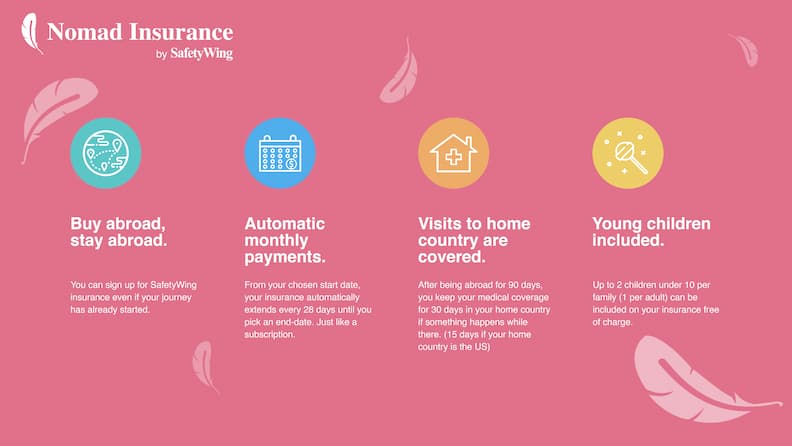
Is SafetyWing Worth It for your 2026 nomad lifestyle? My Honest Verdict
After all the pricing tables, exclusions, add-ons, and claim rules, the real question is simple. Is SafetyWing worth it or not? My honest answer is yes for the right traveler, and no for the wrong one.
I would still place it among the best travel insurance for digital nomads 2026 because it solves a real problem many older insurers still handle badly. Long trips change shape, routes get cut, plans grow, people buy cover late… SafetyWing Insurance was built for that kind of movement, not for a neat return flight booked months in advance.
I would also call it SafetyWing Nomad Insurance one of the most competitive options if your priority is emergency medical cover on the road without paying expat-insurance prices from day one. That is why it’s often mentioned in conversations about the cheapest travel insurance for long term travel, even though cheap should never be the only reason to buy it.
The limits matter, though. SafetyWing Nomad Insurance is not the right answer for every traveler. It’s weak where many classic insurers are strong, especially on travel insurance trip cancellation, and it is weak where expat-style products go much deeper, especially for pre-existing conditions travel insurance, broad maternity travel insurance, and full global health insurance. That’s especially why the company came up with Remote Health and Nomad Citizen to address these gaps.
So here’s The Travel Bunny’s honest verdict. If you move often, work online, travel long term, or need a policy you can buy and manage while already abroad, SafetyWing Nomad Insurance remains a strong option. If you want one product to behave like travel insurance, domestic health insurance, expat cover, and cancellation protection all at once, you will end up disappointed.
SafetyWing Pros. What It Does Really Well
- SafetyWing monthly subscription removes the pressure of guessing your return date. The policy renews every 28 days, which fits long trips that evolve while you travel.
- SafetyWing flexibility makes it easy to keep coverage active while moving between countries. You do not need to rewrite the policy every time your route changes.
- You can buy while abroad, which solves one of the biggest gaps in traditional travel insurance. Many older policies require purchase before leaving home.
- Limited home country coverage allows visits back home during long trips without immediately voiding the policy. That matters for nomads and expats who return occasionally.
- It is designed specifically as digital nomad insurance, which means the structure fits remote workers, freelancers, and long-term travelers better than classic vacation insurance.
- It works well as nomad travel insurance for people who move slowly across regions such as Europe, Southeast Asia, or Latin America.
- SafetyWing signup process is fast and simple, and proof of insurance is available instantly through the dashboard.
- Pricing remains competitive compared with many international health plans, which is why it often appears in discussions about the cheapest travel insurance for long term travel.
SafetyWing Cons. Where It Falls Short
- Trip cancellation coverage weak compared with traditional travel insurance. Travelers booking expensive prepaid trips may need separate protection.
- Low liability limit offers less protection than some competing travel policies, which may matter depending on your travel style.
- Pre-existing conditions limits mean the policy focuses on unexpected illness or accidents rather than ongoing medical care.
- Maternity limits under the Complete plan exist but remain restricted by waiting periods and coverage caps.
- Some travelers report claims friction, especially when documentation is incomplete or unclear.
- Electronics claim proof requirement can be strict because theft claims usually require receipts, ownership proof, and a police report.
- It doesn’t function as full global health insurance, which means it cannot replace comprehensive international healthcare plans.
- It isn’t designed to replace pre-existing conditions travel insurance, which specialized expat policies sometimes handle better.
Who Should NOT Use SafetyWing?
Travelers needing strong trip cancellation coverage should usually look elsewhere or add another policy. SafetyWing isn’t built around heavy cancellation protection, and people who expect that tend to feel burned later.
The second group is travelers with pre-existing medical conditions. If your health situation already requires ongoing care, medication management, or regular monitoring, you should be comparing products designed more like health insurance with pre-existing conditions coverage, not nomad travel medical plans.
The third group is travelers focused on pregnancy. If you specifically need pregnancy travel insurance or substantial maternity coverage, SafetyWing Complete may not go far enough because of its waiting period and cap. That is where stronger maternity-focused international health products make more sense.
The fourth group is people who want resident-style care abroad. People wanting full global health insurance should compare full expat or international health products, not assume SafetyWing Nomad Insurance will quietly become one just because the branding feels modern.
SafetyWing is excellent for mobile people with simple needs and clear expectations. It isn’t a universal answer. It works best when you treat it as flexible long-term travel medical insurance with useful extras, not as a miracle product that covers every risk in every life stage.
SafetyWing FAQs
If you are comparing plans, applying for a visa, living abroad, or trying to decide whether this policy fits your travel style, these are the questions that actually matter. I wrote this section for travelers, expats, sailors, remote workers, and long-term movers who need clear answers on coverage, limits, pricing, claims, and where SafetyWing fits against competitors.
Is SafetyWing insurance legitimate and safe?
Yes, SafetyWing sells real insurance products through formal insurance entities and administrators, not through a vague membership-only shell. On its official site, SafetyWing states that some products are underwritten by SafetyWing Insurance I.I., a Class 5 Puerto Rico-domiciled international insurer. For Nomad Insurance documentation, SafetyWing also publishes policy documents administered by WorldTrips, and WorldTrips states on its own official site that it is part of Tokio Marine HCC.
Is SafetyWing good travel insurance?
Yes, with conditions. Whether SafetyWing is a good travel insurance depends on what kind of traveler you are. I like it for flexible, long-term, multi-country travel where you need emergency medical coverage, predictable renewals, and the option to buy while already abroad. I wouldn’t use it as a cancellation-first holiday policy or as a full substitute for long-term resident healthcare. In other words, it’s strong when your life is mobile and weaker when your life is settled.
Is SafetyWing good for digital nomads?
Yes, SafetyWing is unusually well aligned with digital nomad life because it allows you to buy before departure or while already abroad, covers extended travel, renews automatically, and offers proof of insurance you can download from your account. That combination is why it keeps appearing in discussions about digital nomad insurance rather than only in generic travel insurance roundups.
What is the difference between SafetyWing Essential and Complete?
SafetyWing Essential is travel medical insurance. It focuses on new, unexpected medical issues while traveling and includes hospital stays, surgeries, travel delays, luggage, and emergency evacuations, with an overall medical limit of $250,000.
SafetyWing Complete moves closer to international health insurance. It includes routine and emergency care, mental health support, cancer treatment, delayed luggage, canceled accommodation, and no home-country restrictions, with a higher annual medical limit and broader care structure.
SafetyWing’s older Nomad Health language has effectively been folded into the newer Complete positioning, so current readers should think in terms of Essential vs Complete, not Essential vs some separate Nomad Health product.
How much does SafetyWing cost per month?
How much SafetyWing costs per month depends on the product.
On SafetyWing’s official Nomad Insurance page, Essential currently starts at $62.72 per 4 weeks for ages 18 to 39, while Complete starts at $161.50 per month for ages 18 to 39.
Remote Health pricing starts at $106 per member per month for ages 18 to 39 on a 5-member Standard example. Nomad Citizen is currently presented at $400 per month for ages 18 to 39.
Final price still changes with age, region, and add-ons such as US coverage.
Is SafetyWing enough for a Schengen visa?
Usually, yes, but the final answer depends on the consulate handling your file. Whether SafetyWing is enough for a Schengen visa comes down to whether the policy meets the core visa requirements.
EU guidance says applicants need medical insurance that covers emergency medical care, hospitalization, and repatriation, and Schengen guidance widely applies the EUR 30,000 minimum rule.
SafetyWing Nomad Insurance covers emergency medical treatment, hospitalization, and repatriation-related benefits, and it provides a downloadable insurance certificate. That makes it potentially suitable, but visa decisions are made by consulates, not by travel bloggers or insurers, so you still need to verify the exact requirements for your nationality and embassy.
Does SafetyWing meet the Romanian Digital Nomad Visa requirements?
In most cases, yes. Romania’s immigration authority lists digital nomads under the long-stay visa for other purposes, and the general visa framework requires medical insurance valid throughout the visa.
SafetyWing provides active international medical coverage, hospitalization benefits, evacuation, and documentation you can download as proof of insurance. That makes it a practical fit for the Romanian digital nomad visa.
Is SafetyWing available for US citizens? Does SafetyWing work for US citizens?
Yes, with an important limit. SafetyWing insurance for US citizens abroad works normally while they are outside the United States, but home-country coverage is more restricted. SafetyWing’s Essential plan includes up to 30 days of medical coverage in your home country, while Complete states there are no coverage restrictions at home. So the practical answer is yes abroad, limited at home on Essential, broader at home on Complete.
Can I buy SafetyWing insurance while I’m already abroad?
Yes. This is one of SafetyWing’s most useful features. The official site states you can sign up before you depart or at any point during your travels or while living abroad. If you had an older policy expire, the practical route is to log back in, choose the new plan, set a new start date, and buy again through your dashboard flow. For Nomad Complete, SafetyWing also says that switching from Nomad Essential triggers an automatic cancellation and refund of unused Essential days if there are no ongoing claims.
Does SafetyWing cover scuba diving and water sports?
Yes, SafetyWing covers many recreational water sports and ocean activities when they fall within their defined leisure sports list and when the activity follows the normal safety and certification rules required for that sport.
According to the official SafetyWing policy documentation, the following water sports and water-based activities are covered under the standard leisure sports framework: bodyboard, canoeing, canyoning, cave tubing, deep sea fishing, flatwater rafting, freediving, hydrospeeding, jet boating, jet skiing, kayaking, paipo board, rowing and sculling, sailing, sea canoeing, sea kayaking, snorkelling, speed boating, stand up paddle boarding, surfing, swimming, tubing, wake skating, wakeboarding, water polo, water skiing, windsurfing, wing-foiling, yachting.
These are water sports covered by SafetyWing, which means treatment for injuries sustained while performing them may be reimbursed under the medical coverage limits of the policy. On the SafetyWing Nomad Essential plan, those injuries fall under the overall $250,000 medical limit.
Certification rules still apply for certain activities. SafetyWing requires travelers to hold valid licenses or certifications when the sport normally requires them. For example, scuba diving requires an appropriate diving certification, such as PADI, NAUI, SSI, or BSAC when applicable.
Coverage also applies in several learning scenarios. When a sport appears on the covered activities list, the policy can still apply when you are attending classes, training solo, taking private lessons, or participating in informal group training.
There are also explicit exclusions. Some extreme sports remain outside the policy even with add-ons. One example listed in the SafetyWing policy materials is sky surfing, which isn’t covered even if the traveler purchases the Adventure Sports add-on.
Does SafetyWing cover sailing or boat trips?
Yes, sailing appears in SafetyWing’s covered leisure activities list. That means you can use SafetyWing while sailing for the medical side of the trip. The policy can cover your treatment if you are injured while recreationally sailing, subject to the plan’s usual medical limits and conditions. What it does not do is insure the boat, the hull, or marine liability.
Can I use SafetyWing while sailing around the world?
Yes, for a long route, SafetyWing works as the medical insurance for sailors. It covers the traveler’s health risks, including hospital treatment and evacuation to a better-equipped hospital, up to $100,000 lifetime max on Nomad Essential. It doesn’t replace specialist marine insurance for blue-water passages, vessel damage, or boat liability, so serious sailors usually need both a travel medical policy and a separate marine policy.
Does SafetyWing cover COVID-19 in 2026?
Yes, but timing and travel warnings still matter. SafetyWing’s policy includes an Emergency Quarantine Indemnity of $50 per day for up to 10 days under stated conditions, including proof of quarantine mandated by a physician or governmental authority and at least 28 days of coverage. SafetyWing’s current crisis updates also show the same warning-based logic used in earlier COVID-style restrictions, where coverage can depend on whether a warning existed before arrival and whether you leave within the defined window.
Does SafetyWing cover maternity and pregnancy?
Only partly, and only on the right plan. Nomad Essential does not cover maternity care. Nomad Complete includes maternity, but it comes with a 10-month waiting period and a $2,500 limit. That means SafetyWing can help some mobile families, but it isn’t generous maternity insurance by expat-health standards. Anyone planning a pregnancy abroad should read the maternity rules before buying, not after.
Does SafetyWing cover pre-existing conditions?
No. SafetyWing defines a pre-existing condition as any illness or injury for which you received treatment or diagnosis in your life, and any illness or injury you have experienced symptoms in the last two years. The company also states that the Nomad Complete plan does not cover pre-existing conditions, and Nomad Essential explicitly excludes them as well. That makes SafetyWing a plan for new, unexpected issues after the policy begins, not for ongoing chronic care.
Does SafetyWing cover laptop or electronics theft?
Yes, but only through the right add-on and only with proof. It isn’t part of standard SafetyWing Nomad Essential coverage. On Nomad Complete-related materials, the electronics theft add-on can cover up to $2,000 per stolen item and $5,000 per year. The practical weak point is evidence. If you file an electronics claim, you need strong proof of ownership and, ideally, an official theft record, because this is the kind of claim that gets ugly fast when documentation is weak.
Does SafetyWing cover my home country?
Yes, but not equally across both plans. SafetyWing Nomad Essential includes up to 30 days of medical coverage in your home country, while SafetyWing Nomad Complete states there are no coverage restrictions at home. That is one of the biggest structural differences between the two plans and one of the easiest ways to tell whether you still need travel insurance or have moved into international-health-insurance territory.
What happens if I need to stay in my home country when insured by SafetyWing?
On SafetyWing Nomad Essential, staying home too long can break the travel logic of the plan. It’s designed for people who leave home, travel, and return briefly, not for people who quietly stop traveling and keep the policy running. On SafetyWing Nomad Complete, that problem is much smaller because the official page says there are no home-country restrictions. The practical takeaway is simple. Short home visits fit the Nomad Essential. Longer home stays fit the Nomad Complete much better.
What are the main exclusions of SafetyWing Nomad Insurance? What does SafetyWing not cover?
The most important nuance is that the exclusions are not identical across the product line. On SafetyWing Nomad Essential, chronic and pre-existing conditions, maternity care, and cancer treatment are explicitly excluded. On SafetyWing Nomad Complete, the official page still says pre-existing conditions are not covered, but Nomad Complete adds broader healthcare features, including mental health support, wellness care, and cancer treatment within the overall plan structure. That difference is exactly why readers should stop treating old SafetyWing Nomad Health reviews as current coverage maps.
SafetyWing Nomad Insurance also doesn’t function like a cancellation-first holiday policy, so travelers expecting rich prepaid-trip refunds should’t treat Nomad Insurance as a substitute for trip cancellation insurance.
Can I cancel SafetyWing at any time?
Yes, SafetyWing says you can cancel anytime, and the easiest route is through customer care or your account flow. If the cancellation request arrives before the active insurance period starts, premiums are refunded in full. After the start date, refunds depend on the plan structure, whether you filed a claim, and the cancellation rules for that plan.
How do I file a claim with SafetyWing? How do I file a claim on the SafetyWing dashboard?
Log into your SafetyWing account, open the dashboard, click Make a claim, fill out the form, and upload your documents, receipts, and medical notes explaining what treatment you received and why. SafetyWing says claims are typically reimbursed in 21 days or less when the file is complete. If more information is needed, they will contact you by email. That means the real bottleneck is usually documentation, not the button itself.
Is SafetyWing better than World Nomads?
It depends on the trip. SafetyWing is usually better for long, flexible, open-ended travel because you can buy while abroad, renew automatically, and keep the policy running as your route changes. World Nomads is stronger when the trip is more traditional, more activity-heavy, or more cancellation-sensitive.
SafetyWing wins on flexibility, while classic travel insurance alternatives can win on different benefit structures. If you travel like a digital nomad, SafetyWing usually makes more sense than a rigid trip-policy setup.
What is Rabbit Health by SafetyWing?
There is no official SafetyWing product called Rabbit Health. If people land on that phrase, they are usually trying to find this guide again, blending my name, The Travel Bunny, with Nomad Health by SafetyWing, or misremembering one of SafetyWing’s real products, such as Remote Health. SafetyWing’s official site currently lists Nomad Insurance, Remote Health, and Nomad Citizen, but nothing called SafetyWing Rabbit Health.
Who recommends SafetyWing travel insurance

Hi! I’m Mirela Letailleur, the travel writer behind The Travel Bunny, an award-winning travel blog where I share practical advice for long-term travelers, digital nomads, and slow explorers. I have spent years testing real-world travel insurance, digital nomad insurance, and nomad travel insurance while traveling across Europe, sailing the Mediterranean, and planning routes that constantly changed along the way. My guides combine firsthand experience with deep research so readers understand how policies such as SafetyWing travel insurance, international travel insurance, and travel medical insurance actually work when plans shift or something goes wrong on the road.
I write from the perspective of someone who lives the lifestyle these policies claim to protect. I have organized multi-country sailing routes, worked remotely while traveling, and navigated real insurance decisions while exploring the world with my husband and later with our child. Through The Travel Bunny, I help travelers choose the right travel insurance for long term travel, understand the difference between travel medical insurance and global health plans, and avoid expensive mistakes when buying coverage for life abroad.
Other vacation tips and travel planning articles you should read on The Travel Bunny
Why plan a summer vacation with the family in 2021?
2021 travel destinations on my list
2021 holidays for Melbourne travelers