
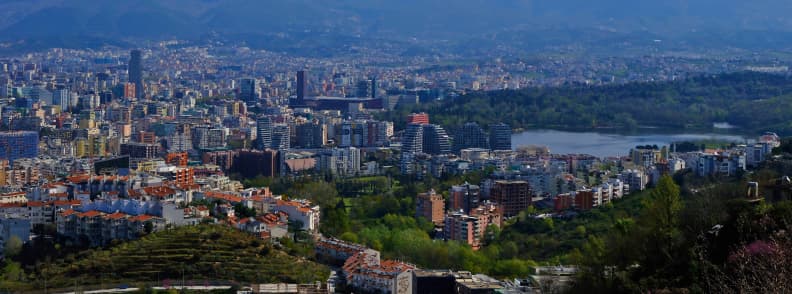
My first experience of Tirana in Albania began with a fairly abrupt change of pace. We left the quiet shores of Lake Ohrid in North Macedonia, crossed the Albanian border, and arrived among traffic, horns, brightly painted buildings, and enough roadside activity to make the previous few hours seem unusually peaceful. I had crossed with my ID card and not my passport, which made me nervous because Albania sits outside the European Union. (Albania remains an EU candidate country in 2026.)
Visiting Tirana by car also taught me something quickly: finding the city is easier than finding somewhere to leave the car. My friend Ana was driving, the traffic wore her down, and the attention she attracted from male drivers shifted from mildly amusing to uncomfortable. By the time we found a parking space, a coffee on a random shaded terrace seemed like a far better idea than immediate sightseeing.
Visit Tirana Albania Guide
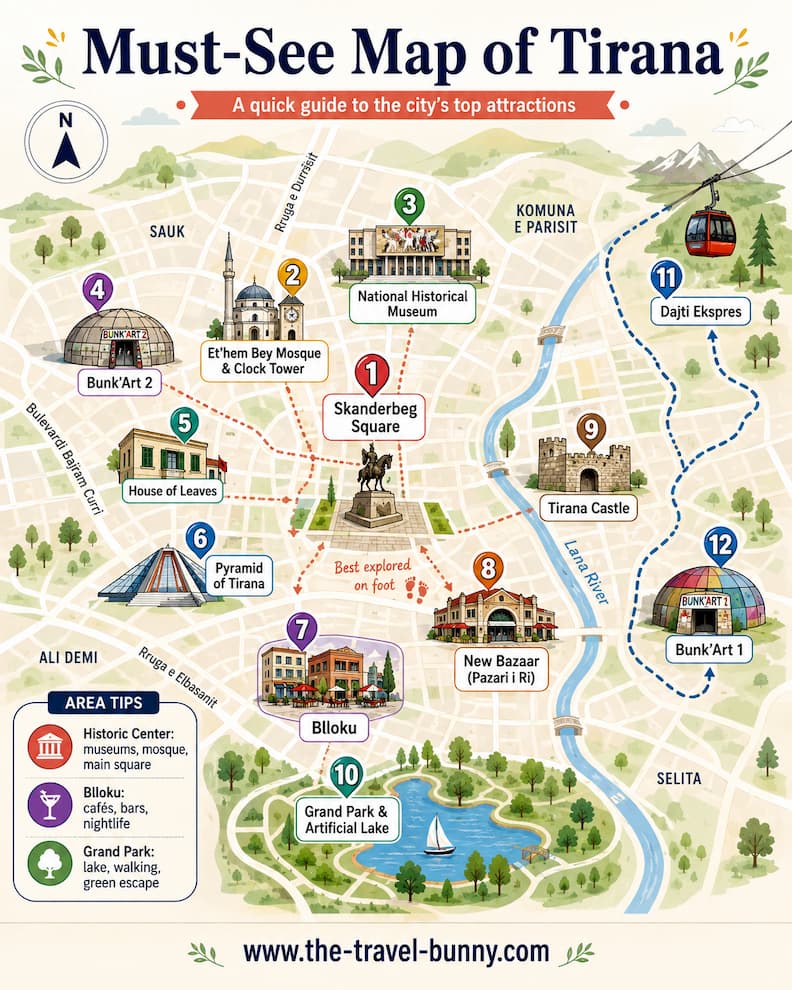
This Tirana travel guide on The Travel Bunny combines my firsthand experiences with current research, so you can visit Tirana with a clearer idea of what deserves your time. I cover the main sights, neighborhoods, museums, food, nightlife, accommodation, transport, costs, day trips, safety, and the practical details that become important once you’re standing in the street and left your Tirana map at home.
My Tirana travel experience included the National Historical Museum, Enver Hoxha’s former residence, difficult parking, questionable accommodation, excellent coffee, and long walks past the painted apartment blocks that changed the city’s appearance.
This complete guide to visiting Tirana Albania in 2026 also accounts for what has changed since those visits. The Tirana Albania map included later will help place the main sights and day-trip routes in context, while the practical advice should make visiting Tirana Albania considerably less improvised than my arrival was.
Disclosure: Some of the links on this page are affiliate links. This means that at no extra cost to you, The Travel Bunny will earn a small commission if you click through and make a purchase. Thank you!
Why Tirana Is Worth Visiting in 2026
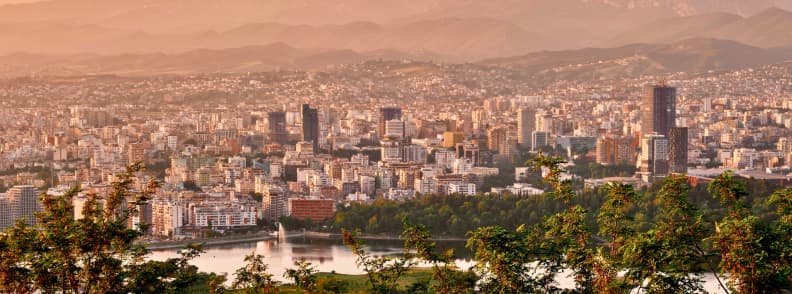
My first impression of Tirana was hardly subtle. We arrived from quiet Lake Ohrid and landed in traffic, horns, staring drivers, difficult parking, and apartment blocks painted in colors that seemed determined to compensate for several decades of gray concrete. Tirana is full of life, an up-and-coming capital that still has enough rough edges to keep you on your toes.
Is Tirana worth visiting? I think so, particularly if you care about recent European history, street life, food, café culture, and cities still changing in plain sight. What Tirana Albania is known for today ranges from Skanderbeg Square and communist-era sites to Blloku, the Pyramid, and Mount Dajti. Albania’s capital is a modern, energetic city shaped by history and contemporary development, with Mount Dajti beside it and the Adriatic coast about 30 kilometers away.
The budget price helps. Tirana ranked third among 50 European cities for value in the 2026 City Costs Barometer, with the measured basket for two people costing about €305. Tirana tourism therefore has a practical advantage over many European capitals: your money stretches further once you arrive.
Tirana Albania is worth visiting if you prefer cities with contradictions over polished museum pieces. The broader Tirana Albania tourism appeal lies in the contrast of Ottoman traces, communist history, new architecture, crowded cafés, mountain views, and a city still deciding what it wants to become.
When to Visit Tirana. Weather, Seasons & Events
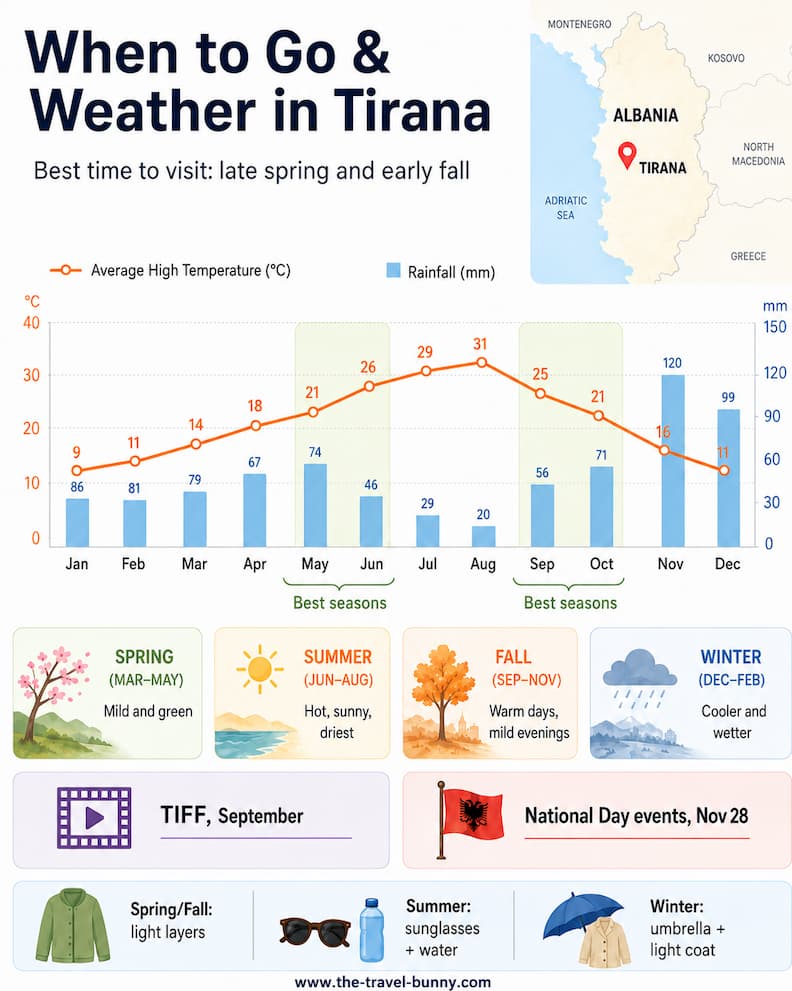
The best time of year to visit Tirana is late spring or early fall, especially May, June, September, and October. You avoid the harshest summer heat while enjoying enough daylight for long walks through the center, Blloku, and the Grand Park. Tirana weather turns hot from mid-June into September, with July averaging around 31°C during the day.
This also makes late spring and early fall the best time to visit Tirana if sightseeing ranks above sunbathing. The best time of year to visit Tirana, Albania, weather-wise depends on your plans, though. Tirana in summer can be wonderful if you want to experience the evening street life and trips toward Dajti or the coast, but midday sightseeing under full sun becomes considerably less appealing. Dajti and the surrounding hills are cooler summer escapes.
Tirana in winter is cooler and wetter, with January temperatures typically ranging around 1°C to 11°C. Museums, cafés, restaurants, and cultural venues make winter city breaks practical, while the city also runs seasonal cultural programming.
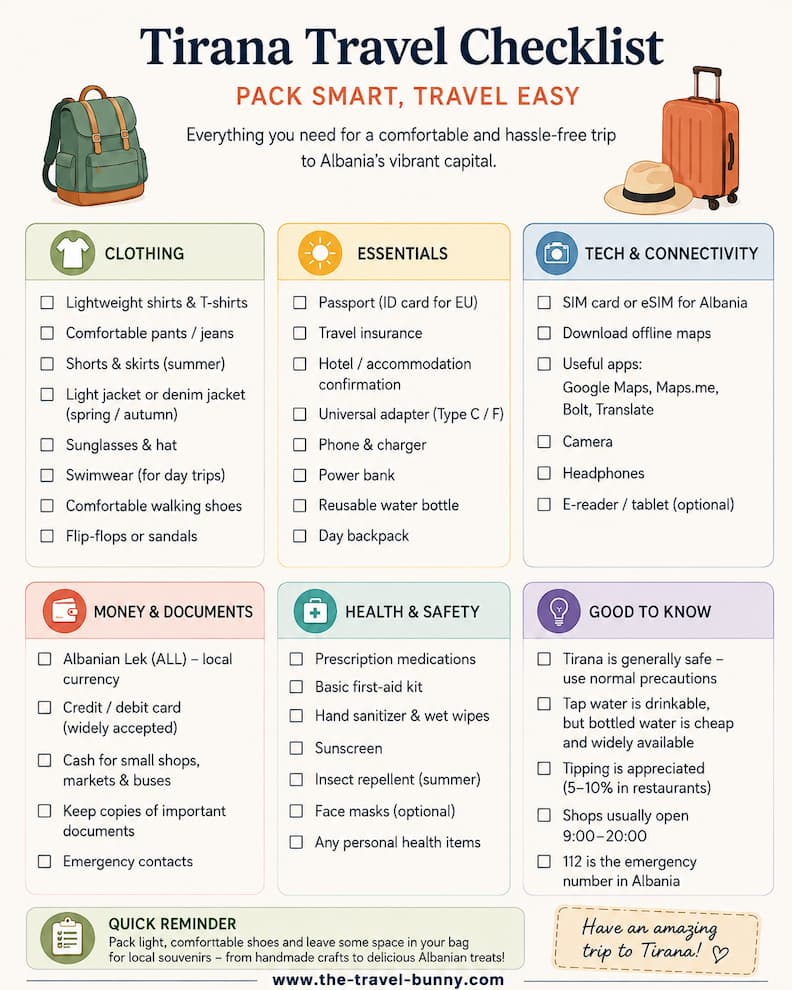
What to wear in Tirana Albania therefore changes considerably by season. Light clothing, sun protection, and comfortable walking shoes belong on a all summer packing list for Tirana. What to wear in Tirana Albania in winter means layers, a warm outer layer, and rain protection. What to pack for Tirana Albania in spring or fall should include a light jacket for cooler evenings. The same advice applies to what to pack for Tirana if you’re spending time on Mount Dajti.
Weather also affects seasonal activities in Tirana. Before committing to a Dajti outing, check Tirana weather tomorrow instead of relying on annual averages. Mountain conditions are different from those downtown.
Tirana Albania weather also overlaps nicely with several major Tirana events. The 24th Tirana International Film Festival runs from 21 to 27 September 2026, while late November brings Flag and Independence Day celebrations, traditionally centered around 28 and 29 November.
Getting to Tirana and Around
Most flights to Tirana arrive at Tirana International Airport Nënë Tereza, usually shortened to Tirana Airport (TIA), at Rinas outside the capital. The airport has added numerous European connections in recent years, so cheap flights to Tirana are often available from several departure cities, not just from a single obvious hub. Check Tirana Airport’s current airline and route information alongside flight-comparison sites because seasonal routes change.
How to get from Tirana Airport to the city center on a budget? Take the LU-NA Tirana airport bus. It runs 24 hours a day, leaves every hour, takes about 30-40 minutes, and costs 400 ALL or €4. In central Tirana, the stop is behind the Palace of Opera and Ballet beside Skanderbeg Square. This makes the bus particularly convenient if your accommodation is central.
A Tirana airport transfer or taxi saves time, especially with luggage or a late arrival. Tirana taxi service takes 20-25 minutes between the airport and central Tirana when traffic cooperates, at about 2,200 ALL or €22 one way. Always use licensed yellow airport taxis and don’t accept random offers outside the terminal. The airport’s transport page also shows where to book a Tirana airport transfer shuttle, including a GoOpti shuttle option.
Uber isn’t available in Tirana. Albania doesn’t appear in Uber’s global cities directory, so the Uber or taxi choice in Tirana Albania is unusually straightforward: take a licensed taxi or use a local service instead.
Driving offers freedom once you leave the capital, but I wouldn’t rent a car purely for getting around Tirana. We arrived by road from North Macedonia, and traffic was the first thing we noticed. Ana found driving tiring, finding parking took a lot of patience, and securing a space became reason enough to leave the car exactly where it was.
The best way to get around Tirana for central sightseeing is on foot. Skanderbeg Square is pedestrianized, and many major sights sit along a walkable route through the historic center, the Pyramid, Blloku, and nearby boulevards. Visit Tirana specifically recommends exploring the principal central attractions on foot.
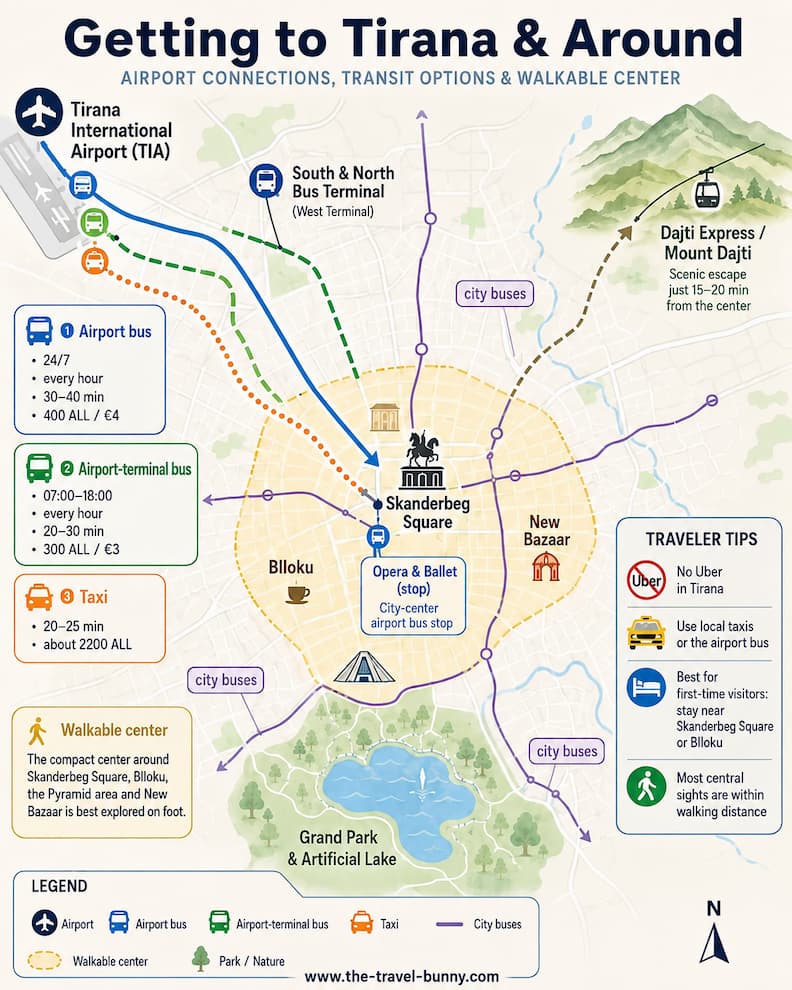
Tirana public transport becomes useful for places farther from the center. City buses cover numerous routes, and Tirana municipality publishes georeferenced bus lines, stops, and terminals. Using public transport in Tirana takes a little preparation because the network is bus-based rather than metro-based. Checking your route before leaving makes how to use public transport in Tirana Albania considerably easier than trying to decipher it from a roadside stop.
A Tirana train station won’t help with your trip in 2026. Albania’s active rail network currently carries freight on limited corridors, while the rebuilt Durrës-Tirana-Rinas passenger line is still under development. Regular passenger service linking Tirana, Durrës, and the airport is currently expected by the end of 2027.
How to get to Tirana depends largely on where you’re starting. Flying into TIA is the obvious choice from much of Europe, buses connect Tirana with other Albanian and Balkan cities, and driving makes sense as part of a wider Balkan road trip. Once you’re there, leave the motorized ambitions for journeys outside the center and walk whenever distance allows.
Where to Stay in Tirana. Neighborhoods, Hotels, and Apartments
The best neighborhood to stay in Tirana depends mostly on how you plan to spend your evenings. As a first-time visitor, you’ll gain the most from staying between Skanderbeg Square and Blloku, where much of central Tirana remains within walking distance. This central strip also has the broadest choice of hotels in Tirana, restaurants, cafés, apartments, and late-night places.
Blloku Tirana is the best base for you if you value going out in the evening as much as sightseeing. Once reserved for Albania’s communist elite, Blloku neighborhood now concentrates restaurants, cocktail bars, cafés, shops, and much of Tirana’s nightlife around a dense grid southwest of Skanderbeg Square. This is where to stay in Tirana for nightlife, but light sleepers should check recent reviews for street noise before booking.
Among the best hotels in Tirana around Blloku, Xheko Imperial Luxury Hotel & SPA is one of the most established upscale stays in the city. It offers a full-service spa, an indoor pool, and a rooftop terrace that overlooks Tirana, making it an excellent accommodation choice if you want a more resort-style experience in the middle of Albania’s capital.
Boutique Hotel Kotoni is directly in Blloku and offers a more intimate, boutique-style stay. It’s smaller in scale, with individually designed rooms and a quieter atmosphere, but still places you within a few steps of the area’s main cafés, bars, and restaurants.
An apartment is a good option if you want a kitchen, washing machine, or extra room. Blloku Apartment on Rruga Vaso Pasha offers a modern, fully equipped space with two separate bedrooms, a living area, and a kitchen that makes longer stays more comfortable. Its location puts you right in the heart of Blloku, so restaurants, bakeries, and nightlife are all within a short walk.
And here’s another Blloku Apartment listing on Rruga Janos Hunyadi. It provides a similarly well-equipped setup, with a bright, contemporary interior, and practical amenities like a washing machine and full kitchen. These options are good examples of Tirana apartments that provide the same independence and flexibility you would expect from an Airbnb-style stay, without being tied to any expensive cleaning fees.
My Airbnb tip for Tirana: Check the exact street before paying. A pin inside Blloku can mean convenient restaurants downstairs, followed by convenient restaurants downstairs at 1:00 am. If you’re driving, confirm parking in writing too. My own arrival involved enough circling for a parking space to make vague promises about parking nearby sound considerably less comforting.
Skanderbeg Square is the easiest choice to book a hotel in Tirana if sightseeing comes first. Accommodation near Skanderbeg Square puts you close to the Clock Tower, Et’hem Bey Mosque, Pazari i Ri, the airport bus stop, and several central museums and monuments.
Among the best hotels near Skanderbeg Square Tirana, Maritim Hotel Plaza Tirana is a modern high-rise property offering spacious, soundproof rooms, an on-site spa, and panoramic city views from its upper floors. It’s a comfortable option for both short stays and business trips.
Castle Boutique Hotel is a smaller, design-focused stay in a restored building, with individually styled rooms, warm interiors, and a more intimate atmosphere. It feels closer to a guesthouse than a large hotel.
Vila Jasmine is a family-run stay with a quiet residential feel, offering simple but well-kept rooms, a small garden area, and the added convenience of private parking, which is particularly useful in this part of the city where street parking can be limited. Its position about 700 meters from Skanderbeg Square means you can reach the main sights on foot in just a few minutes while still staying slightly removed from the busiest streets.
Budget travelers have plenty of Tirana accommodation outside conventional hotels. Mandarine Hostel is a social, centrally located option with a relaxed common area, shared kitchen, and a mix of dorm beds and simple private rooms. It’s popular with backpackers who want to stay close to the main sights without spending much.
Sisterhood Hostel, a women-only property, focuses on safety and comfort, offering female-only dorms, a calm atmosphere, and thoughtfully designed shared spaces that appeal to solo female travelers.
These Tirana hostels are great for solo travelers who value communal space and lower nightly rates. Hostels in Tirana also commonly offer private rooms, which can narrow the price difference between a hostel and a simple guesthouse.
The best budget hotels in Tirana Albania under 50 euros tend to be small hotels, guesthouses, hostels with private rooms, and apartments rather than large international properties. Compare your findings against your exact dates because Tirana room rates move quickly.
For genuinely good budget accommodation in Tirana, I would prioritize a private bathroom, air-conditioning in summer, recent cleanliness reviews, and a location within roughly 15 minutes on foot of Skanderbeg Square or Blloku. Saving €8 on the room loses some of its appeal when you spend the difference on taxis.
You can still find cheap hotels in Tirana city center, especially outside busy weekends and peak summer periods, but compare the final stay price rather than the first number shown in the results.
When choosing hotels in Tirana in 2026, I would filter Booking.com to a review score of at least 8, then check air-conditioning, elevator access if you have heavy luggage, private parking if you’re driving, and recent comments about street noise. Also, open the property on the map before booking. In Tirana, a hotel described as central should sit right beside the main attractians.
The best neighborhoods to stay in Tirana Albania come down to what you want within easy walking distance. Blloku puts bars, restaurants, and late nights outside your door. Around Skanderbeg Square, you’re better placed for sightseeing and the airport bus. Pazari i Ri keeps you central but gives evenings a different rhythm, built around the market, restaurants, and pedestrian streets instead of Blloku’s bar scene.
Move farther out and you’ll often gain quieter nights and lower room rates, but you’ll spend more time on buses or in taxis. Thinking about Tirana neighborhoods this way is far more useful than comparing dozens of hotels scattered across the city.
Travelers planning longer stays should also check longterm Tirana apartment rentals and stop limiting the search to hotels. MiddleNest Central Apartment is 400 meters from Skanderbeg Square and offers a modern one-bedroom layout with a fully equipped kitchen, fast Wi‑Fi, and a comfortable living space designed for both short visits and extended stays. It’s practical for remote work or self-catering.
Blloku Unique Apartments is 700 meters from the square in a livelier district, featuring contemporary interiors, air conditioning, and immediate access to cafés, restaurants, and nightlife. It’s great for couples or travelers who want to stay in the heart of the city’s social scene. A kitchen and washing machine become increasingly useful once a city break stretches into a week or longer.
I wouldn’t prioritize Tirana all-inclusive packages for a city stay. You should see the city and eat outside your hotel, especially around Blloku and Pazari i Ri. Central accommodation keeps restaurants within easy reach. Paying for every meal in advance removes one of the simpler pleasures of staying in the capital of Albania.
Where to stay in Tirana Albania? I stayed central on my visit, and I’d make the same choice again. Our hostel was within walking distance of major sights, while some of the city’s better bars were close enough for an easy evening out. The location was the best thing about it. Probably the only good thing about it.
We had gone to that hostel because Lonely Planet recommended it in their Balkans guide, only to find that the original place had closed. Someone else had taken over the property, kept renting rooms, added no obvious improvements, charged too much for what he offered, and had manners that didn’t exactly encourage repeat business. I wouldn’t recommend the place even if you could still book it.
But we stayed anyway. Parking had taken so much time and patience that moving the car again sounded worse than tolerating one mediocre room for a night. This experience is one reason I’d still choose central accommodation in one of the best neighborhoods in Tirana. A good location lets you walk to the main sights, restaurants, and bars, and in a city where driving and parking tested us within the first hour, leaving the car alone had considerable appeal.
Currency, Cost, and Practical Tips for Tirana
The currency used in Tirana Albania is the Albanian lek (ALL). To make it easy to estimate costs, keep in mind that 100 lek is about €1. Just note that the rate offered by an exchange office will differ slightly.
Tirana currency lek vs. euro choice is simple in daily life: pay in lek whenever possible. Some tourist-facing restaurants and businesses accept euros, but Albania’s official currency remains the lek, and local tourism guidance recommends keeping Albanian cash with you. Paying in euros also leaves the conversion rate in the merchant’s hands, which rarely favors the person holding the menu or the shop item.
You NEED cash in Tirana. Larger hotels, supermarkets, upscale restaurants, and many central businesses accept cards, but smaller cafés, bakeries, markets, taxis, and independent establishments still rely heavily on cash. Credit cards are accepted in Tirana Albania, but I’d never head out with only a card.
A Tirana currency exchange is easy to find around the center. To exchange money in Tirana Albania at the best rate, check Bank of Albania’s official euro-to-lek reference first, then compare the buy rate posted outside several exchange offices before handing over cash. Airport convenience rarely deserves automatic loyalty. And always request a receipt!
The Tirana cost of travel remains attractive compared with many Western European capitals, although prices have risen. An inexpensive restaurant meal at about 800 ALL, roughly €8.60, and a cappuccino around 188 ALL, close to €2. Tirana is cheap enough for €10 meals to remain realistic, especially away from upscale restaurants and the most tourist-heavy tables.
But how much a trip to Tirana costs depends heavily on where you sleep. A careful daily Tirana budget is around €35 to €45 per person with a hostel, inexpensive food, public buses, and mostly free or low-cost sights. A comfortable mid-range day rises closer to €80 to €100 once a central hotel, restaurant meals, admissions, and occasional taxis enter the picture.
This puts how much money you need per day in Tirana into perspective. Food itself doesn’t need to dominate the budget. Accommodation and paid excursions change the total much faster. How expensive Tiran Albania is for tourists therefore depends less on coffee and byrek and much more on hotel category, private transport, nightlife, and organized tours.
Tirana budget travel is particularly easy if you stay centrally and walk. Many major sights cost nothing, including Skanderbeg Square, the Pyramid exterior and rooftop access, the Grand Park, and simply walking through Blloku or Pazari i Ri. Those are among the best things to do in Tirana Albania on a budget, and wandering between them also removes several taxi fares from the day.
Visiting Tirana on a budget doesn’t require living on supermarket sandwiches either. One of the easiest ways to save money in Tirana is to eat like the locals. Choose bakeries selling byrek, neighborhood grills, cafés away from main squares, and casual restaurants with prices in lek.
My most useful cheap travel tips for Tirana are similarly unglamorous. Walk through the center, use buses for longer urban trips, compare exchange rates, carry smaller lek notes, and check the total price before ordering or agreeing to a taxi. These Tirana travel tips save small amounts repeatedly, which is usually far more effective than spending twenty minutes hunting down a coffee that’s 20 lek cheaper.
Tipping in Tirana is fairly relaxed. Rounding up is appropriate in cafés and taxis, while 5 to 10% is increasingly common in tourist-facing sit-down restaurants, when service has been good. Check the bill first because some higher-end venues add a service charge. Remember that cash tips are preferable in smaller establishments.
Mobile data is easy to arrange after landing. One Albania has a shop in the arrivals terminal at Tirana International Airport, while Vodafone operates a tourist desk at its Rinas Airport shop. Vodafone’s 2026 tourist packages start at 2,700 ALL for 15 days and include large data allowances. If immediate connectivity is important, buying a local SIM at the airport saves a separate errand after check-in.
Safety requires ordinary city awareness rather than paranoia. Reports of crime targeting foreigners are rare, but pickpocketing and bag theft remain worth watching for in tourist areas and transport hubs. So keep valuables secure, particularly in crowds.
Traffic deserves greater attention. I remember how tiring Tirana’s roads were for Ana when we arrived. Diving in Albania is aggressive and erratic, and pedestrians should stay alert while crossing even with a green light.
Is Tirana expensive or cheap? Between food, transport, attractions, and money in Tirana, Albania’s capital still supports a relatively low-cost city break. Tirana costs rise quickly with boutique hotels, private transfers, cocktails, and organized excursions, but everyday expenses remain manageable with a little planning.
Top Attractions in Tirana
The obvious things to do in Tirana include museums, historic buildings, markets, parks, and viewpoints, but the city becomes much more interesting once you start noticing how quickly one period of its history gives way to another. Ottoman landmarks sit near communist monuments, while brightly painted apartment blocks and new towers have altered streets that looked very different a generation ago.
Many of the main Tirana attractions lie within or close to the center, so you can cover a surprising amount on foot. I’d still resist trying to see everything in one day. Some places deserve more than a hurried photograph, especially if Albania’s recent history interests you.
The following sights are the places I would prioritize when deciding what to see in Tirana, with a mix of major landmarks, museums, public spaces, and a few stops that reveal something less obvious about the city.
Start at Skanderbeg Square and Tirana’s Historic Center
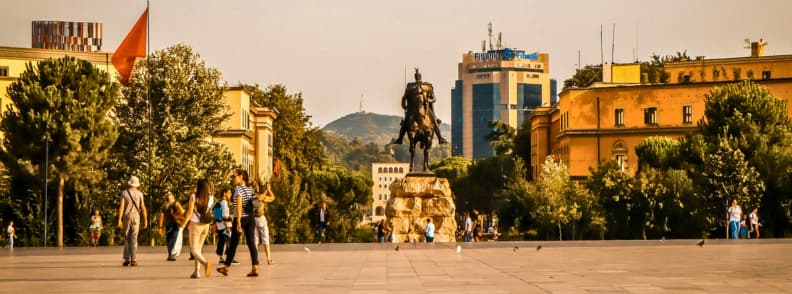
Tirana’s Skanderbeg Square puts several periods of the capital’s history within a few minutes’ walk. The broad pedestrian square is paved with stone from across Albania, with the Skanderbeg statue in Tirana rising near its center. This monument to national hero Gjergj Kastrioti Skanderbeg was inaugurated in 1968.
Around Skanderbeg Square in Tirana, the architecture changes quickly. The early 19th-century Et’hem Bey Mosque stands beside the 35-meter Clock Tower in Tirana, while the Palace of Culture and National Historical Museum represent a much later city.
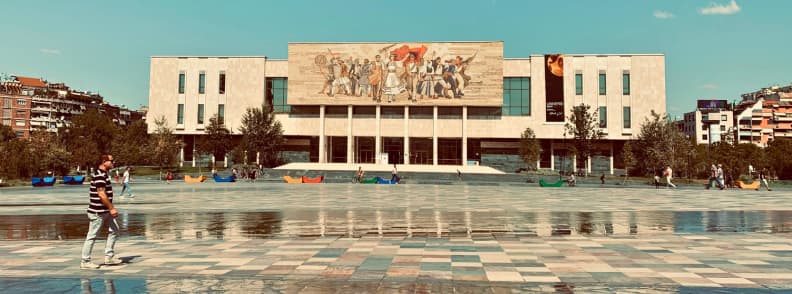
I spent much of my own visit inside the National Historical Museum in Tirana, and I found it fascinating. You currently have to admire its huge façade mosaic from outside, though. The museum is undergoing a major restoration and reconstruction, with further structural and exhibition work continuing in 2026.
This part of Tirana’s old town is a good place to slow down and stop racing between pins on a map. Within a small area, the city shifts from Ottoman Tirana to communist-era monumentality and the pedestrian center you see today.
Bunk’Art 1 vs Bunk’Art 2. Which One Should You Visit?
The two Tirana Bunk’Art museums cover different parts of Albania’s communist past.
- Bunk’Art 1 occupies a huge five-level nuclear bunker on the eastern outskirts near Mount Dajti and focuses on the military, daily life under dictatorship, and Albania’s 20th-century history.
- Bunk’Art 2 sits in the center, close to Skanderbeg Square, and concentrates on the Ministry of Internal Affairs, the Sigurimi secret police, surveillance, and political persecution.
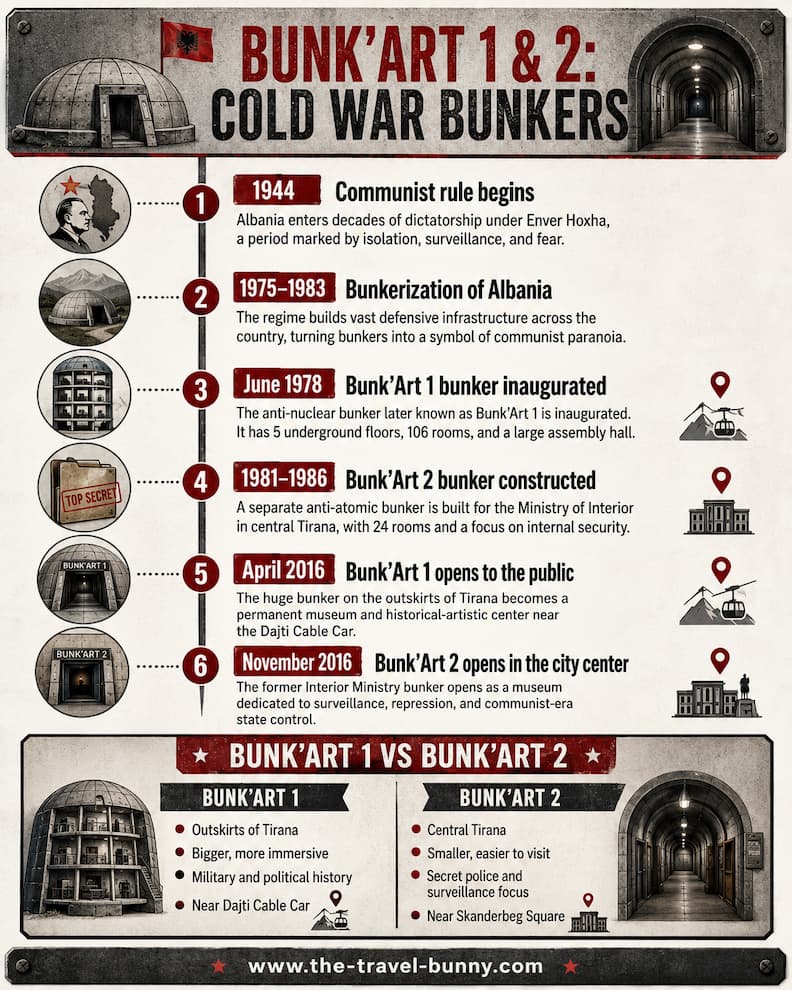
Bunk’Art 1 vs Bunk’Art 2, which to visit depends on your time. I’d choose Bunk’Art 2 for a short city break because its central location is easier to combine with other sights. But Bunk’Art 1 deserves the trip if you want the broader historical account and the experience of walking through a far larger Cold War bunker.
Is Bunk’Art worth visiting in Tirana? Yes, especially if Albania’s communist period interests you. The original concrete rooms give the history a physical setting that photographs and timelines alone can’t provide. Bunk’Art Tirana also offers a combined ticket covering both museums, valid for 72 hours.
Bunk’Art 2 tickets cost 900 lek and they are available to buy at the museum. If you’re trying to figure out how to book Bunk’Art 2 tickets online in Tirana, you can only book Bunk’Art guided tours on the internet.
Climb the Pyramid of Tirana
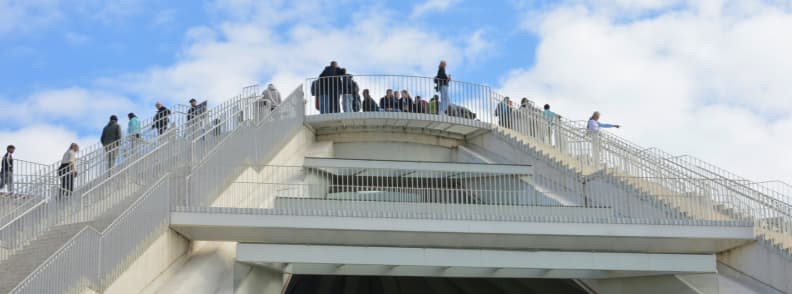
The Pyramid of Tirana has had several lives. Opened in 1988 as a museum dedicated to Enver Hoxha, it later hosted exhibitions and events before a major redesign turned the concrete shell into a public cultural and technology hub. The original structure remains, but stairs now run up its sloping sides.
The Tirana Pyramid climb is one of the stranger sightseeing experiences in the center of Albania’s capital. You can walk to the top for wide Pyramid Tirana views over the surrounding boulevards and rooftops. A lift on the western side also reaches the upper level.
How to visit the Pyramid of Tirana Albania. The Pyramid is on Bulevardi Dëshmorët e Kombit, within walking distance of Skanderbeg Square. The exterior is publicly accessible, but I’d take the steps slowly in harsh summer sun or wet weather rather than treating the roof like a racecourse. You can slide down after enjoying the view.
Ride the Dajti Ekspres Cable Car Above Tirana
The Tirana cable car gives you a surprisingly quick escape from the traffic below. The Dajti Ekspres cable car runs 4.7 kilometers up Dajti Mountain above Tirana, making it the longest cableway in the Balkans.
How long does the Dajti cable car take? About 15 minutes, with the city gradually spreading out beneath you as the cabins climb toward Dajti National Park.
At the upper station, the Dajti Mountain complex has walking trails, an 18-hole mini-golf course, an adventure park, and Ballkoni Dajtit restaurant overlooking Tirana. A Dajti Mountain Tirana outing easily fills half a day if you add a hike before you ride back down.
How to get to Dajti Mountain from Tirana center: Take the blue Qendër-Porcelan bus from near the Clock Tower at Skanderbeg Square, then walk uphill from the final stop to the lower cable-car station. The bus ride lasts 20-30 minutes and currently costs 40 ALL.
The Dajti cable car currently opens from 9:00 a.m. to 6:30 p.m. on weekdays and until 7:00 p.m. on weekends, with Tuesday normally closed for maintenance. Tickets are sold only at the lower station. A June 2026 visitor reported 1,400 ALL for a return ticket, while the operator now asks visitors to confirm the current fare at the station.
Step Inside the House of Leaves
The House of Leaves in Tirana is easy to walk past, which seems oddly appropriate for a building devoted to surveillance. Built in 1931 as a clinic, it later housed the Gestapo during World War II and, from 1944 to 1991, served Albania’s communist security apparatus, including units responsible for electronic interception and monitoring foreigners.
Inside, 31 rooms examine wiretapping, postal control, secret files, surveillance equipment, informants, arrests, and political persecution. The museum won the Council of Europe Museum Prize in 2020, recognition that gives this relatively understated stop considerable weight among Tirana’s communist-history sites.
How to visit the House of Leaves Museum in Tirana: It stands opposite the Resurrection of Christ Orthodox Cathedral, a short walk from Skanderbeg Square. The admission price is 700 ALL for adults, and children under 8 years old visit for free.
Step Inside Et’hem Bey Mosque
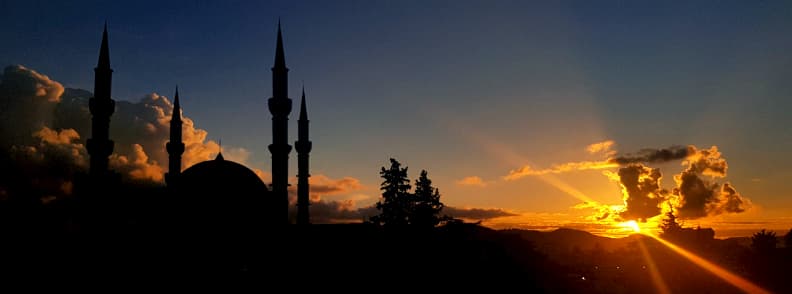
The Et’hem Bey Mosque is in Skanderbeg Square, small enough to be overshadowed by the buildings around it yet far too interesting to ignore. Begun in the late 18th century and completed in 1820–1821, it survived Albania’s communist campaign against religious institutions. Its painted trees, waterfalls, bridges, and floral scenes are unusually figurative for Islamic art.
Visiting Et’hem Bey Mosque in Tirana takes little time. Current Et’hem Bey Mosque visiting hours are generally 9:00 am to noon and 2:00 to 4:00 pm, with a shorter Friday afternoon opening and visits paused during prayers.
How to visit Et’hem Bey Mosque in Tirana, including dress code: Wear modest clothing and remove your shoes before entering. The mosque is free to visit, with no official admission fee, although voluntary donations are welcomed at the entrance.
Browse Pazari i Ri, Then Walk Around Grand Park
Visit Pazari i Ri in Tirana in the morning, when the covered market is busiest with fruit, vegetables, spices, meat, fish, and other local produce. The New Bazaar in Tirana also has cafés, restaurants, artisan workshops, and souvenir shops around Avni Rustemi Square. It’s one of the best traditional markets to visit in Tirana if you want daily city life alongside Tirana shopping like a local.
If you’re deciding what to buy as souvenirs in Tirana Albania, look around the artisan stalls before settling for generic magnets. Buying souvenirs at a Tirana market gives you a better chance of finding locally made crafts, while the wider choice of souvenirs from Tirana varies with the vendors and seasonal fairs. Among Tirana markets, Pazari i Ri is also one of the easiest to combine with central sightseeing.
Later, swap market stalls for the Grand Park in Tirana, built around the city’s 55-hectare artificial lake. Among the main Tirana parks, this is the obvious place for an afternoon walk, with broad paths used for walking, running, cycling, and family outings.
Other Tirana Hidden Gems Worth a Detour
A few more Tirana hidden gems fit easily between the headline sights.
Tirana Castle or Kalaja e Tiranës preserves Byzantine-era walls beside pedestrianized Murat Toptani Street, although the interior now mixes restaurants, shops, and remnants of the old fortress.
The newer Tirana mosque, Xhamia e Namazgjasë, gives the center a dramatically different silhouette. Opened in October 2024 near the Parliament, its four minarets rise 50 meters.
Pazari i Ri is better for food and browsing, while Sou Fujimoto’s white steel Reja, meaning Cloud, provides one of Tirana’s odder public-art stops and regularly hosts cultural events.
Gamblers also have Grand Casino Tirana inside the Maritim Plaza Hotel, close to Skanderbeg Square.
Food and Drink in Tirana. What to Eat and Where in Albania’s capital
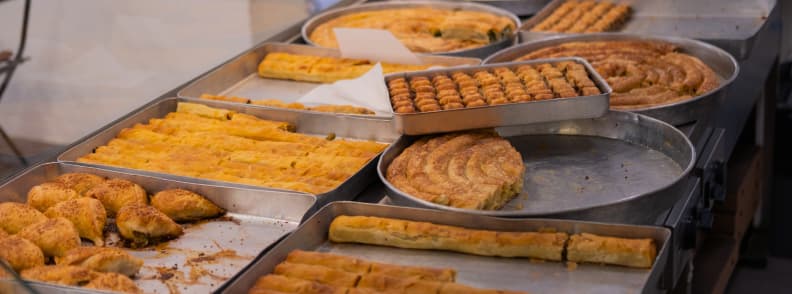
The quickest introduction to Tirana food is byrek. This thin, crisp pastry comes filled with cheese, spinach, meat, or pumpkin, and you’ll see it in bakeries across the city. Byrek in Tirana belongs to everyday life rather than special-occasion dining, which is exactly why I’d start there.
If you’re deciding what to eat in Tirana and you’re looking for local Albanian traditional food add tavë kosi, lamb baked with yogurt and rice, plus fërgesë, a rich dish built around peppers, dairy, eggs, and sometimes meat. These are some of the best local dishes to try in Tirana Albania, while qofte, stuffed peppers, dhallë (Albanian ayran), olives and village cheeses expand the list of Albanian food to try in Tirana.
The Travel Bunny’s foodie tip: When you go out to Tirana restaurants, search the menu for Albanian dishes instead of defaulting to international dishes.
Dessert is another serious decision. Baklava appears across Albania in several variations, usually layered with walnuts or almonds and soaked in syrup. Kadaif and revani are also common Tirana sweets if you want something beyond the obvious choice.
Where to eat traditional Albanian food in Tirana? Split your meals between central taverns and Pazari i Ri. The New Bazaar combines produce stalls with restaurants and food shops around Avni Rustemi Square, so you can look at cheeses, olives, spices, and seasonal ingredients before sitting down for lunch. Among Tirana restaurants, Oda Garden remains a popular traditional option, while Ceren Ismet Shehu inside Tirana Castle is praised by many travelers visiting the capital.
The concentration of Tirana Blloku restaurants, bars, and Tirana cafés makes it the easiest neighborhood for eating without planning every stop in advance. Era Blloku is one of the best restaurants in Tirana Blloku, while the wider district covers Albanian, Mediterranean, Italian, and contemporary menus. If you’re building your own shortlist of the best restaurants in Tirana, check recent reviews and don’t assume yesterday’s fashionable table still deserves tomorrow’s dinner.
Coffee deserves separate attention. Tirana coffee culture is deeply social, and sitting over one espresso for an impressively long time appears to be the norm here. I still remember the coffee I had after our rather exhausting arrival in Tirana. Ana and I found a random shaded terrace while the others dealt with accommodation, ordered coffee, and immediately improved the day.
I appreciated that small stop even more once I realized how deeply café culture runs through the capital. The best cafés in Tirana range from traditional neighborhood bars to newer specialty spots.
For remote work, Streha Coffee & Community, Antigua Specialty Coffee, and Destil Creative Hub are three of the best cafés to work from in Tirana. They offer the combination most laptop users need, including Wi-Fi, power access, coffee, and seating where opening a computer doesn’t get you eye rolls. They’re also among the more practical Tirana coffee shops if you’re staying in the city for several days.
Best coffee shops to work in Tirana Albania: Visit Streha and Destil first, especially if you need somewhere suitable for a longer work session rather than a quick espresso.
Blloku has the highest concentration of cafés, bars, and restaurants, and this neighborhood stays lively well into the evening.
A food tour in Tirana is worthwhile if you want context next to a succession of plates appearing mysteriously in front of you. The Tirana Local Food Experience and Walking Tour lasts about three hours and includes the New Bazaar, byrek, qofte, village cheese, and dhallë. It’s a useful introduction to where to eat local food in Tirana before choosing restaurants independently.
Short Tirana food guide: Check out neighborhoods before rankings. Pazari i Ri is where you’ll find traditional flavors and Blloku gives you the widest evening choice. For Tirana restaurants serving the best local food, prioritize places cooking recognizable Albanian dishes and avoid menus attempting to represent six countries at once.
You will soon learn what the food is like in Tirana Albania. It’s generous, dairy-rich, pastry-heavy, vegetable-friendly, and strongly influenced by Balkan, Ottoman, and Mediterranean cooking.
Nightlife and Culture in Tirana
Blloku has one of Tirana’s better historical jokes built into its street plan. During communism, ordinary Albanians couldn’t enter this quarter because senior party officials lived here. Now everybody comes here to enjoy the busiest Tirana nightlife, with cocktail bars, clubs, restaurants, and cafés packed into a few streets. Blloku nightlife gets louder as the evening goes on, especially around Rruga Pjetër Bogdani and Brigada VIII.
The best area for nightlife in Tirana is Blloku, especially if you want to do a bit of bar hopping. This is another reason why Tirana Blloku is perfect for first-time visitors. Among the best nightlife areas in Blloku Tirana Albania, the streets around Pjetër Bogdani are the easiest starting point for the Tirana bar scene, with some of the busiest Tirana bars.
Rooftops change the perspective completely. Sky Club, at the top of Sky Tower, rotates slowly above the city and gives you one of the broadest evening views over Tirana. I think it’s one of the best rooftop bars with a view in Tirana Albania, especially close to sunset.
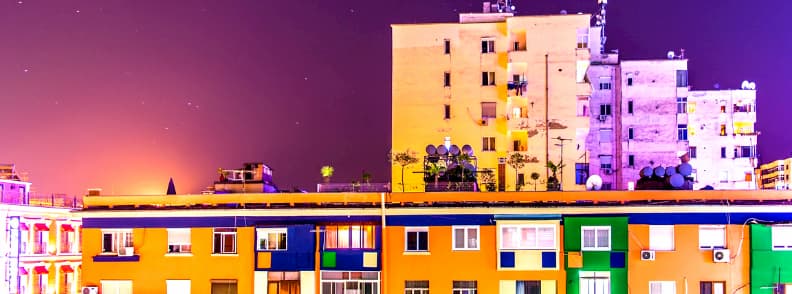
The part of Tirana culture I find most interesting is how openly the city carries its political past into its present. Tirana communist history isn’t confined to museums. You see it in Blloku, in former government buildings, and in the apartment blocks repainted during Edi Rama’s years as mayor.
An artist I later met in Dubrovnik told me those colors had been introduced to help reduce crime. I’ve never found solid evidence proving the crime claim, but the repainting itself was real and became one of the most visible changes in modern Tirana history.
Blloku nightlife guide to Tirana: Live music, screenings, and summer events add entertainment after dark. Leave room for whatever is happening that week, and don’t pin your whole evening to one venue.
If you’re deciding what to do in Tirana at night, start in Blloku Tirana, have a drink, check for live music or a cultural event near the center, and keep the evening loose enough to change plans when something better appears.
Day Trips from Tirana
Tirana is a useful base for a few carefully chosen excursions, as long as you don’t assume every interesting place in Albania belongs on a day trip. Some destinations sit close enough to turn them into a proper day out. Others mostly give you an intimate relationship with the inside of a vehicle.
Krujë is one of the easiest day trips from Tirana. North of the capital, the old town climbs toward Krujë Castle, where Skanderbeg resisted Ottoman forces in the 15th century. The castle complex now includes the Skanderbeg Museum and Ethnographic Museum, while the cobbled bazaar below still sells carpets, crafts, and souvenirs.
How to visit Kruja Castle from Tirana Albania? You can get in a car or bus, but a guided trip is better if you want the history explained. Have a look at Kruja Castle, Old Bazaar & Sari Salltik tour from Tirana. This seven-hour Tirana day tour includes transport, an English-speaking guide, Kruja Castle admission, time in the Ottoman bazaar, and the mountain shrine of Sari Salltik.
For Tirana hiking, head in the opposite direction toward Bovilla Lake near Tirana. The reservoir is about 19 kilometers from Albania’s capital, surrounded by mountains including Gamti. A guided day trip from Tirana to Bovilla combines the lake with a climb to a viewpoint above the water. The final approach includes a rural road, so this is one of the Tirana excursions where organized transport has obvious appeal.
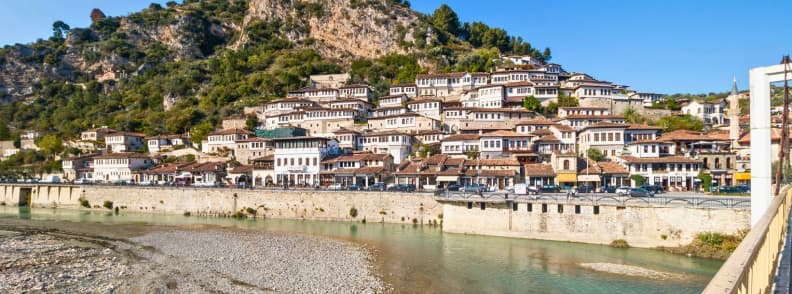
Berat deserves most of a day. The UNESCO-listed old town spreads across Mangalem, Gorica, and the still-inhabited castle district, which means a Tirana to Berat outing offers far more than a quick castle photograph.
If you want Tirana to Berat as one of your day trips from Tirana, book the Berat Town & Belshi Lake Day Tour. It’s a practical answer to how to get from Tirana to Berat Albania for a day trip because this 9 to 10-hour tour includes hotel pickup and drop-off in Tirana, transport, a guided visit to Berat Castle and Mangalem, and a traditional Albanian lunch. The return journey stops at Belshi Lake, where you can walk by the water or take an optional boat ride. Among Tirana day tours, I like the pacing of this one.
In summer, Tirana to Durrës is the simplest way to add the Adriatic to your city stay. Durrës combines a long coastline with a Roman amphitheater, archaeological sites, and Albania’s largest seaport. How to get from Tirana to Durrës is easy by intercity bus or car, and among Tirana Albania beaches, this is the sensible option for a single-day escape.
The Albanian Riviera from Tirana deserves its own stretch of the trip. Himarë, Dhërmi, Sarandë, and Ksamil sit far enough south that racing there and back in one day turns the coast into a view through a windshield. The Albanian Riviera should be planned as a multi-day route, which is a far better use of the distance.
How to get from Tirana to Saranda: Intercity buses leave from Tirana’s North and South Bus Terminal for Sarandë, Himarë, and other southern destinations. Longer bus fares such as Tirana to Sarandë cost 1,000-1,200 ALL. Check the national eTransport platform before departure for current times and operators.
How to combine Tirana and the Albanian Riviera becomes much easier if you give Tirana a few city days first, then move your base to Himarë or Sarandë and continue along the Ionian coast at a pace that lets you stop in Dhërmi, Qeparo, Borsh, or Ksamil rather than collecting their names from a bus window.
Still, a Tirana sailing Riviera day is possible. This Sazan Island, Haxhi Ali Cave and Karaburun speedboat trip includes hotel pickup in Tirana, the drive to Vlorë, then several hours by boat around Sazan Island, Haxhi Ali Cave, and the Karaburun Peninsula, with swimming and beach time. The whole outing takes around 9 to 10 hours.
The Travel Bunny’s sailing tip: These transfer-inclusive trips are some of the best boat trips near Tirana Albania if you want a day on the water without moving your overnight base to the coast first.
Shkodër and Lake Koman belong at the ambitious end of the day trip options from Tirana. They are possible, but they make super long days. I’d save them for an overnight stay unless your enthusiasm for early departures exceeds mine.
For the best day trips from Tirana Albania in 2026, I’d keep the list short and cute: Krujë for history, Bovilla for mountains, Berat for architecture, and Durrës for the sea. These are the best day trips from Tirana Albania if you want to spend the day seeing Albania instead of mostly crossing it.
Sample Tirana Itinerary for 1 to 3 Days
How many days do you need in Tirana? I’d choose two for a first visit. One day covers the center surprisingly well, while Tirana in 3 days gives you time for museums and a Tirana day trip without seeing breakfast as an administrative obstacle.
Visit Tirana in One Day
Tirana in one day is perfectly manageable if you resist the urge to turn the capital into a race. A 1-day itinerary in Tirana Albania should stay around the center, where most of the places worth prioritizing sit close enough together to explore on foot.
Start at Skanderbeg Square, then step inside Et’hem Bey Mosque before choosing one communist-history museum. Bunk’Art 2 is the easiest to visit because it sits right in the center, while the House of Leaves gives you a quieter and more focused account of surveillance under the dictatorship. They are both some of the best things to do in Tirana for first-time visitors, and trying to squeeze in both would leave less time for the city itself.
From there, walk toward the Pyramid, continue through the boulevards and into Blloku, then leave the late afternoon open for coffee, dinner, and a drink at Radio Bar. That route covers many of the best things to do in Tirana in one day without reducing every stop to a photograph and a departure time.
That’s how I’d plan what to do in Tirana Albania in one day today. My own one day in Tirana Albania itinerary was far less organized. When we arrived in Tirana, finally found somewhere to park, dropped our luggage, and went straight back outside.
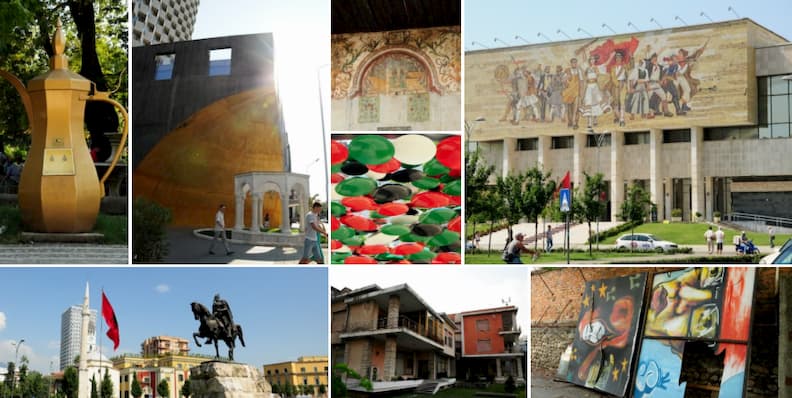
Tirana gave us plenty to photograph without much effort. We crossed Skanderbeg Square beneath the Albanian flag and Skanderbeg’s statue, saw the colorful Friendship Monument, stopped around Et’hem Bey Mosque, passed public art and communist-era reminders, and photographed the graffiti-covered fragment of the Berlin Wall at Postbllok. The giant teapot fountain also made the album, because Tirana apparently saw no reason why a park shouldn’t have an enormous tea pots.
We spent much of our time inside the National Historical Museum, whose huge mosaic dominates one side of Skanderbeg Square. I found the museum fascinating, but it’s currently closed for restoration, so I’d replace it with Bunk’Art 2 or the House of Leaves if I were to visit today.
Later, we ended up at Radio Bar and fell in love with the place. Years later, it’s still the bar I recommend whenever someone tells me they’re passing through Tirana.
See Tirana in 2 Days
Is Tirana worth visiting for 2 days? Yes, two days are enough time to understand the capital without spending the entire visit checking the clock, and they leave time for one quick glimpse of Albania outside the city.
My 2-day Tirana travel guide would keep the first day entirely in Tirana. Follow the one-day route through Skanderbeg Square, Et’hem Bey Mosque, Bunk’Art 2 or the House of Leaves, the Pyramid, and Blloku. Stay for dinner and save some time to wander around in the evening. When every hour is no longer an appointment, Tirana gets better and better.
On day two, leave the capital. A Tirana Albania itinerary for 2 days pairs especially well with a day trip to Krujë for history, Bovilla Lake for mountains, or Durrës if summer has made the Adriatic irresistible. I’d choose one, you’re not trying to check off all these places before sunset.
This split also works for a Tirana weekend. If you’re planning how to spend 48 hours in Tirana, one full city day followed by one carefully chosen excursion gives you two quite different sides of Albania without spending half your short break in transit.
Explore Tirana in 3 Days
A Tirana itinerary for 3 days offers enough time to stop visiting Albania’s capital as a collection of highlights and start understanding how its different pieces fit together.
Keep the first day for central Tirana. Walk through Skanderbeg Square, visit Et’hem Bey Mosque, choose Bunk’Art 2 or the House of Leaves, continue toward the Pyramid, and finish in Blloku. You’ll cover the historic center without rushing past half of it.
Use day two for the places that need longer. Visit whichever communist-history museum you skipped, then head to Grand Park or take the cable car up Dajti Mountain. This balance is what I’d build into a Tirana Albania itinerary for 3 days, because another full day of central sightseeing would start producing diminishing returns.
Then, spend the third day outside the capital. By this point, you’ve already seen enough of Tirana to appreciate how quickly Albania changes once you leave it. Choose one of the day trips from Tirana covered earlier and give it the full day rather than trying to squeeze another cluster of city sights into the schedule. This makes deciding what to do in Tirana, Albania in 3 days fairly simple.
There are enough things to do in Tirana, Albania in 3 days to keep every day distinct, which is exactly why I would prefer three days for travelers who have the time.
A Tirana 5 days plan is ideal if the capital becomes your base for several excursions. Remote workers or slow travelers in Albania can make the most of an extended Tirana stay. For a standard first trip, though, my Tirana itinerary stays at two or three days. It’s enough time to understand the city without reducing your visit to a collection of timestamps.
Local Tips for Tirana. Safety, Language, and Connectivity
The useful things to know before going to Tirana are mostly small ones. Keep some lek because cash still appears where cards don’t, use marked taxis, and treat tipping as optional rather than compulsory. Among the other things to know about Tirana, safety, entry rules, water, and mobile data deserve sorting before arrival.
Is Tirana safe for tourists?
Tirana is generally safe for tourists, but I’d attach an asterisk to that answer. Petty theft occurs, especially on public transport, and current. Recent demonstrations in central Tirana sometimes turn violent. Avoid protests instead of treating them as unexpected sightseeing.
The less glamorous side of Tirana safety for tourists is traffic. I remember how chaotic the roads seemed when we arrived, and pedestrian crossings deserve attention even in the center.
I also wouldn’t judge Tirana safety from a single Tirana crime rate number. Reliable city-level crime data are patchy.
Is Tirana safe for solo female travelers?
Tirana solo travel is generally considered manageable, including for women, but I don’t have a solo trip of my own to turn into evidence. I was traveling with friends.
I did watch Ana attract a remarkable amount of attention while she drove. Men stared from neighboring cars and leaned toward windows to get a better look. We found it funny at first. After a while, less so.
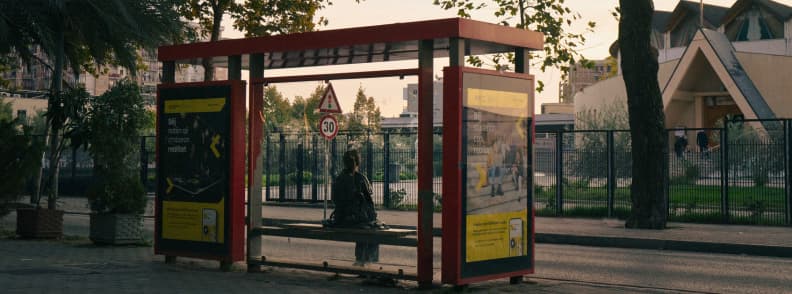
Near a bus stop where I had gone a bit ahead, I got a lot of stares from men. I felt unsafe, even though it was a public space, and I slowed my step to stay with my group.
These experiences shape my view of Tirana female solo travel without turning unwanted attention into evidence of danger. Tirana is generally safe for solo female travelers, but street harassment and staring belong in this conversation.
So, is Tirana, Albania good for solo female travelers? For many women, yes. Safe solo travel in Tirana still requires ordinary urban awareness. While the city is a reasonable solo destination, but I wouldn’t pretend unwanted attention never happens. Tripadvisor accounts from women traveling alone describe a similar pattern, with safety generally rated positively alongside occasional persistent male attention.
Is Tirana safe for American tourists in 2026?
Tirana is generally safe for American tourists, and Albania remains one of the more strongly pro-American countries in Europe. A 2026 IRI survey found that 68% of Albanians considered the United States their country’s most important political partner.
There is one current political wrinkle worth knowing about. Large protests in 2026 have targeted luxury developments linked to Jared Kushner and Ivanka Trump on Sazan Island and around the protected Vjosa-Narta wetlands. Demonstrators have criticized environmental damage, disputed land deals, corruption, and the involvement of the Trump family, with some protests carrying openly hostile slogans toward Ivanka Trump.
Ordinary American visitors, including Trump voters, haven’t been targeted because of their nationality or politics. I would still avoid political demonstrations and probably skip turning a Tirana bar conversation into a spirited defense of the Kushner resort. That’s less a safety rule than basic common sense.
Is it safe to walk around Tirana at night?
Walking around Tirana at night is reasonable in busy central areas, particularly around Skanderbeg Square and Blloku, where restaurants and bars keep plenty of people on the streets.
I’d be less enthusiastic about poorly lit peripheral streets, empty parks, or long walks through unfamiliar residential areas after everything around you has closed. There is petty crime, so take care of your belongings. Demonstrations remain another reason to check what is happening in the center before heading out.
What language do people speak in Tirana Albania?
Albanian is the official language in Tirana, Albania. That is what language people speak in Tirana Albania at home, in government, and in everyday city life.
Do people speak English in Tirana, Albania? Frequently, yes. English is widely spoken in Tirana, especially among younger people and in hotels, restaurants, tourism businesses, and other central services. People do speak English in Tirana, although I’d still learn faleminderit, meaning thank you. It’s one word, we’ll survive.
Do you need a visa to visit Tirana Albania?
Albania’s national entry rules apply, so do you need a visa to visit Tirana Albania depends on your nationality.
Many European nationalities enter visa-free for short stays. US citizens also enter Albania without a tourist visa and currently stay for up to one year without obtaining a residence permit. An Albania visa for a US citizen therefore isn’t required for an ordinary tourist trip.
Visit Albania’s Ministry for Europe and Foreign Affairs for current Tirana visa Albania requirements instead of a commercial visa website. The ministry warned in April 2026 about unauthorized sites copying official visa information.
Is Tirana Albania in the EU?
No. Tirana Albania isn’t in the EU because Albania isn’t an EU member state.
Albania has been an EU candidate country since 2014, and accession negotiations continue. This distinction is important for entry rules, mobile roaming, and travel insurance. An EU passport doesn’t mean you have crossed into another EU member country.
Is tap water in Tirana safe to drink?
Drinking tap water in Tirana isn’t recommended. Albanian tap water is not potable, so only use bottled water, particularly if you have a sensitive stomach. I’m quite happy to let someone else perform the intestinal research.
Also, be careful, because ice sometimes comes from tap water.
How do you get a SIM card in Tirana, Albania?
The easiest way of getting a SIM card in Tirana, Albania is before you even leave Tirana International Airport. Both One Albania and Vodafone have stores in the arrivals terminal, which saves you from hunting for a phone shop with luggage in tow.
A prepaid Tirana SIM card is especially useful because Albania isn’t inside the EU roaming area.
Internet in Tirana is easy to access, and Wi-Fi in Tirana is common in hotels, apartments, restaurants, and cafés. Tirana Airport also provides free Wi-Fi, so you have a connection while arranging transport or activating mobile service after landing.
What is the Tirana emergency number?
The main Tirana emergency number is 112. You also have 129 for police, 127 for medical emergencies, and 128 for fire and rescue.
Save these numbers before your trip. Emergency numbers have a strange habit of becoming harder to remember at precisely the moment you need one.
What should you know about healthcare and travel insurance in Tirana?
Healthcare in Tirana includes the Mother Teresa University Hospital Center and several private hospitals, but medical facilities in Albania have limitations, particularly for specialist care. There is limited healthcare capacity and medical evacuation becomes expensive.
I’d buy travel insurance for Albania with medical treatment and evacuation cover. Don’t count on your European health card.
Travel insurance for Tirana also deserves a check if you plan hiking, boating, or other outdoor activities, since some policies exclude them unless declared.
Is drinking alcohol legal in Tirana?
Yes, alcohol is sold openly in Tirana’s restaurants, cafés, bars, and clubs, and raki appears everywhere from traditional meals to nightlife.
Driving afterward is the part to take seriously. Albania applies zero tolerance to alcohol behind the wheel, with penalties for any detectable level. So while you can drink alcohol in Tirana, pair the drink with a walk or taxi rather than the rental car.
Do you still need cash in Tirana?
Yes. Larger hotels, supermarkets, banks, and many established restaurants accept major cards, while smaller businesses still rely heavily on cash. Keep some Albanian lek rather than assuming your card will cover every coffee, taxi, bakery, or market purchase.
Tipping is optional. Rounding up or leaving something for good service is enough in most casual places. Taxis remain inexpensive compared with many European capitals, which also makes one a sensible choice when a late walk no longer looks appealing.
About the author

Hi, I’m Mirela Letailleur, the Romanian-born travel writer and founder of The Travel Bunny. I’ve explored the Balkans extensively by road, including Tirana Albania, where I arrived from North Macedonia and experienced the capital beyond its headline attractions. I spent time in the historic center, explored the National Historical Museum, walked past communist-era landmarks and Tirana’s colorful apartment blocks, battled the traffic and parking, and found a favorite at Radio Bar.
I use those firsthand experiences alongside detailed research to write practical Albania and Tirana travel guides for travelers and expats. My advice on visiting Tirana, the best things to do in Tirana, Albanian food, neighborhoods, costs, transport, safety, and day trips comes from seeing the city on the ground and then checking what has changed since my visit, so you can plan with current information rather than recycled travel advice.
After planning your upcoming trip to Tirana Albania, check out these travel guides on The Travel Bunny
Radio Bar Tirana
Why you have to visit Shkoder, Albania
Time to relax on the Komani Lake ferry ride